In This Article
When Queen Elizabeth I granted a Royal Charter on December 31, 1600 to “The Governor and Company of Merchants of London Trading into the East Indies,” the nascent joint-stock enterprise immediately collided with the monetary orthodoxy of Tudor England. Early modern bullionist doctrine held that a kingdom’s wealth and security depended on retaining gold and silver specie within the realm, and English statutes since the fourteenth century had prohibited the export of coin or bullion without royal license. Yet the spice islands of the Indonesian archipelago and the textile markets of Mughal India had scant use for heavy English woolen broadcloths; Asian merchants demanded payment in high-fineness silver. Over the course of the seventeenth century, the East India Company’s structural need to ship Spanish New World silver to Asia—after the failure of Elizabeth I’s 1600–1601 “Portcullis” trade coinage—ignited the 1620s English bullionist controversy, inspired Company director Thomas Mun’s foundational treatises on the balance of trade, prompted Parliament to legalize the free export of foreign bullion in 1663, and drove the Company to establish its own sovereign-style mints at Fort St. George (Madras) in 1639–1640 and Bombay in 1672. [1]
The 1600 Royal Charter and the Failure of “Portcullis Money”
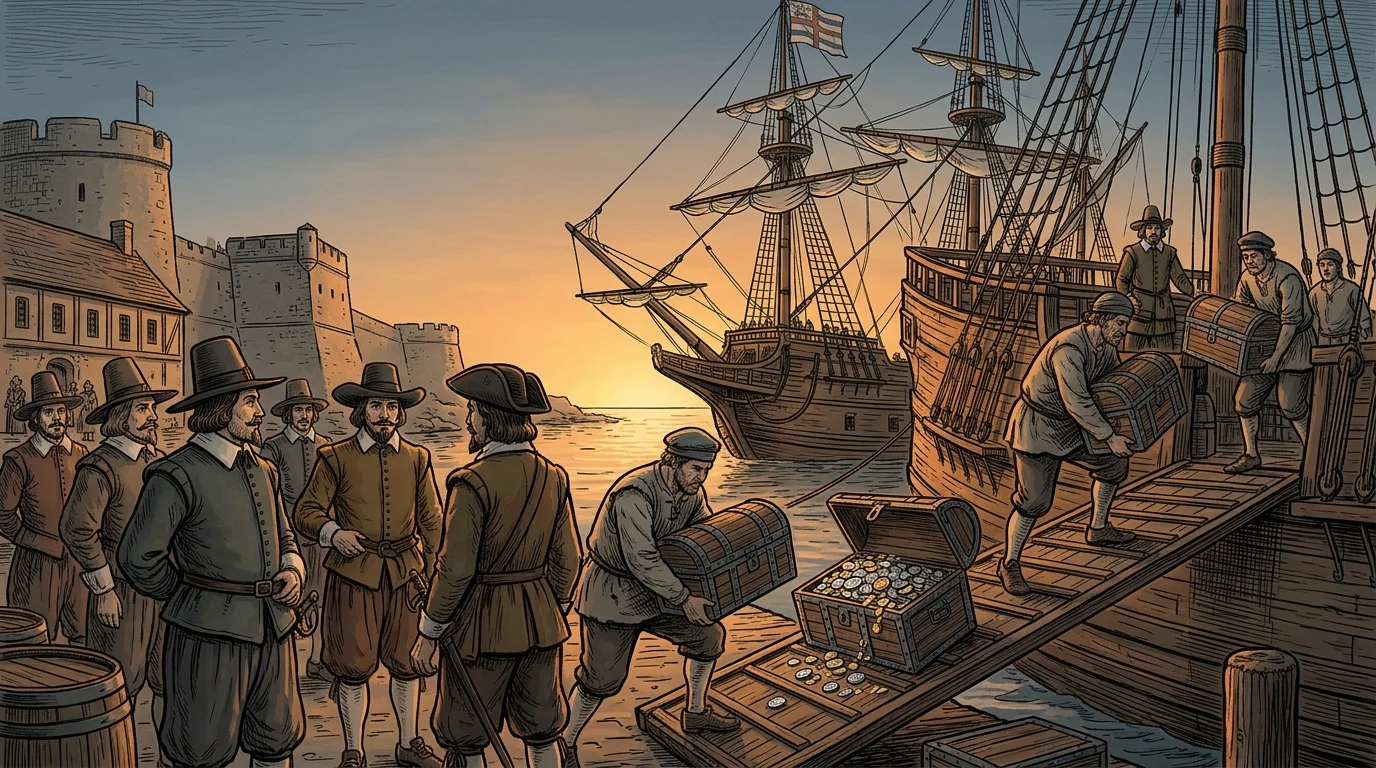
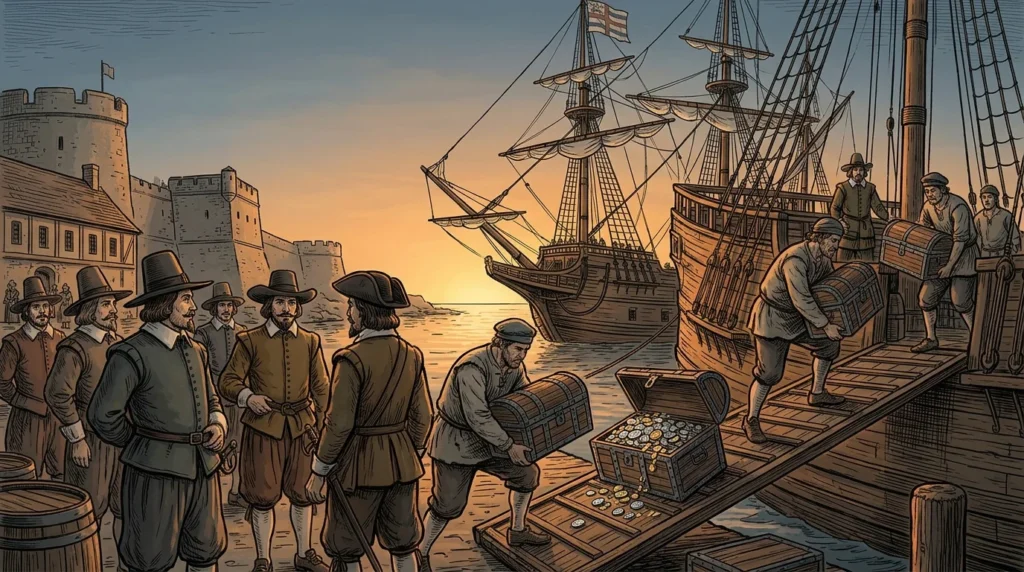
In preparing the East India Company’s First Voyage in 1600–1601 under the command of Captain Sir James Lancaster, the Company’s subscriber-merchants petitioned the Privy Council for permission to carry Spanish silver reales de a ocho—the universally trusted “pieces of eight” minted from the silver mines of Potosí and Zacatecas—directly to Bantam and Aceh. Since the Portuguese arrival in the Indian Ocean and the Spanish colonization of Manila in 1571, the 8-real cob coin had become the de facto international settlement currency across maritime Asia. [2]
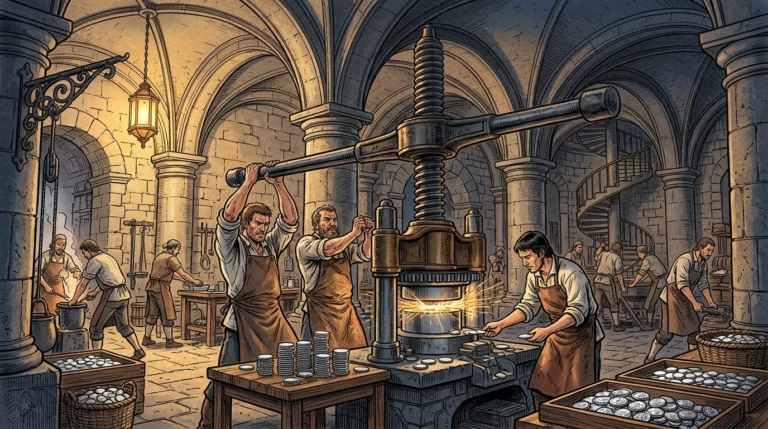
Queen Elizabeth I and her treasury advisers, however, balked at permitting an English chartered corporation to circulate the effigy and heraldic arms of England’s Catholic rival, King Philip III of Spain, in Eastern courts. Declaring that the Queen would not suffer Spanish silver to pass in the East without bearing her own royal stamp, the Crown ordered the Tower Mint in London in late 1600 and early 1601 to strike England’s first dedicated colonial trade coinage, known to numismatists as “Portcullis money”: [3]
- Denominations and Metrology: The Tower Mint struck four silver denominations—the 8-testern (Portcullis dollar or crown, weighing roughly 420.9 grains troy), 4-testern (half-dollar), 2-testern (quarter-dollar), and 1-testern—calibrated to match the exact weight and sterling-adjacent fineness of the Spanish 8-, 4-, 2-, and 1-real pieces.
- Tudor Iconography: The obverse displayed the crowned royal shield of Elizabeth I flanked by the crowned initials E R (Elizabetha Regina), while the reverse featured a crowned Tudor portcullis with chains and the Latin motto POSVI DEVM ADIVTOREM MEVM (“I have made God my helper”).
- Commercial Rejection in Asia: Lancaster’s fleet sailed from Woolwich in February 1601 carrying £21,742 in bullion and specie, of which roughly £6,000 consisted of newly minted Portcullis money and the remainder Spanish reals. Upon reaching Aceh and Bantam in 1602, English factors discovered that Southeast Asian and Chinese spice dealers distrusted the unfamiliar Tudor coins, accepting them only at a steep discount or melting them down as raw bullion while demanding genuine Spanish pieces of eight.
Recognizing the commercial futility of the Portcullis issue, the East India Company never again struck English-type trade dollars at the Tower Mint for Asian circulation. Instead, Elizabeth’s December 31, 1600 Charter—and subsequent Stuart renewals under James I and Charles I—codified a strict bullion export quota: the Company was authorized to export up to £30,000 in foreign silver coin or bullion per voyage, provided that at least £6,000 had first been recoined at the Royal Mint and that the Company imported an equivalent quantity of foreign silver back into England through re-exports within six months of each voyage’s completion. [4]
Spanish Silver Flows and the 1620s Bullionist Controversy
As the Company expanded from single-voyage syndicates into multi-year Joint Stocks after 1613 and opened mainland Indian trading factories at Surat (1612) and Masulipatnam (1611), the £30,000 per-voyage ceiling proved chronically inadequate. Between 1601 and 1624, tracked in the quantitative ledgers reconstructed by economic historian K. N. Chaudhuri, the East India Company exported £753,336 in treasure (overwhelmingly silver reals procured in Seville, Cadiz, Amsterdam, and St. Malo) compared to just £351,236 in English woolens, tin, lead, and coral—meaning precious metal accounted for nearly 70 percent of total outward cargoes. [5]
When a severe trade depression and silver shortage struck England between 1620 and 1623—caused primarily by currency debasements in central Europe at the outbreak of the Thirty Years’ War (the Kipper- und Wipperzeit) and a slump in English cloth exports—parliamentary critics and bullionist pamphleteers blamed the East India Company for draining the realm of coin. Led by Gerard de Malynes, who argued that state control of foreign exchange rates was necessary to halt specie outflows, and initially echoed by Edward Misselden in Free Trade, or the Meanes to Make Trade Florish (1622), critics attacked the Company as a parasitic monopoly that shipped solid silver to the East in return for perishable spices, silks, and calicoes. [6]
Thomas Mun’s Mercantilist Defense and the 1663 Bullion Act
To save the Company’s charter from parliamentary revocation, East India Company committee member (director) Thomas Mun (1571–1641) published A Discourse of Trade, from England unto the East-Indies in 1621 and drafted his masterpiece, England’s Treasure by Forraign Trade, around 1630 (published posthumously by his son John Mun in 1664). Mun’s intervention revolutionized European economic thought by dismantling bilateral bullionism in favor of the multilateral balance of trade: [7]
- Seed-Corn Analogy of Specie: Mun compared the export of silver bullion to a farmer scattering seed in springtime—Looking only at the outward ships leaving the Thames with Spanish reals ignored the harvest when East India men returned laden with pepper, cloves, indigo, saltpetre, and cotton piece-goods.
- Re-Export Arbitrage in Europe: Mun demonstrated from customs house records that Asian commodities bought directly at Indian Ocean ports cost roughly one-third of the price English consumers had previously paid to Levantine overland caravans and Venetian or Portuguese intermediaries. Better still, the Company re-exported the bulk of its imported Asian pepper and calicoes to France, Italy, Germany, and the Baltic at four to five times their original silver cost in India, bringing far more Spanish treasure back into England than the Company had initially exported.
- The 1663 Free Export of Foreign Bullion Act: Mun’s intellectual victory was codified shortly after the Stuart Restoration. By Section 9 of the Act for the Encouragement of Trade of 1663 (15 Cha. II c. 7), the Cavalier Parliament abolished the archaic royal licensing caps on non-English precious metals, granting merchants the statutory right to export any quantity of foreign coin or gold and silver bullion duty-free simply by registering the shipment at the custom house.
The Madras Mint (1639–1640) and Gold Pagodas
Even when the Company delivered chests of Spanish reals or silver ingots to India, foreign coins could not circulate directly as legal tender inside Indian markets. In the Mughal Empire of northern and western India, imported silver had to be taken to imperial Mughal mints (such as Surat or Rajmahal) to be melted, refined to near-pure 96–98 percent fineness, and struck into Mughal silver sicca rupees upon payment of brassage and seigniorage fees—subjecting English factors to costly delays and dependency on local sarrafs (moneychangers). [8]
On the Coromandel Coast of southeastern India, however, where the monetary system followed the South Indian gold standard rather than the Mughal silver rupee, the East India Company secured its first direct minting privilege. On August 22, 1639, Company factors Francis Day and Andrew Cogan obtained a grant (cowle) from Damarla Venkatadri Nayaka, the local Nayak of Vandavasi (Wandiwash) under the Vijayanagara Empire, ceding a coastal strip at Madraspatnam to build a fortified factory—Fort St. George, founded in 1640—together with the explicit right to establish a mint and strike coins at half the customary local customs duties.
Confirmed and expanded by a royal charter issued in October–November 1645 by the Vijayanagara Emperor Sri Ranga Rayal III (and subsequently reconfirmed by the Sultanate of Golconda after 1647), the Fort St. George mint at Madras began striking gold pagodas (~52.8 grains troy of 86 percent fine gold, matching the regional Vijayanagara weight standard) alongside fractional gold fanams and copper cash (kasu). Because local weavers and cloth merchants along the Coromandel Coast accepted only familiar indigenous designs, the early Madras Mint struck “Old Pagodas” and “Three-Swami Pagodas” bearing traditional Hindu images of Lord Venkateswara (Vishnu) on the obverse and a convex granulated reverse, allowing the Company to convert imported gold and silver bullion directly into local purchasing power for cotton textiles without paying external mint fees.
The 1672 Bombay Mint and the Rise of Company Coinage
Three decades after founding the Madras Mint, the East India Company acquired a second, fully sovereign minting jurisdiction on India’s western coast. In 1661, the island of Bombay was ceded to King Charles II of England as part of the marriage dowry of the Portuguese princess Catherine of Braganza. Finding the distant enclave expensive to garrison, Charles II transferred Bombay to the East India Company by Royal Charter on March 27, 1668 for a nominal quit-rent of £10 in gold per year, explicitly empowering the Company to stamp gold, silver, copper, and tin coins of any form provided they did not use the names or designs of current English domestic coins.
In 1672, Bombay’s energetic Governor, Gerald Aungier, inaugurated the Bombay Mint, issuing a distinctive quadri-metallic colonial currency tailored for western coastal trade: gold Carolinas, silver Anglinas (weighing 177.8 grains to compete with the Mughal Surat rupee), copper Copperoons (pice), and tin Tinnys (budgrooks), stamped with the Company’s coat of arms and the Latin legend MONETA BOMBAIENSIS. Confirmed by King James II’s Letters Patent of October 5, 1686—which authorized the Company to strike indigenous Indian coin types equal in weight and fineness to those of Indian princes—the Madras and Bombay mints laid the institutional foundation for the East India Company’s transformation from a silver-exporting trading venture into the monetary sovereign of the Indian subcontinent.
Theoretical & Balance-Sheet Transmission Mechanism
In the Kindleberger–Minsky taxonomy of financial instability (Kindleberger, 1978; Minsky, 1986) and Irving Fisher’s (1933) debt-deflation framework, speculative asset booms become systemic crises when credit expansion shifts balance sheets from hedge finance (cash flows covering principal and interest) to speculative and Ponzi finance (relying on rising asset prices and short-term margin roll-overs).
Once monetary tightening or an exogenous shock halts price appreciation, forced margin liquidations trigger Fisherian debt-deflation: fire-sale asset discounts erode bank collateral values, contracting credit supply across the real economy.
Sources and Further Reading
- K. N. Chaudhuri, “ The East India Company and the Export of Treasure in the Early Seventeenth Century,” The Economic History Review, 1963. Peer-Reviewed / Academic Research
- Thomas Mun, “ England’s Treasure by Forraign Trade (1664),” Hanover Historical Texts Project, Hanover College, 1664. Peer-Reviewed / Academic Research
- Reserve Bank of India, “ British India Coinage: Early English Settlements (Madras, Bombay and Bengal),” Reserve Bank of India Museum, 2020. Historical & Financial Reference
- Holden Furber, “ Trade and Politics in Madras and Bombay,” Harvard University Press (John Company at Work), 1948. Peer-Reviewed / Academic Research
- Emily Erikson, “ Between Monopoly and Free Trade: The English East India Company, 1600–1757,” Princeton University Press, 2014. Peer-Reviewed / Academic Research
- A. S. Shngreiyo, “ The Portuguese Working Under the English East India Company at Fort St. George Madras in the Seventeenth Century,” IRA International Journal of Education and Multidisciplinary Studies, 2016. Peer-Reviewed / Academic Research
- Irving Fisher — "The Debt-Deflation Theory of Great Depressions," Econometrica 1, no. 4 (FRASER Federal Reserve Archive, 1933): 337–357 Central Bank / Monetary Authority
- Charles P. Kindleberger & Robert Z. Aliber — Manias, Panics, and Crashes: A History of Financial Crises (Palgrave Macmillan) Peer-Reviewed / Academic Research
Cite This Historical Dossier (APA / Chicago)
APA (7th ed.): Ç., S. (Ed.). (2026). East India Company Bullion Exports, Portcullis Money, and the Madras Mint. In Forgotten Fortunes Historical Monograph Series (Forgotten Fortunes Editorial Desk). https://forgottenfortunes.net/east-india-company-bullion-mints/
MLA (9th ed.): Ç., Soner, ed. "East India Company Bullion Exports, Portcullis Money, and the Madras Mint." Forgotten Fortunes: Financial & Monetary History Archive, 2026, https://forgottenfortunes.net/east-india-company-bullion-mints/.
Chicago (17th ed.): Ç., Soner, ed. "East India Company Bullion Exports, Portcullis Money, and the Madras Mint." Forgotten Fortunes Historical Monograph Series (Forgotten Fortunes Editorial Desk), September 12, 2026. https://forgottenfortunes.net/east-india-company-bullion-mints/.
Have an idea for another financial history documentary or article? Request a story →