In This Article
For the first century and a half of its operations in the Indian Ocean, the English East India Company functioned as a structural conduit for New World silver into Mughal India, shipping chests of Spanish pieces of eight and silver ingots from London to pay for Indian cotton textiles, raw silk, and saltpetre. In August 1765, that global bullion flow reversed overnight. By the Treaty of Allahabad, Mughal Emperor Shah Alam II granted Major-General Robert Clive and the East India Company the Diwani—the sovereign right to collect land and customs revenues—across the wealthy eastern provinces of Bengal, Bihar, and Orissa. Armed with Bengal’s agrarian tax surplus, the Company abruptly stopped importing silver from Britain and instead financed its European export cargoes (“the Investment”) and its China tea trade directly out of Bengal tax receipts, precipitating a severe deflationary specie shortage during the Great Bengal Famine of 1769–1770. Seven decades later, after struggling to manage a chaotic patchwork of regional sicca, sonaut, Arcot, and Bombay currencies, the Company enacted Coinage Act XVII of 1835—removing the Mughal Emperor’s name from Indian money and establishing the uniform 180-grain (165 grains pure silver) Company Rupee across British India. [1]

The 1765 Grant of the Bengal Diwani
Prior to the mid-eighteenth century, Bengal was the industrial and agricultural powerhouse of the Mughal Empire, attracting massive inflows of silver and gold bullion from English, Dutch, and French trading companies whose European manufactures found almost no buyers in South Asia. Following Robert Clive’s victory over Nawab Siraj-ud-Daulah at the Battle of Plassey in June 1757 and Major Hector Munro’s defeat of the combined armies of Nawab Mir Qasim of Bengal, Nawab Shuja-ud-Daulah of Awadh, and Mughal Emperor Shah Alam II at the Battle of Buxar in October 1764, the East India Company became the undisputed military arbiter of eastern India. [2]
On August 12, 1765, inside a ceremonial tent at Allahabad, Shah Alam II issued an imperial farman granting the East India Company the office of Diwan (chief fiscal administrator) of Bengal, Bihar, and Orissa. Under the terms of the Allahabad settlement, the Company agreed to pay the Mughal Emperor an annual tribute of 26 lakh (2.6 million) rupees (£260,000) and allocate 53 lakh rupees (£530,000) to the Nawab of Bengal at Murshidabad to maintain the civil and criminal administration (the Nizamat). Every rupee of land tax and customs duty collected above those fixed stipends belonged to the East India Company. [3]
Clive projected that the Diwani would yield the Company a clear annual fiscal surplus of £1.5 million to £2 million out of gross provincial collections exceeding £3 million. Under Clive’s “Dual System” of government (1765–1772), actual tax collection remained in the hands of indigenous deputy ministers (naib diwans) and hereditary tax-farmers (zamindars), giving a London joint-stock corporation sovereign taxing power over roughly 20 to 30 million inhabitants without direct administrative accountability. [4]
Financing “The Investment” and the 1769–1770 Bengal Silver Drain
In the accounting vocabulary of Leadenhall Street, the annual purchase of Indian cotton piece-goods, raw silk, indigo, and saltpetre for shipment to London auctions was termed “the Investment.” Before Plassey, between 70 and 85 percent of the Bengal Investment had been financed by physical shipments of silver bullion from Europe. The acquisition of the Diwani allowed the Company’s Court of Directors to sever that link completely: instead of shipping silver from London to Calcutta, Bengal’s peasant cultivators paid land taxes in silver rupees to Company collectors, who handed those same silver rupees back to Bengali weavers and silk winders to buy export cargoes shipped to Britain. [5]
The monetary shock to Bengal’s domestic economy was compounded by three simultaneous specie drains between 1765 and 1770: [6]
- Cessation of European Bullion Imports: Not only did the English East India Company halt silver shipments to Bengal after 1765, but competing Dutch (VOC) and French East India companies—as well as Danish traders—stopped importing silver from Europe as well. Instead, European rivals financed their own Bengal textile purchases by accepting massive rupee deposits in Calcutta from English Company servants seeking to remit private fortunes home to London via bills of exchange drawn on Amsterdam, Paris, and Copenhagen.
- Specie Transfers to Canton, Madras, and Bombay: To purchase Chinese Bohea and Singlo tea at Canton without draining Britain of silver, the Bengal Presidency shipped chests of silver rupees directly from Calcutta to China, while simultaneously exporting millions of rupees in specie to finance the Company’s military wars against Hyder Ali of Mysore in the Madras Presidency and the Marathas in Bombay.
- Tribute to Allahabad and Private Hoarding: Annual shipments of 26 lakh silver rupees left Bengal for Shah Alam II’s court at Allahabad. Combined with Canton and inter-presidency transfers, contemporary Bengal Governor Harry Verelst (who served from 1767 to 1769) and whistleblowing merchant William Bolts estimated that Bengal lost between £5 million and £8 million in circulating silver specie in the decade following Plassey.
This acute monetary contraction collided with the failure of the monsoon rains in late 1768 and 1769, triggering the catastrophic Great Bengal Famine of 1769–1770 (the year 1176 in the Bengali calendar). While grain prices soared and an estimated one-third of Bengal’s population—roughly 10 million people—perished from starvation and smallpox, the Company’s revenue collectors enforced a 10 percent surcharge (najai) on surviving villages to compensate for deceased neighbors, actually collecting higher net land revenue in 1770–1771 (£1.52 million) than in the pre-famine drought year of 1768–1769. [7]
Currency Multiplicity: Sicca, Sonaut, Arcot, and star Pagodas
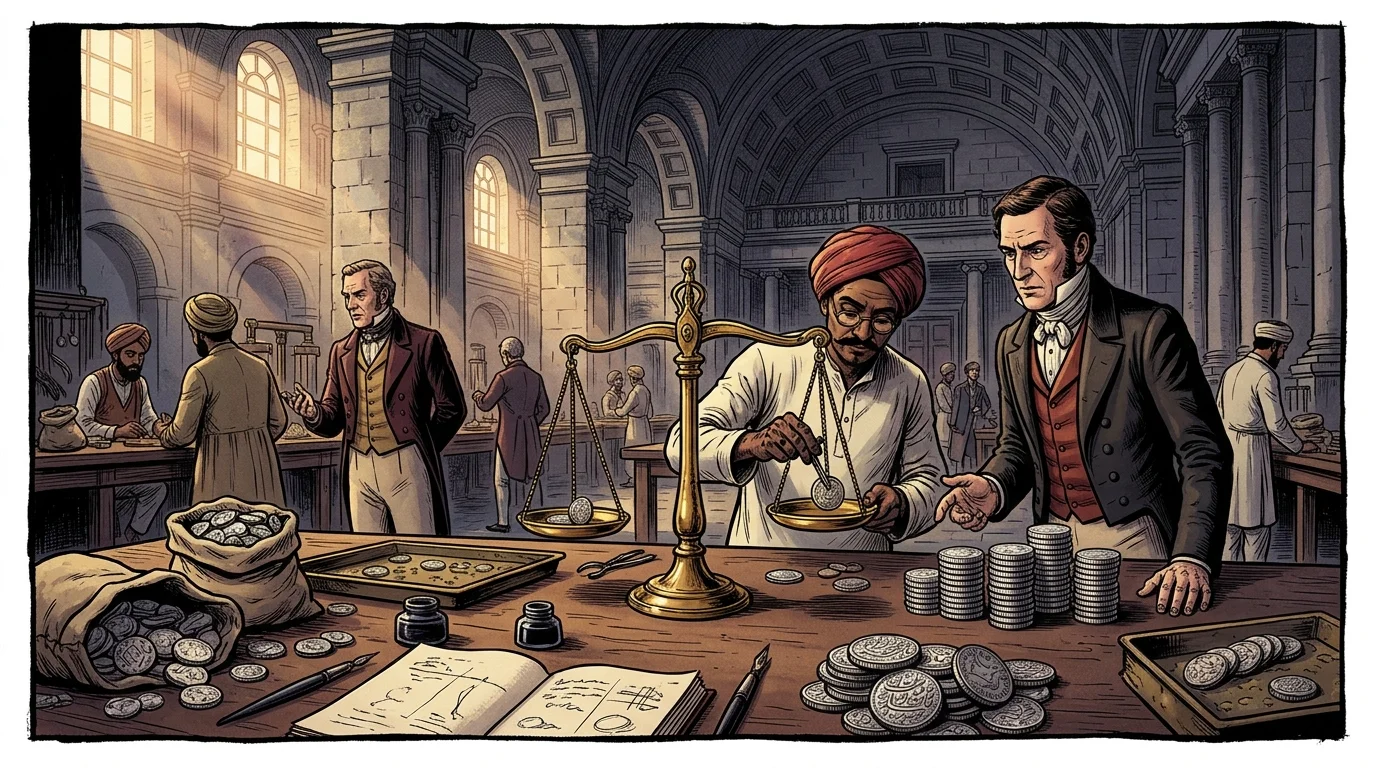
Even as the Company consolidated political rule under Governor-General Warren Hastings (1772–1785) and Lord Cornwallis (1786–1793), internal trade and tax collection across Company territories were crippled by a bewildering multiplicity of coins circulating simultaneously without a single legal-tender standard. Under the inherited Mughal monetary system, newly minted silver sicca rupees (~179.66 grains troy, containing roughly 175.9 grains or 98 percent pure silver) retained their full face value only during the regnal year (san) in which they were struck. Once a coin was one year old, it was downgraded to a sonaut (sanwat) rupee and subjected to an arbitrary discount—known as batta—of 2 to 5 percent enforced by powerful indigenous merchant-bankers (sarrafs), led in Bengal by the house of Jagat Seth. [8]
To keep track of diverse physical coins whose silver content varied by mint and vintage, the Company kept its books in an imaginary unit of account called the “Current Rupee” (Chalani), against which physical coins were rated by fixed or market batta schedules:
- The Bengal 19-San Sicca Rupee (1793): To break the sarrafs’ stranglehold on annual coin discounting, Governor-General Lord Cornwallis closed the provincial mints at Dacca, Patna, and Murshidabad and enacted Regulation XXXV of 1793, ordering that all future Bengal silver rupees struck at the Calcutta Mint bear the frozen date of the 19th regnal year (19-san) of Mughal Emperor Shah Alam II, thereby abolishing age-based batta discounts on sicca coins.
- The Madras Arcot Rupee and Star Pagoda: In southern India, the Madras Presidency maintained accounts in gold Star Pagodas (~52.56 grains, 80 percent fine gold) while also minting silver Arcot rupees in the name of the Mughal Emperor under a 1742 grant from the Nawab of Arcot, reformed in 1818 to a standard of 180 grains troy (165 grains pure silver).
- The Bombay (Surat) Rupee: On the western coast, the Bombay Mint struck silver rupees modeled on the Mughal mint of Surat, standardized in 1800 and aligned in 1824 with the Madras 180-grain (165 grains pure silver) specification.
Coinage Act XVII of 1835 and the Uniform 180-Grain Company Rupee
By the early 1830s, the coexistence of the heavier Bengal sicca rupee (standardised at 191.916 grains troy containing 175.923 grains pure silver after 1818) alongside the lighter 180-grain Madras and Bombay rupees (165 grains pure silver) imposed constant conversion friction on inter-presidency trade, army pay, and public debt accounting. When the British Parliament enacted the Charter Act of 1833 (3 & 4 Will. IV c. 85), stripping the East India Company of its remaining commercial monopolies (including the China tea trade), transforming it into a purely administrative agency of the Crown, and centralizing all legislative authority in the Governor-General of India in Council, the path was cleared for monetary unification.
On August 17, 1835, under Acting Governor-General Sir Charles Metcalfe and Law Member Thomas Babington Macaulay, the Governor-General in Council passed Act No. XVII of 1835, effective September 1, 1835. The statute established a single, uniform monometallic silver standard across all territories of the East India Company:
- The 180-Grain (1 Tola) Standard: Section I of Act XVII of 1835 decreed that the sole standard silver coin of British India—officially designated the “Company’s Rupee” alongside a Double Rupee, Half Rupee, and Quarter Rupee—would weigh exactly 180 grains troy (11.6638 grams, corresponding to the traditional Indian weight unit of one tola).
- 11/12ths Fineness (165 Grains Pure Silver): The alloy standard was fixed at 11/12ths (91.67 percent) fine silver and 1/12th (8.33 percent) copper alloy, giving every Company Rupee exactly 165 grains (10.6918 grams) of pure silver and 15 grains of alloy.
- Replacement of Mughal Regnal Legends with William IV: Ending more than a century of striking coins in the name of the Mughal Emperor at Delhi, the 1835 Act mandated that the obverse bear the effigy and English title of the reigning British monarch, King William IV (succeeded after 1837 by Queen Victoria), while the reverse displayed a laurel wreath, the value in English and Persian, and the legend EAST INDIA COMPANY 1835.
- Abolition of the Bengal Sicca Rupee and Gold Legal Tender: The Bengal sicca rupee ceased to be struck and lost its legal-tender status ( officially converted at the intrinsic silver ratio of 16 Company Rupees for every 15 Bengal sicca rupees, or 106.67 to 100), while Section IX stripped gold coins—including the newly specified 180-grain gold mohur (15-rupee piece)—of legal-tender status between private parties, placing British India firmly on a silver monometallic standard.
Struck using modern Boulton and Watt steam-powered coining presses installed at the newly constructed Calcutta and Bombay mints in the late 1820s and early 1830s, the 1835 Company Rupee unified the monetary system of the Indian subcontinent. Following the Indian Rebellion of 1857 and the Government of India Act 1858 transferring rule from the East India Company to the British Crown, the 1862 Crown Rupee preserved the exact 180-grain, 165-grain-fine-silver specification established in 1835—a metrological standard that endured until wartime silver debasement in 1940.
Theoretical & Balance-Sheet Transmission Mechanism
In the Kindleberger–Minsky taxonomy of financial instability (Kindleberger, 1978; Minsky, 1986) and Irving Fisher’s (1933) debt-deflation framework, speculative asset booms become systemic crises when credit expansion shifts balance sheets from hedge finance (cash flows covering principal and interest) to speculative and Ponzi finance (relying on rising asset prices and short-term margin roll-overs).
Once monetary tightening or an exogenous shock halts price appreciation, forced margin liquidations trigger Fisherian debt-deflation: fire-sale asset discounts erode bank collateral values, contracting credit supply across the real economy.
Sources and Further Reading
- H. V. Bowen, “ Traders into Sovereigns: The East India Company, 1757–1765,” Cambridge University Press (Revenue and Reform: The Indian Problem in British Politics 1757–1773), 1991. Peer-Reviewed / Academic Research
- Reserve Bank of India, “ British India Coinage: Early English Settlements and the Coinage Act of 1835,” Reserve Bank of India Museum, 2020. Historical & Financial Reference
- Karolina Hutková, “ Empire, the English East India Company, and Bengal Raw Silk,” Boydell & Brewer / Cambridge Core (The English East India Company’s Silk Enterprise in Bengal, 1750–1850), 2019. Peer-Reviewed / Academic Research
- Karolina Hutková, “ Bengal, Piedmont and the English East India Company,” JSTOR / Boydell & Brewer, 2019. Peer-Reviewed / Academic Research
- Om Prakash, “ The Dutch East India Company and the Economy of Bengal, 1630–1720,” Princeton University Press, 1985. Peer-Reviewed / Academic Research
- Gita Bhatt, “ Currency Notes: More Than Symbolic Value — The History of the Indian Rupee,” International Monetary Fund (Finance & Development), 2011. International Financial Institution
- Irving Fisher — "The Debt-Deflation Theory of Great Depressions," Econometrica 1, no. 4 (FRASER Federal Reserve Archive, 1933): 337–357 Central Bank / Monetary Authority
- Charles P. Kindleberger & Robert Z. Aliber — Manias, Panics, and Crashes: A History of Financial Crises (Palgrave Macmillan) Peer-Reviewed / Academic Research
Cite This Historical Dossier (APA / Chicago)
APA (7th ed.): Ç., S. (Ed.). (2026). From the 1765 Bengal Diwani to the 1835 Coinage Act: Unifying the Silver Rupee. In Forgotten Fortunes Historical Monograph Series (Forgotten Fortunes Editorial Desk). https://forgottenfortunes.net/bengal-diwani-1765-to-1835-company-rupee/
MLA (9th ed.): Ç., Soner, ed. "From the 1765 Bengal Diwani to the 1835 Coinage Act: Unifying the Silver Rupee." Forgotten Fortunes: Financial & Monetary History Archive, 2026, https://forgottenfortunes.net/bengal-diwani-1765-to-1835-company-rupee/.
Chicago (17th ed.): Ç., Soner, ed. "From the 1765 Bengal Diwani to the 1835 Coinage Act: Unifying the Silver Rupee." Forgotten Fortunes Historical Monograph Series (Forgotten Fortunes Editorial Desk), September 12, 2026. https://forgottenfortunes.net/bengal-diwani-1765-to-1835-company-rupee/.
Have an idea for another financial history documentary or article? Request a story →