In This Article
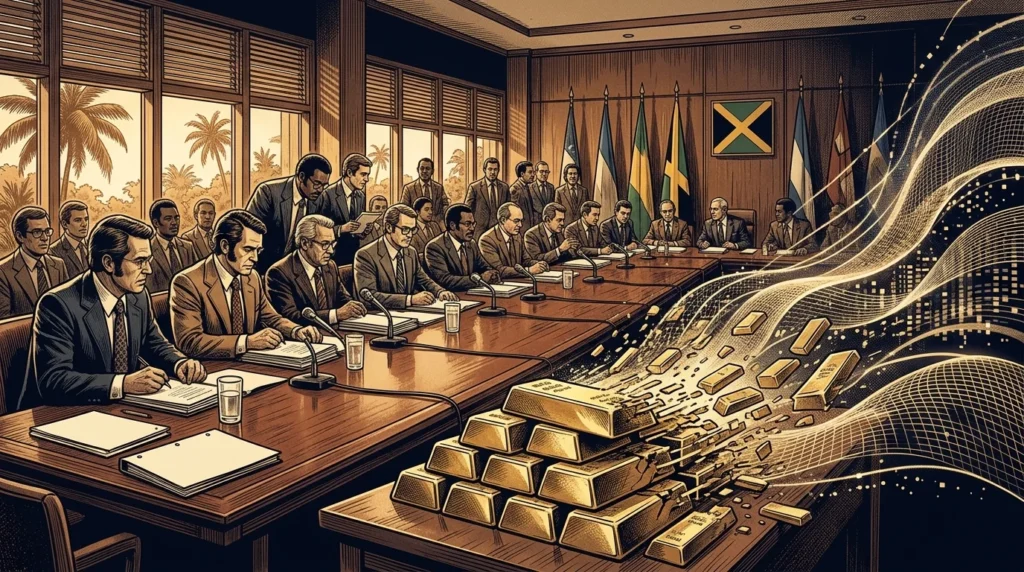
Late on Thursday evening, March 14, 1968, the United States government sent an urgent request to Whitehall: close the London gold market before trading opened the next morning [1]. Earlier that day, a frantic wave of private speculation had drained massive quantities of physical bullion from the London vaults where the Bank of England operated the international Gold Pool on behalf of the Federal Reserve and six European central banks [1][2]. Before midnight in London, the Privy Council convened to approve a Royal Proclamation declaring Friday, March 15, 1968, an emergency Bank Holiday across the United Kingdom, while the governors of the active Gold Pool central banks flew to Washington, D.C., for crisis talks [1].

By Sunday, March 17, 1968, the London Gold Pool was dead [2][3]. Established in November 1961 to keep the free-market price of bullion anchored at the official Bretton Woods parity of $35 per troy ounce, the consortium had lost roughly $3 billion in gold—including $2.2 billion from U.S. reserves alone—in the four months following the November 1967 devaluation of the British pound [2]. In its place, central bankers erected a makeshift “two-tier” gold market that fenced off official monetary reserves from private trading and shifted physical bullion dealing from London to the commercial banks of Zurich [2][6]. Just three and a half years later, on August 15, 1971, President Richard Nixon closed the official gold window altogether, severing the U.S. dollar from bullion and ending the postwar Bretton Woods regime [2][5].
1944–1958: The Bretton Woods Gold-Exchange Standard
The monetary order that fractured in London in March 1968 had been designed twenty-four years earlier at the Mount Washington Hotel in Bretton Woods, New Hampshire [4]. Meeting in July 1944, delegates from forty-four Allied nations sought an exchange-rate architecture that would prevent a return to the competitive devaluations and trade restrictions of the 1930s without imposing the rigid deflationary discipline of the classical gold standard [2][4].
Negotiations centered on two competing blueprints [2][4]. British economist John Maynard Keynes proposed an expansive International Clearing Union functioning as a global central bank that would issue a new international reserve unit called the “bancor” and provide substantial overdraft facilities—envisioned in standard scholarly accounts at roughly $26 billion, though misprinted as “$26 million” in one later summary essay—to force symmetric adjustment on both creditor and debtor nations [2][4]. Representing the U.S. Treasury, Harry Dexter White countered with a far more conservative Stabilization Fund backed by a finite pool of gold and national currencies of $5 billion (likewise misprinted as “$5 million” in the same summary essay) to restrict automatic credit creation [2][4].
White’s dollar-centered blueprint prevailed [4]. When the first twenty-nine member states signed the Articles of Agreement establishing the International Monetary Fund (IMF) in December 1945, they created an adjustable-peg gold-exchange standard [2][4]. Member countries agreed to maintain their currencies within a narrow 1 percent band around fixed par values expressed in terms of the U.S. dollar, while the United States committed to buy and sell gold with foreign monetary authorities at the fixed price of $35 per troy ounce [4][5].
At the outset of the postwar era, when the United States held roughly three-quarters of the world’s official monetary gold reserves and European and Japanese industries were rebuilding, the dollar was universally prized [5]. Once Western European nations restored current-account currency convertibility in December 1958, however, the system’s underlying contradiction—famously diagnosed by economist Robert Triffin—came to the fore [2][4][5]. To supply a growing world economy with international liquidity, the United States had to run persistent balance-of-payments deficits that placed more dollars into foreign hands [2][4][5]. Yet as foreign dollar liabilities grew relative to a static U.S. gold stock, foreign central banks and private investors inevitably began to doubt whether Washington could honor its pledge to redeem every dollar at $35 per ounce [2][3][5].
| Documented Figure / Metric | Historical Significance & Archival Context |
|---|---|
| $35.20 | Treasury's ceiling of $35.20 per ounce to $40.00 on October 20, 1960. |
| $35 | American and European central bankers recognized that if the free-market price of gold in London remained substantially above $35 per ounce, it would create an irresistible arbitrage incentive for foreign central banks to convert their dollar reserves at the U.S. |
| $35.08 | Supported by newly mined bullion and temporary Soviet gold sales to pay for grain imports, the Pool was actually a net buyer of gold during several intervals, stabilizing the London market price near $35.08 to $35.20 per ounce. |
| $35 dollar | In June 1967, France formally withdrew from the Gold Pool altogether rather than continue supplying French gold to defend the $35 dollar parity. |
October 1960–1965: Birth and Mechanics of the London Gold Pool
The first acute tremor hit in October 1960, six years after the reopening of the London gold market in 1954 [2]. Worried that a Democratic victory by John F. Kennedy in the upcoming U.S. presidential election would bring expansionary fiscal policies and a potential dollar devaluation, private buyers bid the price of bullion in London up from the U.S. Treasury’s ceiling of $35.20 per ounce to $40.00 on October 20, 1960 [2][5].
American and European central bankers recognized that if the free-market price of gold in London remained substantially above $35 per ounce, it would create an irresistible arbitrage incentive for foreign central banks to convert their dollar reserves at the U.S. Treasury window for $35 gold and undermine confidence in the entire fixed-rate structure [2][5]. After the U.S. Treasury hastily shipped gold to the Bank of England to push the London price back down, monetary authorities moved to institutionalize a collective defense [2][5].
Alongside bilateral central bank currency swap lines (which grew to $900 million across nine central banks in 1962) and foreign-currency-denominated “Roosa bonds,” the United States and seven European central banks—representing Great Britain, West Germany, France, Italy, Switzerland, the Netherlands, and Belgium—formally established the London Gold Pool on November 1, 1961 [2][5]. Operating through the Bank of England as executing agent at the daily London Gold Fixing, the consortium pledged fixed quota shares of physical bullion to sell into the private market whenever demand threatened to push spot prices above $35.20 per ounce, and to buy gold for distribution among members whenever private supply (primarily from South African mines and Soviet sales) pushed prices toward $35.00 [2][3][5].
For its first four years, from late 1961 through 1965, the London Gold Pool appeared to succeed [2][3]. Supported by newly mined bullion and temporary Soviet gold sales to pay for grain imports, the Pool was actually a net buyer of gold during several intervals, stabilizing the London market price near $35.08 to $35.20 per ounce [2]. Beneath the surface, however, the U.S. monetary gold stock continued to shrink: even though the seven European partners contributed 50 percent (and later 40 percent) of the gold sold through the Pool, several participating central banks quietly replenished their own national bullion reserves outside the Pool by presenting accumulated dollars directly to the U.S. Treasury for redemption [2].
1965–1967: French Defection and the Sterling Devaluation
Between 1965 and 1967, two powerful forces turned the London Gold Pool from a self-sustaining buffer into a one-way drain on Fort Knox [2]. First, U.S. monetary and fiscal expansion accelerated in 1965 to finance both the Vietnam War and domestic Great Society programs, eroding the U.S. trade surplus and stoking domestic inflation [2][5]. Second, in February 1965, French President Charles de Gaulle launched an open campaign against the asymmetric privileges of the U.S. dollar, announcing that the Bank of France would systematically convert its excess dollar reserves into physical gold [2].
Beginning in 1966, private demand for bullion outstripped newly mined supply, and the London Gold Pool became a persistent net seller of official reserves [2]. In June 1967, France formally withdrew from the Gold Pool altogether rather than continue supplying French gold to defend the $35 dollar parity [2]. Rather than let the consortium collapse, the United States absorbed France’s 9 percent quota, increasing Washington’s share of all Gold Pool sales from 50 percent to nearly 60 percent (59 percent) [2].
Five months later, the Pool lost its outer defensive perimeter. Throughout the 1960s, the British pound sterling had served as the second reserve currency of the Bretton Woods system and the first line of defense for the U.S. dollar [2]. Despite repeated international rescue credits supported by Washington, persistent UK balance-of-payments deficits forced Prime Minister Harold Wilson’s government to devalue the pound by 14.3 percent—from $2.80 to $2.40—on November 18, 1967 [2].
Having just profited at the expense of the Bank of England, currency speculators immediately turned their sights on the U.S. dollar and the $35 gold peg [2][3]. Convinced that the United States would soon be forced to devalue the dollar by raising the official price of gold, private buyers flooded the London bullion market with purchase orders [1][2].
March 1968: The Bullion Run and the Washington Two-Tier Accord
Between December 1967 and mid-March 1968, the seven remaining members of the London Gold Pool bled $3 billion in official bullion reserves trying to hold the $35.20 line, with the U.S. Treasury bearing $2.2 billion of the loss [2]. On March 12, 1968, the U.S. Congress passed emergency legislation removing the longstanding statutory requirement that the Federal Reserve hold gold certificates equal to at least 25 percent of the value of Federal Reserve notes in circulation—freeing up domestic gold reserves to ship across the Atlantic to London [2].
Instead of calming the market, the repeal of the domestic gold cover signaled desperation [2]. By Thursday, March 14, 1968, speculative buying in London reached a crescendo that threatened to exhaust the remaining committed reserves of the European partners within days [1][2]. That afternoon in New York, the American prime bank rate was raised by 0.5 percentage points, and on Thursday evening Washington asked the British government to suspend gold pool sales and shut the London bullion market on Friday, March 15 [1].
Addressing an emergency late-night sitting of the House of Commons on March 14, 1968, Chancellor of the Exchequer Roy Jenkins explained that because London was the world’s premier gold market and the venue where the Gold Pool operated, the Queen had approved a Privy Council Proclamation declaring Friday, March 15, a nationwide UK Bank Holiday to prevent disorderly capital flight while Gold Pool central bank governors convened in Washington over the weekend [1].
Meeting at the Federal Reserve Board in Washington on March 16–17, 1968, the central bank governors of the seven active Gold Pool nations—the United States, the United Kingdom, West Germany, Italy, Switzerland, the Netherlands, and Belgium—formally disbanded the London Gold Pool and established a “two-tier” gold system [1][2][3]. Under the Washington communiqué, central banks pledged that they would no longer sell or buy gold in the private bullion market; henceforth, existing official gold stocks would be transferred exclusively among monetary authorities at the official price of $35.00 per ounce, while the private market price of gold would be left to fluctuate freely according to commercial and speculative supply and demand [2][3].
The Rise of Zurich and the 1971 End of Convertibility
The collapse of the London Gold Pool immediately reshaped the geography of international bullion trading [6]. With the London market remains closed for two weeks until April 1, 1968, and the Bank of England no longer channeling South African gold on behalf of the Pool, London lost its monopoly as the world’s primary bullion hub [6]. Seizing the opening, Switzerland’s three largest commercial banks—Union Bank of Switzerland, Swiss Bank Corporation, and Credit Suisse—formed the private Zurich Gold Pool in 1968 [6]. By offering discreet financing and direct physical purchase arrangements to South Africa and the Soviet Union, the Zurich cartel captured roughly 70 percent of the world’s newly mined gold trading throughout the 1970s (before later seeing its share of South African output drop toward 50 percent as U.S. futures exchanges—the New York Commodity Exchange and Chicago’s International Monetary Market—took over price discovery through paper derivatives after 1974) [6].
For the broader Bretton Woods system, the March 1968 two-tier arrangement bought barely three years of borrowed time [2][3]. By severing the link between the private price of gold and the $35 official peg, the Washington accord demonetized gold at the margin, yet it left the U.S. Treasury legally obligated to convert foreign central banks’ dollar reserves into gold at $35 per ounce [2][3]. As U.S. inflation persisted and the free-market price of gold rose above $40 in 1971, European central banks resumed demanding physical gold from Washington [2][5]. Facing an imminent run on the remaining U.S. gold stock by Britain and France in August 1971, President Richard Nixon met with his economic advisers at Camp David and announced on August 15, 1971, that he had directed Treasury Secretary John Connally to suspend the convertibility of the dollar into gold alongside a 90-day wage-price freeze and a 10 percent import surcharge [2][5]. Nineteen months later, in March 1973, the remaining fixed exchange-rate parities collapsed entirely, completing the transition to floating fiat currencies that had begun when the London Gold Pool broke in March 1968 [2][3].
Theoretical & Balance-Sheet Transmission Mechanism
In the Kindleberger–Minsky taxonomy of financial instability (Kindleberger, 1978; Minsky, 1986) and Irving Fisher’s (1933) debt-deflation framework, speculative asset booms become systemic crises when credit expansion shifts balance sheets from hedge finance (cash flows covering principal and interest) to speculative and Ponzi finance (relying on rising asset prices and short-term margin roll-overs).
Once monetary tightening or an exogenous shock halts price appreciation, forced margin liquidations trigger Fisherian debt-deflation: fire-sale asset discounts erode bank collateral values, contracting credit supply across the real economy.
Sources and Further Reading
- UK Parliament, “ LONDON GOLD MARKET (CLOSING) (Hansard, 14 March 1968),” House of Commons Hansard, Vol. 760, cols. 1855–1859, March 14, 1968. Official / State Archive
- Michael D. Bordo, “ The Bretton Woods International Monetary System: A Historical Overview,” in A Retrospective on the Bretton Woods System: Lessons for International Monetary Reform, University of Chicago Press / National Bureau of Economic Research (NBER), January 1993. Peer-Reviewed / Academic Research
- Peter M. Garber, “ The Collapse of the Bretton Woods Fixed Exchange Rate System,” in A Retrospective on the Bretton Woods System: Lessons for International Monetary Reform, University of Chicago Press / National Bureau of Economic Research (NBER), January 1993. Peer-Reviewed / Academic Research
- Sandra Kollen Ghizoni, “ Creation of the Bretton Woods System,” Federal Reserve History, November 22, 2013. Central Bank / Monetary Authority
- Sandra Kollen Ghizoni, “ Nixon Ends Convertibility of U.S. Dollars to Gold and Announces Wage/Price Controls,” Federal Reserve History, November 22, 2013. Central Bank / Monetary Authority
- John Parry, “ Banking on gold price rebound, Swiss aim to remain gold center,” The Christian Science Monitor, July 28, 1982. Historical & Financial Reference
- Irving Fisher — "The Debt-Deflation Theory of Great Depressions," Econometrica 1, no. 4 (FRASER Federal Reserve Archive, 1933): 337–357 Central Bank / Monetary Authority
- Charles P. Kindleberger & Robert Z. Aliber — Manias, Panics, and Crashes: A History of Financial Crises (Palgrave Macmillan) Peer-Reviewed / Academic Research
Cite This Historical Dossier (APA / Chicago)
APA (7th ed.): Ç., S. (Ed.). (2026). The Collapse of the London Gold Pool and the Fall of Bretton Woods. In Forgotten Fortunes Historical Monograph Series (Forgotten Fortunes Editorial Desk). https://forgottenfortunes.net/collapse-of-the-gold-pool-bretton-woods/
MLA (9th ed.): Ç., Soner, ed. "The Collapse of the London Gold Pool and the Fall of Bretton Woods." Forgotten Fortunes: Financial & Monetary History Archive, 2026, https://forgottenfortunes.net/collapse-of-the-gold-pool-bretton-woods/.
Chicago (17th ed.): Ç., Soner, ed. "The Collapse of the London Gold Pool and the Fall of Bretton Woods." Forgotten Fortunes Historical Monograph Series (Forgotten Fortunes Editorial Desk), August 28, 2026. https://forgottenfortunes.net/collapse-of-the-gold-pool-bretton-woods/.
Have an idea for another financial history documentary or article? Request a story →