Dans cet article
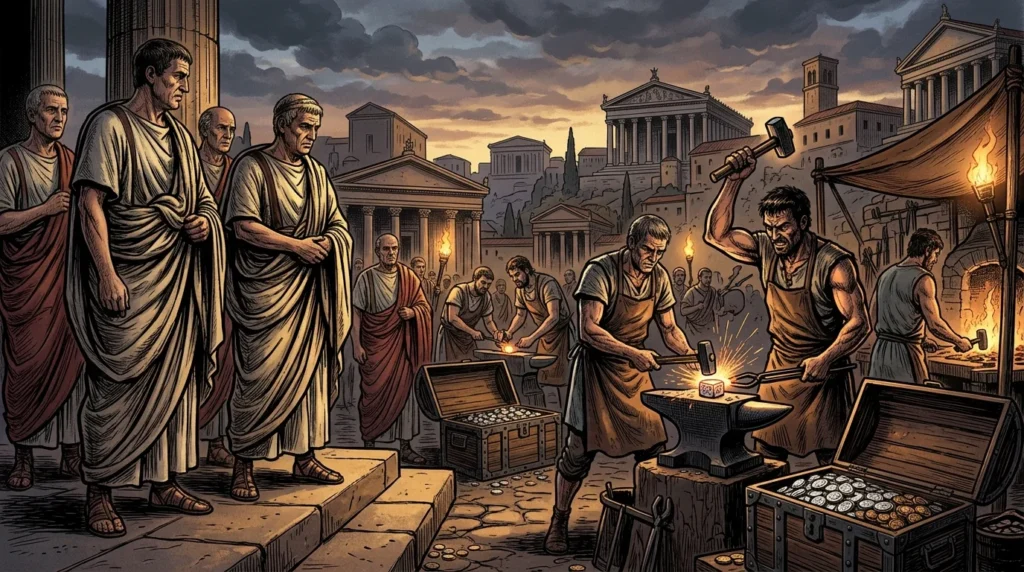
When the Roman Republic overthrew the Tarquin monarchy around 509 BCE, it possessed no coinage of its own. For more than two centuries—long after Greek city-states in southern Italy and Sicily had perfected the art of striking silver coins—Romans conducted market exchange, assessed citizen property in the quinquennial census, levied judicial and military fines (multae), and solemnized property conveyances by weighing unshaped lumps of raw bronze on balance scales. Only during the existential military mobilizations of the Samnite Wars (343–290 BCE) and the Pyrrhic War (280–275 BCE) did the Republic construct a dual monetary system: appointing a board of three mint magistrates (the tresviri monetales), casting massive five-pound bronze ingots (aes signatum) and one-pound circular bronze coins (aes grave) for domestic and legionary payments, and striking Greek-style silver didrachms—the Romano-Campanian issues—that prepared Rome financially for the outbreak of the First Punic War in 264 BCE. [1]
Exchange by Scale: Aes Rude and the Ritual of Per Aes et Libram
Throughout the fifth and fourth centuries BCE, central Italy lacked rich native deposits of gold or silver, whereas the copper mines of Etruria—particularly around Populonia and Volterra—supplied abundant base metal that was alloyed with tin and lead into bronze (aes). In the Latin language, the word aes became synonymous with money itself: the Roman state treasury housed in the Temple of Saturn was the aerarium, debt was aes alienum (« another man’s bronze »), and a soldier’s military pay was aes militare or stipendium (derived from stips, a small heap of bronze, and pendere, « to weigh »).
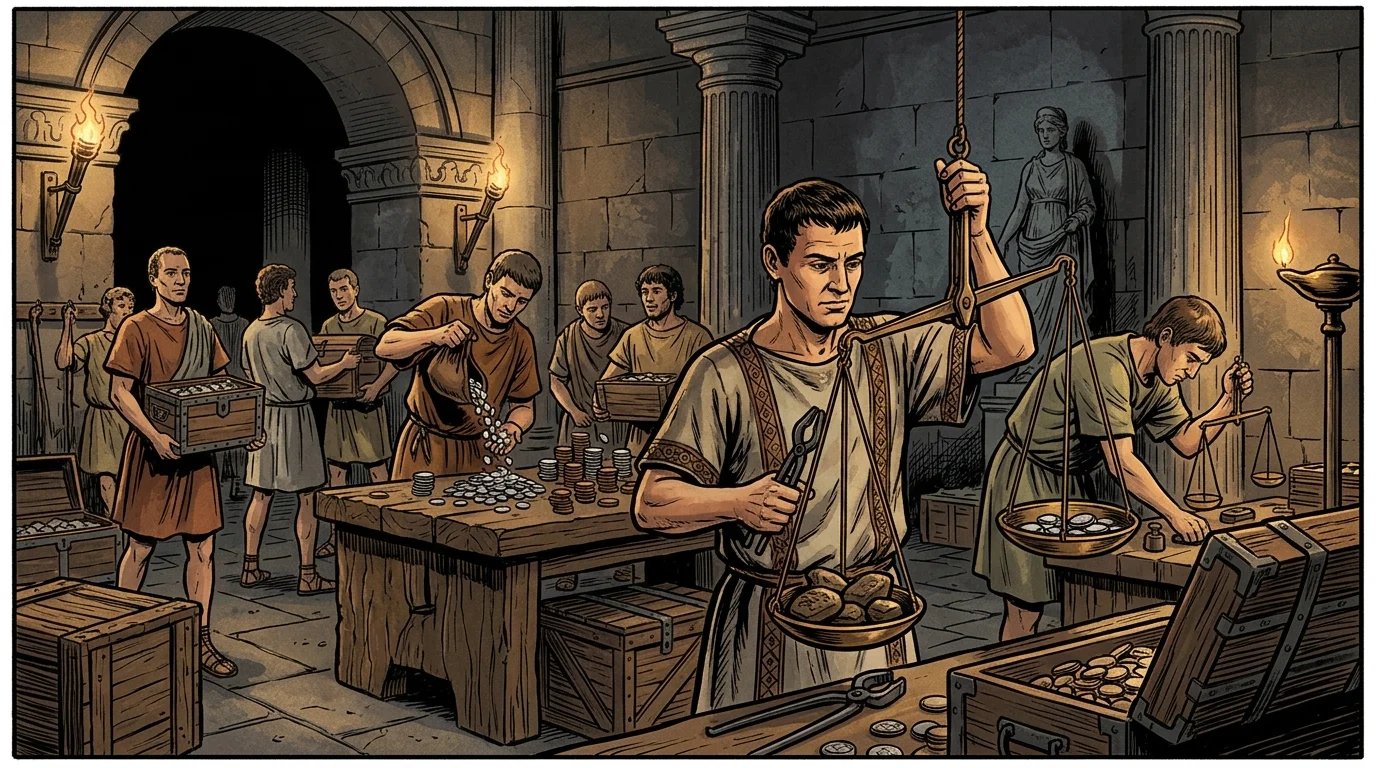
In everyday commerce and votive temple offerings, early Republican citizens used aes rude (« rough bronze »)—amorphous, unworked nuggets, broken casting sprues, and fragmentary ingots weighing anywhere from a few grams to several hundred grams. Because no state stamp guaranteed the weight or purity of these irregular chunks, every transaction required a balance scale (libra) to measure value against the central Italian weight standard: the Roman pound (libra or as, roughly 324 to 327 grams), subdivided into twelve ounces (unciae). [2]
This pre-coinage metallurgy left an indelible imprint on Roman civil law. Under the Twelve Tables codified around 451–450 BCE, transferring legal title to vital agrarian property (res mancipi—land in Italy, slaves, and draft oxen), contracting a debt bond (nexum), or executing a formal testament required the solemn ceremony of mancipatio per aes et libram (« by bronze and balance »). In the presence of five adult citizen witnesses and an official scale-holder (libripens), the purchaser struck the bronze scale with a piece of raw bronze (raudusculum) and handed it to the seller as symbolic payment—a legal ritual that Roman jurists preserved centuries after struck silver and gold coins had replaced weighed metal. [3]
Livestock Fines, the Tributum, and Five-Pound Aes Signatum Bars
Alongside raw bronze, the earliest Republican laws measured public obligations and magistrates’ fines (multae) in livestock—specifically oxen and sheep. As the fifth-century BCE legal system monetized these penalties onto a fixed metallic schedule, statutes such as the Lex Aternia Tarpeia (454 BCE) and the Lex Julia Papiria (430 BCE) established an official statutory conversion rate for state fines and census valuations: one sheep was valued at 10 pounds (asses) of bronze, and one ox at 100 pounds of bronze. Similarly, when the Senate introduced legionary military pay (stipendium) and the wartime citizen property tax (tributum)—traditionally dated by Livy to the prolonged siege of the Etruscan city of Veii around 406 BCE—censuses assessed every citizen’s land, tools, and livestock in bronze asses so the treasury could levy a proportional tax per thousand asses of wealth. [4]
To streamline large-scale transfers of bronze bullion without weighing hundreds of small jagged fragments, central Italian foundries had begun casting crude bronze ingots bearing a leafless « dry branch » motif (ramo secco). By the late fourth and early third centuries BCE, the Roman state elevated this practice into official aes signatum (« stamped » or « signed bronze »): heavy rectangular cast bronze bars measuring roughly 16 by 9 centimeters and weighing approximately five Roman pounds (around 1,500 to 1,650 grams). Cast in two-part clay molds, Roman aes signatum bars carried bold, high-relief civic and military emblems—an eagle holding a thunderbolt, Pegasus paired with the Latin inscription ROMANOM (« of the Romans »), a legionary shield, an anchor and tripod, two chickens feeding (recalling the sacred auspices taken before battle), or a bull—and post-280 BCE issues depicted an elephant and a sow, commemorating how screaming pigs had terrified King Pyrrhus of Epirus’s war elephants at the Battle of Beneventum in 275 BCE. Though magnificent as state bullion, aes signatum lacked fractional denominations and frequently had to be chiselled into halves or quarters for smaller payments. [5]
The Samnite Wars, the Tresviri Monetales, and Cast Libral Aes Grave
The decisive transformation of Roman money came between 312 and 275 BCE, as Rome fought the Samnite confederacy, Etruscan coalitions, Gallic warbands, and the Hellenistic army of Pyrrhus for mastery of peninsular Italy. Constructing the Via Appia (begun by the censor Appius Claudius Caecus in 312 BCE), provisioning multiple consular armies across Campania and Apulia, and distributing war booty strained traditional weighed-metal accounting to its limits. According to the second-century CE jurist Sextus Pomponius (preserved in Justinian’s Digest), around 289 BCE the Republic established a permanent college of three junior magistrates to supervise state coining: the tresviri aere argento auro flando feriundo (« three men for casting and striking bronze, silver, and gold »), commonly known as the tresviri monetales. [6]
Notice the revealing order of the verbs in the magistrates’ official title: flando (« casting ») preceded feriundo (« striking »), and bronze (aere) preceded silver and gold. Around 280 BCE, Rome inaugurated its indigenous fiduciary coinage: the cast circular bronze system known to numismatists as aes grave (« heavy bronze »). Unlike Greek coins struck with hammer and anvil dies from heated blanks, early Roman aes grave coins were too massive to strike and had to be cast by pouring molten leaded tin-bronze into trees of clay molds. [7]
Anchored to the full libral weight standard, the fundamental denomination was the cast bronze as weighing one full Roman pound (roughly 324 grams in the earliest Apollo/Apollo and Janus/Mercury series, and around 270 grams in the classic Janus/prow series). The system was strictly duodecimal (base-12), with each denomination displaying both a distinctive deity head on the obverse and an unmistakable mark of value: [8]
- As (12 ounces / 1 pound): Bearded double head of Janus; marked with vertical bar
I. - Semis (6 ounces / ½ pound): Laureate head of Jupiter or Saturn; marked with
S. - Triens (4 ounces / ⅓ pound): Helmeted head of Minerva or horse/dolphin; marked with four raised pellets (
••••). - Quadrans (3 ounces / ¼ pound): Head of Hercules wearing a lion skin; marked with three pellets (
•••). - Sextans (2 ounces / ⅙ pound): Head of Mercury wearing a winged petasus; marked with two pellets (
••). - Uncia (1 ounce / ⅟₁₂ pound): Helmeted head of Roma or Bellona; marked with a single pellet (
•).
Southward Expansion and the First Romano-Campanian Silver Didrachms (c. 300–264 BCE)
While cast one-pound bronze asses suited domestic fines, agrarian markets in Latium, and legionary stipends at home, they were completely impractical in the commercial world of Campania and Magna Graecia (southern Italy). Cities such as Neapolis (Naples), Cumae, Velia, and Tarentum had operated for centuries on struck silver didrachms (also called nomoi or staters, weighing roughly 7.2 to 7.5 grams) and rejected unwieldy base-metal disks whose transport costs over long distances consumed a significant share of their value.
Once Rome concluded its alliance (foedus) with Neapolis in 326 BCE and pushed its road network and military garrisons deep into Campania, the Senate commissioned its first struck silver coinage—classified by modern historians as the « Romano-Campanian » series. The earliest issue, dated by numismatist Michael Crawford to roughly 300–290 BCE (or around 310 BCE by Andrew Burnett), was struck on the Campanian weight standard (~7.3 grams), almost certainly at the mint of Neapolis using skilled Greek die-engravers. Its obverse portrayed the bearded, helmeted war god Mars, while the reverse featured a bridled horse’s head accompanied by a grain ear and the Greek-influenced legend ROMANO (an archaic genitive plural, Romanom, signifying « [coin] of the Romans »).
During the Pyrrhic War (280–275 BCE) and its immediate aftermath, three further silver didrachm types followed in succession. First came a Carthaginian- and Greek-inspired issue on the lighter ~6.8-gram standard showing the laureate head of Apollo on the obverse and an unbridled galloping horse beneath a star on the reverse (inscribed ROMANO). Next came a ~6.8-gram didrachm depicting youthful Hercules with club and lion skin on the obverse and Rome’s foundational civic emblem on the reverse: the Capitoline she-wolf suckling the twins Romulus and Remus, issued around 269 BCE—the very year to which Pliny the Elder (Natural History 33.44) and Livy’s Periochae dated the introduction of silver coinage inside the city of Rome itself, at the mint attached to the Temple of Juno Moneta on the Arx of the Capitoline Hill (the temple from whose title the English words « money » and « mint » derive). Finally, around 265–242 BCE, Rome struck a series of silver didrachms (~6.6 grams) bearing the legend ROMA rather than ROMANO, culminating in the famous quadrigatus (Jupiter in a four-horse chariot).
Monetary Integration on the Eve of the First Punic War (264 BCE)
By 264 BCE, when Roman legions crossed the Strait of Messina into Sicily to confront Carthage in the First Punic War, the Roman Republic had completed a profound institutional transition in less than two generations. Within Latium and central Italy, cast libral aes grave standardized the archaic bronze pound into portable, state-guaranteed denominations overseen by the tresviri monetales; across southern Italy and the Mediterranean littoral, Romano-Campanian silver didrachms projected Roman sovereignty in the visual and metrological language of the Hellenistic world. When the crushing naval and military costs of the First and Second Punic Wars subsequently forced Rome to devalue the weight of the cast bronze as from twelve ounces down to six, two, and finally one ounce—leading directly to the creation of the struck silver denarius (worth ten reduced asses) around 211 BCE—the legal and fiscal foundations laid between 509 and 264 BCE endured at the heart of Roman public finance.
Mécanisme Théorique et Transmission de Bilan
Selon le modèle d’instabilité financière de Kindleberger–Minsky (Kindleberger, 1978 ; Minsky, 1986) et la théorie de la déflation par la dette d’Irving Fisher (1933), les bulles spéculatives deviennent systémiques lorsque l’expansion du crédit fait basculer les bilans d’un financement couvert vers un financement spéculatif et de type Ponzi fondé sur l’effet de levier à court terme.
Dès que le retournement du marché déclenche des appels de marge, les liquidations forcées d’actifs provoquent une spirale déflationniste qui dégrade la solvabilité bancaire.
Sources and Further Reading
- Marleen K. Termeer, Fleur Kemmers, and Seth Bernard, « Money and Mid-Republican Rome, » The Journal of Roman Studies, 2025. Recherche académique évaluée
- Michael H. Crawford, « Roman Republican Coinage, » Cambridge University Press, 1974. Recherche académique évaluée
- Michael H. Crawford, « Coinage and Finance in Roman Republican Coinage, » Cambridge University Press, 1974. Recherche académique évaluée
- Merav Haklai, « Money in the Roman Empire: Legal and Institutional Frameworks, » Oxford University Research Archive, 2013. Recherche académique évaluée
- Jeremy Armstrong, « Diet and Nutrition in the Roman Republican Army, » Brill, 2023. Recherche académique évaluée
- François Gauthier, « Financing War in the Roman Republic 201 BCE–14 CE, » McGill University eScholarship, 2016. Référence historique et financière
- Irving Fisher — "The Debt-Deflation Theory of Great Depressions," Econometrica 1, no. 4 (FRASER Federal Reserve Archive, 1933): 337–357 Banque centrale / Autorité monétaire
- Charles P. Kindleberger & Robert Z. Aliber — Manias, Panics, and Crashes: A History of Financial Crises (Palgrave Macmillan) Recherche académique évaluée
Citer ce dossier historique (APA / Chicago)
APA (7th ed.): Ç., S. (Ed.). (2026). Du bronze pesé à l'argent frappé : comment la jeune République romaine a forgé sa première monnaie. In Forgotten Fortunes Historical Monograph Series (Rédaction Forgotten Fortunes). https://forgottenfortunes.net/fr/monnaie-romaine-primitive-de-laes-grave-en/
MLA (9th ed.): Ç., Soner, ed. "Du bronze pesé à l'argent frappé : comment la jeune République romaine a forgé sa première monnaie." Forgotten Fortunes: Financial & Monetary History Archive, 2026, https://forgottenfortunes.net/fr/monnaie-romaine-primitive-de-laes-grave-en/.
Chicago (17th ed.): Ç., Soner, ed. "Du bronze pesé à l'argent frappé : comment la jeune République romaine a forgé sa première monnaie." Forgotten Fortunes Historical Monograph Series (Rédaction Forgotten Fortunes), septembre 27, 2026. https://forgottenfortunes.net/fr/monnaie-romaine-primitive-de-laes-grave-en/.
Have an idea for another financial history documentary or article? Request a story →