In This Article
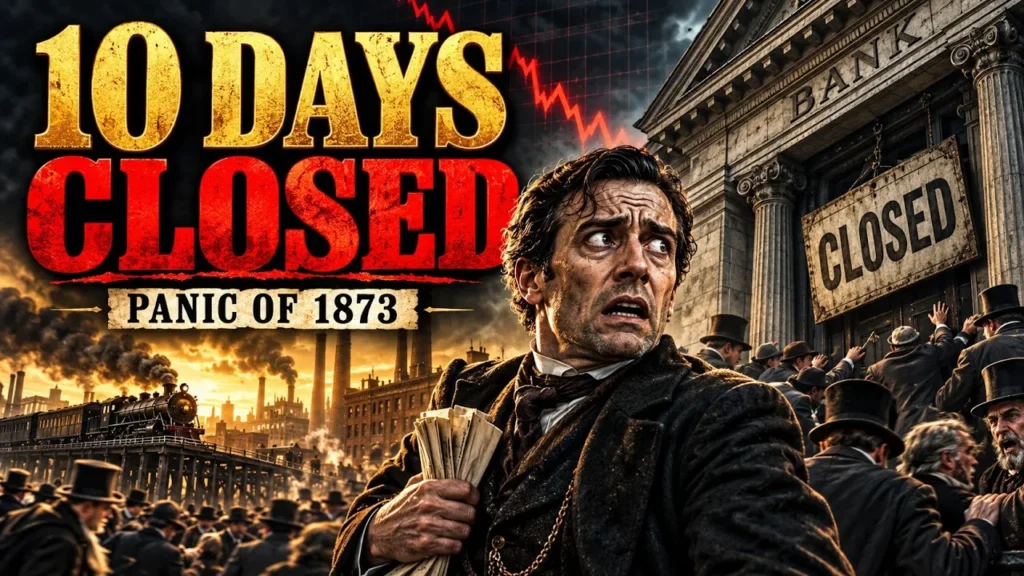
By the summer of 1893, the United States faced two crises of confidence at once. Americans were questioning whether their banks could return their deposits, while investors wondered whether the federal government could continue exchanging paper dollars for gold. [1]

The Treasury’s gold reserves were shrinking. Major railroad companies were collapsing under heavy debts. Banks across the country were struggling to provide cash to frightened customers.
What became known as the Panic of 1893 was not simply a stock market crash or a dispute over precious metals. It was a breakdown in the connections between government money, private credit, business investment, and public trust. [2]
The immediate banking panic eventually subsided. The economic damage lasted much longer, while the fight over America’s monetary future became one of the defining political struggles of the decade.
An Expanding Economy Built on Fragile Foundations
During the decades following the Civil War, the United States underwent an extraordinary industrial transformation. Railroads connected distant regions. Steel production expanded. Factories multiplied, cities grew, and American businesses increasingly depended on financing from banks and investors. Yet this growth contained serious vulnerabilities.
Railroad construction was particularly important. Building new lines required enormous amounts of borrowed capital, often raised through the sale of bonds. Investors purchased these securities expecting future railroad earnings to cover interest payments and repay debts.
The difficulty was that railway construction sometimes advanced faster than the demand for transportation.
Competing companies built routes into territories that could not yet generate sufficient traffic. Some projects carried heavy financial obligations without producing the revenue needed to support them.
As long as investors remained willing to provide new financing, vulnerable companies could continue operating. When that willingness weakened, their debts became dangerous.
Railroad problems also affected the wider economy. Banks held railway securities and made loans to companies connected to the industry. Railway construction supported demand for steel, coal, timber, machinery, and labor.
A major railroad failure could therefore threaten far more than its shareholders. The banking system had weaknesses of its own. The United States had no Federal Reserve or equivalent permanent central bank capable of responding systematically to nationwide shortages of banking reserves.
Banks operated under a complicated national and state banking structure. Many smaller institutions held part of their reserves as deposits with larger banks in designated financial centers, particularly New York.
This arrangement worked reasonably well during ordinary business conditions. During an emergency, however, numerous institutions could demand access to the same limited pool of cash. The American economy was expanding rapidly, but the financial structure supporting that expansion was less resilient than its apparent prosperity suggested.
| Documented Figure / Metric | Historical Significance & Archival Context |
|---|---|
| 575 banks closed | Economic historian Mark Carlson's research discusses contemporary figures indicating that roughly 575 banks closed temporarily or permanently during the broader panic. |
| $41 million | By early February 1895, Cleveland reported that the Treasury's gold reserve had fallen to approximately $41 million. |
| $62 million | In February 1895, the government agreed to exchange approximately $62 million in bonds for slightly more than $65 million in gold. |
The Gold Reserve That Supported America’s Dollar
Understanding the Panic of 1893 requires understanding what a dollar represented at the time.
The United States operated on a gold standard in practice. Under the system then in force, important forms of federal paper currency could be redeemed in gold, and the government sought to preserve the dollar’s established gold value.
This promise was essential to confidence in American money. A person holding an eligible government note could present it for redemption, expecting the Treasury to honor its monetary obligations. But maintaining that promise required the Treasury to possess sufficient gold.
The government had long treated $100 million in gold reserves as an important safeguard for redemption. It was an established policy benchmark rather than a universal legal requirement that every circulating dollar be backed by its own gold coin. [3]
By the early 1890s, the Treasury was approaching that level. Federal Reserve historical research indicates that Treasury gold reserves declined from approximately $190 million in 1890 to around $100 million in early 1893. In April 1893, the reserve fell below the psychologically important $100 million threshold. That development raised a disturbing question: what would happen if too many people demanded gold at once? [4]
The problem was not that every dollar holder would necessarily redeem their money. Most people ordinarily accepted paper currency without questioning its value. The danger was a change in expectations. If investors believed gold redemption might eventually be restricted, they had an incentive to obtain gold while redemption remained available. Those withdrawals would reduce Treasury reserves further, potentially making the feared restriction more likely.
Confidence could therefore become self-defeating.
The more people feared that the government’s gold promise might weaken, the more pressure they placed on the gold needed to preserve it.
How the Sherman Silver Purchase Act Complicated the Crisis
The gold reserve problem was inseparable from a long-running American argument over silver.
The Sherman Silver Purchase Act of 1890 required the federal government to purchase up to 4.5 million ounces of silver bullion each month. [5]
The Treasury issued notes to pay for these purchases.
Under the law, those notes could be redeemed in gold or silver coin at the Treasury secretary’s discretion. At the same time, federal policy committed the government to maintaining the two metals at parity.
In practice, preserving confidence in the dollar meant honoring demands for gold. This created a difficult arrangement. The government was purchasing substantial quantities of silver while trying to maintain a monetary system whose international credibility depended heavily on gold.
As silver prices declined and doubts about American monetary policy increased, investors became increasingly concerned that the government might eventually abandon gold payments or permit the dollar to lose value against gold.
The silver-purchase legislation was not the only reason gold left the Treasury. International investment flows, trade conditions, domestic hoarding, and broader economic weakness also mattered.
Nevertheless, the relationship between Treasury notes, silver purchases, and gold redemption became a central source of uncertainty.
Another feature of the system made the problem especially persistent.
Certain redeemed government notes were reissued rather than permanently retired. A note could therefore be exchanged for gold, return to circulation, and later become another claim against the Treasury.
Removing gold from the reserve did not necessarily remove the paper obligation that had produced the withdrawal.
President Grover Cleveland would later criticize this recurring redemption problem as a fundamental weakness in the monetary system.
Yet disagreement over silver was more than a technical argument about government reserves. It reflected competing economic interests and different understandings of what American money should accomplish.
How the Panic of 1893 Spread Across the Country
The economic situation was already deteriorating before the banking panic reached its height.
In February 1893, the Philadelphia and Reading Railroad entered receivership, a legal arrangement in which a financially distressed company’s operations or property came under court-supervised management. [6]
The failure demonstrated the vulnerability of heavily indebted railroad enterprises. Other business difficulties followed. In May, the National Cordage Company, a major rope manufacturer, collapsed after experiencing severe financing problems. Such failures damaged investor confidence and placed additional pressure on financial markets.
But the defining feature of the Panic of 1893 was the spread of withdrawals through the banking system. During June, bank runs affected cities in the Midwest and West, including Chicago and Los Angeles. More than 100 banks suspended operations during this phase. The situation worsened dramatically between mid-July and mid-August, when approximately 340 additional banks suspended operations, according to Federal Reserve historical research. [7]
Economic historian Mark Carlson’s research discusses contemporary figures indicating that roughly 575 banks closed temporarily or permanently during the broader panic. [8]
This distinction matters.
A bank suspension did not always mean that the institution was permanently bankrupt. Some banks halted payments because they could not immediately obtain sufficient cash, even when their assets might ultimately cover their obligations.
The crisis was also geographically unusual.
Many earlier American financial panics had spread outward from New York. In 1893, much of the severe banking pressure emerged in the country’s interior and eventually reached the leading financial center. [9]
Banks outside New York attempted to withdraw reserves that they had deposited with larger correspondent banks. Those larger banks then faced their own growing demand for cash. As institutions sold securities to raise money, asset prices declined, weakening the financial position of banks and investors holding similar assets. A crisis of confidence was becoming a crisis of liquidity.
Why Even a Solvent Bank Could Be Forced to Close
The mechanics of a bank run help explain why the crisis spread so quickly. Imagine a bank holding $100,000 in customer deposits. It would not normally keep the entire amount as physical currency in its vault. A substantial portion might be lent to businesses, invested in securities, or deposited with other banks. Those arrangements allowed the bank to earn income and finance economic activity. [10]
But if depositors suddenly demanded $60,000 in cash, the bank might struggle to provide it immediately. Its borrowers could not necessarily repay their loans overnight. Securities might have to be sold at steep discounts. Cash held at another institution might become temporarily inaccessible. The bank could be financially sound over the longer term yet unable to meet immediate withdrawal demands. [11]
This is the difference between insolvency and illiquidity.
An insolvent institution has liabilities greater than the value of its assets. An illiquid institution may possess adequate assets but lack the cash required at a particular moment.
The Panic of 1893 involved both problems.
Research by Mark Carlson found that underlying economic shocks were important in explaining where bank suspensions occurred nationally, while local withdrawal behavior and liquidity pressures also played significant roles.
These explanations are not mutually exclusive. Real business failures weakened banks. Fear then caused depositors to withdraw money from institutions whose exact financial condition they could not easily determine. During August, New York banks restricted the flow of currency to institutions elsewhere in the country as they attempted to protect their own reserves. This response reduced immediate pressure in New York but intensified cash shortages elsewhere.
Some communities turned to clearinghouse certificates, emergency scrip, and other temporary payment arrangements.
Ordinary money and credit had become difficult to obtain precisely when businesses needed them most.
The Economic Damage Extended Far Beyond Wall Street
The banking panic disrupted the financial system, but its consequences spread into workplaces, households, and communities. Businesses dependent on bank loans found credit harder to obtain. Firms facing falling sales struggled to finance inventories or pay employees. Railroad construction contracted, affecting industries that supplied equipment, materials, and transportation services. Workers faced layoffs, wage reductions, and diminished opportunities.
The scale of the downturn was extraordinary.
Historical estimates cited by Federal Reserve researchers suggest that American industrial production fell approximately 15.3% between 1892 and 1894. [12]
Estimates of unemployment vary because the United States did not yet collect modern, comprehensive monthly labor-market statistics.
Some historical reconstructions place unemployment at approximately 17–19% during the crisis period. These figures should be understood as retrospective estimates rather than precise contemporary measurements.
For families dependent on regular wages, the difference between a temporary banking panic and an extended depression offered little immediate comfort. A closed factory meant lost income. Reduced hours made existing debts harder to repay. Farmers already facing financial pressures remained vulnerable to weak prices and costly borrowing. The resulting distress helped fuel organized protest. In 1894, unemployed workers associated with Jacob Coxey marched toward Washington, demanding federal action to create employment.
Another major confrontation emerged at Pullman, near Chicago. The Pullman Company manufactured railroad sleeping cars and operated a company town. Under conditions of economic hardship and wage reductions, labor tensions intensified. Workers at Pullman’s factories struck in May 1894. The dispute expanded into a national railway boycott led by the American Railway Union, disrupting transportation and provoking federal intervention.
The Pullman conflict had causes and institutional dynamics of its own. It should not be treated as an automatic consequence of the banking panic. Nevertheless, it unfolded within the broader economic distress that followed the financial collapse. The depression revealed how closely financial instability, industrial employment, and social conflict had become connected.
The Panic of 1893 and the Battle Over Gold and Silver
President Grover Cleveland entered office in March 1893, as the financial situation was becoming increasingly dangerous. Cleveland believed that the Sherman Silver Purchase Act undermined confidence in American currency and threatened the Treasury’s ability to maintain gold redemption. He summoned Congress into a special session. On August 8, 1893, he urged lawmakers to repeal the silver-purchasing provisions.
His position reflected the concerns of many creditors, commercial bankers, and advocates of maintaining the dollar’s established gold value. For these groups, monetary credibility was essential. They feared that weakening the gold commitment could damage international confidence, encourage capital flight, and increase borrowing costs. But opponents of repeal saw the problem differently.
Farmers and other borrowers had experienced years of pressure from falling prices. When the prices of crops or other products declined, fixed debts could become harder to repay. A farmer might owe the same number of dollars while receiving fewer dollars for the harvest used to service that debt. Supporters of broader silver coinage believed that expanding the money supply could ease credit conditions and relieve some of this pressure. For silver-producing regions, increased monetary use of silver also promised stronger demand for the metal.
The debate crossed familiar political lines.
George Washington Murray, a Republican congressman from South Carolina, defended silver policy during the 1893 congressional struggle. He argued that restricting the supply of money harmed poorer constituents and agricultural communities.
The disagreement was therefore about more than whether gold or silver was the superior monetary metal.
It concerned the distribution of economic hardship between creditors and debtors, financial centers and agricultural regions, and those prioritizing monetary stability versus those seeking monetary expansion.
Congress ultimately repealed the Sherman Act’s silver-purchase provisions in late October 1893, ending the compulsory purchasing program. But repeal did not instantly repair failing businesses, restore lost employment, or resolve every weakness in the banking system. Nor did it end the national monetary debate. The argument over America’s dollar was only moving into its next stage.
When the U.S. Treasury Turned to Private Bankers
The immediate banking panic eased during the autumn of 1893. Gold inflows from Europe helped relieve financial pressure, interest rates declined, and banking operations gradually normalized. Yet the Treasury’s gold reserve remained vulnerable. The government continued to face redemption demands, and the problem persisted after the repeal of the silver-purchasing provisions.
In 1894, the Treasury sold bonds to replenish its gold holdings.
Further withdrawals followed.
By early February 1895, Cleveland reported that the Treasury’s gold reserve had fallen to approximately $41 million.
The government faced another serious test of its ability to preserve gold payments. Unable to obtain the legislative solution he preferred, Cleveland turned to a syndicate of private financiers. The arrangement involved J. P. Morgan and Company, August Belmont and Company, and their associated banking interests in London, including the Rothschild financial house.
In February 1895, the government agreed to exchange approximately $62 million in bonds for slightly more than $65 million in gold.
At least half of the gold was to come from abroad. The agreement also included efforts by the bankers to limit further withdrawals while the arrangement remained in force. It helped replenish the Treasury’s depleted reserves, although later gold outflows demonstrated that the underlying monetary problem had not permanently disappeared. The arrangement became politically controversial.
Supporters regarded it as a necessary emergency response to preserve American credit and gold redemption.
Critics objected to the government’s dependence on powerful private financiers and questioned the favorable opportunities the transaction offered participating banks.
The episode exposed an uncomfortable feature of the American financial system: in a national monetary emergency, the federal government had relied on private banking power to defend its own currency arrangements.
Why the Depression Continued After the Panic Ended
A financial panic and an economic depression are related, but they are not identical. A panic is an acute breakdown of confidence and financial functioning. A depression describes a wider, sustained contraction in economic activity. The most intense banking crisis of 1893 eased before the underlying economic problems had disappeared. According to Federal Reserve historical research, the American economy remained in recession until the following summer.
After a period of improvement, economic conditions deteriorated again in late 1895, and a sustained recovery did not emerge until around the middle of 1897. This is why the wider depression is often discussed as extending across much of the period from 1893 to 1897, even though it was not one uninterrupted recession. The distinction prevents a misleading conclusion: stopping the immediate bank runs did not automatically restore investment, employment, or confidence.
Railroads and other businesses still had debts to restructure. Banks remained cautious about lending. Households affected by job losses could not immediately return to their previous spending.
A financial system may begin functioning again long before the wider economy has recovered. The currency debate also remained unresolved. The presidential election of 1896 brought the gold-versus-silver question directly to voters. Republican William McKinley defended the existing gold-centered monetary system, while Democratic nominee William Jennings Bryan championed expanded silver coinage.
Bryan’s campaign reflected the continuing frustration of borrowers and agricultural communities with monetary conditions. McKinley won the election. Economic recovery after 1897 was supported by several developments, including increased international gold production that helped expand monetary conditions within the gold-standard system. In 1900, Congress passed the Gold Standard Act, giving the gold basis of the American dollar a firmer statutory foundation.
The political settlement took years longer than the original banking panic.
What the Panic Revealed About American Financial Power
The Panic of 1893 exposed three interconnected weaknesses. First, the government’s commitment to redeem paper money in gold was vulnerable to sudden changes in public expectations. Second, the banking system depended on reserve arrangements that could transmit liquidity shortages from one region to another. Third, a credit-dependent industrial economy could suffer prolonged damage when financial institutions and investors simultaneously withdrew support.
It would be inaccurate to attribute the entire disaster to the Sherman Silver Purchase Act, railroad speculation, or bank runs alone.
Each contributed to the crisis through different mechanisms.
The monetary controversy weakened confidence. Business failures damaged banks and investors. Banking withdrawals reduced available credit. Financial distress then deepened the economic contraction.
The crisis also became part of a larger argument about the need for banking reform.
Although reform proposals followed the events of 1893, the United States did not immediately create a central bank. Another major panic in 1907 ultimately helped generate the political momentum that led to the establishment of the Federal Reserve System in 1913.
The central lesson of 1893 was not that gold itself guaranteed stability, or that monetary expansion could solve every economic problem. It was that a nation’s financial promises depend on institutions capable of sustaining confidence when conditions deteriorate. In 1893, Americans discovered that neither the government’s gold reserves nor the banking system’s apparent strength could prevent a crisis once confidence began to collapse.
The panic ended before the depression did — and the struggle over what made a dollar trustworthy continued for years afterward.
Theoretical & Balance-Sheet Transmission Mechanism
In the Kindleberger–Minsky taxonomy of financial instability (Kindleberger, 1978; Minsky, 1986) and Irving Fisher’s (1933) debt-deflation framework, speculative asset booms become systemic crises when credit expansion shifts balance sheets from hedge finance (cash flows covering principal and interest) to speculative and Ponzi finance (relying on rising asset prices and short-term margin roll-overs).
Once monetary tightening or an exogenous shock halts price appreciation, forced margin liquidations trigger Fisherian debt-deflation: fire-sale asset discounts erode bank collateral values, contracting credit supply across the real economy.
Sources & Further Reading
- Gary Richardson and Tim Sablik. “Banking Panics of the Gilded Age.” Federal Reserve History, Federal Reserve System, 2015. Historical analysis of the Panic of 1893, the national banking structure, reserve pressures, bank suspensions, and economic consequences.
https://www.federalreservehistory.org/essays/banking-panics-of-the-gilded-age Central Bank / Monetary Authority - Mark Carlson. “Causes of Bank Suspensions in the Panic of 1893.” Finance and Economics Discussion Series, Board of Governors of the Federal Reserve System, 2008. Research examining economic shocks, bank liquidity, solvency, and the geographic distribution of suspensions.
https://www.federalreserve.gov/econres/feds/causes-of-bank-suspensions-in-the-panic-of-1893.htm Central Bank / Monetary Authority - U.S. Department of the Treasury. Annual Report of the Secretary of the Treasury on the State of the Finances for the Year 1893. Government Printing Office, 1893. Primary documentation of Treasury gold reserves, currency redemption, silver purchases, and federal monetary conditions. Digitized by FRASER, Federal Reserve Bank of St. Louis.
https://fraser.stlouisfed.org/title/annual-report-secretary-treasury-state-finances-194/annual-report-secretary-treasury-state-finances-year-1893-5539/fulltext Central Bank / Monetary Authority - Grover Cleveland. “Special Session Message,” August 8, 1893. Presidential address to Congress concerning the financial crisis and repeal of the Sherman Silver Purchase Act. Miller Center, University of Virginia.
https://millercenter.org/the-presidency/presidential-speeches/august-8-1893-special-session-message Historical & Financial Reference - Grover Cleveland. “Annual Message of the President,” December 1895. Foreign Relations of the United States, U.S. Department of State, Office of the Historian. Primary evidence concerning Treasury gold depletion, bond sales, and the 1895 financial syndicate agreement.
https://history.state.gov/historicaldocuments/frus1895p1/message-of-the-president Official / State Archive - U.S. House of Representatives, Office of the Historian. “George Washington Murray.” History, Art & Archives. Congressional biography documenting the silver debate, Murray’s arguments, and the repeal of the Sherman Silver Purchase Act.
https://history.house.gov/People/Detail/18709 Official / State Archive - National Park Service. “The Pullman Story Part 2.” Pullman National Historical Park, updated 2024. Historical account of the 1894 Pullman Strike, railway boycott, and labor conflict during the depression.
https://www.nps.gov/pull/learn/historyculture/the-pullman-story-part-2.htm Official / State Archive - United States Senate Committee on Finance. “History.” Institutional history covering the Sherman Silver Purchase Act, the gold-and-silver controversy, and the transition toward the Gold Standard Act.
https://www.finance.senate.gov/about/history Official / State Archive - Federal Reserve Bank of Atlanta. “Origins of the System.” Institutional history examining the Panic of 1893, the Treasury gold crisis, and the development of American central banking.
https://www.atlantafed.org/who-we-are/atlanta-fed-history/first-75-years/origins-of-the-system Central Bank / Monetary Authority - Smithsonian Institution, National Museum of American History. “1896 Election.” The William Steinway Diary: 1861–1896. Historical context for the election between William McKinley and William Jennings Bryan and their competing monetary positions.
https://americanhistory.si.edu/steinwaydiary/annotations/?id=902&print=1 Peer-Reviewed / Academic Research - Irving Fisher — "The Debt-Deflation Theory of Great Depressions," Econometrica 1, no. 4 (FRASER Federal Reserve Archive, 1933): 337–357 Central Bank / Monetary Authority
- Charles P. Kindleberger & Robert Z. Aliber — Manias, Panics, and Crashes: A History of Financial Crises (Palgrave Macmillan) Peer-Reviewed / Academic Research
Cite This Historical Dossier (APA / Chicago)
APA (7th ed.): Ç., S. (Ed.). (2026). Panic of 1893: When America's Gold Promise Began to Break. In Forgotten Fortunes Historical Monograph Series (Forgotten Fortunes Editorial Desk). https://forgottenfortunes.net/panic-of-1893-gold-bank-runs/
MLA (9th ed.): Ç., Soner, ed. "Panic of 1893: When America's Gold Promise Began to Break." Forgotten Fortunes: Financial & Monetary History Archive, 2026, https://forgottenfortunes.net/panic-of-1893-gold-bank-runs/.
Chicago (17th ed.): Ç., Soner, ed. "Panic of 1893: When America's Gold Promise Began to Break." Forgotten Fortunes Historical Monograph Series (Forgotten Fortunes Editorial Desk), August 22, 2026. https://forgottenfortunes.net/panic-of-1893-gold-bank-runs/.
Have an idea for another financial history documentary or article? Request a story →