In This Article
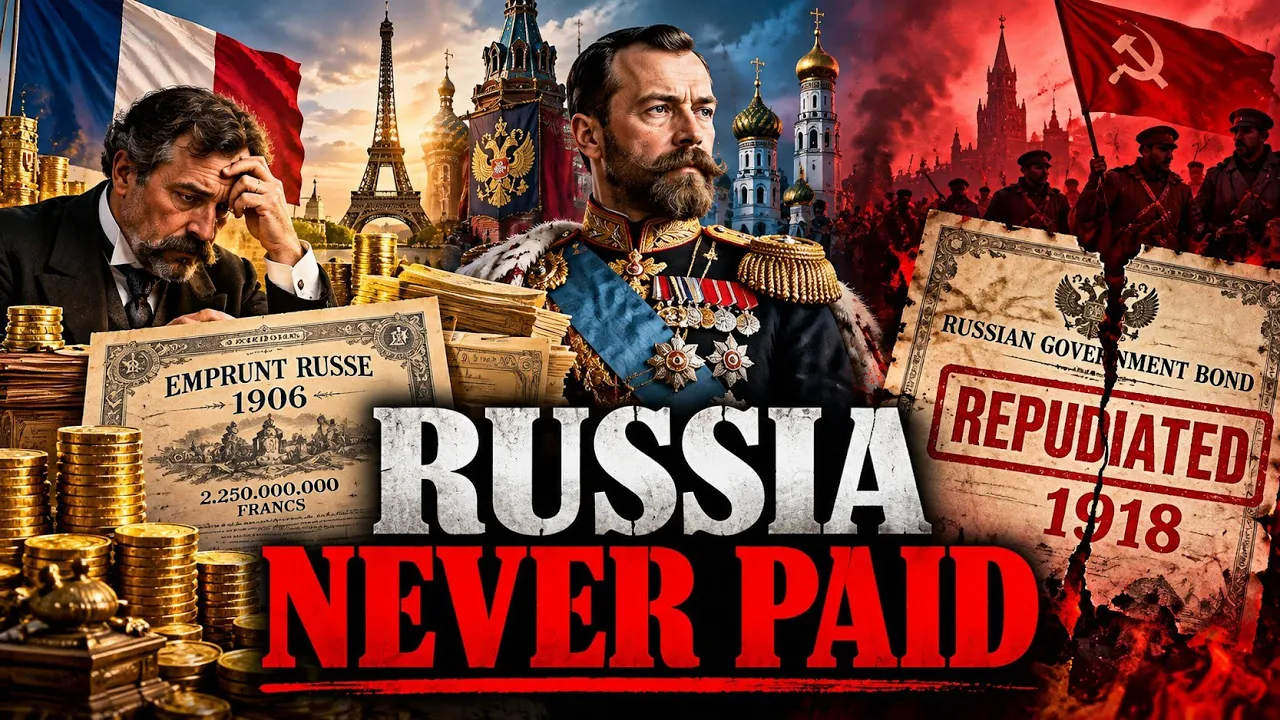
In April 1906, the Russian Empire turned to international investors for one of the largest government loans of its era: 2.25 billion francs. More than half of the issue was reserved for France, where banks offered Russian bonds to savers seeking a steady income. [1]

Russia needed financial breathing room. It had suffered a humiliating military defeat against Japan, endured a wave of revolution, and faced growing doubts about the stability of its government.
The bonds promised regular interest payments backed by a powerful empire. They also linked French household wealth to a foreign political system that investors could not control.
Just twelve years later, the Bolshevik government rejected the debts of its predecessors.
The Russian bonds became more than a failed investment. They exposed a fundamental weakness in international lending: a government can promise repayment for decades, but a revolution can destroy the political foundations of that promise.
When France Became Russia’s Banker
The financial relationship between France and Imperial Russia developed long before the crisis of 1906. During the late nineteenth century, Russia was expanding its railways, factories, industrial centers, and military infrastructure. Such development demanded enormous amounts of capital. Domestic savings alone could not comfortably finance all these ambitions. Russian governments therefore borrowed abroad, especially through European financial markets. France became particularly important. [2]
French investors had accumulated substantial savings, and government securities were familiar investments. Banks could distribute foreign bonds to customers who wanted income without directly managing a business.
Meanwhile, French diplomacy increasingly viewed Russia as a valuable strategic partner. The Franco-Russian alliance of the early 1890s brought the two countries closer as both considered the balance of power in Europe, particularly the strength of Germany. Finance reinforced that relationship.
Russia gained access to capital. France gained a powerful continental ally. French banks earned business arranging and distributing Russian securities, while investors received promises of interest and eventual repayment.
The relationship was not exclusively political. Investors sought returns, banks pursued profits, and Russian officials wanted to finance development and public spending. Yet diplomatic considerations helped determine which foreign governments received access to European savings. By the beginning of the twentieth century, Russian bonds had become an established part of the French investment market. That familiarity mattered. A borrower who has successfully sold bonds for years can appear safer simply because its securities are widely held and regularly traded.
But popularity is not the same as protection against default.
| Documented Figure / Metric | Historical Significance & Archival Context |
|---|---|
| 500 francs | A typical bond represented 500 francs of nominal capital and paid interest at an annual rate of 5 percent. |
| 25 francs | That meant an annual payment of 25 francs, normally divided into two installments. |
| 88 percent | The French offering price was 88 percent of face value. |
| 440 francs | A purchaser therefore paid 440 francs for a bond with a nominal value of 500 francs. |
The 1906 Russian Loan: An Empire Under Pressure
In 1904, Russia went to war with Japan over competing strategic interests in East Asia. The conflict proved disastrous for the Russian Empire. Military defeats imposed financial costs and damaged international confidence. The war ended in 1905, but Russia’s difficulties were far from over. At home, strikes, protests, rural disturbances, military mutinies, and revolutionary activity challenged the authority of Tsar Nicholas II. [3]
The upheaval of 1905 forced the imperial government to make political concessions, including the October Manifesto and the establishment of an elected legislature. For lenders, the crisis raised an uncomfortable question: could Russia continue servicing its debts if its political system remained unstable? The empire still possessed considerable resources, but wartime expenditure and domestic unrest made new financing both more urgent and more difficult. Russian officials sought a major international loan to improve the government’s financial position and restore confidence. [4]
In April 1906, the empire authorized a 5 percent state loan with a nominal value of 2.25 billion francs, equivalent to 843.75 million rubles under the monetary terms of the issue. [5]
The offering was distributed across several European markets, including France, Britain, Austria, and the Netherlands, as well as Russia itself.
Contemporary Paris financial records identify 1.2 billion francs of the loan as the portion reserved for the French market. [6]
That represented approximately 53 percent of the total nominal issue.
French banks involved in distributing the securities included Crédit Lyonnais, Société Générale, Banque de Paris et des Pays-Bas, Comptoir National d’Escompte de Paris, Crédit Industriel et Commercial, and Hottinguer.
The operation was significant for more than its size.
It provided the Russian government with financial breathing room at a dangerous moment and demonstrated that international bankers were still prepared to mobilize large amounts of capital for the empire.
The loan contributed to financial stabilization. It did not, however, resolve the deeper political tensions that had produced the crisis.
Why Russian Bonds Looked Attractive
The structure of the 1906 loan helps explain why investors were willing to participate.
A typical bond represented 500 francs of nominal capital and paid interest at an annual rate of 5 percent.
That meant an annual payment of 25 francs, normally divided into two installments. But French investors did not have to pay the full 500 francs to acquire the bond when it was issued. The French offering price was 88 percent of face value. [7]
A purchaser therefore paid 440 francs for a bond with a nominal value of 500 francs.
The promised 25 francs in annual interest represented approximately 5.7 percent of the purchase price, before costs. This distinction matters. The advertised 5 percent rate was calculated on the bond’s nominal value, not necessarily on the money actually paid by the investor. The discounted purchase price made the income appear more attractive. [8]
There was also a potential repayment benefit.
Under the original terms, the loan was to be repaid at face value through a schedule of drawings beginning in 1917, with complete redemption planned no later than 1956. [9]
If a 500-franc bond purchased for 440 francs was eventually redeemed at 500 francs, its owner would receive an additional 60 francs beyond the purchase price, alongside any interest already collected. [10]
Those returns depended on the issuer continuing to honor its obligations. The securities also provided for payments through established financial institutions in several countries and currencies. They were exempt from Russian taxation under the terms of the issue. For an ordinary saver, the investment could therefore seem straightforward: purchase a bond through a familiar bank, collect coupons, and ultimately receive repayment. A coupon was the detachable certificate attached to a physical bond that entitled its owner to an interest payment.
The financial mechanism was simple.
The political risk behind it was not.
An Alliance With a Financial Price
The 1906 loan was never merely an ordinary transaction between a borrower and independent investors. It belonged to a much wider system in which governments, banks, diplomacy, and public opinion interacted. France had strategic reasons to support Russia. A financially weakened Russian Empire could become a less dependable ally. British policymakers also had reasons to favor Russian stabilization. Participation by the British banking house Barings formed part of the broader financial diplomacy surrounding the loan. [11]
Germany, by contrast, did not participate in the international operation. Its refusal reflected the strained diplomatic environment of the period. The distribution of credit was therefore closely connected to European power politics. There was another, less comfortable dimension. Historical research has established that Russian officials financed efforts to influence French newspaper coverage during the Russo-Japanese War and the revolutionary disturbances.
Journalism, investor confidence, and diplomatic policy were increasingly entangled. This does not mean every French investor was deceived or that every favorable assessment of Russia was dishonest. It means the information environment surrounding Russian investments was not politically neutral. Some French officials had already expressed serious concerns about Russia’s borrowing capacity before the 1906 issue. [12]
French savers, meanwhile, were exposed to a combination of financial promises, diplomatic expectations, and institutional prestige. The problem was not simply that Russia was a foreign borrower. It was that the apparent security of the investment rested partly on assumptions about the survival and behavior of a particular political regime. Investors could evaluate interest rates, repayment schedules, and bond prices.
They could not know how the next Russian government would interpret the financial obligations of the old one.
Revolution and the Repudiation of Russian Debt
The crisis that destroyed the imperial financial system came during the First World War. Russia entered the conflict in 1914 and suffered devastating military losses, economic disruption, inflationary pressure, and growing political instability. War finance placed enormous demands on the state. In 1917, the monarchy collapsed.
Nicholas II abdicated in March, according to the modern calendar. A provisional government took power but continued fighting the war and struggled to establish lasting authority. Later that year, the Bolsheviks seized power during the October Revolution, which occurred in November according to the modern calendar. The new government did not regard the financial commitments of the former ruling system as obligations that had to be honored automatically. Its leaders argued that debts incurred by the imperial government had served the interests of the old political and economic order.
That argument challenged a basic expectation of sovereign lending. Normally, a country’s debts are understood as obligations of the state, not merely personal promises made by the ruler who borrowed the money. Governments change. Their public debts ordinarily remain. The Bolsheviks rejected that continuity.
On February 3, 1918, using the modern calendar, the All-Russian Central Executive Committee adopted a decree annulling state loans. The decree was published on February 8.
It specified that foreign loans were annulled without exception. The measure also canceled government guarantees on certain other obligations. The decree made limited arrangements for some poorer domestic holders of state securities, but foreign creditors received no comparable general protection. For French investors, the implications were profound.
The bonds that had promised decades of interest payments and eventual redemption were no longer recognized by the government controlling Russia.
This was a sovereign debt repudiation: a government’s explicit rejection of debts it was expected to repay.
It differed from a temporary payment suspension caused by a shortage of cash. The Bolshevik decision was also political. It rejected the legitimacy of the previous regime’s financial obligations. Yet repudiation did not mean that every Russian bondholder had received nothing during the years before 1918. Many bonds had paid interest before the revolution, and some principal had already been redeemed under their original terms.
The eventual loss depended on when an investor purchased the security, how much income had already been collected, and whether the bond had previously been sold or redeemed.
The Russian Bonds That Refused to Die
A surprising part of the story begins after the repudiation. One might assume that an officially rejected government bond would immediately become worthless in the market. That is not what happened. Economic historian Kim Oosterlinck studied the prices of Russian imperial bonds traded in Paris after the Soviet decision.
His research found that the 5 percent Russian bond issued in 1906 still traded above 45 percent of its nominal value more than two years after repudiation. At the end of 1921, it was still valued at approximately 20 percent of face value. Why would investors pay anything for a debt that the new government had refused to honor? Because a bond’s market price can reflect expectations about future political events, not simply its current payment status.
Some investors hoped the Bolshevik government might fall during the Russian Civil War. Others considered the possibility that a future Russian government would restore the old debt. There were also expectations that France might compensate its citizens or that international negotiations could produce a settlement. The bonds therefore retained speculative value.
This is an important distinction between repayment value and market value.
A bond can stop paying interest and still have a price if investors believe that some future event might restore part of its worth. Oosterlinck’s research describes this unusual persistence of market prices as a problem of expectations. Events that investors considered possible at the time never materialized in the form they anticipated. Looking backward, the continued trading can seem irrational.
Looking forward from 1918, however, investors were facing an uncertain civil war, shifting diplomatic relations, and competing possibilities for Russia’s future. The continued market price was not proof that the bonds were secure. It revealed how difficult it was to determine the value of a financial promise when the identity and intentions of the future debtor were uncertain.
A Financial Dispute That Outlived the Empire
France did not simply accept the Soviet repudiation. The French government and other creditor governments objected to the cancellation of debts and the nationalization of foreign-owned property. The controversy became entangled with diplomatic recognition, trade negotiations, the Russian Civil War, and the broader relationship between Soviet Russia and Western powers. At the Genoa Conference in 1922, efforts to address outstanding financial claims failed to produce a comprehensive settlement.
The disagreement was not only about money. Western governments generally argued that changing political regimes did not eliminate obligations incurred by a state. Soviet representatives challenged the legitimacy of debts associated with the imperial system and emphasized their own claims arising from foreign intervention and other grievances. Both sides also had practical reasons to negotiate.
The Soviet government needed trade and access to foreign economic resources. Western governments wanted commercial relations while facing pressure from investors and property owners seeking compensation.
Agreement remained difficult because recognition of debt could create major financial obligations, while repudiation continued to obstruct confidence and diplomacy. The dispute persisted through decades of changing international relations. For French families, Russian bond certificates could pass from one generation to another long after their regular income had disappeared. The Soviet Union itself eventually ceased to exist in 1991.
Even that enormous political transformation did not automatically restore the original contracts.
Instead, the dispute moved into a new phase of negotiations between France and the Russian Federation.
The 1997 Settlement: What Was Actually Repaid?
A major diplomatic agreement finally emerged in the 1990s.
France and Russia signed a memorandum on November 26, 1996, followed by a formal agreement on May 27, 1997.
Under the settlement, Russia agreed to pay 400 million US dollars to France in eight installments, with payments scheduled through 2000.
But this was not a direct repayment of the 1906 loan. Nor was the entire amount reserved exclusively for its bondholders. The agreement covered a much broader collection of historical financial and property claims originating before May 9, 1945. These included imperial Russian bonds, other financial debts, and losses connected to the confiscation of French-owned property.
The French government accepted responsibility for distributing compensation among eligible claimants under French law. The settlement ended the dispute between the two governments over the covered claims. It did not mean that every individual investor received the original amount owed, together with decades of interest. The scale of the claims was far greater than the negotiated settlement fund.
A French government response published in 2013 reported that the registration process had identified 315,219 bondholders holding approximately 9 million securities.
These figures related to the broader collection of Russian securities registered during the compensation process, not solely to the 1906 loan. Compensation was distributed, but many holders and their descendants remained dissatisfied. The legal distinction is significant. In a 2019 parliamentary response, the French government stated that the agreement had not deprived individuals of the right to pursue their own claims against Russia.
However, France had committed itself not to present or support those claims diplomatically. The settlement therefore resolved the obligations between the two states without delivering full financial satisfaction to all private claimants. It is more accurate to describe the 1997 agreement as a negotiated closure of a long-running interstate dispute than as complete repayment of the Russian bonds.
What the Russian Bond Affair Reveals About Sovereign Debt
The Russian bond crisis illustrates how international lending can connect household savings to events far beyond the control of individual investors. The 1906 loan served several purposes at once. For Russia, it offered access to capital at a moment of military and political weakness. For France, it supported a strategically important ally.
For banks, it created opportunities to arrange and distribute securities. For savers, it promised an income stream and eventual repayment. Those interests were compatible as long as the system supporting the debt remained intact. The revolution exposed their differences.
A foreign government could change its interpretation of public obligations. Diplomats could prioritize negotiations over complete compensation. Banks could not guarantee repayment merely because they had distributed the securities.
Even international agreements decades later could settle relations between governments without fully restoring private losses.
The affair also demonstrates why a financial instrument should not be judged by its advertised interest rate alone.
A 5 percent bond issued below face value could offer attractive apparent returns. But the greater return was inseparable from exposure to a sovereign borrower whose political future was uncertain.
The most unusual feature of the Russian case was not simply the repudiation itself.
It was the extraordinary duration of the aftermath: bonds continued trading after payments were rejected, investors maintained hopes of recovery, and diplomatic negotiations continued across generations.
The Russian Empire borrowed money in 1906 under promises extending toward 1956.
The empire disappeared before those promises could run their course.
Its debts survived as claims, legal arguments, and political disputes long after the government that issued them had vanished.
That is the central lesson of the Russian bonds: sovereign debt is written as a financial contract, but its ultimate repayment can depend on political continuity, international bargaining, and the uncertain willingness of future governments to honor the past.
Theoretical & Balance-Sheet Transmission Mechanism
In the Kindleberger–Minsky taxonomy of financial instability (Kindleberger, 1978; Minsky, 1986) and Irving Fisher’s (1933) debt-deflation framework, speculative asset booms become systemic crises when credit expansion shifts balance sheets from hedge finance (cash flows covering principal and interest) to speculative and Ponzi finance (relying on rising asset prices and short-term margin roll-overs).
Once monetary tightening or an exogenous shock halts price appreciation, forced margin liquidations trigger Fisherian debt-deflation: fire-sale asset discounts erode bank collateral values, contracting credit supply across the real economy.
Sources & Further Reading
- 1. Imperial Russian Government — Russian State 5% Loan of 1906 — Original imperial bond and decree, April 1906. Historical document transcription, History of Russia in Documents. — https://www.hisdoc.ru/papers/26760 Historical & Financial Reference
- 2. Compagnie des Agents de Change — Russian State Securities, Including the 5% Loan of 1906 — French financial securities yearbook, 1908. Digitized by Data for Financial History (DFIH). Contemporary evidence for the French allocation, subscription price, participating banks, interest payments, and redemption terms. — https://dfih.fr/issuers/461/yearbook-ocr?source=annuaire_cac_1908 Historical & Financial Reference
- 3. William Mulligan — “Loans and Alliances, 1904–1910” — The Fraying Bonds of Peace: Economic Origins of the First World War. Cambridge University Press, 2026. — https://doi.org/10.1017/9781009602358.005 Peer-Reviewed / Academic Research
- 4. James William Long — “Russian Manipulation of the French Press, 1904–1906” — Slavic Review, Volume 31, Issue 2, 1972, pp. 343–354. — https://doi.org/10.2307/2494338 Peer-Reviewed / Academic Research
- 5. United States Department of State — Decree Regarding Annulment of State Loans — American diplomatic transmission of the Soviet decree, February 12, 1918. Foreign Relations of the United States, 1918, Russia, Volume III. Office of the Historian. — https://history.state.gov/historicaldocuments/frus1918Russiav03/d49 Official / State Archive
- 6. Kim Oosterlinck — Hope Springs Eternal: French Bondholders and the Repudiation of Russian Sovereign Debt — Yale University Press, 2016. Historical and financial analysis of Russian bond prices, repudiation, expectations, and possible compensation. — https://doi.org/10.12987/yale/9780300190915.001.0001 Peer-Reviewed / Academic Research
- 7. Eileen Denza and Lauge Poulsen — “Settling Russia’s Imperial and Baltic Debts” — American Journal of International Law, Volume 117, Issue 3, 2023, pp. 441–480. — https://doi.org/10.1017/ajil.2023.23 Peer-Reviewed / Academic Research
- 8. Governments of France and the Russian Federation — Agreements on the Definitive Settlement of Historical Claims — Memorandum of November 26, 1996, and agreement of May 27, 1997. Published in the French Official Journal under Decree No. 98-366 of May 6, 1998. — https://www.legifrance.gouv.fr/jorf/id/JORFTEXT000000189554 Historical & Financial Reference
- 9. French National Assembly — Written Question No. 29131 and Government Response — Published August 13, 2013. Official information on the 1997 settlement, registration of bondholders, and compensation arrangements. — https://questions.assemblee-nationale.fr/q14/14-29131QE.htm Historical & Financial Reference
- 10. French National Assembly — Written Question No. 22341: Rights of Holders of Russian Bonds — Government response published October 15, 2019. Clarification of the legal distinction between the interstate settlement and individual claims. — https://www.assemblee-nationale.fr/dyn/15/questions/QANR5L15QE22341 Historical & Financial Reference
- Irving Fisher — "The Debt-Deflation Theory of Great Depressions," Econometrica 1, no. 4 (FRASER Federal Reserve Archive, 1933): 337–357 Central Bank / Monetary Authority
- Charles P. Kindleberger & Robert Z. Aliber — Manias, Panics, and Crashes: A History of Financial Crises (Palgrave Macmillan) Peer-Reviewed / Academic Research
Cite This Historical Dossier (APA / Chicago)
APA (7th ed.): Ç., S. (Ed.). (2026). The Russian Bonds That Bound France to an Empire—and Outlived It. In Forgotten Fortunes Historical Monograph Series (Forgotten Fortunes Editorial Desk). https://forgottenfortunes.net/russian-bonds-1906-loan-1918-default/
MLA (9th ed.): Ç., Soner, ed. "The Russian Bonds That Bound France to an Empire—and Outlived It." Forgotten Fortunes: Financial & Monetary History Archive, 2026, https://forgottenfortunes.net/russian-bonds-1906-loan-1918-default/.
Chicago (17th ed.): Ç., Soner, ed. "The Russian Bonds That Bound France to an Empire—and Outlived It." Forgotten Fortunes Historical Monograph Series (Forgotten Fortunes Editorial Desk), August 22, 2026. https://forgottenfortunes.net/russian-bonds-1906-loan-1918-default/.
Have an idea for another financial history documentary or article? Request a story →