

In This Article
The Uzbek cotton scandal showed how production targets could reward false reporting. Behind the facade of centralized five-year plans and full state ownership, the late Soviet economy operated on a pervasive system of institutional deception. Because enterprise directors, collective farm chairmen, and republican party bosses were judged—and awarded cash bonuses—almost exclusively on fulfilling physical gross output quotas, falsifying production statistics became a survival mechanism across the USSR. Known in Russian as pripiski (report padding) and tufta (fictitious work), systematic accounting fraud bridged the official state command system and what economist Gregory Grossman termed the Soviet “second economy” (tenevaya ekonomika). During the twilight of Leonid Brezhnev’s rule and the anti-corruption campaigns of Yuri Andropov and Mikhail Gorbachev between 1979 and 1989, two sprawling investigations laid bare how state enterprises and republican ministries turned socialist accounting into organized plunder: the Soviet Fisheries Ministry’s Okean black-caviar smuggling affair and the multi-billion-ruble Uzbek “Cotton Scandal” (Khlopkovoe delo). [1]
The Mechanics of Pripiski and the Soviet Second Economy
In the Soviet command economy administered by the State Planning Committee (Gosplan) and the Central Statistical Administration (TsSU), prices were fixed administratively and enterprises did not compete for market profits. Instead, factories, construction trusts, and agricultural collectives received mandatory physical output targets. Fulfilling 100 percent of the monthly or annual quota unlocked substantial managerial bonuses (premii) from the State Bank (Gosbank) wage fund, career promotion, and political protection; falling even slightly short meant the forfeiture of bonuses and potential party reprimands. At the same time, chronic supply bottlenecks made it nearly impossible to obtain raw materials, spare parts, or transport legally on schedule, while planners routinely ratcheted up future quotas based on the previous year’s reported output. [2]
Faced with this asymmetric incentive structure, Soviet managers engaged in widespread statistical manipulation. Through pripiski, factory directors reported unfinished goods as completed output, inflated construction volumes, understated defective items, or logged phantom workers on payroll ledgers. Crucially, pripiski was not merely a paper distortion: when Gosbank disbursed cash wages, bonuses, and procurement payments against falsified delivery receipts, it injected real rubles into circulation without corresponding goods.
As economists Gregory Grossman and Vladimir Treml documented in their landmark studies of the Soviet underground economy, accounting fraud inside state enterprises directly fueled the private “second economy.” Underground entrepreneurs (tsekhoviki) operated clandestine manufacturing workshops inside state factories using raw materials diverted through padded waste norms, while retail store managers paid standardized monthly kickbacks to trade ministry officials, sanitary inspectors, and the anti-embezzlement police (OBKhSS). Under General Secretary Leonid Brezhnev (1964–1982), whose policy of “stability of cadres” left regional party first secretaries and union ministers in office for decades without external audit, localized bookkeeping fraud evolved into vertically integrated criminal syndicates. [3]
Herring Tins and Swiss Accounts: The 1978–1982 Okean Caviar Scandal
The first major scandal to pierce the immunity of Brezhnev-era ministries erupted inside the USSR Ministry of the Fish Industry (Minrybkhoz), headed since 1940 by Minister Aleksandr Ishkov. In the mid-1970s, the ministry launched “Okean” (Океан), a flagship chain of modern, self-service fish supermarkets equipped with Western refrigeration and processing technology imported through Spanish commercial contractors. Designed to showcase Soviet consumer abundance, the Okean chain rapidly expanded to more than a hundred stores across Moscow, Leningrad, Sochi, and major regional capitals. [4]
Beneath this modern retail veneer, Deputy Minister of Fisheries Vladimir Rytov, Okean production-trade association director Efim Feldman, and store managers such as Yuri Fishman at Moscow’s flagship Store No. 13 and Arsenty Prusov in the Black Sea resort of Sochi constructed a lucrative two-tier fraud network. At the domestic retail level, store directors systematically thawed and re-froze fish to increase ice-glaze weight by 15 to 20 percent, short-weighed customers, and relabeled inexpensive fish species as premium varieties, skimming millions of unrecorded cash rubles that were divided upward through ministry kickbacks. [5]
The syndicate’s crowning operation, however, involved the international smuggling of Caspian Sea sturgeon black caviar—a state export monopoly worth hundreds of dollars per kilogram in Western Europe. At processing depots controlled by the Fisheries Ministry, workers packed tons of top-grade Astrakhan black caviar into large 3- to 5-kilogram lithographed metal tins labeled across the top as cheap “Pacific Smoked Herring” (Sel’d Ivasi). Through the foreign trade agency Prodintorg, Rytov and his accomplices signed export contracts selling hundreds of tons of this “smoked herring” at rock-bottom prices to Western partner firms, including West German impresario and import broker Othmar E. Once the shipments cleared Soviet customs, the Western partners unpacked the black caviar, sold it on European luxury markets at massive markups, and deposited millions of dollars in hard-currency kickbacks into numbered Swiss and West German bank accounts held by Soviet ministry officials or funneled luxury Western electronics, automobiles, and jewelry back to Moscow. [6]
The conspiracy unraveled through a mundane clerical blunder in late 1978. At a Moscow Okean store, a warehouse worker failed to recognize the secret pencil markings designating a batch of three-kilogram “smoked herring” tins for illicit export or privileged buyers and placed them on the public retail counter. A customer—an aging World War II veteran with poor eyesight, and in a parallel incident an off-duty police investigator celebrating a wedding—purchased a cheap herring tin and opened it at home to discover three kilograms of pure black caviar worth more than a Soviet worker’s monthly salary. When the customer returned to the store demanding to buy more “herring” and store clerks hastily tried to buy back the open tin, the incident reached the KGB. [7]
Because KGB Chairman Yuri Andropov was locked in a quiet power struggle with Brezhnev’s corrupt Minister of Internal Affairs, Nikolai Shchelokov, KGB economic-crime investigators pursued the “Fish Affair” (Rybnoe delo) aggressively between 1979 and 1982. Over 1,500 witnesses were interrogated and roughly 200 Fisheries Ministry and trade officials were arrested. Personal intervention by Brezhnev spared 73-year-old Minister Aleksandr Ishkov from criminal prosecution; Ishkov was quietly dismissed and retired on a pension in February 1979. His deputy, Vladimir Rytov, received no such clemency. Convicted by the Supreme Court of the USSR of organizing large-scale theft of socialist property and taking more than 300,000 rubles in bribes, Rytov was sentenced to death and executed by firing squad in 1982, while Feldman and Fishman received long prison terms. [8]
White Gold on Paper: Sharof Rashidov and the Uzbek Cotton Affair (1978–1983)
If the Okean affair exposed hard-currency smuggling inside a single Moscow ministry, the Uzbek “Cotton Scandal” (Khlopkovoe delo, or the “Uzbek Affair”) revealed that an entire Soviet republic had falsified its macroeconomic output for nearly a decade. Under Sharof Rashidov, who ruled as First Secretary of the Communist Party of Uzbekistan from 1959 until 1983 and sat as a candidate member of the CPSU Politburo, the Uzbek SSR became the Soviet Union’s primary supplier of “white gold”—raw cotton essential for both textile manufacturing and nitrocellulose munitions propellants. [9]
Courting favor with Brezhnev—who showered Rashidov with ten Orders of Lenin and two Gold Stars of Hero of Socialist Labor—Rashidov repeatedly promised Moscow ever-higher cotton harvests. After claiming 5.3 million metric tons in 1976, Rashidov pledged to breach the symbolic threshold of 6 million metric tons by 1980. In reality, decades of ruthless cotton monoculture, heavy pesticide use, and the diversion of the Amu Darya and Syr Darya rivers had exhausted Uzbekistan’s soil and triggered the ecological desiccation of the Aral Sea. Actual annual harvests stagnated closer to 4.5 or 5 million tons.
To bridge the gap between physical reality and political promises, Uzbekistan’s leadership institutionalized republic-wide pripiski between 1978 and 1983. The mechanism operated as an integrated financial circuit:
- Falsified Ginning Receipts: Collective and state farm (kolkhoz and sovkhoz) chairmen bribed directors of state cotton-cleaning plants (khlopkozavody) under Uzbek Minister of the Cotton Cleaning Industry Vakhobjon Usmanov to issue procurement receipts for hundreds of thousands of tons of raw cotton that had never been grown or delivered.
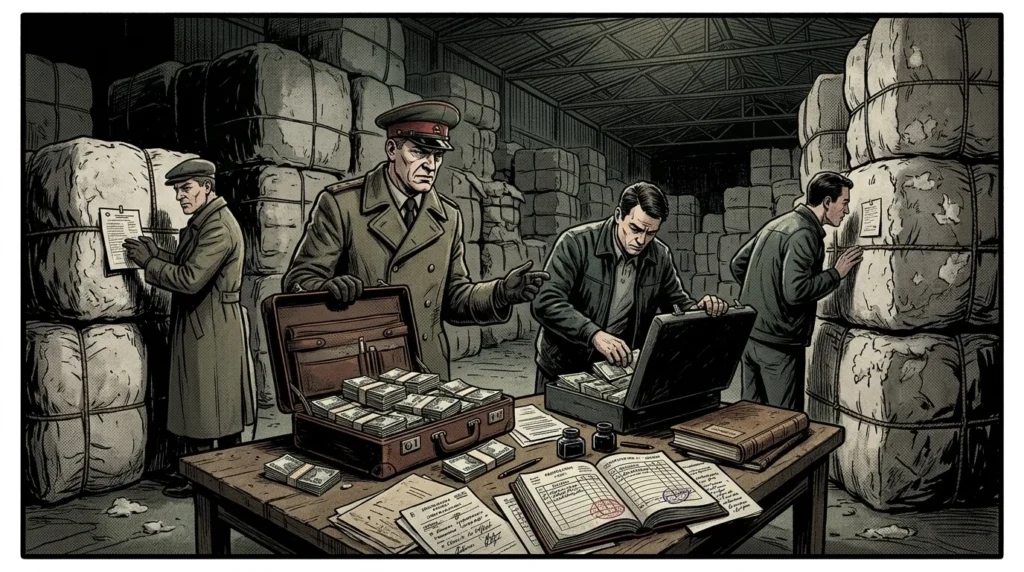
- Adulterated Bales and Mill Kickbacks: To conceal the missing tonnage downstream, ginning plants padded bales with dirt, stones, cotton stems, and moisture, while paying massive cash bribes to directors of state textile mills in the Russian SFSR, Ukraine, and Eastern Europe to sign off on phantom railcar shipments and write off the missing fiber as processing waste.
- Central Budget Transfers: Presenting these falsified procurement certificates to Moscow, Uzbek authorities collected full state payments from Gosbank. Between 1978 and 1983 alone, Uzbekistan billed the central Soviet budget for approximately 4.5 to 5 million metric tons of nonexistent cotton, siphoning between 3 billion and 4 billion rubles (roughly $4 billion to $5 billion at official Soviet exchange rates) in state funds.
Roughly half of the fraudulent proceeds remained in collective farm accounts to cover operating losses, wages, and local patronage, while an estimated 1.5 to 2 billion rubles was skimmed as cash by a pyramid of party secretaries, police chiefs, and enterprise bosses—who hoarded suitcases of 25- and 100-ruble notes, gold bullion, and Tsarist coins buried in garden courtyards, and carried trunks of cash to Moscow to bribe Central Committee supervisors and law-enforcement officials.
The Gdlyan–Ivanov Purge, the Churbanov Trial, and the Crisis of Empire (1983–1989)
After Yuri Andropov succeeded Brezhnev as General Secretary in November 1982, the KGB moved to dismantle Rashidov’s patronage machine. In early 1983, KGB officers in Bukhara arrested regional OBKhSS anti-fraud chief A. Muzaffarov caught accepting a bribe, which led investigators to Bukhara retail trade director Shody Kudratov, on whose property agents unearthed millions of rubles in buried cash, gold, and jewels. In April 1983, the USSR Prosecutor General’s Office established a special investigative commission headed by senior investigator Telman Gdlyan and his deputy Nikolai Ivanov, who eventually commanded a team of 200 prosecutors and KGB operatives across Central Asia.
Confronted by Andropov over satellite imagery and audit data proving the cotton harvest had been fabricated, Sharof Rashidov died suddenly on October 31, 1983, officially of a heart attack amid widespread rumors of suicide. Even after his successor, Inomjon Usmonxoʻjayev, pledged to clean up the republic, the Gdlyan–Ivanov investigation snowballed under Mikhail Gorbachev’s post-1985 glasnost and anti-corruption drive. In 1984, investigators arrested Ahmadjon Odilov, the notorious director general of the Pap Agro-Industrial Complex in the Fergana Valley, who had ruled tens of thousands of collective farmers like a feudal khan, maintaining his own private guards and underground punishment cells while hoarding millions in gold and currency. Former Cotton Cleaning Minister Vakhobjon Usmanov was convicted of systematic bribery and executed by firing squad in 1986.
Ultimately, the Gdlyan–Ivanov commission traced the bribery pyramid directly into the Kremlin and the USSR Ministry of Internal Affairs. In 1987–1988, investigators arrested former Uzbek First Secretary Usmonxoʻjayev, four regional party first secretaries, and, most sensationally, Colonel General Yuri Churbanov—First Deputy Minister of Internal Affairs of the USSR and the son-in-law of Leonid Brezhnev. Televised excerpts of Gdlyan and Ivanov displaying iron chests and glass jars overflowing with confiscated gold coins, diamond jewelry, and stacks of ruble notes stunned the Soviet public. Following a four-month trial before the Military Collegium of the USSR Supreme Court from September to December 1988, Churbanov was convicted on December 30, 1988 of accepting bribes during inspection tours of Uzbekistan and sentenced to twelve years in prison.
In total, the Uzbek Cotton Affair resulted in more than 4,000 criminal convictions and the dismissal of over 50,000 party, state, and economic cadres across Uzbekistan—even extending to the posthumous exhumation and removal of Sharof Rashidov’s remains from central Tashkent in 1986. Yet the crusade ultimately backfired politically. In May 1989, after Gdlyan and Ivanov went on television to accuse conservative Politburo member Yegor Ligachev and Supreme Court judges of taking Uzbek bribes, the newly elected USSR Congress of People’s Deputies convened a parliamentary commission that reprimanded the two investigators for coercing confessions through mass preventative arrests of suspects’ family members. Inside Uzbekistan, the sweeping purge of native cadres by Moscow prosecutors was widely resented as colonial humiliation, discrediting central Soviet authority and accelerating the republic’s path toward independence in 1991.
Theoretical & Balance-Sheet Transmission Mechanism
In the Kindleberger–Minsky taxonomy of financial instability (Kindleberger, 1978; Minsky, 1986) and Irving Fisher’s (1933) debt-deflation framework, speculative asset booms become systemic crises when credit expansion shifts balance sheets from hedge finance (cash flows covering principal and interest) to speculative and Ponzi finance (relying on rising asset prices and short-term margin roll-overs).
Once monetary tightening or an exogenous shock halts price appreciation, forced margin liquidations trigger Fisherian debt-deflation: fire-sale asset discounts erode bank collateral values, contracting credit supply across the real economy.
Sources and Further Reading
- Gregory Grossman, “ The Second Economy: Boon or Bane for the Reform of the First Economy?“, Palgrave Macmillan (in Economic Reforms in the Socialist World), 1989. Peer-Reviewed / Academic Research
- Mark Harrison, “ Forging Success: Soviet Managers and Accounting Fraud, 1943–1962“, Journal of Comparative Economics, 2011. Peer-Reviewed / Academic Research
- Luc Duhamel, “ The KGB Campaign against Corruption in Moscow, 1982–1987“, University of Pittsburgh Press, 2010. Peer-Reviewed / Academic Research
- William A. Clark, “ Crime and Punishment in Soviet Officialdom, 1965–90“, Europe-Asia Studies, 1993. Peer-Reviewed / Academic Research
- Gregory Grossman, “ Command Economy“, Palgrave Macmillan (in Problems of the Planned Economy), 1990. Peer-Reviewed / Academic Research
- Riccardo Mario Cucciolla, “ Aleksandr Minkin: A Pioneer of Investigative Journalism in Soviet Central Asia (1979–1991)“, Journalism, 2018. Peer-Reviewed / Academic Research
- Andreï Kozovoï, “ Luc Duhamel, The KGB Campaign against Corruption in Moscow, 1982–1987“, Cahiers du monde russe, 2010. Peer-Reviewed / Academic Research
- Irving Fisher — "The Debt-Deflation Theory of Great Depressions," Econometrica 1, no. 4 (FRASER Federal Reserve Archive, 1933): 337–357 Central Bank / Monetary Authority
- Charles P. Kindleberger & Robert Z. Aliber — Manias, Panics, and Crashes: A History of Financial Crises (Palgrave Macmillan) Peer-Reviewed / Academic Research
Cite This Historical Dossier (APA / Chicago)
APA (7th ed.): Ç., S. (Ed.). (2026). Pripiski and White Gold: The Okean Caviar Fraud and the Uzbek Cotton Scandal, 1978–1989. In Forgotten Fortunes Historical Monograph Series (Forgotten Fortunes Editorial Desk). https://forgottenfortunes.net/soviet-shadow-economy-okean-caviar-uzbek-cotton-scandal/
MLA (9th ed.): Ç., Soner, ed. "Pripiski and White Gold: The Okean Caviar Fraud and the Uzbek Cotton Scandal, 1978–1989." Forgotten Fortunes: Financial & Monetary History Archive, 2026, https://forgottenfortunes.net/soviet-shadow-economy-okean-caviar-uzbek-cotton-scandal/.
Chicago (17th ed.): Ç., Soner, ed. "Pripiski and White Gold: The Okean Caviar Fraud and the Uzbek Cotton Scandal, 1978–1989." Forgotten Fortunes Historical Monograph Series (Forgotten Fortunes Editorial Desk), September 5, 2026. https://forgottenfortunes.net/soviet-shadow-economy-okean-caviar-uzbek-cotton-scandal/.
Have an idea for another financial history documentary or article? Request a story →