In This Article
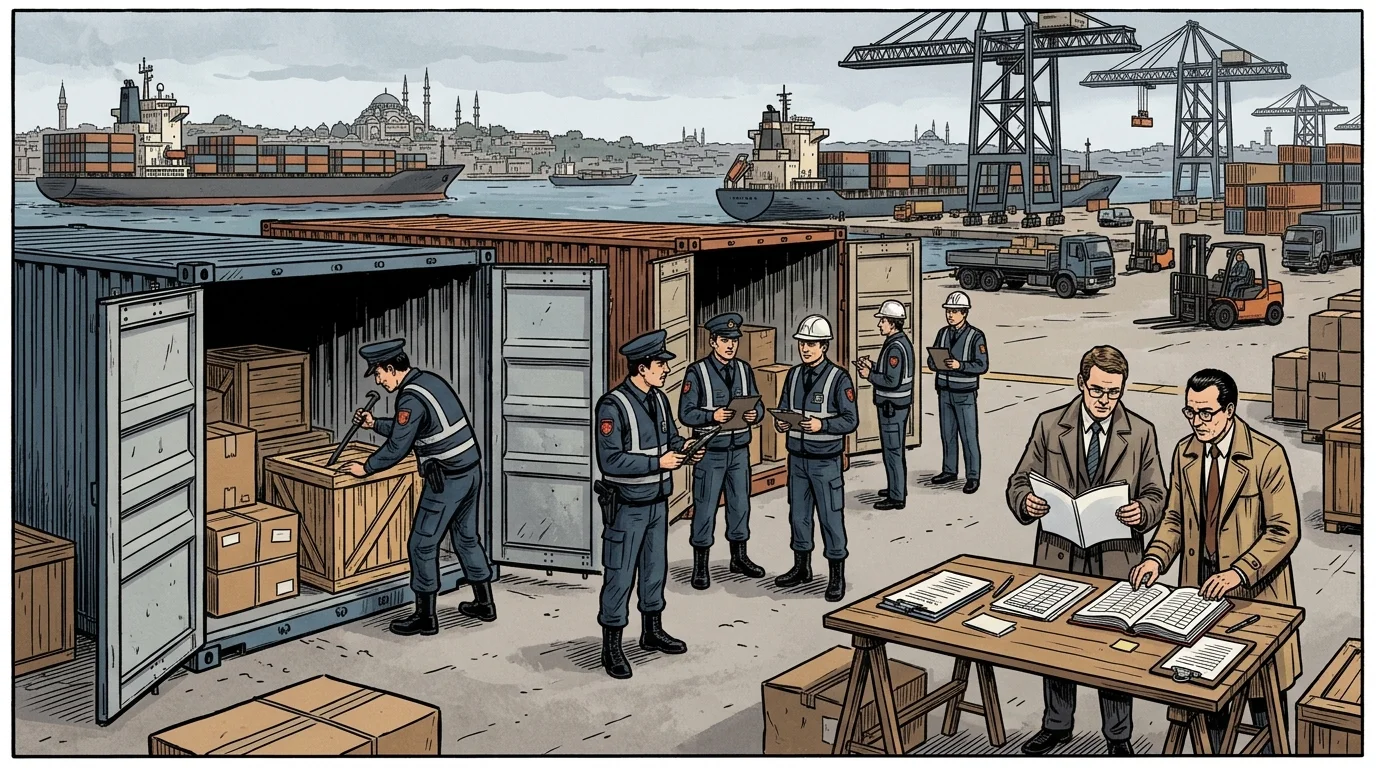
In the spring of 1975, customs records and tax-rebate ledgers in Ankara recorded an extraordinary surge in luxury Turkish woodworking exports. According to shipping manifests filed by corporations controlled by twenty-five-year-old entrepreneur Yahya Demirel—nephew of Prime Minister Süleyman Demirel—crate after crate of hand-carved walnut bedroom suites and artisanal wooden furniture had been dispatched from Turkish ports to buyers in Switzerland and transferred onward toward the Middle East. On the strength of those customs declarations and foreign currency receipts, the central bank and treasury paid out millions of Turkish liras in cash export tax rebates (vergi iadesi) calculated at rates reaching 75 percent of the declared invoice value. When investigative journalists Altan Öymen and Uğur Mumcu examined the shipping trail, however, they discovered that the Swiss importing firms did not exist and that the crates contained cheap, unworked particleboard (sunta) worth a fraction of the declared luxury furniture. [1]

Dubbed the “Furniture File” (Mobilya Dosyası), the 1975 Yahya Demirel affair introduced a permanent new term into the Turkish political and economic lexicon: hayali ihracat, or “fictitious export.” What began as a family scandal under Türkiye’s late import-substitution regime mutated after the January 24, 1980 market reforms into an industrialized macroeconomic fraud. Between 1984 and 1988, corporate trading houses inflated export invoices by billions of dollars to harvest state tax rebates and subsidized credits, culminating in businessman Kemal Horzum’s notorious 1984–1985 scheme that drained more than $80 million from state-owned Türkiye Emlak Kredi Bankası (Emlakbank) through phantom Swiss commodity and machinery letters of credit. [2]
Import Substitution, Foreign-Exchange Starvation, and the 1975 “Furniture File”
The financial mechanism that made hayali ihracat profitable originated in Türkiye’s chronic balance-of-payments bottlenecks during the 1960s and 1970s. Under the five-year development plans administered by the State Planning Organization, the Turkish lira was maintained at an artificially overvalued fixed exchange rate to subsidize capital-goods imports for domestic manufacturers. Because an overvalued lira penalized Turkish exporters in world markets, the government enacted Law No. 261 in 1963, authorizing the Council of Ministers to refund indirect production taxes—and effectively pay cash export premiums—to manufacturers who shipped industrial products abroad and repatriated hard currency. [3]
By the mid-1970s, after the first OPEC oil shock widened Türkiye’s current account deficit and depleted Central Bank hard-currency reserves, Ankara raised tax-rebate tiers on high-value-added manufactured goods—including finished wooden furniture—to as much as 75 percent of the free-on-board export price. Because the black-market premium on foreign currency was far smaller than a 75 percent state cash rebate, any trader who could obtain a stamped customs exit declaration and purchase foreign exchange on the parallel market in Zurich or Beirut to wire back to a Turkish bank as “export proceeds” could pocket a risk-free arbitrage profit from the Turkish Treasury. [4]
Between 1973 and 1975, Yahya Demirel’s companies exploited this exact loophole, shipping rough chipboard panels invoiced at exorbitant prices as finished furniture to shell entities in Switzerland. In 1976, investigative reporters Altan Öymen and Uğur Mumcu published their book-length exposé Mobilya Dosyası, documenting the forged customs manifests, phantom consignees, and state bank loans behind the shipments. Resulting parliamentary inquiries and martial-law court proceedings after the 1980 military coup ultimately led to Yahya Demirel’s conviction and stripped him of his citizenship while he was abroad, cementing the 1975 chipboard affair as the prototype of Turkish white-collar subsidy fraud. [5]
The January 24, 1980 Export Turn and the 1984–1988 Over-Invoicing Boom
Far from disappearing, fictitious exports expanded dramatically in the 1980s when Türkiye abandoned import substitution for an aggressive export-led growth strategy. Following the sovereign debt reschedulings of 1978–1980—which accounted for nearly 70 percent of all developing-country debt renegotiated worldwide during that period—Undersecretary (later Prime Minister) Turgut Özal launched the landmark January 24, 1980 stabilization and structural adjustment program with backing from the International Monetary Fund and the World Bank. To transform conglomerates into global exporters, the government paired continuous real depreciation of the lira with a generous battery of fiscal and financial subsidies. [6]
Under the Foreign Trade Capital Companies (Dış Ticaret Sermaye Şirketleri) framework introduced in the early 1980s, large trading houses that exceeded annual export thresholds received direct cash tax rebates of up to 20 to 30 percent (including supplemental volume bonuses), duty-free raw material import licenses, foreign-exchange retention rights, and preferential Central Bank rediscount credits at interest rates far below Türkiye’s 40 to 50 percent inflation rate. When all direct rebates, tax exemptions, and credit subsidies were combined, total state support frequently reached 30 to 50 percent of declared export value. [7]
The result was both a genuine industrial export surge and a massive statistical mirage. Economists Merih Celâsun, Dani Rodrik, İsmail Arslan, and Sweder van Wijnbergen demonstrated in National Bureau of Economic Research and World Bank studies that when Turkish export statistics to partner countries in the Organisation for Economic Co-operation and Development (OECD) were compared against the partner countries’ own customs import records, a yawning discrepancy emerged after 1980. Prior to 1980, Turkish traders had systematically under-invoiced exports to leave clandestine capital abroad; by 1984, Turkish exporters were over-invoicing shipments to OECD markets by an average of 20 to 28 percent—representing well over $1 billion per year in phantom trade value created solely to claim state tax rebates. [8]
In the most brazen cases during 1984–1987, syndicate operators bypassed over-invoicing real textiles or steel and reverted to pure paper fabrication: shipping containers filled with scrap iron, cobble stones, or low-grade plastic parts invoiced as precision electronics and industrial machinery, or bribing customs officers at border crossings to stamp blank export declarations (gümrük çıkış beyannamesi) for trucks that never crossed the frontier.
Kemal Horzum and the $80 Million Emlak Bankası Scandal
The nexus of fictitious export rebates, Swiss shell companies, and lax state banking supervision reached its climax in the “Horzum Event” (Horzum Olayı) of 1984–1987. Born in Denizli, businessman Kemal Horzum built a sprawling network of more than twenty domestic trading and industrial firms—headed by Hortaş and Okemeks—alongside affiliated entities in Geneva and Zurich. Operating at the height of the mid-1980s export drive, Horzum combined over-invoiced export rebate claims with massive foreign-currency credit extraction from state-owned Türkiye Emlak Kredi Bankası (later renamed Türkiye Emlak Bankası, or Emlakbank), historically a mortgage and housing development lender that had hurriedly expanded into commercial trade finance.
Working through Emlakbank’s Kızılay branch in Ankara and international correspondent accounts in Switzerland during 1984 and early 1985, Horzum’s companies obtained tens of millions of U.S. dollars and Swiss francs in export-promotion loans and import letters of credit without adequate collateral or board authorization. In a circular financing loop, funds disbursed by Emlakbank to finance supposed machinery imports or export operations were routed to Swiss companies secretly controlled by Horzum himself, while fabricated export receipts were used to collect additional state tax rebates and roll over existing credit lines.
When central bank auditors and Emlakbank inspectors uncovered the uncollateralized foreign-exchange hole in January 1985—ultimately calculated in parliamentary and judicial records at more than $80 million (roughly 60 to 80 billion Turkish liras at mid-1980s exchange rates)—Kemal Horzum fled Türkiye on January 29, 1985. The scandal shook the Özal government, triggered a parliamentary inquiry in the Grand National Assembly of Türkiye (TBMM) examining political and bureaucratic protection around state banks, and led to Horzum’s arrest by Swiss authorities and extradition to Türkiye in 1988. Subsequent banking crises, including the later collapse of İmar Bankası and the state bank restructurings of 2001, echoed the exact governance failures exposed at Emlakbank in 1985.
Abolition of Cash Export Rebates and the Shift to Eximbank
By 1987 and 1988, the fiscal cost of hayali ihracat scandals and mounting international pressure under the General Agreement on Tariffs and Trade (GATT) Subsidies Code forced Ankara to dismantle the cash rebate apparatus. After temporarily cutting rebate rates and exposing hundreds of fraudulent exporting firms in central bank inspections, the Turkish government formally notified GATT on January 31, 1989 (Document L/6450/Add.2) that the direct export tax-rebate system had been completely abolished at the end of 1988. In its place, Türkiye shifted export support toward audited pre-shipment credit and export insurance programs administered by the newly founded Türk Eximbank, closing the chapter on one of modern financial history’s most notorious experiments in unmonitored export subsidies.
Theoretical & Balance-Sheet Transmission Mechanism
In the Kindleberger–Minsky taxonomy of financial instability (Kindleberger, 1978; Minsky, 1986) and Irving Fisher’s (1933) debt-deflation framework, speculative asset booms become systemic crises when credit expansion shifts balance sheets from hedge finance (cash flows covering principal and interest) to speculative and Ponzi finance (relying on rising asset prices and short-term margin roll-overs).
Once monetary tightening or an exogenous shock halts price appreciation, forced margin liquidations trigger Fisherian debt-deflation: fire-sale asset discounts erode bank collateral values, contracting credit supply across the real economy.
Sources and Further Reading
- Merih Celâsun and Dani Rodrik, “Turkish Experience with Debt: Macroeconomic Policy and Performance,” National Bureau of Economic Research / University of Chicago Press, 1989. Peer-Reviewed / Academic Research
- İsmail Arslan and Sweder van Wijnbergen, “Turkey: Export Miracle or Accounting Trick?,” World Bank Policy, Research, and External Affairs Working Paper, 1990. International Financial Institution
- General Agreement on Tariffs and Trade (GATT), “Subsidies: Notifications Pursuant to Article XVI:1 — Turkey (L/6450/Add.2),” GATT Secretariat, 1989-02-13. International Financial Institution
- Grand National Assembly of Türkiye (TBMM), “TBMM Tutanak Dergisi, Dönem 18, Cilt 34, Birleşim 34 (Kemal Horzum ve Emlak Bankası Soruşturması),” TBMM, 1989. Official / State Archive
- NTV, “Hayali İhracatın Mucidi Oldu: Yahya Demirel ve Mobilya Dosyası,” NTV Türkiye, 2012-11-08. Historical & Financial Reference
- Uğur Dündar, “İyi ki Varsınız (Mobilya Dosyası ve Kemal Horzum Soruşturmaları),” Hürriyet, 2009-12-27. Historical & Financial Reference
- Irving Fisher — "The Debt-Deflation Theory of Great Depressions," Econometrica 1, no. 4 (FRASER Federal Reserve Archive, 1933): 337–357 Central Bank / Monetary Authority
- Charles P. Kindleberger & Robert Z. Aliber — Manias, Panics, and Crashes: A History of Financial Crises (Palgrave Macmillan) Peer-Reviewed / Academic Research
Cite This Historical Dossier (APA / Chicago)
APA (7th ed.): Ç., S. (Ed.). (2026). Hayali İhracat: Yahya Demirel's Furniture Rebate Fraud and the $80M Kemal Horzum Scandal. In Forgotten Fortunes Historical Monograph Series (Forgotten Fortunes Editorial Desk). https://forgottenfortunes.net/hayali-ihracat-export-rebate-fraud/
MLA (9th ed.): Ç., Soner, ed. "Hayali İhracat: Yahya Demirel's Furniture Rebate Fraud and the $80M Kemal Horzum Scandal." Forgotten Fortunes: Financial & Monetary History Archive, 2026, https://forgottenfortunes.net/hayali-ihracat-export-rebate-fraud/.
Chicago (17th ed.): Ç., Soner, ed. "Hayali İhracat: Yahya Demirel's Furniture Rebate Fraud and the $80M Kemal Horzum Scandal." Forgotten Fortunes Historical Monograph Series (Forgotten Fortunes Editorial Desk), September 20, 2026. https://forgottenfortunes.net/hayali-ihracat-export-rebate-fraud/.
Have an idea for another financial history documentary or article? Request a story →