In This Article
Between the outbreak of the First World War in 1914 and the launch of Joseph Stalin’s First Five-Year Plan in 1928, industrial finance in Russia underwent three radical transformations that redefined the relationship between sovereign power, private capital, and international markets. During the final years of the Romanov Empire, rampant contract cost overruns, munition shortages, and War Industries Committee (Voenno-promyshlennye komitety, or VPK) advances culminated in the February 1916 state sequestration of Petrograd’s giant Putilov Works. After the October 1917 Bolshevik Revolution and the Allied “Gold Blockade” of 1919–1921 cut Soviet Russia off from Western banking channels, trade envoy Leonid Krasin and the State Repository of Valuables (Gokhran) shipped hundreds of tonnes of confiscated Tsarist and Romanian gold to Stockholm, where Swedish financier Olof Aschberg’s Nya Banken (restructured as Svenska Ekonomiebolaget) melted and re-stamped the bullion with Swedish mint marks to re-enter European commerce. When Vladimir Lenin introduced the New Economic Policy (NEP) in 1921, Moscow combined profit-accounting state trusts (khozraschyot) with foreign corporate concessions for American entrepreneurs Armand Hammer and W. Averell Harriman—an experiment abruptly liquidated in the spring of 1928 alongside the landmark Shakhty engineers’ show trial. [1]
The 1915 Munitions Crisis, VPK Advances, and the 1916 Putilov Sequestration
When Imperial Russia entered the First World War in August 1914, its heavy industrial base was dominated by syndicate-controlled metallurgical and engineering conglomerates in St. Petersburg (renamed Petrograd) and the southern Donbas basin, financed largely by Franco-Russian commercial banks led by the Russo-Asiatic Bank. None was more strategically vital than the Putilov Company (Obshchestvo Putilovskikh Zavodov). Headed by financier Alexei Putilov and employing more than 30,000 workers in Petrograd by 1916, the Putilov Works was the empire’s premier manufacturer of field artillery, shrapnel shells, naval turrets, and railway locomotives. [2]
During the “Great Retreat” and acute shell shortage of 1915, Russian industrialists led by Alexander Guchkov and Pavel Ryabushinsky established the Central and regional War Industries Committees (VPK) to channel state treasury advances to private factories and mobilize medium-scale industry for the front. At the same time, the Tsarist Main Artillery Administration poured tens of millions of rubles in interest-free and low-interest state advances into the Putilov Works to expand artillery and munitions capacity. Instead of stabilizing production, the influx of state credit collided with severe fuel and raw-material bottlenecks, speculative cost overruns, and bitter disputes between Putilov’s private banking syndicate and military procurement officers led by General Alexei Manikovsky. [3]
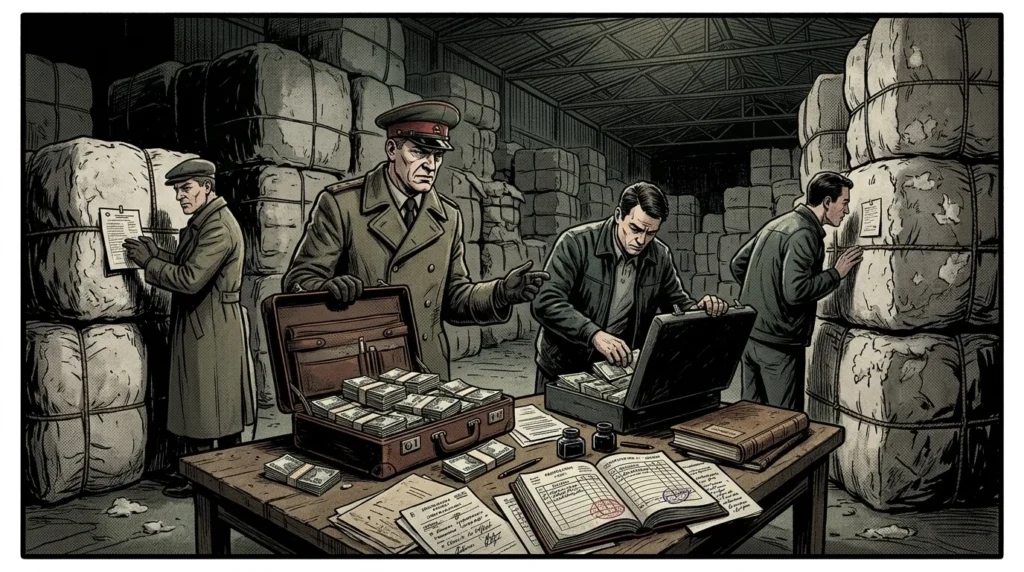
Accusing Putilov’s board of using state treasury advances to cover pre-war commercial debts and extract wartime profiteering margins while falling behind on artillery deliveries—and alarmed by militant strikes among Putilov metalworkers over inflation and food shortages—the Tsarist government invoked emergency wartime powers in late February 1916 to place the Putilov Works under state sequestration. The private board was dismissed and replaced by a military-appointed administration under the Main Artillery Administration. Far from quelling unrest, state management at Putilov presided over deepening financial deficits and labor radicalization: in February 1917, a lockout and mass walkout by Putilov’s 30,000+ workers ignited the street demonstrations in Petrograd that toppled Tsar Nicholas II. [4]
The Allied Gold Blockade and Olof Aschberg’s Stockholm Bullion Pipeline
Following the October 1917 Bolshevik seizure of power and the February 1918 repudiation of Imperial Russia’s sovereign and corporate foreign debts, the Soviet government nationalized all commercial banks and large-scale factories. To finance the Red Army during the Russian Civil War and purchase desperately needed foreign locomotives, coal, and industrial machinery, the Council of People’s Commissars established Gokhran (the State Repository for Valuables) in February 1920 to centralize the remaining Imperial gold reserve, confiscated private bank vaults, aristocratic jewelry, and Russian Orthodox Church treasures—alongside the 93.4-tonne Romanian National Bank gold reserve that Bucharest had shipped to the Moscow Kremlin for safekeeping during the First World War. [5]
Converting that bullion into Western industrial imports proved extraordinarily difficult because Britain, France, and the United States enforced a strict “Gold Blockade” between 1919 and early 1921, refusing to accept gold coins or bars bearing Russian Imperial hallmarks on the grounds that they represented stolen property owed to Western bondholders and expropriated corporate claimants. To pierce the embargo, Bolshevik Commissar of Foreign Trade Leonid Krasin and Maxim Litvinov turned to neutral Sweden and to Olof Aschberg (1877–1960), the left-leaning Stockholm financier known across Europe as “the Red Banker.” [6]
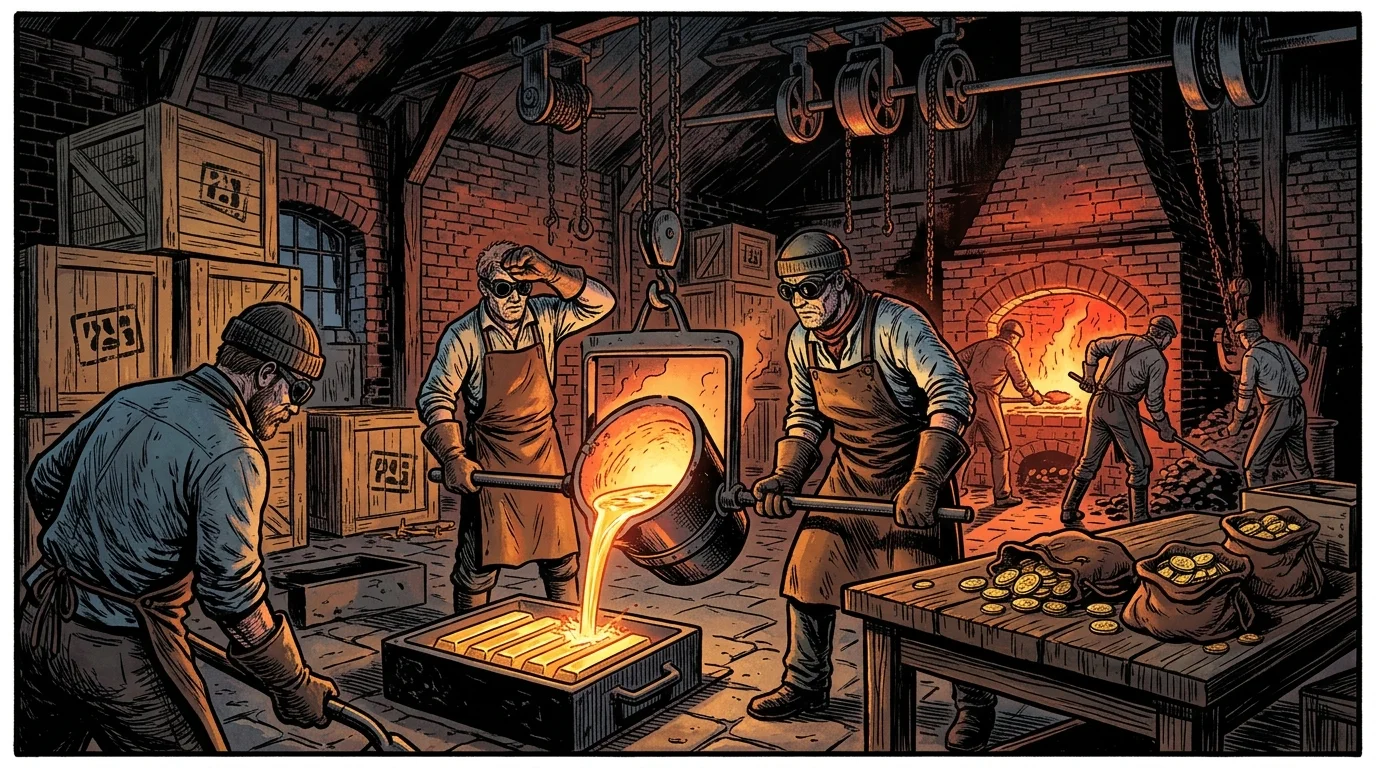
In 1912, Aschberg had founded Nya Banken (The New Bank) in Stockholm to finance trade unions, workers’ housing, and cooperative enterprises. After Allied authorities blacklisted Nya Banken in 1918 over wartime financial transactions with Germany, Aschberg reorganized the institution under the name Svenska Ekonomiebolaget. Operating between Stockholm, Tallinn (Reval), Berlin, and Moscow in 1920–1921, Aschberg and Krasin engineered the “Bolshevik gold” laundering operation: hundreds of tonnes of Tsarist gold rubles and foreign gold coins were shipped by rail and sea through Estonia to Stockholm, where they were melted down at the Royal Swedish Mint and partner refineries, re-cast into ingots bearing clean Swedish assay marks, and sold or pledged to European and American financial institutions in exchange for Swedish Nydqvist & Holm (NOHAB) railway locomotives, agricultural tools, and hard currency. In recognition of his role in breaking the financial blockade, the Soviet government appointed Aschberg in 1922 to head Ruskombank (the Russian Commercial Bank), the first foreign-trade commercial bank of the NEP era. [7]
NEP Mixed Trusts, Khozraschyot, and the Hammer & Harriman Concessions
With the Civil War won but Soviet industrial output at less than one-fifth of its 1913 level, Lenin unveiled the New Economic Policy (NEP) in March 1921. While the Soviet state retained the “commanding heights” of heavy industry, banking, and foreign trade, nationalized factories were reorganized into autonomous state trusts required to operate under khozraschyot (commercial cost accounting)—covering their own operating expenses, borrowing at interest from the reconstituted State Bank (Gosbank), and competing in domestic wholesale markets. Simultaneously, the Soviet Council of People’s Commissars authorized foreign corporate concessions to import Western capital and engineering expertise. [8]
The first American entrepreneur to sign a Soviet concession was Armand Hammer, a young physician and businessman whose father, Julius Hammer, was a founding figure in the American communist movement. After meeting Lenin in the Kremlin in October–November 1921—documented in Lenin’s personal letter of November 3, 1921 praising Hammer’s arrangement to ship one million bushels of American wheat to the famine-stricken Urals in exchange for Soviet furs, caviar, and confiscated gemstones—Hammer received an asbestos mining concession at Alapayevsk in the Urals, served as the exclusive Soviet agency (Allied American Corporation) for Fordson tractors and thirty-seven U.S. manufacturers, and later operated a highly profitable Moscow pencil factory before selling his holdings back to the state at the end of the decade. [9]
Far larger—and ultimately disastrous—was the concession signed on June 12, 1925 in Moscow between Felix Dzerzhinsky, Chairman of the Supreme Council of the National Economy (VSNKh), and John Speed Elliott, vice president of W. Averell Harriman’s New York investment house W.A. Harriman & Co. Inc. Forming the Georgian Manganese Company Ltd. (with 25 percent German steel participation), Harriman acquired a 20-year monopoly through July 25, 1945 to mine and export the rich Chiatura (Tchiatouri) manganese deposits in Soviet Georgia, pledging to invest millions of dollars in modernizing the mines, rebuilding the narrow-gauge railway to Sharopan, and constructing a 600-ton-per-hour mechanical ore loader at the Black Sea port of Poti while paying Moscow an estimated $62,350,000 in minimum royalties over twenty years. Almost immediately, however, the Soviet government and the German firm Rawack & Grünfeld ramped up competing manganese output at the state-backed Nikopol mines in Ukraine, boosting the USSR’s share of world manganese production from 23 percent in 1924 to 32 percent in 1925 and depressing global ore prices while Soviet trade unions imposed costly labor demands at Chiatura.
The 1928 Shakhty Engineers’ Trial and the Liquidation of NEP
Facing losses estimated at $2.50 per ton and unable to compete with state-subsidized Nikopol ore despite a July 1927 contract revision, Harriman pulled his American staff out of Chiatura on April 17, 1928. In the ensuing liquidation agreement, the Soviet government took over the Chiatura mines and compensated Harriman with $3,450,000 in 15-year Soviet state bonds bearing 7 percent interest, which Moscow redeemed on schedule through 1943.
Harriman’s exit coincided to the month with Stalin’s decisive assault on the NEP corporate order and its “bourgeois specialists” (spetsy)—the pre-revolutionary engineers and managers who ran Soviet trusts under khozraschyot. In March 1928, the OGPU secret police announced the discovery of a vast counter-revolutionary “wrecking” conspiracy in the Shakhty coal-mining district of the North Caucasus Donbas. From May 18 to July 5, 1928, fifty-three mining engineers and technicians (including three German engineers employed by AEG) were put on public show trial in the Hall of Columns at Moscow’s House of Trade Unions before presiding judge Andrei Vyshinsky and state prosecutor Nikolai Krylenko, accused of taking bribes from exiled former Tsarist mine owners in Paris and Warsaw to flood mines, waste capital, and sabotage coal output. Forty-nine defendants were convicted and five were executed—marking the end of foreign concessions, autonomous commercial trusts, and managerial independence as the Soviet economy plunged into the command mobilization of the First Five-Year Plan.
Theoretical & Balance-Sheet Transmission Mechanism
In the Kindleberger–Minsky taxonomy of financial instability (Kindleberger, 1978; Minsky, 1986) and Irving Fisher’s (1933) debt-deflation framework, speculative asset booms become systemic crises when credit expansion shifts balance sheets from hedge finance (cash flows covering principal and interest) to speculative and Ponzi finance (relying on rising asset prices and short-term margin roll-overs).
Once monetary tightening or an exogenous shock halts price appreciation, forced margin liquidations trigger Fisherian debt-deflation: fire-sale asset discounts erode bank collateral values, contracting credit supply across the real economy.
Sources and Further Reading
- John Rose, “Workers’ democracy in revolutionary Petrograd,” International Socialist Review, Issue 106, 2017. Peer-Reviewed / Academic Research
- Carl Marklund, “The Icons of ‘the Red Banker’: Olof Aschberg and the Transactions of Social Capital,” Baltic Worlds 1 (Södertörn University), 2018-06-18. Historical & Financial Reference
- Carl Marklund and Andreas Mørkved Hellenes, “The Diplomat and the Entrepreneur: Olof Aschberg – Converter of Capital, Trader in Trust,” Scandinavian Journal of History (Chalmers University), 2023. Peer-Reviewed / Academic Research
- Vladimir I. Lenin, “Letter to Armand Hammer (November 3, 1921),” Lenin Collected Works, Vol. 45, Progress Publishers (Marxists Internet Archive), 1976. Historical & Financial Reference
- Stephen D. Fitch, “The Harriman Manganese Concession in the Soviet Union: Lessons for Today,” International Tax & Business Lawyer (Berkeley Law) 9, no. 2, 1991. Peer-Reviewed / Academic Research
- Otar Janelidze, “The Soviet Experiment of New Economic Policy (NEP) and Georgia (1921–1928),” History, Archaeology, Ethnology (Gori State University), 2021. Historical & Financial Reference
- Encyclopedia of Russian History, “Shakhty Trial,” Encyclopedia.com, 2004. Historical & Financial Reference
- Irving Fisher — "The Debt-Deflation Theory of Great Depressions," Econometrica 1, no. 4 (FRASER Federal Reserve Archive, 1933): 337–357 Central Bank / Monetary Authority
- Charles P. Kindleberger & Robert Z. Aliber — Manias, Panics, and Crashes: A History of Financial Crises (Palgrave Macmillan) Peer-Reviewed / Academic Research
Cite This Historical Dossier (APA / Chicago)
APA (7th ed.): Ç., S. (Ed.). (2026). From the 1916 Putilov Sequestration and Bolshevik Gold to NEP and the Shakhty Trial. In Forgotten Fortunes Historical Monograph Series (Forgotten Fortunes Editorial Desk). https://forgottenfortunes.net/bolshevik-gold-putilov-shakhty/
MLA (9th ed.): Ç., Soner, ed. "From the 1916 Putilov Sequestration and Bolshevik Gold to NEP and the Shakhty Trial." Forgotten Fortunes: Financial & Monetary History Archive, 2026, https://forgottenfortunes.net/bolshevik-gold-putilov-shakhty/.
Chicago (17th ed.): Ç., Soner, ed. "From the 1916 Putilov Sequestration and Bolshevik Gold to NEP and the Shakhty Trial." Forgotten Fortunes Historical Monograph Series (Forgotten Fortunes Editorial Desk), September 19, 2026. https://forgottenfortunes.net/bolshevik-gold-putilov-shakhty/.
Have an idea for another financial history documentary or article? Request a story →