In This Article
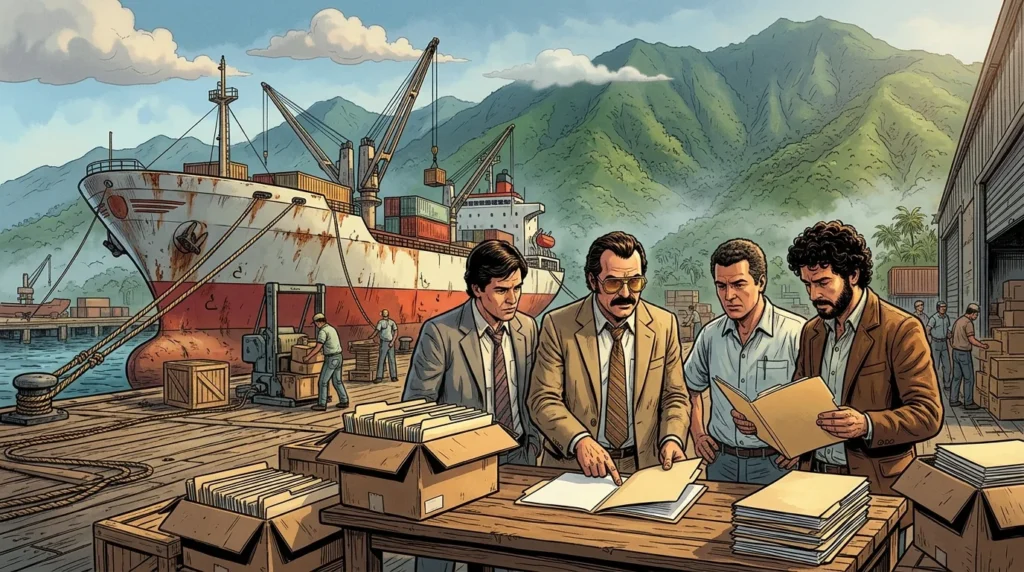
Between the late 1970s and the end of the 1980s, the Greek corporate and financial system underwent a structural crisis that reshaped the boundaries between state-controlled banking, private industrial ownership, and European Community law. For three decades after the Second World War, Greece’s industrial expansion—led by textile mills, cement producers, paper manufacturers, and mining conglomerates—had been financed not through deep equity or bond markets, but through politically directed credit from state-controlled commercial banks, led by the National Bank of Greece. When the 1979 oil shock, rising nominal interest rates, and Greece’s January 1981 accession to the European Economic Community (EEC) eliminated protective tariff walls, dozens of over-leveraged industrial groups collapsed into technical insolvency. Rather than allow mass bankruptcies, Prime Minister Andreas Papandreou’s Panhellenic Socialist Movement (PASOK) government enacted Law 1386/1983 on August 5, 1983, creating the Business Reconstruction Organization (Organismos Anasygkrotiseos Epicheiriseon, or OAE) to take control of financially distressed businesses. A core group of 44 large “problematic enterprises” (provlimatikes epicheiriseis) came under this program over the following years. What began as an industrial rescue experiment triggered landmark litigation before the European Court of Justice over compulsory shareholder dilution and ended amid the twin financial convulsions of 1988–1989: George Koskotas’s 30-billion-drachma embezzlement at the Bank of Crete and the Yugoslav maize tariff-evasion trial. [1]
Politically Directed Credit and the Post-1979 Industrial Insolvency Crisis
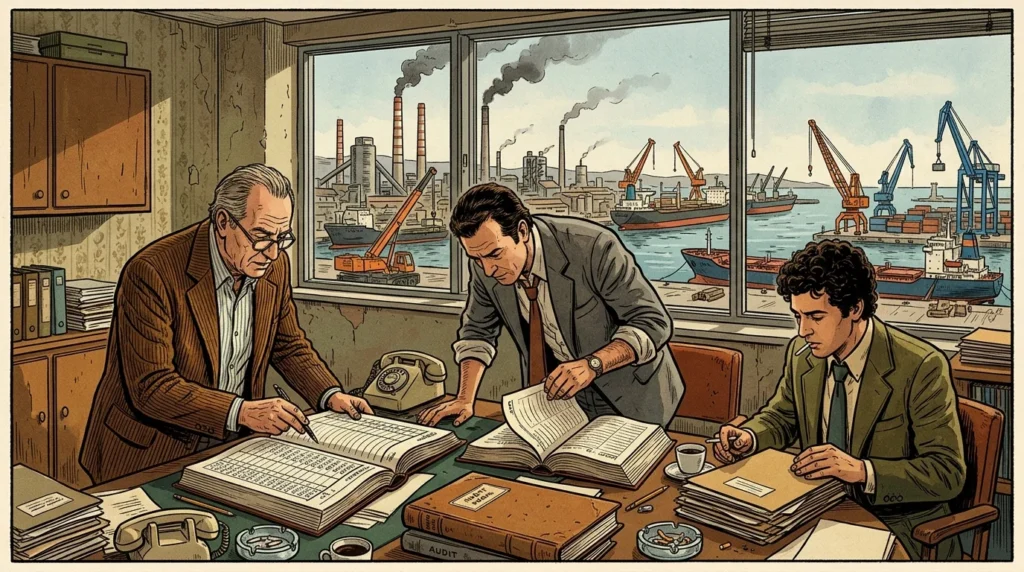
The roots of the problematic enterprises crisis lay in the postwar architecture of Greek finance. Because domestic capital markets and non-bank institutional investors remained underdeveloped, Greek commercial banks served as the primary conduit for industrial funding, accounting for more than 70 percent of deposit and loan activity through state-controlled institutions led by the National Bank of Greece, the Commercial Bank of Greece, and the Ionian Bank. Under a dense web of Bank of Greece credit quotas, compulsory reserve blockings, and differentiated interest rates, commercial banks were required to channel low-interest loans to priority manufacturing sectors while absorbing more than 40 percent of their deposits into compulsory treasury bills and central bank reserves. [2]
Within this regulated environment, objective credit analysis was frequently displaced by political patronage and personal relationships between bank boards and family-owned industrial groups. Even after corporate profitability began deteriorating after 1977, state-controlled banks continued extending new working-capital loans to cover operating deficits and debt service. Between 1979 and 1986, roughly 40 percent of Greek manufacturing firms reported net losses, and from 1982 onward the Greek manufacturing sector as a whole recorded negative aggregate net income. By 1986, across more than 3,000 manufacturing enterprises holding 2,428.2 billion drachmas (GRD) in total assets, total corporate liabilities had reached 2,069.8 billion GRD—including 1,300 billion GRD in bank loans that exceeded the entire Greek banking system’s book equity base of roughly 87.2 billion GRD. [3]
The distress was heavily concentrated in Greece’s largest flagship conglomerates. Traditional industrial champions—such as the textile giant Piraiki-Patraiki, the bauxite and magnesite mining conglomerate FIMISCO/Skalistiris Group, paper manufacturers Athenaiki Paper (maker of Softex), MEL, and Thessaliki Paper, munitions and metal manufacturer Pyrkal, electrical appliance producer Elinda, and textile spinner Klostiria Velka—saw their equity wiped out by foreign-exchange losses, surging wage costs, and import competition following EEC entry. Had the distressed industrial groups been allowed to enter liquidation simultaneously, World Bank economists estimated that Greece’s paper industry would have lost 60 percent of its productive capacity and 75 percent of its exports, while the cement sector would have lost between 40 and 45 percent of its capacity. [4]
| Documented Figure / Metric | Historical Significance & Archival Context |
|---|---|
| 29 percent | In 1983, the National Bank of Greece held 29 percent of Heracles's shares, while the founding Tsatsos family held or controlled 25 percent and managed the group. |
| US$200 million | When Bank of Greece auditors forced an inspection in late 1988, they uncovered a shortfall exceeding 30 billion GRD (more than US$200 million). |
Law 1386/1983 and the OAE Takeover of 44 Problematic Enterprises
To prevent a chain reaction of industrial closures and mass unemployment, the PASOK government enacted Law 1386/1983 on August 5, 1983 (Official Gazette A’ 107). The statute established the Business Reconstruction Organization (OAE), a public limited liability corporation operating under state supervision with an initial share capital of 2 billion GRD—rapidly raised by ministerial decree to 5 billion GRD—and backed by state-guaranteed borrowing authority. Under Article 5 of Law 1386/1983, the Minister for the National Economy could place an enterprise under OAE control upon the application of creditors, state banks, the Manpower Employment Organization, or the company itself if the firm had suspended payments, accumulated debts exceeding five times its paid-up capital and visible reserves, or was deemed vital to national defense or social employment. [5]
Once a company was officially designated as “problematic,” Law 1386/1983 triggered immediate statutory consequences. The existing board of directors was dismissed and replaced by OAE-appointed administrators; principal and interest payments on pre-existing debts were frozen for a 36-month grace period; and OAE evaluated whether the enterprise was economically viable. Between 1983 and 1987, the Ministry vetted more than 250 corporate applications and brought a core portfolio of 44 major manufacturing enterprises (later expanded to 45–46 interventions) under the OAE regime. Although those 44 companies represented just 1.3 percent of Greek manufacturing firms by number, they accounted for 11.5 percent of the nation’s fixed industrial assets, 16.9 percent of total manufacturing liabilities, and roughly 33,000 workers in 1981 (28,000 by 1986). [6]
The OAE divided the 44 problematic enterprises into 23 “viable” firms slated for debt-to-equity capitalization and 21 “non-viable” firms slated for auction or liquidation. Even after initial restructurings, the financial drain on state-controlled banks was immense. By 1986, the 44 problematic firms carried 349.6 billion GRD in total liabilities against 219.1 billion GRD in assets, leaving a negative net worth of roughly 130.5 billion GRD. At the National Bank of Greece alone, equity holdings in 20 problematic companies—led by Piraiki-Patraiki (which recorded 22.0 billion GRD in cumulative losses between 1981 and 1987), the Skalistiris mining group (17.4 billion GRD in losses), Athenaiki Paper (15.4 billion GRD in losses), Thessaliki Paper (9.3 billion GRD in losses), and MEL (8.0 billion GRD in losses)—amounted to 65.9 billion GRD in 1987, equivalent to 156.8 percent of the bank’s entire equity capital. [7]
The Heracles General Cement Takeover and the ECJ Karella Rulings
The most contentious mechanism of Law 1386/1983 was its power to execute compulsory debt-to-equity conversions by administrative decree, bypassing the general meeting of shareholders. Nowhere was this clash sharper than at Heracles General Cement S.A. (AGET Iraklis). Founded in 1911, Heracles was Greece’s largest cement producer and Europe’s largest cement exporter, controlling 33 subsidiary and affiliated companies. In 1983, the National Bank of Greece held 29 percent of Heracles’s shares, while the founding Tsatsos family held or controlled 25 percent and managed the group. In September 1983, after the Minister of National Economy went on television to accuse the management of foreign-exchange and corporate fraud—charges that an Athens appeals court eventually dismissed in July 1993 for lack of evidence—the National Bank refused to honor Heracles’s cheques, forcing the private board members to resign on September 13, 1983. [8]
Under state-appointed directors between 1983 and 1985, Heracles swung from profitability into cumulative losses of 7,249 million GRD while its debt climbed from 24 billion GRD to 44 billion GRD. On August 7, 1986, the Deputy Minister for Industry, Energy and Technology issued Ministerial Order No. 203/1986 placing Heracles under Law 1386/1983 and ordering the compulsory capitalization of 27,755 million GRD of its debts into new share capital. Because 68.01 percent of the new shares were issued directly to the OAE and the remainder to state-controlled creditors, Heracles’s share capital expanded elevenfold and private shareholders saw their combined ownership diluted to less than 10 percent before the state eventually sold the company to the Italian group Calcestruzzi in March 1992.
Both the European Commission and minority shareholders challenged the OAE model under Community law. In October 1986, the European Commission opened state-aid infringement proceedings under Article 93(2) of the EEC Treaty against Law 1386/1983. In Commission Decision 88/167/EEC of October 7, 1987, Commissioner Peter Sutherland conditionally permitted OAE’s operations as a remedy for a serious disturbance in the Greek economy alongside an October 1985 austerity loan of 1,750 million ECU, but explicitly ordered Athens to amend Law 1386/1983 by December 31, 1987 to stop infringing the Second Company Law Directive (77/91/EEC). Meanwhile, Marina Karella and Nicolas Karellas, minority shareholders in the textile firm Klostiria Velka AE—placed under OAE administration in December 1983 and subjected to an administrative capital increase of 400 million GRD—sued before the Greek Council of State. On May 30, 1991, in Joined Cases C-19/90 and C-20/90 (Karella and Karellas), the European Court of Justice issued a landmark ruling holding that Article 25(1) of Directive 77/91/EEC had direct effect and strictly prohibited national governments from increasing a public company’s share capital by administrative act without a vote of the general meeting of shareholders.
The 1988–1989 Koskotas Bank of Crete and Yugoslav Maize Scandals
By 1988, the opaque nexus between state enterprises, public deposits, and politically connected financiers erupted into two scandals that brought down the Papandreou government. The first centered on George Koskotas, a former employee at the privately owned Bank of Crete who had quietly used forged internal accounts to purchase control of the bank in 1984–1985 and build the Grammi media empire and acquire the Olympiacos football club. Koskotas fueled his expansion by persuading state-owned corporations and public utilities to deposit vast reserves at the Bank of Crete. When Bank of Greece auditors forced an inspection in late 1988, they uncovered a shortfall exceeding 30 billion GRD (more than US$200 million). Indicted for massive embezzlement and forgery, Koskotas fled Greece in November 1988 to Brazil and then to the United States, where FBI agents arrested him in Massachusetts.
From a U.S. prison before his 1991 extradition, Koskotas alleged that he had siphoned billions of drachmas from the Bank of Crete to pay kickbacks to PASOK officials via cash-stuffed briefcases and interest skimming on state enterprise deposits. At the exact same moment, the European Court of Justice was adjudicating the “Yugoslav maize” fraud in Case 68/88 (Commission v. Hellenic Republic). In May 1986, the state-controlled trading enterprise ITCO had loaded roughly 9,000 tonnes of cheap Yugoslav corn onto the cargo ship Alfonsina at the Yugoslav port of Koper (part of roughly 20,000 tonnes of smuggled grain) and used falsified Greek customs certificates to export the cargo to Belgium as duty-free Greek produce, evading EEC Common Agricultural Policy import levies.
Special Court Trials, Accountability, and Institutional Legacy
The twin scandals dominated the June 1989 parliamentary elections, in which PASOK lost its majority and a temporary coalition between conservative New Democracy and the left-wing Synaspismos alliance formed a government specifically to launch Katharsis (constitutional cleansing) before the statutes of limitations expired. On September 21, 1989, the European Court of Justice ruled against Greece in Case 68/88, ordering Athens to pay the evaded Community agricultural levies plus default interest and establishing the foundational EU legal principle that member states must penalize frauds against Community funds with “effective, proportionate, and dissuasive” sanctions equivalent to domestic law.
In Athens, the Hellenic Parliament referred former Deputy Finance Minister Nikos (Panagiotis) Athanasopoulos and civil servants to the Special Court over the Yugoslav corn cover-up; despite Athanasopoulos’s defense that falsifying the documents had been an act of “national duty” to protect Greek trade interests, he was convicted in 1990 and sentenced to prison. In the separate Bank of Crete trial concluding on January 17, 1992, the 13-judge Special Court narrowly acquitted former Prime Minister Andreas Papandreou by a 7–6 vote on charges of ordering state deposits into the Bank of Crete, while convicting two former ministers and later sentencing George Koskotas to a 25-year prison term. Together, the collapse of the OAE bailout model, the ECJ’s enforcement of European company and customs law, and the Bank of Crete scandal forced Greece in the 1990s to dismantle credit controls, liquidate or privatize the surviving OAE portfolio, and modernize central bank supervision.
Theoretical & Balance-Sheet Transmission Mechanism
In the Kindleberger–Minsky taxonomy of financial instability (Kindleberger, 1978; Minsky, 1986) and Irving Fisher’s (1933) debt-deflation framework, speculative asset booms become systemic crises when credit expansion shifts balance sheets from hedge finance (cash flows covering principal and interest) to speculative and Ponzi finance (relying on rising asset prices and short-term margin roll-overs).
Once monetary tightening or an exogenous shock halts price appreciation, forced margin liquidations trigger Fisherian debt-deflation: fire-sale asset discounts erode bank collateral values, contracting credit supply across the real economy.
Sources and Further Reading
- Dimitris Antoniades and Dimitris Kouzionis, “Financial Distress of Industrial Firms on the Greek Banking System,” World Bank Policy, Research, and External Affairs Working Paper WPS 57, April 1990. International Financial Institution
- European Commission, “Commission Decision 88/167/EEC of 7 October 1987 concerning Law 1386/1983 by which the Greek Government grants aid to Greek industry,” Official Journal of the European Communities L 76/18, 1988-03-22. Official / State Archive
- European Court of Human Rights, “Decision as to the Admissibility of Applications nos. 46392/99, 46394/99, 46396/99 and 46397/99 by Georgios Tsatsos and Others against Greece,” Council of Europe HUDOC, 2000-03-09. Historical & Financial Reference
- Court of Justice of the European Communities, “Judgment of the Court of 30 May 1991: Marina Karella and Nicolas Karellas v Minister for Industry, Energy and Technology and Organismos Anasygkrotiseos Epicheiriseon AE (Joined Cases C-19/90 and C-20/90),” European Court Reports (SDU HSE), 1991-05-30. Historical & Financial Reference
- Court of Justice of the European Communities, “Judgment of the Court of 21 September 1989: Commission of the European Communities v Hellenic Republic (Case 68/88),” European Court Reports (SDU HSE), 1989-09-21. Historical & Financial Reference
- William D. Montalbano, “Court Acquits Papandreou of All Charges in Scandal,” Los Angeles Times, 1992-01-17. Historical & Financial Reference
- Irving Fisher — "The Debt-Deflation Theory of Great Depressions," Econometrica 1, no. 4 (FRASER Federal Reserve Archive, 1933): 337–357 Central Bank / Monetary Authority
- Charles P. Kindleberger & Robert Z. Aliber — Manias, Panics, and Crashes: A History of Financial Crises (Palgrave Macmillan) Peer-Reviewed / Academic Research
Cite This Historical Dossier (APA / Chicago)
APA (7th ed.): Ç., S. (Ed.). (2026). Greece's 1983 OAE Rescue Program, 44 Firms and the 1988–1989 Scandals. In Forgotten Fortunes Historical Monograph Series (Forgotten Fortunes Editorial Desk). https://forgottenfortunes.net/greece-oae-koskotas-scandal/
MLA (9th ed.): Ç., Soner, ed. "Greece's 1983 OAE Rescue Program, 44 Firms and the 1988–1989 Scandals." Forgotten Fortunes: Financial & Monetary History Archive, 2026, https://forgottenfortunes.net/greece-oae-koskotas-scandal/.
Chicago (17th ed.): Ç., Soner, ed. "Greece's 1983 OAE Rescue Program, 44 Firms and the 1988–1989 Scandals." Forgotten Fortunes Historical Monograph Series (Forgotten Fortunes Editorial Desk), September 19, 2026. https://forgottenfortunes.net/greece-oae-koskotas-scandal/.
Have an idea for another financial history documentary or article? Request a story →