In This Article
On January 23, 1997, Hanbo Iron & Steel Co.—the flagship of South Korea’s fourteenth-largest industrial conglomerate (chaebol)—defaulted on its commercial paper obligations and collapsed under 5.7 trillion won ($6.6 billion) in bank debt, more than twenty times its paid-in equity capital. Subsequent parliamentary and prosecutorial investigations revealed that founder Chung Tai-soo had bribed cabinet ministers, lawmakers, and commercial bank presidents to extract trillions of won in unsecured loans for a colossal steel mill on reclaimed tidal flats at Tangjin. Rather than an isolated failure, the Hanbo Steel collapse cracked open the facade of South Korea’s leveraged development model, setting off a chain reaction of chaebol insolvencies that culminated in Seoul’s $58 billion International Monetary Fund (IMF) bailout in December 1997. [1]

Even more staggering accounting deceptions lay hidden beneath the surface of South Korea’s corporate balance sheets. In August–November 1999, Daewoo Group—the nation’s second-largest conglomerate—imploded under 89 trillion won (roughly $75 to $80 billion) in total liabilities after founder Kim Woo-choong used a secret British Virgin Islands shell entity, British Finance Center (BFC), to conceal massive overseas trading losses and inflate corporate net worth by 41 trillion won ($35 to $40 billion)—then the largest corporate accounting fraud in world history. Four years later, in March 2003, prosecutors uncovered 1.55 trillion won ($1.3 billion) in fabricated profits and hidden bank debt at SK Global, the trading arm of South Korea’s third-largest conglomerate, triggering a systemic run on Korean bond investment trusts and proving that dismantling chaebol opacity required more than a single post-crisis bailout. [2]
The Leveraged Chaebol Model and Cross-Debt Guarantees
For three decades following the 1960s export drive, South Korea’s industrial transformation rested on a symbiotic triangle uniting the presidential Blue House, state-influenced commercial banks, and family-controlled conglomerates known as chaebol. Founding patriarchs and their heirs—holding an average of less than 5 to 10 percent of direct equity in their sprawling corporate empires—exercised absolute control over dozens of affiliated companies through circular cross-shareholdings (sunhwan chulja) and opaque Chairman’s Planning and Coordination Offices. [3]
Because founding families resisted issuing new voting shares that would dilute their control, chaebol expansion was financed overwhelmingly through bank debt and short-term commercial paper. As Korea University economist Sung Wook Joh documented in National Bureau of Economic Research (NBER) studies, by 1996 the average debt-to-equity ratio of South Korea’s thirty largest chaebol reached nearly 400 percent—and exceeded 500 percent by 1997—while the average return on invested capital had fallen below the prevailing cost of borrowed funds for nearly a decade. Core profitable affiliates routinely issued interlocking “cross-debt guarantees” (sangho jigeup bojeung) to underwrite the borrowings of money-losing sister companies, while commercial banks extended rollovers on the implicit assumption that the South Korean state considered top chaebol “too big to fail.” [4]
| Documented Figure / Metric | Historical Significance & Archival Context |
|---|---|
| 200 percent | When the 1997 Asian financial crisis struck and the incoming administration of President Kim Dae-jung ordered all chaebol to slash their debt-to-equity ratios below 200 percent by the end of 1999, Hyundai, Samsung, and LG began selling off peripheral subsidiaries. |
| $20 billion | Between 1997 and 1999, Daewoo funneled more than $20 billion in unrecorded foreign-exchange transactions through BFC accounts to service offshore bank debts, pay bribes, and disguise insolvent overseas subsidiaries as thriving profit centers. |
| 10 trillion won | In July 1999, after Daewoo failed to meet restructuring pledges, Kim Woo-choong pledged 10 trillion won in personal and affiliate collateral to secure an emergency debt rollover, triggering a panic in Seoul’s corporate bond market. |
| 14 trillion won | When external auditors conducted forensic due diligence on the twelve workout affiliates in late 1999, they discovered a vast black hole: against reported positive net worth of 14 trillion won, Daewoo Group actually had a negative net worth of more than 25 trillion won. |
January 1997: The 5.7-Trillion-Won Hanbo Steel Bribery Collapse
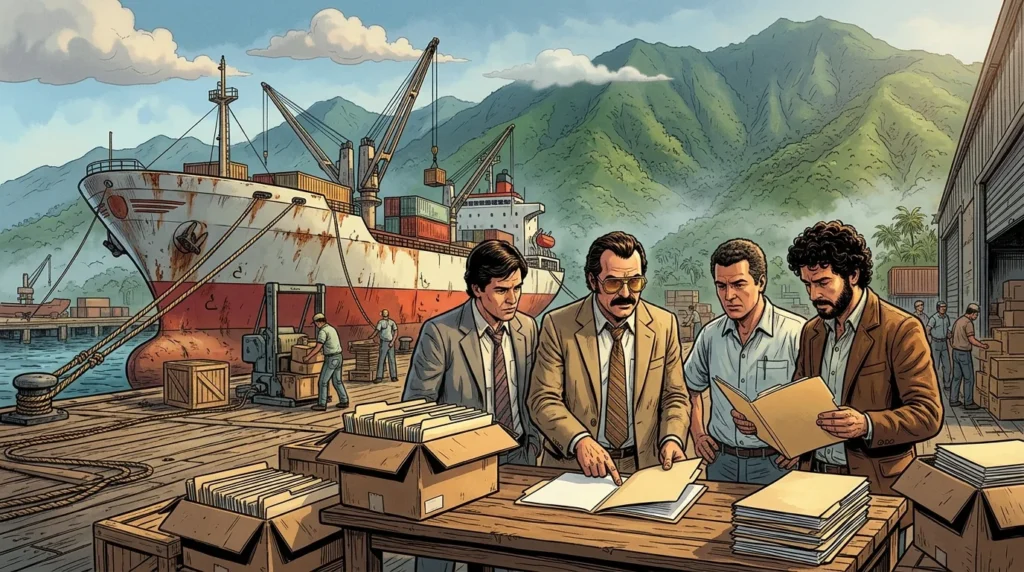
That implicit sovereign guarantee shattered in January 1997 at Tangjin on South Korea’s western coast. Chung Tai-soo, a former tax official who had founded the Hanbo Group in the 1970s and previously survived a 1991 Seoul housing bribery scandal, embarked in the early 1990s on an audacious campaign to challenge state-backed steel giant POSCO by constructing an integrated steelworks at Tangjin. Originally projected to cost 2.7 trillion won, the Tangjin mill was plagued by technical delays, flawed equipment layouts, and soaring construction costs that more than doubled the budget. [5]
Despite holding less than 280 billion won in equity capital and possessing no prior track record in integrated blast-furnace steelmaking, Hanbo Iron & Steel secured 5.7 trillion won ($6.6 billion) in loans and payment guarantees from a syndicate of major Korean lenders led by Korea First Bank, Cho Hung Bank, Korea Exchange Bank, and the state-owned Korea Development Bank. When creditor banks finally refused to advance further working capital on January 23, 1997, Hanbo Steel collapsed into court receivership—the largest corporate bankruptcy in South Korean history up to that date. [6]
President Kim Young-sam ordered an all-out prosecutorial investigation on January 27, 1997 after opposition parties charged that no bank president could have lent twenty times Hanbo’s net worth without high-level political coercion. The resulting “Hanbo Gate” probe exposed a vast bribery network: Chung Tai-soo had maintained slush funds from Tangjin construction loans to pay billions of won in kickbacks to senior politicians, cabinet ministers, and the presidents of Korea First Bank and Cho Hung Bank. In May 1997, President Kim Young-sam’s own son, Kim Hyun-chul, was arrested on charges of influence peddling and tax evasion, while Chung Tai-soo was convicted of bribery and embezzlement and sentenced to 15 years in prison. More ominously, Hanbo’s default crippled Korea First Bank’s capital base and triggered a domino wave of chaebol bankruptcies across 1997—including Sammi Steel in March, Jinro Group in April, and Kia Motors in July—prompting foreign banks to pull short-term dollar credit lines from Seoul and precipitating the November–December 1997 Korean currency crisis. [7]
Kim Woo-choong’s “Global Management” and the BFC Slush Network
If Hanbo Steel lit the fuse of the 1997 financial crisis, the Daewoo Group represented the ultimate test of whether post-crisis South Korea would end “too big to fail.” Founded in March 1967 by Kim Woo-choong as a small textile exporter with $10,000 in capital, Daewoo had grown into South Korea’s second-largest conglomerate after Hyundai, producing automobiles, supertankers, heavy machinery, electronics, and construction projects across more than 100 countries under Kim’s aggressive “Global Management” (Segye Gyeongyeong) banner. [8]
When the 1997 Asian financial crisis struck and the incoming administration of President Kim Dae-jung ordered all chaebol to slash their debt-to-equity ratios below 200 percent by the end of 1999, Hyundai, Samsung, and LG began selling off peripheral subsidiaries. Kim Woo-choong did the exact opposite. Betting that Daewoo could grow its way out of insolvency—and that the government would never allow a conglomerate accounting for roughly 10 percent of South Korea’s exports to fail—Daewoo absorbed struggling automaker SsangYong Motor in early 1998 and issued 17 trillion won in high-yield corporate bonds and commercial paper in 1998 alone, bringing the group’s domestic and foreign liabilities to nearly 89 trillion won ($75 to $80 billion). [9]
Behind this borrowing binge lay a sophisticated global accounting fraud orchestrated from London and the Caribbean. As prosecutors later proved in court, whenever Daewoo Corporation’s overseas subsidiaries suffered massive operating and foreign-exchange losses on Eastern European, Uzbek, and Indian automobile and trading ventures, Kim Woo-choong and his finance executives fabricated fake export invoices, inflated overseas inventory values, and routed circular loans through a secret offshore hub known as British Finance Center (BFC)—a clandestine financial clearinghouse incorporated in the British Virgin Islands and operated out of Daewoo’s London office. Between 1997 and 1999, Daewoo funneled more than $20 billion in unrecorded foreign-exchange transactions through BFC accounts to service offshore bank debts, pay bribes, and disguise insolvent overseas subsidiaries as thriving profit centers.
1999: The 89-Trillion-Won Daewoo Collapse and 41-Trillion-Won Fraud Verdict
By spring 1999, foreign rating agencies and South Korea’s newly created Financial Supervisory Commission (FSC) had grown alarmed by Daewoo’s soaring short-term debt. In July 1999, after Daewoo failed to meet restructuring pledges, Kim Woo-choong pledged 10 trillion won in personal and affiliate collateral to secure an emergency debt rollover, triggering a panic in Seoul’s corporate bond market. On August 26, 1999, creditor banks placed twelve core Daewoo companies into a formal debt workout program; by November 1999, the Daewoo Group was formally dismantled.
When external auditors conducted forensic due diligence on the twelve workout affiliates in late 1999, they discovered a vast black hole: against reported positive net worth of 14 trillion won, Daewoo Group actually had a negative net worth of more than 25 trillion won. In October 1999, while attending an automotive event in China, Kim Woo-choong vanished into a nearly six-year self-imposed exile in Europe and Southeast Asia.
Even in Kim’s absence, South Korean prosecutors indicted top Daewoo executives and outside auditors for falsifying financial statements across 1997–1998 by 41 trillion won (approximately $35 to $40 billion)—dwarfing the subsequent 2001–2002 American accounting frauds at Enron and WorldCom. In April 2005, the Supreme Court of South Korea upheld prison sentences for seven former Daewoo executives (including former Daewoo Corporation president Kang Byung-ho) and levied a record 23 trillion won ($23 billion) in joint monetary forfeitures. Two months later, on June 14, 2005, an ailing 68-year-old Kim Woo-choong returned to Incheon International Airport and was arrested on arrival. In May 2006, the Seoul Central District Court convicted Kim of masterminding the 41-trillion-won accounting fraud, fraudulently obtaining 9.8 trillion won in bank loans, and illegally diverting $3.2 billion abroad via BFC; on November 3, 2006, the Seoul High Court sentenced him to 8.5 years in prison and ordered him to forfeit 17.9 trillion won ($19 billion), before he received a presidential pardon in December 2007.
March 2003: The 1.55-Trillion-Won SK Global Scandal and Bond Run
Although the Daewoo breakup convinced global investors that South Korea had conquered chaebol moral hazard, one final shock in 2003 demonstrated how deeply accounting manipulation remained embedded in conglomerate trading arms. On March 11, 2003—just two weeks after reformist President Roh Moo-hyun took office—the Supreme Prosecutors’ Office announced the indictment of SK Corporation Chairman Chey Tae-won and nine executives of SK Global, the trading and fuel-distribution arm of the SK Group (then South Korea’s third-largest conglomerate).
Investigators revealed that SK Global had systematically rigged its balance sheets for years, inflating 2001 earnings and falsifying accounts by 1.55 trillion won ($1.3 billion)—primarily by deleting 1.1 trillion won in concealed bank debts held at domestic and overseas branches and fabricating over 320 billion won in fictitious trading profits. In addition, Chairman Chey was charged with orchestrating illicit off-market equity swaps among SK affiliates to consolidate his personal control over the group’s flagship oil refiner and mobile carrier SK Telecom at the expense of minority shareholders.
The March 2003 SK Global revelation triggered an immediate liquidity crisis in South Korea’s financial markets. Shares of SK Group companies plunged by over 20 percent, and terrified retail and institutional investors redeemed more than 10 trillion won from domestic bond investment trusts within days, fearing that SK Global’s default would cascade through Korea’s corporate debt market at the exact moment credit-card companies were suffering surging household delinquencies. The Bank of Korea injected 2 trillion won in emergency open-market liquidity, while domestic creditor banks led by Hana Bank organized a debt-for-equity workout that saved SK Global (renamed SK Networks) from liquidation. Coming after Hanbo and Daewoo, the 2003 SK Global scandal finally compelled the National Assembly to enact the Securities-Related Class Action Act (effective 2005), mandate chief executive accounting certification modeled on the US Sarbanes-Oxley Act, and enforce strict independent board oversight across South Korea’s corporate giants.
Theoretical & Balance-Sheet Transmission Mechanism
In the Kindleberger–Minsky taxonomy of financial instability (Kindleberger, 1978; Minsky, 1986) and Irving Fisher’s (1933) debt-deflation framework, speculative asset booms become systemic crises when credit expansion shifts balance sheets from hedge finance (cash flows covering principal and interest) to speculative and Ponzi finance (relying on rising asset prices and short-term margin roll-overs).
Once monetary tightening or an exogenous shock halts price appreciation, forced margin liquidations trigger Fisherian debt-deflation: fire-sale asset discounts erode bank collateral values, contracting credit supply across the real economy.
Sources and Further Reading
- Sung Wook Joh, “ The Korean Economic Crisis and Corporate Governance System,” in Governance, Regulation, and Privatization in the Asia-Pacific Region, National Bureau of Economic Research (NBER) and University of Chicago Press, 2004. Peer-Reviewed / Academic Research
- Valerie Reitman, “ Steel Giant’s Collapse Shakes S. Korea Leader,” Los Angeles Times, 1997-01-28. Historical & Financial Reference
- The Korea Herald, “ Fugitive Chaebol Chief Might Be Dead: Prosecutors,” The Korea Herald, 2019-06-25. Historical & Financial Reference
- Korea JoongAng Daily, “ Record Fines Levied for Daewoo Fraud,” Korea JoongAng Daily, 2005-04-30. Historical & Financial Reference
- Al Jazeera, “ Fugitive Ex-Daewoo Chief Arrested,” Al Jazeera, 2005-06-14. Historical & Financial Reference
- Bruce Wallace, “ Daewoo Founder Receives 8 1/2-Year Sentence for Fraud,” Los Angeles Times, 2006-11-04. Historical & Financial Reference
- Katherine Maria, “ South Korean Corporate Accounting Scandal Rocks Investor Confidence,” Voice of America (VOA), 2003-03-17. Historical & Financial Reference
- Irving Fisher — "The Debt-Deflation Theory of Great Depressions," Econometrica 1, no. 4 (FRASER Federal Reserve Archive, 1933): 337–357 Central Bank / Monetary Authority
- Charles P. Kindleberger & Robert Z. Aliber — Manias, Panics, and Crashes: A History of Financial Crises (Palgrave Macmillan) Peer-Reviewed / Academic Research
Cite This Historical Dossier (APA / Chicago)
APA (7th ed.): Ç., S. (Ed.). (2026). South Korea’s Chaebol Scandals: Hanbo, Daewoo and SK. In Forgotten Fortunes Historical Monograph Series (Forgotten Fortunes Editorial Desk). https://forgottenfortunes.net/south-korea-hanbo-daewoo-sk-scandals/
MLA (9th ed.): Ç., Soner, ed. "South Korea’s Chaebol Scandals: Hanbo, Daewoo and SK." Forgotten Fortunes: Financial & Monetary History Archive, 2026, https://forgottenfortunes.net/south-korea-hanbo-daewoo-sk-scandals/.
Chicago (17th ed.): Ç., Soner, ed. "South Korea’s Chaebol Scandals: Hanbo, Daewoo and SK." Forgotten Fortunes Historical Monograph Series (Forgotten Fortunes Editorial Desk), September 18, 2026. https://forgottenfortunes.net/south-korea-hanbo-daewoo-sk-scandals/.
Have an idea for another financial history documentary or article? Request a story →