In This Article
Between 1967 and 1989, Greece’s financial system underwent three dramatic convulsions that reshaped the relationship between private capital, the Athens Stock Exchange, and the Greek state. Under the military dictatorship of 1967–1974, tax incentives enacted through Emergency Law 148/1967 ignited an unprecedented speculative frenzy on the Athens Stock Exchange in 1972–1973 before the 1973 oil shock and the July 1974 Cyprus crisis shattered the market. Following the restoration of democracy (Metapolitefsi), conservative Prime Minister Constantine Karamanlis moved in 1975–1976 to dismantle the private banking oligarchy by nationalizing Professor Stratis G. Andreadis’s Commercial Bank of Greece conglomerate, placing the vast majority of Greek commercial credit under state control. Twelve years later, that politicized state-banking apparatus produced the most explosive financial scandal in modern Greek history: 34-year-old financier George Koskotas’s 1988 embezzlement of more than 30 to 33 billion drachmas (over $210 million) from the Bank of Crete (Trapeza Kritis), propelled by state-enterprise deposit transfers and forged New York deposit certificates from Merrill Lynch and Irving Trust. [1]

Emergency Law 148/1967 and the 1972–1973 Athens Stock Exchange Bubble
For two decades after the end of the Greek Civil War in August 1949, the Athens Stock Exchange on Sofokleous Street remained a thin, closely held market dominated by a handful of banking families and industrialists, even after the exchange introduced its General Price Index in late 1964. Following the April 1967 military coup, the regime’s economic planners sought to mobilize domestic savings and force family-owned Greek industrial firms onto the public capital market. Their primary instrument was Emergency Law 148/1967, titled “Measures for the Support of the Capital Market.” The statute granted generous tax exemptions on dividends and capitalized corporate reserves for listed companies, required profitable corporations (sociétés anonymes) to distribute a mandatory minimum percentage of net profits as cash dividends to shareholders, and laid the statutory foundation for Greece’s Capital Markets Commission, which formally commenced operations in 1972. [2]
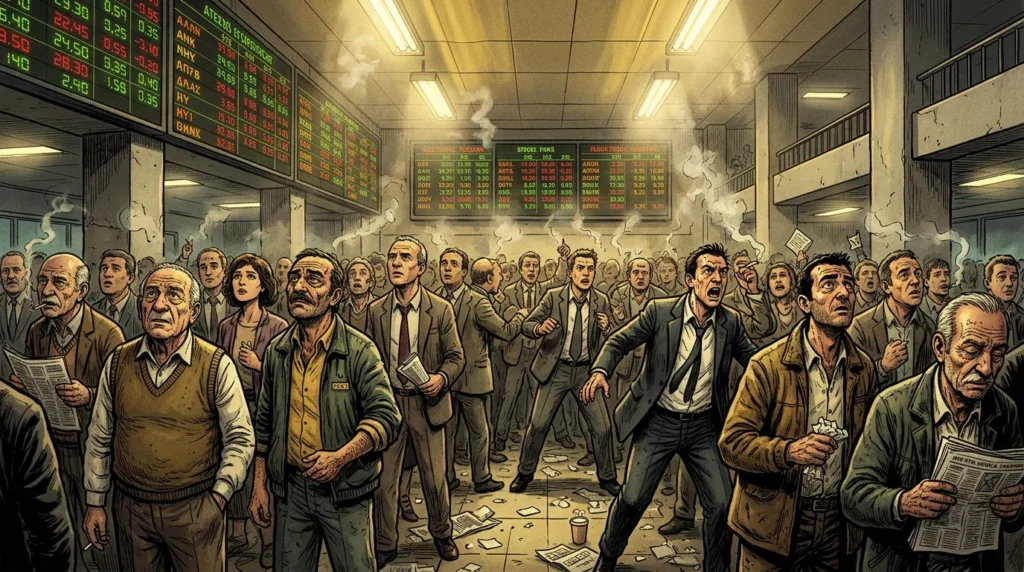
Combined with rapid domestic credit expansion, low controlled interest rates, and a construction boom, Law 148/1967 triggered a speculative mania on the Athens Stock Exchange across 1972 and 1973. Dozens of textile, shipping-related, cement, and manufacturing enterprises rushed to list or issue new shares through capital increases, while middle-class Greek households poured savings into industrial equities whose market prices multiplied severalfold within months. By late 1973, however, domestic inflation surged past 30 percent in the wake of the first global oil shock, the November 1973 Athens Polytechnic uprising destabilized the dictatorship, and the July 1974 Turkish invasion of Cyprus forced the temporary suspension of trading on the Athens Stock Exchange, wiping out much of the speculative paper wealth accumulated during the 1972–1973 boom. [3]
| Documented Figure / Metric | Historical Significance & Archival Context |
|---|---|
| 5 billion drachmas | In the summer of 1988 alone, state enterprises transferred roughly 5 billion drachmas ($35 million) into the bank, doubling its deposit base. |
| $30 million | Within days, both Merrill Lynch and Irving Trust confirmed to Greek authorities that the documents and the $30 million in New York accounts were complete forgeries. |
| 33.5 billion drachmas | Forensic audits soon revealed that between 30 billion and 33.5 billion drachmas ($210 million to $230 million) had been embezzled from the bank. |
Stratis Andreadis and the 1975–1976 Commercial Bank Nationalization
Towering over Greece’s postwar private banking and industrial landscape was Professor Stratis G. Andreadis, a Chios-born shipowner, administrative law professor at the Athens University of Economics and Business, and president of the Union of Greek Shipowners from 1960 to 1974. Having acquired majority control of the Commercial Bank of Greece (Emporiki Trapeza)—then the nation’s second-largest commercial lender—in 1952, Andreadis assembled Greece’s largest private-sector business empire. His group absorbed the Ionian and Popular Bank of Greece in 1957, the Bank of Piraeus in 1962, and the Bank of Attica in 1964, founded the Investment Bank of Greece in 1962–1963 alongside ten major international institutions including Bank of America and Barclays, launched Greece’s first mutual fund, built the Athens Hilton, and tripled its branch network while pioneering mobile banking across rural villages with a fleet of 45 buses. [4]
During the 1967–1974 dictatorship, Andreadis expanded his industrial footprint further, including contracting in 1972 to construct a major oil refinery at Megara through Stran Greek Refineries. When democratic rule returned in July 1974 under Prime Minister Constantine Karamanlis, the new government accused Andreadis’s banking group of irregular intercompany lending and overly close cooperation with the fallen regime. In 1975–1976, the Karamanlis administration appointed state commissioners and orchestrated mandatory share-capital increases through state-controlled pension funds and central-bank mechanisms that stripped Andreadis of control over the Commercial Bank of Greece Group and its affiliated banks, insurance firms, and industrial subsidiaries without direct compensation (a wave of state takeovers later extended by Andreas Papandreou’s Socialist government in the early 1980s, and contested for nearly two decades until the European Court of Human Rights ruled in Andreadis’s favor regarding the cancelled Stran refinery contract in December 1994). By the late 1970s, more than 80 percent of Greek commercial banking assets sat under state ownership or control. [5]
The Meteoric Rise of George Koskotas at the Bank of Crete
Ironically, the smallest institution stripped from the old Andreadis orbit—the Bank of Crete, founded in 1924 and revived in the 1970s—became the vehicle for the spectacular fraud that convulsed Greece in 1988. Its protagonist, George Koskotas, had returned to Athens in 1979 at age 25 after liquidating a family painting contracting business on Long Island, New York, leaving behind federal and state indictments for defrauding the Internal Revenue Service and New York unemployment authorities of $41,000. Hired later in 1979 as a mid-level accounting and internal audit clerk at the Bank of Crete, Koskotas quietly exploited weaknesses in the bank’s foreign-exchange and clearing controls to accumulate an initial 2 percent equity stake. [6]
In 1984, at just 30 years of age, Koskotas stunned Athens financial circles by purchasing majority control of the Bank of Crete for roughly $6 million to $8 million and installing himself as chairman and managing director. Over the next four years, operating inside the Bank of Crete with virtually no independent board oversight, Koskotas built a $300 million corporate empire centered on Grammi S.A., a massive media and publishing house operating five magazines, three daily newspapers, a radio station, and one of Europe’s most advanced printing plants, before purchasing Greece’s most popular football club, Olympiacos Piraeus, in 1987. Whenever the Bank of Greece under Governor Demetrios Chalikias sought to inspect the rapid expansion of the Bank of Crete’s balance sheet and questionable foreign-exchange transfers, auditing initiatives were repeatedly stalled by political allies inside Prime Minister Andreas Papandreou’s Panhellenic Socialist Movement (PASOK) administration, notably Justice and Deputy Prime Minister Agamemnon “Menios” Koutsogiorgas. [7]
State-Enterprise Deposits and the Forged New York Certificates
The financial engine behind Koskotas’s empire combined direct embezzlement of private customer deposits with systematic political arbitrage of public-sector cash. As parliamentary investigators led by deputy John Paleocrassas and subsequent court audits documented, PASOK officials directed more than a dozen state-controlled corporations and public utilities—including the Hellenic Telecommunications Organization (OTE), Olympic Airways, the Postal Savings Bank, the Organization of Urban Transportation, and the State Pharmaceutical Company—to shift billions of drachmas out of major state banks into the tiny Bank of Crete. In the summer of 1988 alone, state enterprises transferred roughly 5 billion drachmas ($35 million) into the bank, doubling its deposit base. According to Koskotas’s subsequent testimony, these state deposits were booked at abnormally low interest rates of 2 to 3 percent at a time when Greek bank accounts routinely paid 15 percent, allowing the interest rate differential and principal balances to be siphoned off into Grammi S.A. and political kickbacks—allegedly delivered to party intermediaries in blue briefcases stuffed with 5,000-drachma banknotes and even a box of Pampers diapers. [8]
By the autumn of 1988, persistent press reports of massive holes in the Bank of Crete’s books triggered a panicked run by private depositors. Pressed by the Bank of Greece and judicial investigators in late September 1988 to prove the origin and existence of the Bank of Crete’s purported foreign-currency reserves, Koskotas handed over photocopies of account statements claiming that the bank held $13 million on deposit with Merrill Lynch & Co. and $17 million at Irving Trust Company in New York. Within days, both Merrill Lynch and Irving Trust confirmed to Greek authorities that the documents and the $30 million in New York accounts were complete forgeries. [9]
The 33-Billion-Drachma Collapse and the 1989 Constitutional Crisis
On October 19, 1988, the Bank of Greece removed Koskotas and appointed an interim commissioner to seize control of the Bank of Crete. Forensic audits soon revealed that between 30 billion and 33.5 billion drachmas ($210 million to $230 million) had been embezzled from the bank. In November 1988, despite being under round-the-clock police surveillance while facing indictment, Koskotas slipped out of Greece aboard a private jet, fleeing first to Brazil before flying to Massachusetts, where U.S. federal agents arrested him on November 23, 1988, on his outstanding 1979 tax and fraud warrants. Held in the Essex County Jail in Salem, Massachusetts, Koskotas gave explosive interviews to TIME and the Los Angeles Times in March and April 1989, alleging that Prime Minister Papandreou and senior cabinet ministers had orchestrated the state-enterprise deposit scheme in exchange for millions of dollars in bribes.
The revelations paralyzed Greek politics and brought down the PASOK government in the June 1989 parliamentary elections. An unprecedented temporary coalition between conservative New Democracy and the communist-led Left and Progress alliance formed a government specifically to prevent the statute of limitations from expiring and indicted Prime Minister Papandreou and four senior ministers before the Special Court under Article 86 of the Greek Constitution. Extradited from the United States in 1991, Koskotas testified at the televised Special Court trial in Athens. In January 1992, Papandreou was narrowly acquitted by a 7–6 vote of the judges (while two former ministers were convicted, and Menios Koutsogiorgas suffered a fatal stroke on the courtroom stand in April 1991). Koskotas himself was convicted in 1991 and sentenced to 25 years in prison, serving until his conditional release in March 2001—leaving the 1988 Bank of Crete scandal as the defining cautionary episode that forced Greece to modernize banking supervision and emancipate the Bank of Greece from ministerial control in the 1990s.
Theoretical & Balance-Sheet Transmission Mechanism
In the Kindleberger–Minsky taxonomy of financial instability (Kindleberger, 1978; Minsky, 1986) and Irving Fisher’s (1933) debt-deflation framework, speculative asset booms become systemic crises when credit expansion shifts balance sheets from hedge finance (cash flows covering principal and interest) to speculative and Ponzi finance (relying on rising asset prices and short-term margin roll-overs).
Once monetary tightening or an exogenous shock halts price appreciation, forced margin liquidations trigger Fisherian debt-deflation: fire-sale asset discounts erode bank collateral values, contracting credit supply across the real economy.
Sources and Further Reading
- Athens Stock Exchange (ATHEX Group / Euronext Athens), “ Our History: 1950–1980 Post-War Reconstruction and Institutional Reforms“, Euronext Athens Official History, 2024. Historical & Financial Reference
- Greek Shipping Hall of Fame, “ Prof Stratis G. Andreadis“, Greek Shipping Hall of Fame Inductee Archive, 2020. Historical & Financial Reference
- Greek Shipping Miracle, “ Stratis G. Andreadis“, Greek Shipping Miracle Historical Archive, 2020. Historical & Financial Reference
- European Court of Human Rights, “ Case of Stran Greek Refineries and Stratis Andreadis v. Greece (Application no. 13427/87), Judgment of 9 December 1994“, HUDOC / Council of Europe, 1994-12-09. Historical & Financial Reference
- “ Scandals: The Looting of Greece“, TIME Magazine, 1989-03-13. Historical & Financial Reference
- “ Koskotas Implicates Premier in Payoffs, Bribery: Ex-Banker's Tale May Be Greek Tragedy“, Los Angeles Times, 1989-04-16. Historical & Financial Reference
- Stephen Brookes, “ Awash in Scandal, Greece Wrestles its Political Furies“, Insight Magazine, 1989-03-06. Historical & Financial Reference
- Irving Fisher — "The Debt-Deflation Theory of Great Depressions," Econometrica 1, no. 4 (FRASER Federal Reserve Archive, 1933): 337–357 Central Bank / Monetary Authority
- Charles P. Kindleberger & Robert Z. Aliber — Manias, Panics, and Crashes: A History of Financial Crises (Palgrave Macmillan) Peer-Reviewed / Academic Research
Cite This Historical Dossier (APA / Chicago)
APA (7th ed.): Ç., S. (Ed.). (2026). The 1972 Athens Stock Boom, the Andreadis Takeover, and the Koskotas Bank Scandal. In Forgotten Fortunes Historical Monograph Series (Forgotten Fortunes Editorial Desk). https://forgottenfortunes.net/athens-stock-exchange-boom-andreadis-koskotas-bank-scandal/
MLA (9th ed.): Ç., Soner, ed. "The 1972 Athens Stock Boom, the Andreadis Takeover, and the Koskotas Bank Scandal." Forgotten Fortunes: Financial & Monetary History Archive, 2026, https://forgottenfortunes.net/athens-stock-exchange-boom-andreadis-koskotas-bank-scandal/.
Chicago (17th ed.): Ç., Soner, ed. "The 1972 Athens Stock Boom, the Andreadis Takeover, and the Koskotas Bank Scandal." Forgotten Fortunes Historical Monograph Series (Forgotten Fortunes Editorial Desk), September 5, 2026. https://forgottenfortunes.net/athens-stock-exchange-boom-andreadis-koskotas-bank-scandal/.
Have an idea for another financial history documentary or article? Request a story →