In This Article
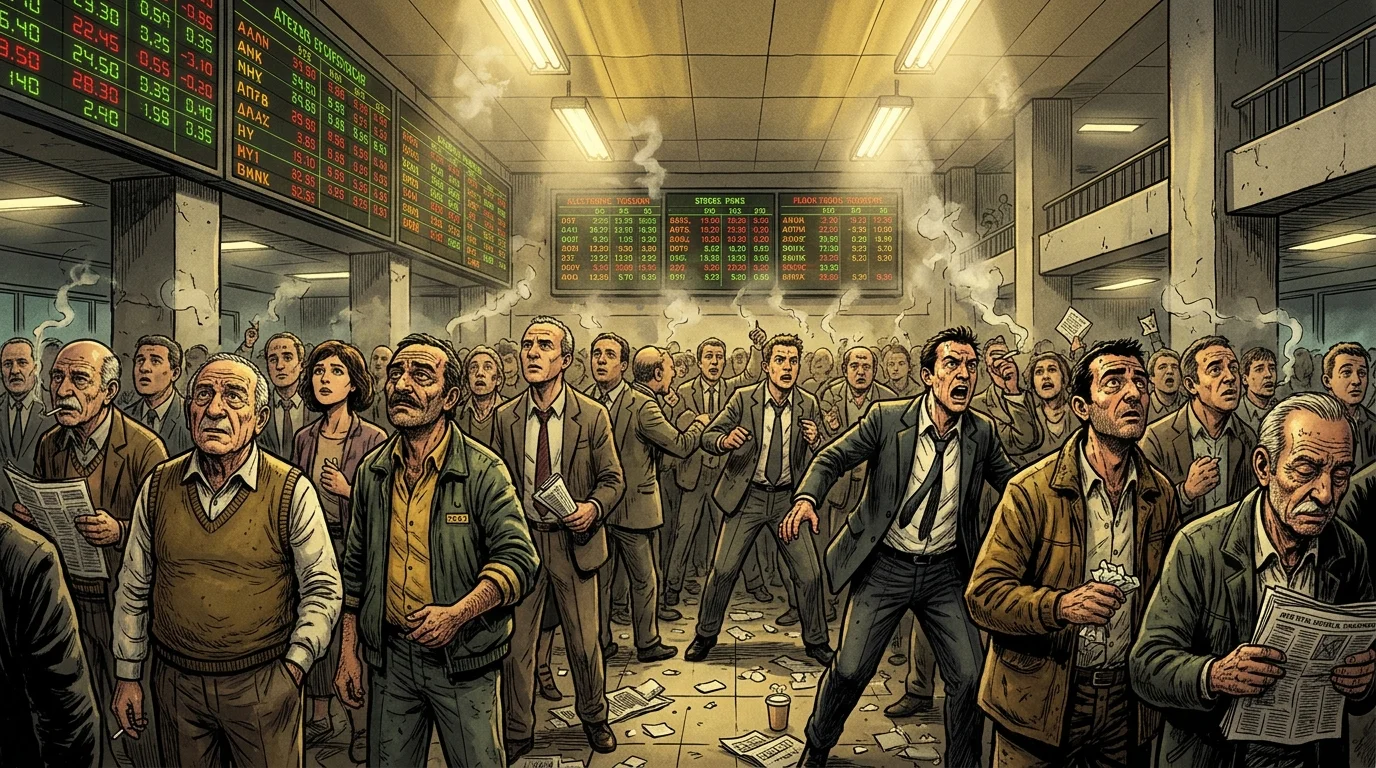
On Friday, September 17, 1999, the General Index of the Athens Stock Exchange—known across Greece simply as the Chrimatistirio—reached an intraday peak of 6,355 points (closing near 6,335), capping a rally of more than 500% since the beginning of 1997. Across Athens and provincial towns alike, brokerage screens hung in coffee shops, civil servants checked share tickers between shifts, and roughly 1.5 million active investor trading codes—representing nearly one in three Greek households—participated in a market that had been a sleepy, closely held bourse less than a decade earlier. Within three and a half years of that September peak, the index had lost nearly 80% of its value, bottoming below 1,400 points in March 2003 and erasing approximately €100 billion (over 30 trillion drachmas) in nominal market capitalization and household savings. Remembered in Greek political and social memory as the “Stock Market Scandal” (To Skandalo tou Chrimatistiriou), the episode exposed how rapid monetary convergence without commensurate corporate governance and supervisory protections could transform macroeconomic modernization into a nationwide retail speculative mania. [1]
Eurozone Convergence and the Collapse of Traditional Yields
The macroeconomic catalyst for the late-1990s Athens equity boom was Greece’s determined drive to qualify for the European Economic and Monetary Union (EMU) and adopt the euro. Under the convergence program pursued by Prime Minister Costas Simitis and Minister of National Economy and Finance Yannos Papantoniou after 1996, Greek fiscal deficits were narrowed, capital controls were dismantled, and inflation was brought down toward Maastricht Treaty benchmarks. In March 1998, the Greek drachma entered the European Exchange Rate Mechanism (ERM) accompanied by a 12.3% devaluation against the European Currency Unit, a policy step that anchored exchange-rate expectations and triggered a rapid influx of foreign portfolio capital. [2]
For decades, Greek household savers had relied on high nominal yields from tax-free Greek government Treasury bills and bank time deposits to preserve purchasing power against double-digit inflation. As disinflation took hold and the Bank of Greece gradually converged domestic interest rates toward euro-area levels, nominal yields on government paper and bank deposits fell from above 15% in the mid-1990s toward single digits by 1999. Faced with shrinking returns on traditional fixed-income savings, Greek households began shifting capital into equities, mutual funds, and initial public offerings on the Athens Stock Exchange on an unprecedented scale. [3]
Political rhetoric reinforced the shift. Throughout the late 1990s, senior cabinet officials pointed to the rising bourse as tangible proof of Greece’s modernization, boosted further by Athens winning the bid in September 1997 to host the 2004 Summer Olympic Games. Prime Minister Simitis famously described the surging exchange as “a mirror of the Greek economy,” a phrase that encouraged inexperienced first-time savers to view equity appreciation as an almost guaranteed dividend of European integration. [4]
The Anatomy of Retail Euphoria and the Cost-of-Equity Gap
As domestic liquidity flooded Sofokleous Street—the historic home of the Athens Stock Exchange—the structure of the Greek capital market proved ill-equipped to absorb the demand. Historically, Greek industry was dominated by family-controlled enterprises that relied on relationship banking for credit rather than public capital markets. When equity prices began doubling and tripling between 1997 and 1999, controlling shareholders discovered an extraordinary arbitrage opportunity. [5]
Academic research on the Greek capital market between 1995 and 1999 has documented a stark divergence in how retail buyers and corporate insiders priced equity. Retail investors entering the market during the boom expected annual capital gains averaging roughly 70%, driven by momentum and daily price-limit surges. For listed companies and their founding families, however, the visible cost of equity—measured by actual cash dividends paid out to minority shareholders—dropped to roughly 1% of market value. Because Greek corporate governance norms lacked strict minority-shareholder protections, independent board mandates, or rigorous disclosure of how raised funds would be deployed, insiders treated initial public offerings and seasoned equity offerings (capital increases) as virtually free capital. [6]
Between 1998 and 2000, hundreds of small and medium-sized companies rushed to list on the main and parallel markets of the Athens Stock Exchange, while existing firms announced massive rights issues. Total funds raised through new listings and capital increases surged from modest levels in the mid-1990s to more than 4 trillion drachmas (roughly €12 billion) at the height of the boom in 1999–2000. In numerous cases, newly raised capital was not invested in productive industrial capacity; instead, corporate treasuries used the proceeds to buy shares in affiliated companies or speculate on the exchange itself, creating circular balance-sheet valuations that amplified the bubble. [7]
Margin Trading, Price Limits, and Small-Cap Mania
By the spring and summer of 1999, trading on the Athens Stock Exchange had detached from underlying corporate earnings. While blue-chip banking and telecommunications stocks—including partially privatized state enterprises such as the Hellenic Telecommunications Organization (OTE) and National Bank of Greece—led the initial 1997–1998 advance, the final phase of the rally in 1999 was dominated by small-capitalization and parallel-market shares, popularly dubbed “slot-machine stocks” (frouitakia).
Several institutional mechanics fueled the frenzy. The Athens Stock Exchange operated with daily price fluctuation limits of 8% (later adjusted during the period), which in a thin, momentum-driven market acted as a magnet rather than a circuit breaker. When a rumoured takeover or capital increase hit the market, a small-cap stock would lock at its +8% daily limit (limit-up) at the opening bell with unexecuted buy orders queuing for days, convincing retail traders that upward movement was certain. Econometric studies of daily, weekly, and monthly return dispersions on the ASE between 1998 and 2007 confirm statistically significant investor herding during the 1999 bubble, as uninformed retail participants abandoned fundamental valuation and chased market-wide price momentum.
Informal and formal leverage compounded the risk. Brokerage firms and banks extended short-term credit lines and unofficial margin accounts (mesoprothesma) that allowed retail speculators to purchase shares on deferred settlement terms, pledging the inflated shares themselves as collateral. At the peak in September 1999, price-to-earnings (P/E) ratios across scores of small and mid-cap construction, textile, shipping, and technology firms exceeded 100 to 200 times trailing earnings, while total ASE market capitalization surpassed 150% of Greece’s gross domestic product.
The September 1999 Peak and the 1999–2003 Collapse
The turning point arrived on September 17, 1999, when the ASE General Index touched its all-time intraday high of 6,355 points. Within days, institutional insiders, foreign funds, and controlling shareholders who had accumulated massive paper gains began distributing shares into retail buying. As liquidity tightened and warnings mounted from the Bank of Greece regarding consumer credit growth and inflationary pressures, the index slipped below 6,000 in October 1999, triggering the first wave of forced liquidations on unsettled brokerage accounts.
Even as the downturn gathered pace, political sensitivity ahead of the April 2000 general election kept official commentary optimistic. On March 9, 2000, as Prime Minister Simitis appeared on live television to announce that Greece had formally submitted its application to become the 12th member of the eurozone, the ASE General Index dropped 56.5 points during his fifteen-minute broadcast, saved from a steeper close only when state-linked institutional investors stepped in during the final half-hour of trading.
Following the narrow re-election of the PASOK government in April 2000 and the simultaneous bursting of the global dot-com bubble, the Athens market entered a relentless multi-year contraction. Small-cap shares that had locked at daily limit-ups on the way up became completely illiquid on the way down, trapping retail holders who faced daily limit-down (-8%) sessions with no bids. By the time Greece physically adopted euro notes and coins in January 2002, the General Index had fallen below 2,600; by March 2003, it reached a trough of roughly 1,467 points—a cumulative decline of nearly 77% from its September 1999 zenith, with small-cap indices losing over 90%.
Wealth Transfer, Regulatory Reform, and Historical Legacy
The collapse of the Chrimatistirio bubble wrought a massive redistribution of wealth within Greek society. An estimated €100 billion in peak market capitalization evaporated, while tens of thousands of middle- and working-class families who had liquidated agricultural land, real estate, or life savings at the height of the mania in summer 1999 suffered permanent capital losses. Angry retail investors staged street protests outside the Athens Stock Exchange and formed associations of ruined shareholders demanding judicial investigations into price manipulation and fraudulent prospectuses.
In the aftermath, Greek authorities overhauled the country’s securities and corporate governance architecture. The Hellenic Capital Market Commission (HCMC) expanded its enforcement powers over market abuse and insider dealing, while Parliament enacted Law 3016/2002 on Corporate Governance in May 2002. Law 3016/2002 mandated for the first time that Greek listed companies appoint non-executive and independent board members, establish internal audit units, and strictly account for any deviation in how funds raised through share capital increases were spent. Although judicial inquiries into late-1990s stock manipulation dragged through Greek courts for well over a decade before resulting in targeted convictions, the 1999 crash permanently scarred domestic retail participation in Greek equities—leaving the Athens market dependent on foreign institutional flows and state borrowing in the decade leading up to the 2009 Greek sovereign debt crisis.
Theoretical & Balance-Sheet Transmission Mechanism
In the Kindleberger–Minsky taxonomy of financial instability (Kindleberger, 1978; Minsky, 1986) and Irving Fisher’s (1933) debt-deflation framework, speculative asset booms become systemic crises when credit expansion shifts balance sheets from hedge finance (cash flows covering principal and interest) to speculative and Ponzi finance (relying on rising asset prices and short-term margin roll-overs).
Once monetary tightening or an exogenous shock halts price appreciation, forced margin liquidations trigger Fisherian debt-deflation: fire-sale asset discounts erode bank collateral values, contracting credit supply across the real economy.
Sources and Further Reading
- Stavros Thomadakis et al., “ The Greek Capital Market: Caught in Between Poor Corporate Governance and Market Inefficiency,” European Research Studies Journal, 2006. Historical & Financial Reference
- Guglielmo Maria Caporale, Fotini Economou, and Nikolaos Philippas, “ Herding behaviour in extreme market conditions: the case of the Athens Stock Exchange,” Economics Bulletin, 2008. Historical & Financial Reference
- Anthee Carassava, “ A Greek Tragedy,” TIME, 2000-04-10. Historical & Financial Reference
- International Monetary Fund, “ Greece: Selected Issues and Statistical Appendix (IMF Staff Country Report No. 01/57),” International Monetary Fund, 2001-04. International Financial Institution
- Chrissanthi E. Tsene, “ The Greek Paradigm of Corporate Governance and Board of Directors,” Corporate Law & Governance Review, 2021. Peer-Reviewed / Academic Research
- Irving Fisher — "The Debt-Deflation Theory of Great Depressions," Econometrica 1, no. 4 (FRASER Federal Reserve Archive, 1933): 337–357 Central Bank / Monetary Authority
- Charles P. Kindleberger & Robert Z. Aliber — Manias, Panics, and Crashes: A History of Financial Crises (Palgrave Macmillan) Peer-Reviewed / Academic Research
Cite This Historical Dossier (APA / Chicago)
APA (7th ed.): Ç., S. (Ed.). (2026). The 1999 Athens Stock Exchange (Chrimatistirio) Bubble and Crash. In Forgotten Fortunes Historical Monograph Series (Forgotten Fortunes Editorial Desk). https://forgottenfortunes.net/athens-stock-exchange-1999-bubble-crash/
MLA (9th ed.): Ç., Soner, ed. "The 1999 Athens Stock Exchange (Chrimatistirio) Bubble and Crash." Forgotten Fortunes: Financial & Monetary History Archive, 2026, https://forgottenfortunes.net/athens-stock-exchange-1999-bubble-crash/.
Chicago (17th ed.): Ç., Soner, ed. "The 1999 Athens Stock Exchange (Chrimatistirio) Bubble and Crash." Forgotten Fortunes Historical Monograph Series (Forgotten Fortunes Editorial Desk), September 10, 2026. https://forgottenfortunes.net/athens-stock-exchange-1999-bubble-crash/.
Have an idea for another financial history documentary or article? Request a story →