In This Article
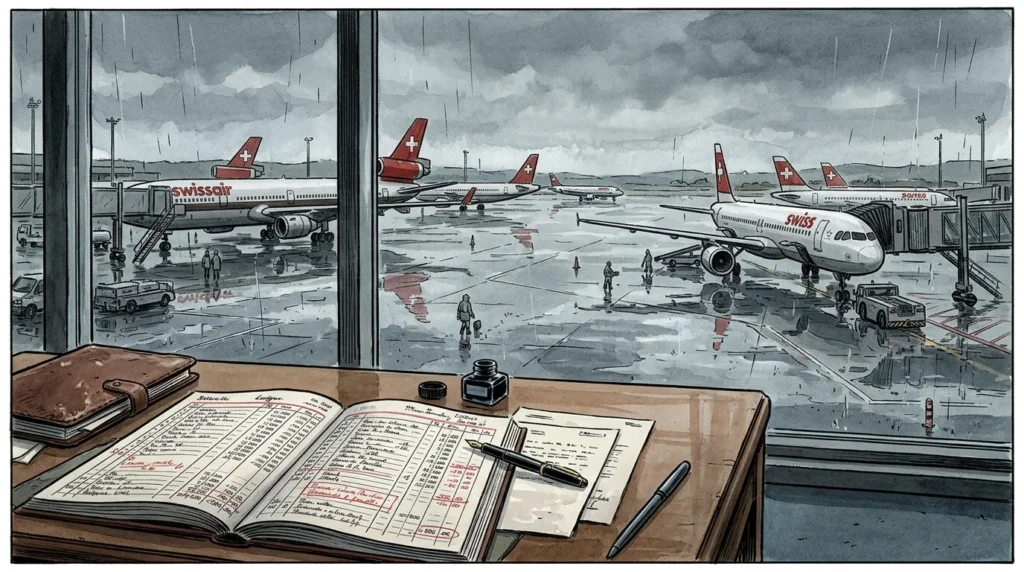
On Tuesday, October 2, 2001—a date remembered in Switzerland simply as Das Grounding (“Black Tuesday”)—Swissair suspended all flight operations worldwide after running out of liquid cash to pay fuel suppliers and airport authorities. Founded in 1931, the Swiss national flag carrier had been known for decades as “The Flying Bank” because of its vast cash reserves, hidden aircraft equity, and financial conservatism. Yet within four years of adopting an aggressive acquisition blueprint known as the “Hunter Strategy,” Swissair’s parent company, SAirGroup, accumulated CHF 17 billion in debt, suffered a catastrophic CHF 2.9 billion annual loss for 2000, and collapsed in the largest corporate bankruptcy in Swiss history. [1]
From “The Flying Bank” to EEA Isolation (1992–1997)
For most of the post-war era, Swissair occupied a privileged position in European commercial aviation. Operating from high-yield hubs in Zurich and Geneva and shielded by bilateral air-traffic treaties, the carrier generated consistent profits and maintained such liquid reserves that industry analysts joked it was a bank that happened to fly airplanes.
That business model was undermined on December 6, 1992, when Swiss voters rejected membership in the European Economic Area (EEA) in a national referendum. As the European Union deregulated internal skies during the 1990s—granting EU airlines “cabotage” and open-skies rights to fly freely between any two European cities—Swissair was left outside the single aviation market, restricted to traditional point-to-point routes to and from Switzerland. [2]
To overcome its geographic and regulatory isolation without merging into a larger rival such as Lufthansa, British Airways, or Air France, Swissair’s board of directors—stuffed with luminaries of the Swiss political and financial establishment, including Credit Suisse chief executive Lukas Mühlemann and Geneva private banker Bénédict Hentsch—turned to management consultancy McKinsey & Company. In 1997, newly appointed chief executive Philippe Bruggisser reorganized the company as SAirGroup and launched the McKinsey-crafted “Hunter Strategy”. [3]
The Mechanics of the “Hunter Strategy” and the Qualiflyer Alliance
The premise of the Hunter Strategy was that SAirGroup could build a “fourth force” in European aviation—the Qualiflyer alliance—to rival the emerging Star Alliance and Oneworld networks by acquiring substantial minority equity stakes (typically up to the 49.5 percent foreign-ownership limit permitted under bilateral aviation treaties) in second-tier national and regional airlines across Europe. By feeding passenger traffic into Zurich and integrating partner airlines into SAirGroup’s profitable aviation-services divisions (catering unit Gate Gourmet, maintenance arm SR Technics, duty-free retailer Nuance, and IT provider Atraxis), Bruggisser and McKinsey projected that SAirGroup would capture economies of scale without surrendering Swiss independence. [4]
In practice, because healthy first-tier European flag carriers were neither for sale nor willing to subordinate their hubs to Zurich, Swissair was forced to buy into heavily indebted, structurally loss-making airlines that larger competitors had shunned. Between 1995 and 2000, SAirGroup poured billions of Swiss francs into a sprawling portfolio of distressed carriers: [5]
- Belgium (Sabena): Having acquired a 49.5 percent equity stake in Belgium’s chronically unprofitable flag carrier Sabena in 1995, SAirGroup agreed under Bruggisser to increase its commitment toward an eventual 85 percent holding alongside the Belgian state, absorbing relentless operating deficits.
- Germany (LTU): In 1998, SAirGroup acquired a 49.9 percent stake in German charter and leisure airline LTU, which soon required massive restructuring infusions as German tour-operator competition intensified.
- France (AOM, Air Liberté, Air Littoral): Seeking to challenge Air France on its home turf, SAirGroup bought minority stakes in three loss-making French regional and leisure airlines—AOM, Air Liberté, and Air Littoral—attempting to fuse them into a French network that burned tens of millions of francs every month.
- Eastern Europe, Italy, and Africa: Additional equity stakes were purchased in Poland’s LOT (37.6 percent), Italy’s Volare and Air Europe, Portuguese carriers TAP and Portugália, and South African Airways (20 percent).
The CHF 2.9 Billion Loss of 2000 and the Debt Spiral
Because SAirGroup held less than 50 percent of the voting equity in most of its Qualiflyer partner airlines, it initially avoided consolidating their full operating losses and liabilities onto its group balance sheet, even as it signed binding shareholder agreements and comfort letters committing to fund their deficits. A later independent forensic audit commissioned by Swiss authorities from Ernst & Young severely criticized SAirGroup’s financial reporting during this period for obscuring the true scale of its off-balance-sheet commitments and liquidity drain. [6]
By late 2000, rising jet-fuel prices and runaway losses in France, Belgium, and Germany made the accounting facade untenable. In January 2001, SAirGroup’s board dismissed Philippe Bruggisser, abandoned the Hunter Strategy, and eventually handed executive control in March 2001 to Mario Corti, the former chief financial officer of Nestlé, after most of the discredited board announced its resignation. [7]
When SAirGroup published its audited results for fiscal year 2000 in April 2001, the figures stunned Switzerland: the group recorded a net loss of CHF 2.885 billion (nearly CHF 2.9 billion) after taking massive write-downs and restructuring provisions on its French, Belgian, and German airline holdings. Group net debt had ballooned to roughly CHF 15–17 billion, while shareholder equity was virtually wiped out. [8]
September 11, “Project Phoenix,” and the Grounding of October 2, 2001
Throughout the summer of 2001, Corti scrambled to keep the group solvent by extricating Swissair from the French carriers, renegotiating with the Belgian government over a promised CHF 200 million (€220 million) recapitalization payment to Sabena, and attempting to sell non-aviation subsidiaries such as Gate Gourmet and Nuance. Then came the terrorist attacks of September 11, 2001 in the United States.
The temporary closure of North American airspace and the collapse in transatlantic business travel deprived Swissair of its most lucrative cash-generating routes while slashing the market value of the aircraft and subsidiaries Corti had hoped to sell by 40 to 60 percent. On September 17, 2001, Corti warned the Swiss federal government in Bern that SAirGroup faced an acute liquidity crisis. Over the weekend of September 29–30, Switzerland’s two largest commercial banks—UBS, led by Marcel Ospel, and Credit Suisse, led by former SAirGroup director Lukas Mühlemann—engineered an emergency restructuring blueprint dubbed “Project Phoenix”.
Unveiled on Monday, October 1, 2001, Project Phoenix did not rescue SAirGroup; instead, UBS and Credit Suisse agreed to pay roughly CHF 260 million to purchase SAirGroup’s 70 percent stake in its healthy regional subsidiary, Crossair, and inject additional capital (totalling roughly CHF 1.36 billion in package commitments) so Crossair could take over two-thirds of Swissair’s fleet and routes, leaving legacy SAirGroup to file for debt-restructuring moratorium (Nachlassstundung).
The announcement triggered an immediate run by Swissair’s trade creditors. Realizing that SAirGroup was entering insolvency protection and that the banks’ purchase price for Crossair shares was restricted from paying pre-existing unsecured bills, fuel suppliers and airport operators demanded cash in advance on the morning of Tuesday, October 2, 2001. At London Heathrow, airport operator BAA briefly impounded two Swissair jets over unpaid landing fees; in Zurich and across the globe, fuel companies refused to refuel Swissair aircraft because UBS had not yet released the CHF 260 million Crossair share proceeds into operating accounts before billing cutoffs expired. At 15:45 CET on October 2, 2001, SAirGroup cancelled all flights worldwide, grounding its 77-aircraft fleet and stranding nearly 40,000 passengers.
Aftermath: Sabena’s Contagion, SWISS, and the 2007 Bülach Trial
The humiliation of seeing the white cross on red tailfins immobilized on television screens provoked public outrage across Switzerland. On October 3, 2001, the Swiss federal government stepped in with an emergency CHF 450 million federal bridge loan to resume flights, followed later by more than CHF 1 billion in public transition financing. SAirGroup entered formal insolvency proceedings on October 4–5, 2001 with CHF 17 billion in liabilities, wiping out shareholders and bondholders, eliminating roughly 5,000 jobs directly, and triggering the bankruptcy of Sabena in November 2001 after Swissair failed to honor its Belgian funding tranche.
On April 1, 2002, the last legacy Swissair flight landed in Zurich from São Paulo, and Crossair was rebranded as Swiss International Air Lines (SWISS), which was subsequently acquired by Germany’s Lufthansa Group in 2005. In early 2007, 19 former SAirGroup executives, directors, and advisors—including Mario Corti, Philippe Bruggisser, and Bénédict Hentsch—stood trial in Bülach near Zurich on criminal mismanagement and creditor-preference charges; all 19 were acquitted in June 2007 after the court ruled that prosecutors had not proven criminal intent beyond strategic misjudgment.
Theoretical & Balance-Sheet Transmission Mechanism
In the Kindleberger–Minsky taxonomy of financial instability (Kindleberger, 1978; Minsky, 1986) and Irving Fisher’s (1933) debt-deflation framework, speculative asset booms become systemic crises when credit expansion shifts balance sheets from hedge finance (cash flows covering principal and interest) to speculative and Ponzi finance (relying on rising asset prices and short-term margin roll-overs).
Once monetary tightening or an exogenous shock halts price appreciation, forced margin liquidations trigger Fisherian debt-deflation: fire-sale asset discounts erode bank collateral values, contracting credit supply across the real economy.
Sources and Further Reading
- Mark Milner, Keith Harper, and Andrew Clark, “ Financial Crisis Grounds Swissair Fleet,” The Guardian, 2001-10-03. Historical & Financial Reference
- Andrew Clark, “ Belgian Threat to Sue as Swissair Grounds Jets,” The Guardian, 2001-10-02. Historical & Financial Reference
- Institutional Investor, “ Who Lost Swissair?,” Institutional Investor, 2002. Historical & Financial Reference
- SWI swissinfo.ch, “ Swissair Grounding Could Have Been Avoided,” SWI swissinfo.ch, 2003-01-24. Historical & Financial Reference
- SWI swissinfo.ch, “ Corti Blames Banks for ‘Strangling’ Swissair,” SWI swissinfo.ch, 2007-01-16. Historical & Financial Reference
- SWI swissinfo.ch, “ Swissair Grounding: 15 Years On,” SWI swissinfo.ch, 2016-10-02. Historical & Financial Reference
- Irving Fisher — "The Debt-Deflation Theory of Great Depressions," Econometrica 1, no. 4 (FRASER Federal Reserve Archive, 1933): 337–357 Central Bank / Monetary Authority
- Charles P. Kindleberger & Robert Z. Aliber — Manias, Panics, and Crashes: A History of Financial Crises (Palgrave Macmillan) Peer-Reviewed / Academic Research
Cite This Historical Dossier (APA / Chicago)
APA (7th ed.): Ç., S. (Ed.). (2026). The 2001 Collapse of Swissair and the Failed 'Hunter Strategy'. In Forgotten Fortunes Historical Monograph Series (Forgotten Fortunes Editorial Desk). https://forgottenfortunes.net/swissair-2001-collapse/
MLA (9th ed.): Ç., Soner, ed. "The 2001 Collapse of Swissair and the Failed 'Hunter Strategy'." Forgotten Fortunes: Financial & Monetary History Archive, 2026, https://forgottenfortunes.net/swissair-2001-collapse/.
Chicago (17th ed.): Ç., Soner, ed. "The 2001 Collapse of Swissair and the Failed 'Hunter Strategy'." Forgotten Fortunes Historical Monograph Series (Forgotten Fortunes Editorial Desk), September 10, 2026. https://forgottenfortunes.net/swissair-2001-collapse/.
Have an idea for another financial history documentary or article? Request a story →