In This Article
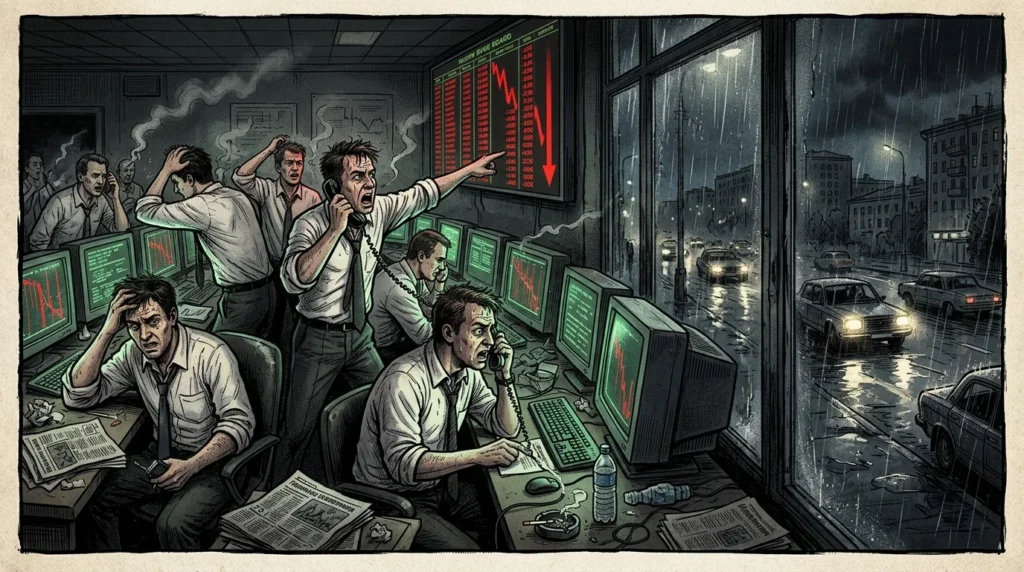
Few episodes in modern financial history illustrate the tension between revolutionary ideology and monetary necessity as starkly as the first twelve years of Soviet rule. In early 1918, Vladimir Lenin’s Bolshevik government executed the largest sovereign debt default in history, unconditionally repudiating roughly 60 billion rubles in domestic and foreign obligations—including more than 16 billion gold rubles owed to foreign creditors—while abolishing private banks and shuttering the Petrograd and Moscow stock exchanges. Within four years, however, the economic devastation of the Russian Civil War and hyperinflation forced the Kremlin into a remarkable reversal. Under the New Economic Policy (NEP, 1921–1928), Soviet authorities led by People’s Commissar of Finance Grigory Sokolnikov reopened wholesale commodity bourses, established formal currency and securities trading floors known as fondovye otdely, and introduced a gold-backed banknote, the chervonets. For nearly half a decade, state industrial trusts and private entrepreneurs known as NEPmen traded gold coins, foreign exchange, and state lottery bonds inside the former Moscow Stock Exchange building before Joseph Stalin’s First Five-Year Plan extinguished Russia’s last financial markets in 1930. [1]
Imperial Russia’s Debt Burden and the 1918 Bolshevik Repudiation
On the eve of the First World War in 1914, the Russian Empire was the world’s largest sovereign borrower. Rapid railway construction, industrial subsidies, and military modernization since the 1880s had been financed heavily through foreign bond issues, above all on the Paris Bourse. Encouraged by the Franco-Russian diplomatic alliance and attracted by yields exceeding those on French rentes, approximately 1.5 to 2 million French households accumulated Russian sovereign and state-guaranteed railway bonds (emprunts russes). By 1914, Russia’s state debt stood at roughly 8.8 billion gold rubles, nearly half of which was held abroad, with French investors holding roughly 80 percent of the prewar foreign share. [2]
Total war between 1914 and 1917 shattered the fiscal foundations of the Tsarist state and its successor, the Russian Provisional Government. Cut off from central European export markets and forced to mobilize millions of conscripts, Petrograd suspended gold convertibility in July 1914, closed the official floor of the St. Petersburg (Petrograd) Stock Exchange, and financed the war through massive domestic bond drives—including the Provisional Government’s 1917 “Liberty Loan” (Zaem Svobody)—alongside inter-Allied war credits from Great Britain, France, and the United States. By late 1917, Russia’s cumulative public liabilities had swollen to approximately 60 billion rubles, comprising around 44 billion rubles in domestic long- and short-term debt and at least 16 billion gold rubles in foreign obligations. [3]
After seizing power in the October Revolution of November 1917, the Bolsheviks moved swiftly to dismantle capitalist financial institutions. On December 14 (December 27, New Style), 1917, armed Red Guards occupied private commercial banks in Petrograd, merging them into the State Bank (renamed the People’s Bank of the RSFSR), while a subsequent decree banned all transactions in stocks and bonds and confiscated safe-deposit boxes containing gold and securities. The decisive blow arrived on January 21, 1918 (February 3, 1918, New Style; published February 10), when the All-Russian Central Executive Committee (VTsIK), chaired by Yakov Sverdlov, promulgated the Decree on the Annulment of State Loans. [4]
Taking retroactive effect from December 1, 1917, the decree declared that all state loans concluded by the governments of the Russian landowners and Russian bourgeoisie—including both Tsarist bonds and Provisional Government war issues—were annulled. Article 3 of the decree stated without qualification that all foreign loans, without exception, were unconditionally repudiated. Domestic citizens holding less than 10,000 rubles in internal state bonds were nominally promised replacement certificates in a new Soviet loan, though galloping inflation soon rendered that provision meaningless. On the Paris Bourse and in London, Russian bonds continued to trade at steep discounts throughout 1918 and 1919 as foreign bondholders bet that White armies or Allied intervention would topple the Bolsheviks and restore debt service. [5]
| Documented Figure / Metric | Historical Significance & Archival Context |
|---|---|
| 27 billion rubles | The total volume of paper currency in circulation expanded from roughly 27 billion rubles in January 1918 to over 1.1 trillion rubles by January 1921 and nearly 2 quadrillion pre-redenomination rubles by early 1923. |
| 25 percent | Under the decree's strict reserve rules, at least 25 percent of all chervontsy issued had to be backed by gold, platinum, or stable foreign currencies at gold parity, while the remaining 75 percent had to be covered by short-term commercial bills of exchange and easily marketable goods. |
| 10 percent | Throughout 1923, as chervontsy grew from less than 10 percent of the real money supply to over 75 percent, the velocity of the dying sovznak accelerated violently. |
| 50,000 rubles | On March 7, 1924, the final redemption rate for old paper money was set at 50,000 rubles of the 1923 pattern—equivalent to 50 billion pre-1922 sovznak rubles—for 1 new gold ruble. |
War Communism, the Sovznak, and Hyperinflationary Collapse
Isolating Soviet Russia from international capital markets while fighting a multi-front Civil War (1918–1920), the Bolshevik government resorted to the radical command policies of War Communism. Private trade was outlawed, industrial enterprises were nationalized without compensation, peasant grain surpluses were seized through forced requisitioning (prodrazvyorstka), and Bolshevik theorists briefly celebrated the impending disappearance of money altogether. In January 1920, the People’s Bank itself was formally abolished and folded into the budgetary apparatus of the People’s Commissariat of Finance (Narkomfin). [6]
Because tax collection had virtually collapsed in a barter-and-rationing economy, the Soviet state covered more than 80 percent of its wartime expenditures by running the printing presses. Beginning in 1919, the government issued unbacked paper settlement tokens known as sovznaki (“Soviet tokens”), alongside continued printings of Tsarist “Nikolaevki” and Provisional Government “Kerenki” notes. The result was one of the twentieth century’s classic hyperinflations. The total volume of paper currency in circulation expanded from roughly 27 billion rubles in January 1918 to over 1.1 trillion rubles by January 1921 and nearly 2 quadrillion pre-redenomination rubles by early 1923. Peasants refused to exchange grain for worthless paper, urban black markets reverted to barter or prewar gold ten-ruble coins, and industrial output plunged to less than one-fifth of its 1913 level. [7]
The New Economic Policy and the Birth of the Gold-Backed Chervonets
Confronted with rural rebellions, urban strikes, and the Kronstadt naval mutiny, Lenin persuaded the Tenth Congress of the Russian Communist Party in March 1921 to abandon War Communism and adopt the New Economic Policy (NEP). The state replaced forced grain seizures with a fixed agricultural tax in kind (prodnalog, later converted to cash), permitted peasants to sell their surpluses on the open market, denationalized small-scale workshops, and allowed private merchants and industrialists—soon known as NEPmen—to lease factories and conduct retail and wholesale commerce. Large-scale industry, banking, transport, and foreign trade remained in state hands as “the commanding heights,” but state factories were reorganized into self-financing commercial trusts (tresty) instructed to operate on profit-and-loss accounting (khozraschyot). [8]
Market exchange and commercial accounting proved impossible without a stable unit of account and a functioning banking system. In October 1921, VTsIK re-established the State Bank of the RSFSR (later the State Bank of the USSR, or Gosbank), which opened for business in November 1921 under the chairmanship of Aron Sheinman. At Narkomfin, Grigory Sokolnikov assembled a team of pre-revolutionary monetary specialists—including Professor Leonid Yurovsky, Vladimir Tarnovsky, and Nikolai Kutler—to design a monetary stabilization program. [9]
Rather than attempting to stabilize the hyperinflating sovznak while the state budget remained in deep deficit, Sokolnikov and Yurovsky introduced a parallel hard currency. By a Sovnarkom decree of October 11, 1922, Gosbank was granted the monopoly right to issue banknotes denominated in a new unit called the chervonets (plural chervontsy), named after the traditional Russian term for high-purity gold coin. Entering circulation in late November 1922, one chervonets was legally defined as equivalent to ten pre-revolutionary gold rubles, containing 7.74234 grams of fine gold (119.4826 grains). Under the decree’s strict reserve rules, at least 25 percent of all chervontsy issued had to be backed by gold, platinum, or stable foreign currencies at gold parity, while the remaining 75 percent had to be covered by short-term commercial bills of exchange and easily marketable goods.
The Moscow Goods Exchange and the Fondovye Otdely (1922–1926)
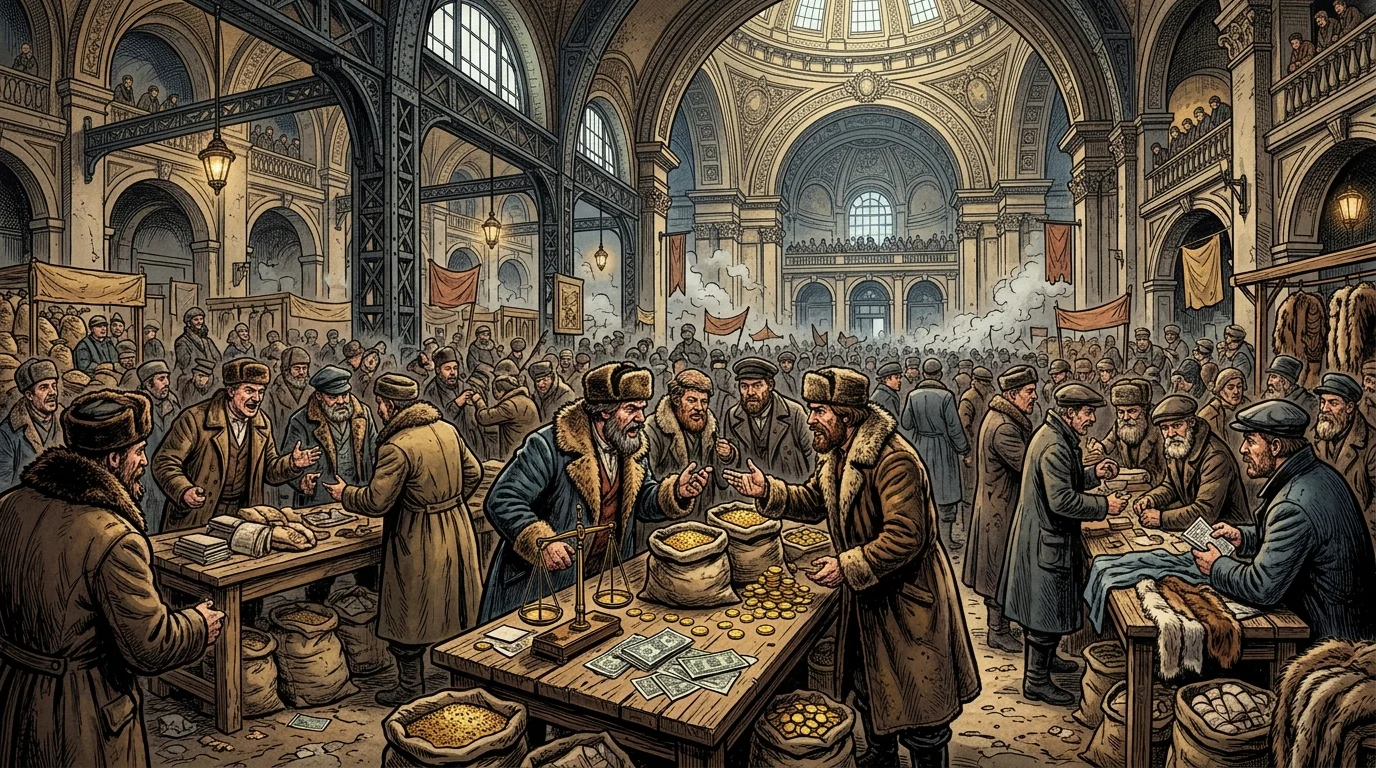
To connect state industrial trusts, agricultural cooperatives, and private NEPmen, the Soviet government revived the network of commodity exchanges (tovarnye birzhi) that had existed under the Empire. Opened in late 1921 and formally chartered in 1922 inside the neoclassical building of the former Moscow Stock Exchange on Ilyinka Street, the Moscow Central Goods Exchange (Moskovskaya Tovarnaya Birzha) rapidly became the nerve center of Soviet wholesale commerce. By 1923–1924, roughly 70 to 100 provincial commodity exchanges operated across the Soviet Union, registering millions of rubles in wholesale contracts for grain, textiles, timber, metals, and oil products.
Crucially, the reintroduction of foreign trade and hard currency required an organized financial market where exchange rates could be discovered and regulated. During early 1922, illegal curb trading in gold coins, Tsarist banknotes, US dollars, and British pounds flourished on the streets surrounding Ilyinka Street in Moscow—an open-air black market colloquially known as the Amerikanka or “Black Exchange” (Chernaya Birzha). Rather than relying solely on police raids by the OGPU, Narkomfin opted to absorb and regulate currency trading through official institutions.
On October 20, 1922, Sovnarkom issued a decree authorizing the creation of specialized Currency and Securities Sections—known as fondovye otdely (“stock sections”)—attached to the Moscow Goods Exchange and major regional commodity exchanges in Petrograd (Leningrad), Kharkov, Kiev, Odessa, Tiflis, Baku, and Vladivostok. The Moscow Fondovy Otdel opened its trading floor in February 1923. Membership was open to state banks, joint-stock credit institutions, state industrial trusts, cooperative unions, and vetted private traders who paid substantial membership dues. On the floor of the fondovye otdely, brokers traded four principal categories of financial instruments:
- The Gold-Backed Chervonets and Sovznaki: Between November 1922 and February 1924, Russia operated a dual-currency system in which the chervonets floated daily against the depreciating sovznak. State trusts and NEPmen used the exchange to dump sovznaki and acquire chervontsy, turning the trading floors into what contemporaries called “chervonets exchanges” (chervonnye birzhi).
- Foreign Currencies and Bullion: Licensed participants bought and sold British pounds sterling, US dollars, Swedish kronor, and gold bullion, with Gosbank and Narkomfin’s Special Currency Office intervening directly on the floor to keep the chervonets at or near its gold parity against sterling and the dollar.
- Soviet State Lottery and Reconstruction Bonds: Beginning with the First 6 Percent State Lottery Loan of October 1922 (denominated in 5-ruble and 25-ruble gold bonds totaling 100 million gold rubles), the Soviet state issued domestic bonds to close budget gaps without printing paper money.
- Commercial Bills and Joint-Stock Shares: Short-term trade bills discounted by state trusts and shares of mixed state-private joint-stock banks and trading companies also changed hands under Narkomfin supervision.
Speculation, Compulsory Bonds, and the 1924 Monetary Reform
Trading on the Moscow Fondovy Otdel and the parallel Ilyinka curb market quickly exposed the contradictions of a market-based currency operating inside a socialist state. Throughout 1923, as chervontsy grew from less than 10 percent of the real money supply to over 75 percent, the velocity of the dying sovznak accelerated violently. Workers paid in sovznaki rushed to convert their wages within hours, while rural peasants demanded payment in chervontsy or goods, contributing to the “Scissors Crisis” of autumn 1923, when industrial prices soared relative to agricultural prices.
In February and March 1924, Sokolnikov executed the final stage of the Soviet monetary reform. The printing of sovznaki was permanently halted on February 15, 1924. Narkomfin issued new state Treasury notes in small denominations of 1, 3, and 5 gold rubles (alongside silver and copper coinage), legally convertible into Gosbank chervontsy at the fixed ratio of 10 new rubles per 1 chervonets. On March 7, 1924, the final redemption rate for old paper money was set at 50,000 rubles of the 1923 pattern—equivalent to 50 billion pre-1922 sovznak rubles—for 1 new gold ruble. For a brief window in 1924 and 1925, the Soviet chervonets achieved international credibility, winning official or unofficial quotations on foreign exchanges in London, Berlin, Riga, Rome, Constantinople, and Harbin.
Inside the USSR, the fondovye otdely also became the arena for intense arbitrage in Soviet domestic bonds. Because voluntary investor appetite remained weak after the 1918 repudiation and Civil War hyperinflation, Narkomfin resorted to compulsory placements: wage earners had bond subscriptions deducted from their paychecks, state enterprises were required to hold reserve funds in state bonds, and private NEPmen were forced to purchase bonds in proportion to their business tax assessments. Recipients immediately dumped these obligatory bonds onto the fondovye otdely and curb markets for cash, driving market prices down by 30 to 50 percent below face value and yielding annualized returns exceeding 30 to 40 percent for speculative buyers. By late 1923 and 1924, Narkomfin abandoned compulsory placements for the bourgeoisie and instructed Gosbank to buy back discounted state lottery bonds on the Moscow exchange, turning the Fondovy Otdel into a lively secondary bond market whose turnover grew from roughly 295 million gold rubles in fiscal year 1922/23 to over 350 million rubles at its peak.
Credit Expansion, the Loss of Convertibility, and Stalin’s Liquidation of the Exchanges
The golden age of the chervonets and the NEP exchanges proved short-lived. By late 1925, political leadership inside the Communist Party shifted toward rapid state-financed industrialization. Under pressure from the Supreme Council of the National Economy (VSNKh), Gosbank expanded long-term credit to heavy industry well beyond the growth of agricultural goods and export revenues. Domestic prices climbed, creating a widening gap between the internal purchasing power of the chervonets and its official external gold parity.
Private NEPmen and currency speculators on the Moscow Fondovy Otdel and the black market responded by buying gold coins, British pounds, and US dollars at the official rate to finance contraband imports or capital flight. Between late 1925 and spring 1926, Gosbank lost tens of millions of rubles from its gold and foreign exchange reserves trying to defend parity through open-market currency interventions. Facing the exhaustion of its bullion buffer, the Politburo sided with industrial planners over Narkomfin’s sound-money orthodoxies. Sokolnikov was removed as Finance Commissar in January 1926, and in Spring 1926 Gosbank ceased supplying gold and foreign exchange to private buyers on the exchanges. A decree of July 9, 1926 prohibited the export of chervontsy abroad, and on March 21, 1928, the Soviet government banned the re-importation of Soviet banknotes into the USSR. The chervonets ceased to be an internationally convertible hard currency and became a closed domestic fiat unit whose official exchange rate was set by administrative fiat.
As Joseph Stalin consolidated power and launched the First Five-Year Plan (1928–1932), the institutional foundations of the NEP market economy were systematically dismantled. Prohibitive retroactive taxes, police confiscations, and criminal prosecutions for “speculation” wiped out the NEPmen. State syndicates replaced wholesale market contracting with centralized physical allocation of materials, rendering commodity bourses redundant. Finally, the Credit Reform of January 30, 1930 abolished commercial credit and bills of exchange between state enterprises, funneling all settlement directly through Gosbank accounts. Stripped of private traders, commercial paper, and currency arbitrage, the Moscow Goods Exchange and all remaining fondovye otdely were permanently closed in early 1930—ending organized securities and currency trading in Russia until the twilight of the Soviet Union in 1990–1991.
Theoretical & Balance-Sheet Transmission Mechanism
In the Kindleberger–Minsky taxonomy of financial instability (Kindleberger, 1978; Minsky, 1986) and Irving Fisher’s (1933) debt-deflation framework, speculative asset booms become systemic crises when credit expansion shifts balance sheets from hedge finance (cash flows covering principal and interest) to speculative and Ponzi finance (relying on rising asset prices and short-term margin roll-overs).
Once monetary tightening or an exogenous shock halts price appreciation, forced margin liquidations trigger Fisherian debt-deflation: fire-sale asset discounts erode bank collateral values, contracting credit supply across the real economy.
Sources and Further Reading
- Lyndon Moore and Jakub Kaluzny, “ Regime Change and Debt Default: The Case of Russia, Austro-Hungary, and the Ottoman Empire Following World War One“, Explorations in Economic History, 2005. Peer-Reviewed / Academic Research
- Kim Oosterlinck and John S. Landon-Lane, “ Hope Springs Eternal – French Bondholders and the Soviet Repudiation (1915–1919)“, Review of Finance, 2006. Peer-Reviewed / Academic Research
- Vincent Barnett, “ Soviet Commodity Markets during NEP“, The Economic History Review, 1995. Peer-Reviewed / Academic Research
- Yurii Goland, “ Currency Regulation in the NEP Period“, Europe-Asia Studies, 1994. Peer-Reviewed / Academic Research
- Jon Lundesgaard and Victoria V. Tevlina, “ Profit under the Soviets: Timber Concessions, Western Interests and the Monetary Reforms under NEP“, Revolutionary Russia, 2021. Peer-Reviewed / Academic Research
- Vincent Barnett, “ Kondratiev and Economic Policy during NEP“, Palgrave Macmillan, 1998. Peer-Reviewed / Academic Research
- Filip Novokmet, Thomas Piketty, and Gabriel Zucman, “ From Soviets to Oligarchs: Inequality and Property in Russia, 1905–2016“, National Bureau of Economic Research (NBER Working Paper No. 23712), 2017. Peer-Reviewed / Academic Research
- Irving Fisher — "The Debt-Deflation Theory of Great Depressions," Econometrica 1, no. 4 (FRASER Federal Reserve Archive, 1933): 337–357 Central Bank / Monetary Authority
- Charles P. Kindleberger & Robert Z. Aliber — Manias, Panics, and Crashes: A History of Financial Crises (Palgrave Macmillan) Peer-Reviewed / Academic Research
Cite This Historical Dossier (APA / Chicago)
APA (7th ed.): Ç., S. (Ed.). (2026). From Sovereign Default to the Chervonets Exchanges: Soviet Markets Under NEP, 1918–1930. In Forgotten Fortunes Historical Monograph Series (Forgotten Fortunes Editorial Desk). https://forgottenfortunes.net/bolshevik-1918-debt-default-nep-chervonets-exchanges/
MLA (9th ed.): Ç., Soner, ed. "From Sovereign Default to the Chervonets Exchanges: Soviet Markets Under NEP, 1918–1930." Forgotten Fortunes: Financial & Monetary History Archive, 2026, https://forgottenfortunes.net/bolshevik-1918-debt-default-nep-chervonets-exchanges/.
Chicago (17th ed.): Ç., Soner, ed. "From Sovereign Default to the Chervonets Exchanges: Soviet Markets Under NEP, 1918–1930." Forgotten Fortunes Historical Monograph Series (Forgotten Fortunes Editorial Desk), September 5, 2026. https://forgottenfortunes.net/bolshevik-1918-debt-default-nep-chervonets-exchanges/.
Have an idea for another financial history documentary or article? Request a story →