
In This Article
Around 1510—and again on a second diplomatic journey around 1512–1514—a young Andalusian-born Moroccan diplomat named al-Hasan ibn Muhammad al-Wazzan al-Fasi crossed the Sahara from Fez and Sijilmasa with his uncle on an embassy to the court of the Songhai Emperor Askia Muhammad I (r. 1493–1528) and the lingering western tributary rulers of the Mali Empire. Captured in 1518 by Christian corsairs in the Mediterranean and presented to Pope Leo X in Rome—where he was baptized as Johannes Leo de Medicis, known to history as Leo Africanus—al-Wazzan completed his famous Italian geographical treatise, Della descrittione dell’Africa (“Description of Africa”), in 1526 (published in Venice by Giovanni Battista Ramusio in 1550). [1]
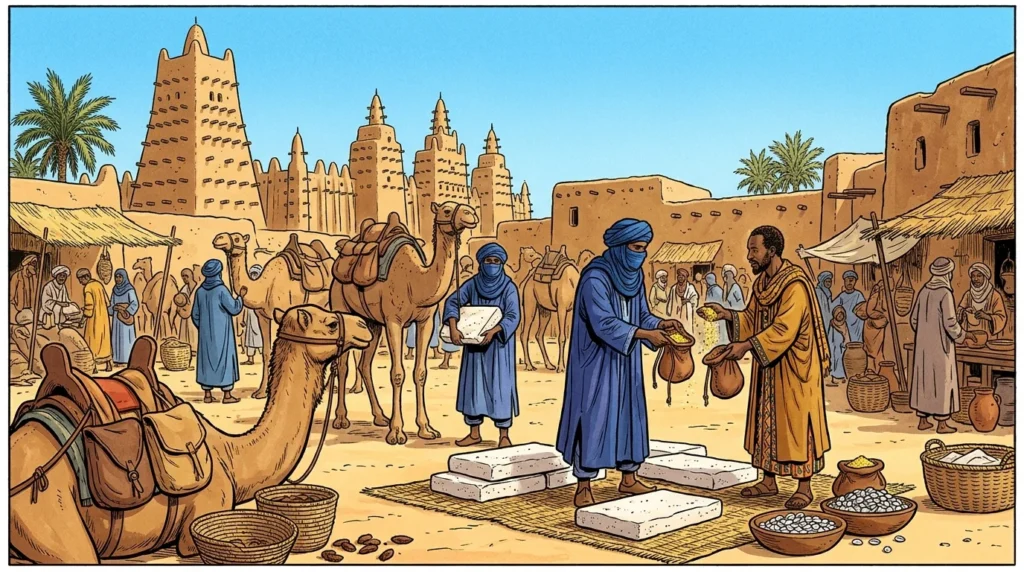
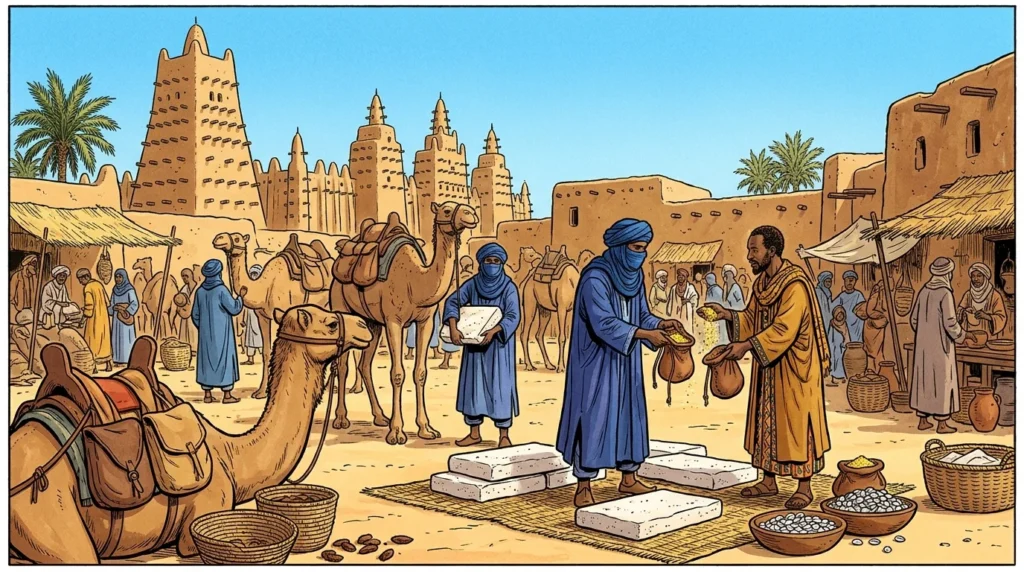
Book VII of Leo Africanus’s Description of Africa preserves the most detailed eyewitness price schedule and monetary anatomy of sixteenth-century West Africa ever recorded. Observing the bustling markets of Timbuktu, Jenne, and Gao at the height of their commercial prosperity, Leo Africanus documented an economy with an extraordinary hierarchy of purchasing power: a city where imported handwritten Arabic books commanded higher profit margins than any luxury commodity on earth, where North African cavalry horses sold for 40 to 50 gold ducats (mithqals) apiece, where Saharan rock salt could surge to 80 ducats a camel load during supply bottlenecks, and where everyday bazaar transactions were settled through a multi-tiered currency of uncoined gold grains, cowrie shells, iron bars, and standardized copper rods smelted at Takedda—a fragile equilibrium that was violently overturned when Sultan Ahmad al-Mansur of Morocco launched the musket-armed conquest of the Niger Bend at the Battle of Tondibi in 1591. [2]
Leo Africanus’s Price Schedule in Timbuktu and Gao (c. 1510–1526)
When Leo Africanus entered Timbuktu and Gao during the reign of Askia Muhammad, he found an urban consumer market bifurcated between abundant local agricultural staples and fabulously expensive trans-Saharan imports. Irrigated by the seasonal floods of the Niger River and supplied by fleets of cargo canoes from Jenne, the grain, cattle, milk, and butter markets around Timbuktu were remarkably cheap and well provisioned. By contrast, manufactured and mineral goods hauled 1,500 miles across the Sahara on camelback commanded staggering prices denominated in the gold mithqal (which Leo translated for Italian readers as the Venetian gold ducat, roughly 4.25 to 4.5 grams of pure gold): [3]
- Handwritten Arabic Manuscripts (The Highest-Margin Commodity): In his most celebrated passage on Timbuktu, Leo observed that the king richly maintained scores of judges (qadis), doctors of law (ulama), and priests at royal expense, and that “hither are brought diverse manuscripts or written books out of Barbarie [North Africa], which are sold for more money than any other merchandize.” Copyists, calligraphers, and paper merchants in Fez, Tlemcen, and Cairo exported treatises on Maliki jurisprudence, grammar, astronomy, medicine, and Quranic exegesis to wealthy Timbuktu bibliophiles (such as the Aqit and Baghayogho families), paying 5 to 20 gold mithqals or more for rare volumes.
- North African Cavalry Horses (40 to 50 Gold Ducats): Because trypanosomiasis limited local horse breeding in the savanna, imported Barbary warhorses were the ultimate capital military good. Leo noted that small local horses served only for travelers and courtiers, whereas fine horses brought by Arab-Berber merchants from North Africa were immediately inspected by the ruler’s officers, who had the right of first refusal and paid 40 to 50 gold ducats per mount (equivalent in contemporary Songhai valuations to 12 to 20 enslaved captives per horse).
- European and Venetian Textiles (4 to 30 Ducats a Yard): Artisans in Timbuktu and Jenne wove abundant local cotton cloth, but the royal court and merchant elite prized imported European woolens and silks transported via Venice and North African ports. Coarse European broadcloth sold in Gao for 4 gold ducats an ell (yard), mid-grade scarlet and Venice cloth fetched 15 ducats a yard, and fine crimson or purple cloth ornamented with gold thread sold for 30 gold ducats a yard.
- Taghaza Rock Salt (Up to 80 Ducats a Camel Load During Shortages): Timbuktu and Jenne possessed neither marine salt pans nor inland brine springs; all salt came from the desert mines of Taghaza, located twenty days’ journey north of Timbuktu. Because the Taghaza miners depended entirely on food brought from the south or north and periodically fled when desert raids disrupted provisions, salt prices were acutely volatile. Leo recorded that while a camel load of two rock-salt slabs cost a few ducats at the mine, he personally witnessed the price of a single camel load of salt spike to 80 gold ducats in the markets of the Niger Bend and Gao when caravan deliveries were delayed.
Multi-Tiered Money: Unstamped Gold, Takedda Copper Rods, Iron, and Cowries
How did merchants and ordinary townspeople settle transactions across a price spectrum ranging from a 50-ducat warhorse down to a bowl of millet or a bundle of firewood? Both Leo Africanus and earlier Arab chroniclers (including Ibn Battuta, who visited the region in 1352–1353) described a carefully segmented monetary system that avoided the cost of operating a state gold mint: [4]
- Wholesale Currency — Unstamped Gold Ingots and Gold Dust (Tibr): For wholesale purchases above one-sixth of a mithqal, merchants in Timbuktu and Jenne used pure gold dust and small unstamped gold nuggets or cast pieces without any royal insignia, weighed on pocket balance scales against standardized glass and brass weights.
- Mid-Tier Currency — Standardized Copper Rods from Takedda and Iron Bars: At the oasis and mining center of Takedda (modern Azelik in Niger, east of Gao), local laborers mined malachite copper ore, smelted it in clay furnaces, and cast the metal into standardized bars or rods measuring roughly a span and a half in length. As Ibn Battuta documented, Takedda produced two denominations of copper rods: thick copper rods, which exchanged at 400 rods to one gold mithqal, and thin copper rods, which exchanged at 600 to 700 rods to one gold mithqal. Thick rods purchased cattle, grain, and garments, while thin rods bought meat and firewood. In the river port of Jenne, Leo Africanus noted that small-scale trade similarly used weighed pieces of iron for petty transactions below a quarter or sixth of a ducat.
- Retail Currency — Indian Ocean Cowrie Shells (Wada’): For the smallest everyday bazaar purchases in Timbuktu, Leo observed that inhabitants used spiral white seashells (Cypraea moneta) imported from the Maldive Islands via Cairo, Persia, and Venice, which traded at roughly 400 cowrie shells to the gold ducat in the early 1500s (later depreciating to 1,000–3,000 cowries per mithqal as European ships imported barrels of shells along the Atlantic coast).
The 1585 Taghaza Salt Crisis and the 1591 Battle of Tondibi
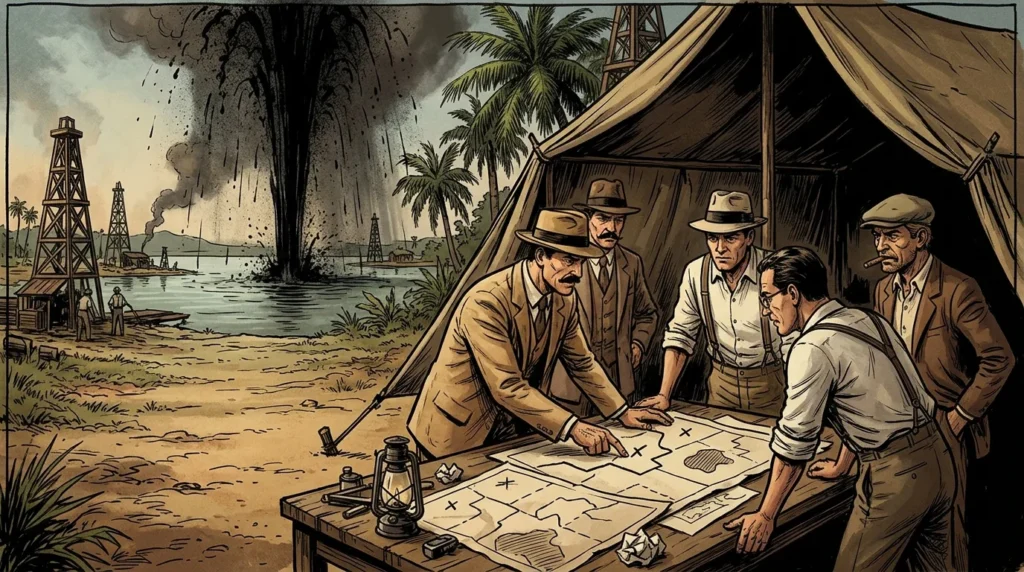
The extraordinary profitability of Timbuktu’s gold-for-salt exchange ultimately drew a fatal foreign invasion. Following his triumph over King Sebastian of Portugal at the Battle of Alcácer Quibir (Battle of the Three Kings) in 1578, the Saadian Sultan of Morocco, Ahmad al-Mansur (r. 1578–1603), sought direct control over the sources of West African gold to finance his state and counter Ottoman and Spanish power. [5]
Al-Mansur struck first at the monetary jugular of the Niger Bend: the Taghaza salt mines. Claiming universal Islamic sovereignty over desert mineral deposits, the Moroccan sultan demanded in the 1580s that the Songhai Emperor Askia Ishaq II pay a tax of one gold mithqal on every camel load of salt extracted at Taghaza. When Songhai refused and in 1585 a Moroccan force of 200 musketeers occupied Taghaza, the Tuareg salt miners abandoned Taghaza en masse and opened new salt pans further south at Taoudenni, triggering an immediate salt-supply shock across the Niger Bend. [6]
Determined to seize the riverine gold emporia outright, Sultan Ahmad al-Mansur organized an unprecedented trans-Saharan military expedition in October 1590. Commanded by Judar Pasha, a Spanish-born eunuch convert (uluj) from Granada, an elite Moroccan strike force of 4,000 soldiers—half of them Andalusian, European renegade, and Moroccan infantry armed with matchlock arquebuses (muskets), accompanied by six English-cast bronze cannon, 8,000 pack camels, and 1,000 cavalry horses—accomplished a grueling 135-day march across the Sahara, reaching the Niger River near Gao at the end of February 1591. [7]
On March 13, 1591 (or April 1591 according to variant calendar conversions), Judar Pasha’s 2,500 surviving musketeers confronted Askia Ishaq II’s imperial Songhai army of roughly 18,000 cavalry and 9,700 infantry on the plain of Tondibi, thirty miles north of Gao. Although Askia Ishaq II drove a herd of 1,000 stampeding long-horned cattle toward the Moroccan lines to break their formation, Judar Pasha’s disciplined volleys of gunfire and cannon shot stampeded the cattle back into the Songhai ranks and cut down the charging armored cavalry. Within hours, the Songhai Empire collapsed. [8]
The Economic Aftermath: Plunder of the Libraries and the Collapse of Caravan Peace
Ironically, the Moroccan conquerors never found the legendary mountains of gold they had imagined. Because Gao and Timbuktu were commercial clearinghouses rather than mining centers—the actual mines lay hundreds of miles further south in Bambuk, Bure, and Akan beyond the reach of Moroccan muskets—Judar Pasha found Gao a modest town of mud-brick houses and shifted his headquarters to Timbuktu in May 1591. Even so, the immediate plunder extracted by successive Moroccan governors (Judar Pasha and Mahmud ibn Zergun) was immense enough to earn Sultan Ahmad al-Mansur the epithet al-Dhahabi (“The Golden”) in Marrakesh, delivering an initial tribute of 10,000 ounces of gold and 200,000 gold mithqals looted from Timbuktu’s merchant houses and scholarly elites.
In October 1593, after Timbuktu’s citizens protested Moroccan military requisitions, Pasha Mahmud ibn Zergun arrested more than seventy of the Sankore Mosque’s leading jurists—including Ahmad Baba al-Timbukti, whose personal library of 1,600 volumes was confiscated—and deported them in chains across the Sahara to Marrakesh. Deprived of a unified imperial state capable of policing the desert-edge routes against Tuareg, Fulani, and Bambara raids, the Niger Bend descended into chronic warfare under the semi-independent Moroccan Arma garrison caste. While gold dust increasingly flowed southward to European ships at Elmina and the Atlantic coast, Timbuktu’s century of commercial peace—when Arabic manuscripts outpriced every ware in the bazaar—passed into history.
Theoretical & Balance-Sheet Transmission Mechanism
In the Kindleberger–Minsky taxonomy of financial instability (Kindleberger, 1978; Minsky, 1986) and Irving Fisher’s (1933) debt-deflation framework, speculative asset booms become systemic crises when credit expansion shifts balance sheets from hedge finance (cash flows covering principal and interest) to speculative and Ponzi finance (relying on rising asset prices and short-term margin roll-overs).
Once monetary tightening or an exogenous shock halts price appreciation, forced margin liquidations trigger Fisherian debt-deflation: fire-sale asset discounts erode bank collateral values, contracting credit supply across the real economy.
Sources and Further Reading
- Mark Cartwright, “ Leo Africanus,” World History Encyclopedia, 2019. Historical & Financial Reference
- Encyclopedia.com, “ Leo Africanus,” Gale Encyclopedia of World History, 2020. Historical & Financial Reference
- Library of Congress, “ Ancient Manuscripts from the Desert Libraries of Timbuktu: Exhibition Items,” Library of Congress Exhibitions, 2003. Official / State Archive
- Mark Cartwright, “ The Salt Trade of Ancient West Africa,” World History Encyclopedia, 2019. Historical & Financial Reference
- Mark Cartwright, “ Songhai Empire,” World History Encyclopedia, 2019. Historical & Financial Reference
- South African History Online, “ Songhai, African Empire, 15-16th Century,” South African History Online (SAHO), 2019. Historical & Financial Reference
- Irving Fisher — "The Debt-Deflation Theory of Great Depressions," Econometrica 1, no. 4 (FRASER Federal Reserve Archive, 1933): 337–357 Central Bank / Monetary Authority
- Charles P. Kindleberger & Robert Z. Aliber — Manias, Panics, and Crashes: A History of Financial Crises (Palgrave Macmillan) Peer-Reviewed / Academic Research
Cite This Historical Dossier (APA / Chicago)
APA (7th ed.): Ç., S. (Ed.). (2026). Books Pricier Than Gold: Leo Africanus on Timbuktu's Markets and the 1591 Tondibi Shock. In Forgotten Fortunes Historical Monograph Series (Forgotten Fortunes Editorial Desk). https://forgottenfortunes.net/leo-africanus-timbuktu-markets/
MLA (9th ed.): Ç., Soner, ed. "Books Pricier Than Gold: Leo Africanus on Timbuktu's Markets and the 1591 Tondibi Shock." Forgotten Fortunes: Financial & Monetary History Archive, 2026, https://forgottenfortunes.net/leo-africanus-timbuktu-markets/.
Chicago (17th ed.): Ç., Soner, ed. "Books Pricier Than Gold: Leo Africanus on Timbuktu's Markets and the 1591 Tondibi Shock." Forgotten Fortunes Historical Monograph Series (Forgotten Fortunes Editorial Desk), September 16, 2026. https://forgottenfortunes.net/leo-africanus-timbuktu-markets/.
Have an idea for another financial history documentary or article? Request a story →