In This Article
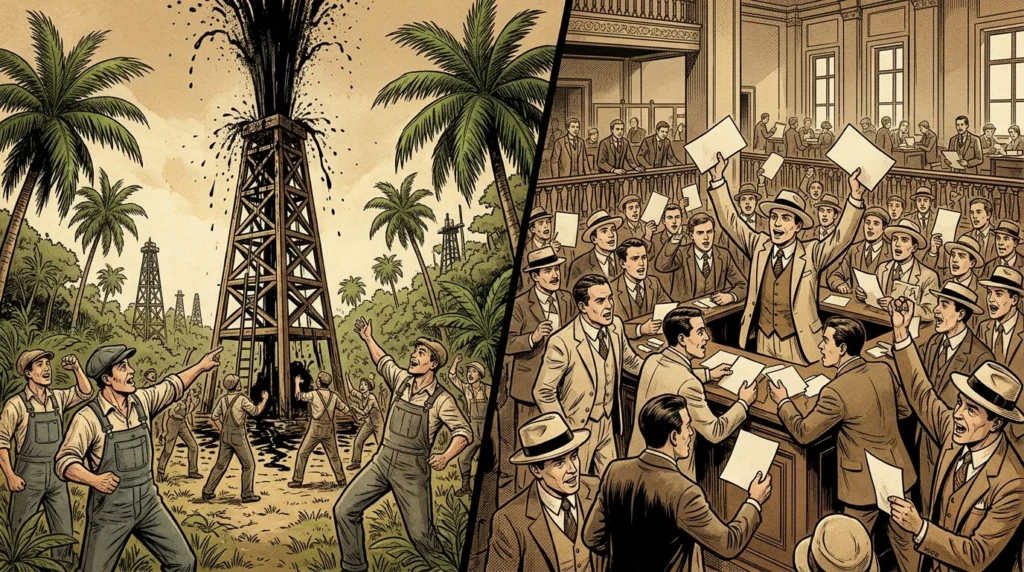
At dawn on December 14, 1922, drillers working for Venezuelan Oil Concessions Ltd. (VOC)—an operating subsidiary controlled by the Royal Dutch Shell group—shattered a subterranean sandstone cap at the Los Barrosos No. 2 well near Cabimas, on the eastern shore of Lake Maracaibo. From a depth of roughly 1,500 feet, a pressurized column of heavy crude oil blasted through the wooden derrick and shot more than 200 feet into the tropical sky. Visible from Maracaibo city across the water, the gusher roared unchecked for nine consecutive days, spraying an estimated 100,000 barrels of crude per day over the surrounding rainforest before bridging itself with silt on December 23. Nearly 900,000 barrels of oil flowed from that single bore in just over a week. Overnight, the spectacle at Cabimas transformed Venezuela from a quiet agrarian republic dependent on coffee and cacao into the focal point of an international petroleum rush, unleashing a speculative market in state concessions and setting in motion the monetary distortions that economists would later call Dutch Disease. [1]
From Asphalt Lakes to the Bolívar Coastal Field
Before the blowout at Cabimas, foreign capital viewed Venezuela primarily through the lens of sovereign default and political risk. Just two decades earlier, between December 1902 and February 1903, British, German, and Italian warships had blockaded Venezuelan ports and bombarded coastal forts to enforce payment on defaulted nineteenth-century railway bonds and civil war indemnities. When General Juan Vicente Gómez seized power in December 1908 from his ailing predecessor Cipriano Castro, he inherited a treasury burdened by more than 230 million bolívares in internal and external public obligations, alongside an economy reliant on volatile agricultural exports. [2]
Gómez recognized that consolidating a personalist autocracy required fiscal autonomy from regional caudillos and Caracas merchant-bankers. Beginning with a series of sweeping mineral grants between 1907 and 1912—including the massive Valladares, Vigas, Jimenez Arraiz, and Aranguren concessions—the state leased millions of hectares across Zulia and eastern Venezuela. Early exploration by Caribbean Petroleum and VOC yielded the Zumaque No. 1 discovery at Mene Grande in July 1914, prompting Royal Dutch Shell to construct a refinery on the nearby Dutch island of Curaçao to process heavy Maracaibo crude safely offshore. Yet American oil majors remained skeptical that the shallow waters and malarial swamps of the Maracaibo Basin could rival the Mexican Golden Lane or Oklahoma oilfields. [3]
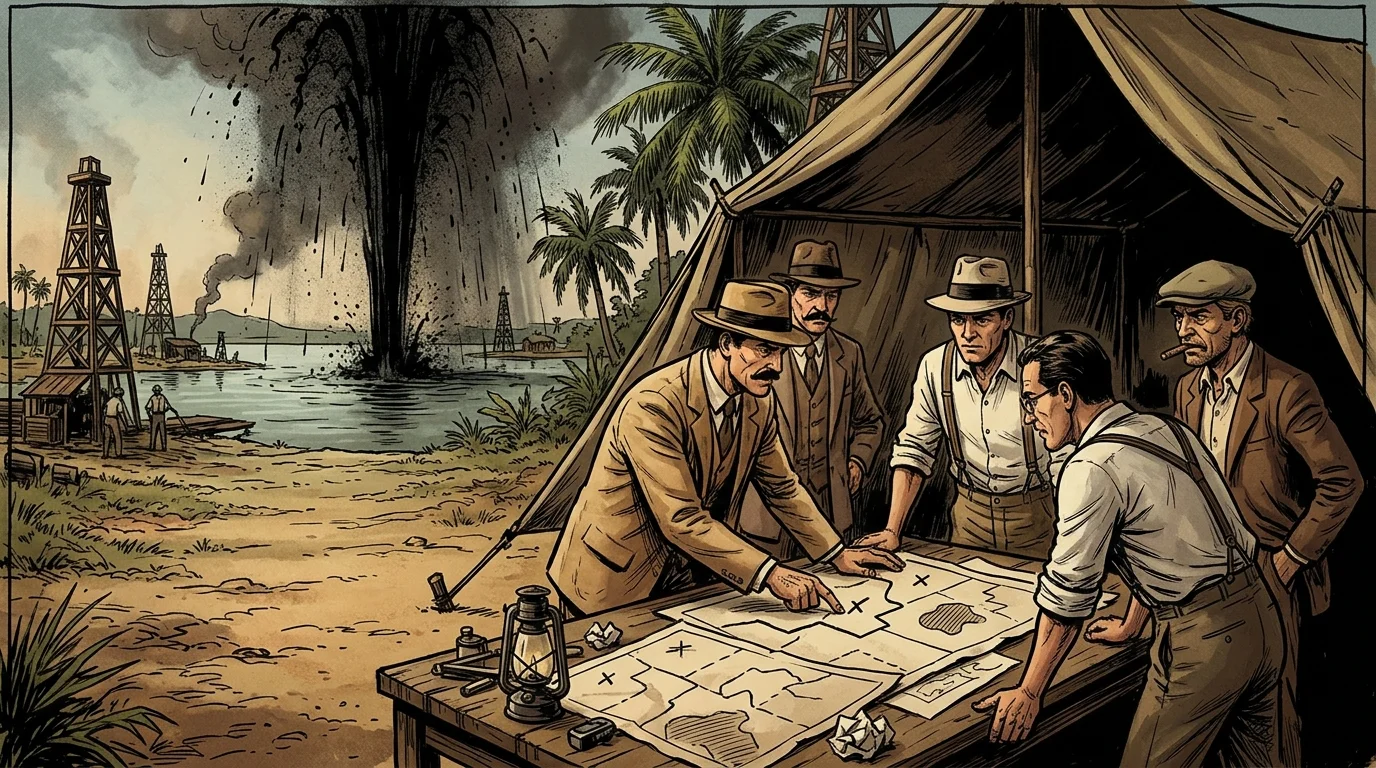
The nine-day eruption of Barroso No. 2 erased all geological doubt. Reports from petroleum geologists confirmed that the Cabimas strike tapped into a vast Miocene reservoir stretching for miles along the eastern margin of Lake Maracaibo—the Bolívar Coastal Field. Within months of the blowout, executives and landmen from Standard Oil of New Jersey, Standard Oil of Indiana (Pan American), Gulf Oil, and British syndicates converged on Caracas and Gómez’s rural stronghold in Maracay, bidding aggressively for drilling rights across the lakebed and shoreline. [4]
| Documented Figure / Metric | Historical Significance & Archival Context |
|---|---|
| $20.67 | Roosevelt's Gold Reserve Act of January 1934, which devalued the US dollar from $20.67 to $35.00 per troy ounce of gold—Venezuela refused to devalue the bolívar. |
| 60 percent | Estates across the Andes and coastal valleys faced foreclosure, agricultural exports fell from over 60 percent of non-oil trade to historic lows, and rural workers migrated toward the oil camps and urban public works. |
| 10 million bolívar | 3.03–3.06 per dollar and used to buy physical gold bullion abroad or fund an emergency 10 million bolívar export subsidy for distressed coffee and cacao producers. |
Gómez’s Concession Syndicate and the Compañía Venezolana de Petróleo
To capture the windfall generated by competing Anglo-Dutch and American oil companies, Development Minister Gumersindo Torres had worked alongside advisers imported from US oil companies to draft the Hydrocarbons Law of June 1922. A landmark of investor-friendly resource legislation, the 1922 statute standardized exploration parcels at 10,000 hectares, permitted concessions to run for forty years, lowered surface taxes, set production royalties at 10 percent (reducible to 7.5 percent for submerged lakebed or inland tracts), and granted multinational operators sweeping duty-free privileges to import drilling pipes, barges, and camp supplies. [5]
Crucially, the law institutionalized the system of reservas nacionales (national reserves). Whenever a concessionaire surveyed a 10,000-hectare exploration lot, it was allowed to retain half the acreage in checkerboard blocks of 500 hectares while returning the remaining 5,000 hectares directly to the executive branch as proven national reserves. Rather than auctioning these prime reserve blocks through transparent treasury tenders, General Gómez distributed them gratis or for nominal filing fees to his family members, military commanders, cabinet ministers, and domestic favorites—known colloquially in Caracas as the gomecista concessionaires. [6]
In June 1923, to centralize and monetize this traffic, Gómez and his inner circle—led by Lucio Baldó, Roberto Ramírez, and the dictator’s close associates—incorporated the Compañía Venezolana de Petróleo (CVP) with nominal capital of 5 million bolívares. Operating not as an active drilling enterprise but as the dictator’s personal brokerage house, CVP received vast transfers of national reserve zones across the Maracaibo Basin and immediately flipped them to foreign oil corporations for cash bonuses and overriding royalty shares. Between 1923 and 1928, CVP and favored intermediaries transferred hundreds of thousands of hectares to Gulf Oil, Lago Petroleum, and Standard Oil affiliates, generating tens of millions of bolívares in private commissions while secondary shares in Venezuelan holding vehicles—such as Lago Petroleum, Venezuelan Petroleum, and Carib Syndicate—traded feverishly on the New York Curb Exchange and in London. [7]
The 1928 Export Surge and the 1930 Sovereign Debt Payoff
Driven by intense competition along the eastern shore of Lake Maracaibo—where Lago Petroleum drilled out the shallow water strip while Gulf and VOC drilled offsetting wells along the beach and marine boundary—Venezuelan crude output expanded at an unprecedented pace. National production jumped from 2.2 million barrels in 1922 to 19.7 million barrels in 1925, and passed 106 million barrels in 1928. That year, Venezuela overtook Mexico and the Soviet Union to become the world’s second-largest petroleum producer behind the United States and the single largest oil exporter on the globe, reach 137 million barrels in 1929. [8]
Although the 1922 Hydrocarbons Law capped the direct fiscal take per barrel, the sheer volume of exports flooded the Ministry of Finance with gold-backed revenue. Under the conservative stewardship of Finance Minister Román Cárdenas and his successors, Gómez maintained rigid budgetary surpluses, modernized internal treasury accounting, and accumulated a massive gold reserve hoard held on deposit with the Banco de Venezuela. Even after the Wall Street Crash of October 1929 triggered sovereign defaults across almost every republic in South America, Venezuela’s fiscal position remained impervious. [9]
In May 1930, to commemorate the centenary of the death of Liberator Simón Bolívar (December 17, 1830), General Gómez asked the National Congress to authorize the immediate and total liquidation of Venezuela’s remaining external sovereign debt. The government transferred roughly 23.7 million bolívares in gold and foreign exchange to European diplomatic legations and bond agents, retiring the last outstanding tranches of the 1905 three-percent diplomatic debt. By the close of 1930, Venezuela stood completely free of external public debt—a solitary anomaly in a depression-stricken hemisphere.
The 1934 Gold Bolívar Shock and Early Dutch Disease
While petroleum royalties fortified the state treasury and enriched the Maracay clique, the oil enclave quietly hollowed out the traditional agrarian economy that still employed more than two-thirds of Venezuela’s population. Under the Monetary Law of June 1918, the Venezuelan bolívar was strictly defined on the gold standard at 0.2903225 grams of fine gold, fixing its mint parity against the US dollar at Bs. 5.18 (commonly traded around Bs. 5.20 per dollar).
When the Great Depression deepened and the United States abandoned the gold standard in April 1933—culminating in President Franklin D. Roosevelt’s Gold Reserve Act of January 1934, which devalued the US dollar from $20.67 to $35.00 per troy ounce of gold—Venezuela refused to devalue the bolívar. Because Caracas maintained its statutory gold parity while oil companies continued converting tens of millions of dollars into bolívares to pay domestic wages, taxes, and surface royalties, the bolívar appreciated violently against the dollar. Between early 1933 and July 1934, the exchange rate fell from roughly Bs. 5.25–6.00 per dollar to an unprecedented low of Bs. 3.04–3.09 per dollar—an appreciation of more than 55 percent in dollar purchasing power.
The macroeconomic result was a textbook demonstration of what twentieth-century economists later termed Dutch Disease. Venezuelan coffee and cacao planters, who sold their harvests in depressed world markets priced in devalued dollars and pounds sterling while paying domestic debts, freight, and rural wages in gold-hardened bolívares, saw their bolívar revenues collapse by more than half. Estates across the Andes and coastal valleys faced foreclosure, agricultural exports fell from over 60 percent of non-oil trade to historic lows, and rural workers migrated toward the oil camps and urban public works.
The 1934 Convenio Tinoco and the Birth of Differential Exchange
The hyper-valued bolívar simultaneously squeezed the foreign oil companies, which now had to surrender far more US dollars for every bolívar of local operating payroll and tax liabilities. Confronted by threats of agricultural ruin from coffee growers and protests from Standard Oil and Shell, Finance Minister Pedro Rafael Tinoco Smith negotiated an emergency monetary pact in August 1934 known as the Convenio Tinoco (Tinoco Agreement).
Under the August 1934 arrangement, the Venezuelan government abandoned passive gold-standard orthodoxy and inaugurated seventy years of state-managed foreign exchange intervention. The foreign oil companies agreed to sell their US dollars to the Venezuelan government at a fixed rate of Bs. 3.90 per dollar, provided those dollars could be absorbed by domestic commercial banks to finance private imports at Bs. 3.93. Any surplus dollars exceeding commercial import demand were purchased by the government at the gold import point of approximately Bs. 3.03–3.06 per dollar and used to buy physical gold bullion abroad or fund an emergency 10 million bolívar export subsidy for distressed coffee and cacao producers.
Following Gómez’s death in December 1935, this mechanism of multiple exchange rates—where the state captured oil-company foreign exchange at a penalized rate and resold dollars to importers at a higher rate—became a permanent fiscal pillar of the Central Bank of Venezuela (founded in 1939). Meanwhile, the domestic capital accumulated from concession royalties, real estate appreciation, and import mercantile houses laid the groundwork for organized corporate finance in the capital, culminating in the formal founding of the modern Bolsa de Comercio de Caracas in January 1947. Yet the structural paradox born in December 1922 at Barroso No. 2 endured: a state flush with petrodollars, an overvalued currency that penalized domestic production, and an economy perpetually tethered to the price of crude oil.
Theoretical & Balance-Sheet Transmission Mechanism
In the Kindleberger–Minsky taxonomy of financial instability (Kindleberger, 1978; Minsky, 1986) and Irving Fisher’s (1933) debt-deflation framework, speculative asset booms become systemic crises when credit expansion shifts balance sheets from hedge finance (cash flows covering principal and interest) to speculative and Ponzi finance (relying on rising asset prices and short-term margin roll-overs).
Once monetary tightening or an exogenous shock halts price appreciation, forced margin liquidations trigger Fisherian debt-deflation: fire-sale asset discounts erode bank collateral values, contracting credit supply across the real economy.
Sources and Further Reading
- Harvard University David Rockefeller Center for Latin American Studies, “El Barroso,” ReVista: Harvard Review of Latin America, 2015. Peer-Reviewed / Academic Research
- Rossi Guerrero, Félix P., “The Transition from Private to Public Control in the Venezuelan Petroleum Industry,” Vanderbilt Journal of Transnational Law, 1976. Peer-Reviewed / Academic Research
- Time Magazine, “Venezuela: Meritorious Dictator,” Time Archive, 1935-12-30. Historical & Financial Reference
- Fundación Empresas Polar, “Gómez, Juan Vicente,” Diccionario de Historia de Venezuela, 1997. Historical & Financial Reference
- Fundación Empresas Polar, “Tinoco Smith, Pedro Rafael,” Diccionario de Historia de Venezuela, 1997. Historical & Financial Reference
- Fundación Empresas Polar, “Agosto de 1934: El Convenio Tinoco y la Revaluación del Bolívar,” Cronología de Historia de Venezuela, 2000. Historical & Financial Reference
- U.S. Department of State, “Foreign Relations of the United States, 1950, Volume II, The United Nations; The Western Hemisphere, Document 527,” Office of the Historian, 1950. Official / State Archive
- Irving Fisher — "The Debt-Deflation Theory of Great Depressions," Econometrica 1, no. 4 (FRASER Federal Reserve Archive, 1933): 337–357 Central Bank / Monetary Authority
- Charles P. Kindleberger & Robert Z. Aliber — Manias, Panics, and Crashes: A History of Financial Crises (Palgrave Macmillan) Peer-Reviewed / Academic Research
Cite This Historical Dossier (APA / Chicago)
APA (7th ed.): Ç., S. (Ed.). (2026). Barroso No. 2, Gómez's Oil Concession Mania, and the 1934 Gold Bolívar Shock. In Forgotten Fortunes Historical Monograph Series (Forgotten Fortunes Editorial Desk). https://forgottenfortunes.net/venezuela-barroso-oil-bolivar/
MLA (9th ed.): Ç., Soner, ed. "Barroso No. 2, Gómez's Oil Concession Mania, and the 1934 Gold Bolívar Shock." Forgotten Fortunes: Financial & Monetary History Archive, 2026, https://forgottenfortunes.net/venezuela-barroso-oil-bolivar/.
Chicago (17th ed.): Ç., Soner, ed. "Barroso No. 2, Gómez's Oil Concession Mania, and the 1934 Gold Bolívar Shock." Forgotten Fortunes Historical Monograph Series (Forgotten Fortunes Editorial Desk), September 20, 2026. https://forgottenfortunes.net/venezuela-barroso-oil-bolivar/.
Have an idea for another financial history documentary or article? Request a story →