In This Article
Between 1906 and 1944, Brazil conducted the most audacious experiment in state commodity market manipulation of the twentieth century. Producing roughly 70 percent of the world’s coffee across the fertile red-earth (terra roxa) plateaus of São Paulo, Minas Gerais, and Rio de Janeiro, Brazil’s planter oligarchy repeatedly turned to foreign merchant banks in London and New York to finance state purchases of surplus beans—a policy known as valorização (“valorization”). While early interventions in 1906, 1917, and 1921 temporarily rescued export prices, the establishment of São Paulo’s permanent Coffee Institute in 1924—funded by multi-million-pound sterling loans from Lazard Brothers & Co.—unleashed a speculative credit and planting bubble centered on the Bolsa Oficial de Café de Santos. When the October 1929 Wall Street Crash severed international credit lines and caused coffee prices to plunge by two-thirds, the collapse toppled Brazil’s Old Republic and forced President Getúlio Vargas to finance a desperate Keynesian bailout by physically burning 78.2 million 60-kilogram bags of coffee—nearly three years of total global consumption. [1]

The 1906 Convênio de Taubaté and Early Coffee Valorizations
To grasp why Brazilian governments repeatedly risked sovereign solvency to corner the coffee market, one must understand the peculiar agronomy of the Arabica coffee tree. Newly planted coffee seedlings require four to five years to bear a full commercial harvest, after which they produce beans for decades with relatively modest variable labor costs. High coffee prices in the early 1890s had triggered a massive wave of planting across São Paulo’s western frontier. By the bumper harvest of 1906–1907—which yielded an unprecedented 20 million 60-kilogram bags in Brazil alone against total world consumption of roughly 16 million bags—a catastrophic glut threatened to bankrupt the planter elite (fazendeiros) who dominated the República Velha. [2]
In February 1906, the governors of São Paulo (Jorge Tibiriçá), Minas Gerais (Francisco Sales), and Rio de Janeiro (Nilo Peçanha) met in the paulista city of Taubaté to sign the historic Convênio de Taubaté. Under the pact, the state governments agreed to borrow £15 million abroad to buy surplus coffee off the market at a guaranteed minimum floor price, store the beans in European and North American port warehouses, and service the foreign debt through a surtax of three gold francs (later five francs) per exported bag, accompanied by a newly created gold-exchange stabilization board (the Caixa de Conversão) to prevent currency appreciation from eroding planter incomes in local mil-réis. [3]
When Brazil’s traditional London banker, N. M. Rothschild & Sons, initially balked at underwriting a speculative commodity corner, São Paulo turned to German coffee importer Theodor Wille and a syndicate of Hamburg, London, Paris, and New York banks led by J. Henry Schröder & Co. and National City Bank.By withholding more than 8 million bags from the market and imposing temporary taxes on new tree plantings, the 1906–1908 valorization succeeded in pushing international coffee prices up by more than 50 percent, allowing the syndicate to liquidate its stockpiles at a profit before World War I. Emboldened by that triumph, Brazilian authorities executed a second valorization in 1917–1918 using federal paper-money issues and a third valorization in 1921–1922 backed by a £9 million London loan under President Epitácio Pessoa. [4]
São Paulo’s 1924 Coffee Institute, Lazard Loans, and the Santos Bubble
When conservative President Artur Bernardes dismantled federal price-support operations in 1924, São Paulo’s powerful planters decided to transform valorization from an episodic emergency rescue into a permanent, automated cartel. In December 1924, the state created the Instituto Paulista da Defesa Permanente do Café (reorganized in 1926 as the Instituto do Café do Estado de São Paulo). Instead of buying coffee on the open market, the Institute erected a compulsory network of eleven vast interior “regulating warehouses” (armazéns reguladores). Planters were prohibited from shipping their harvest directly down the São Paulo Railway to the port of Santos; instead, every bag had to be deposited in an interior regulating warehouse, which released only a trickle of beans each month to keep spot prices artificially high on the Bolsa Oficial de Café de Santos (founded in 1917 and housed from 1922 in its grand neoclassical palace on Rua XV de Novembro). [5]
To prevent planters from going bankrupt while their harvests sat locked inside interior warehouses for a year or more, the Institute acquired control of a state bank—the Banco do Estado de São Paulo (Banespa)—to advance planters up to 60–70 percent of the market value of their warehoused coffee against warehouse receipts (conhecimentos). Because Rothschilds refused to finance permanent stockpiling, the Institute turned to the aggressive London merchant bank Lazard Brothers & Co., which floated a £10 million sterling Coffee Institute bond issue in London in 1926, followed by multi-million-pound mortgage tranches and short-term revolving credits. [6]
For three intoxicating years (1926–1928), Lazard’s sterling inflows fueled an exuberant financial boom in São Paulo and Rio de Janeiro. Santos spot prices were held near 22 U.S. cents per pound—more than double production costs—generating windfall profits that washed into urban real estate, textile shares, and coffee futures on the Bolsa de Santos. Yet the permanent defense contained a fatal structural flaw: unlike the 1906 pact, the 1924 Institute never prohibited new planting. Lured by guaranteed high prices and easy Banespa credit against warehoused beans, paulista planters planted nearly one billion new coffee trees between 1920 and 1929, while rival growers in Colombia, Central America, and East Africa expanded aggressively under Brazil’s price umbrella. [7]
October 1929: The Coffee Crash and the Fall of the Old Republic
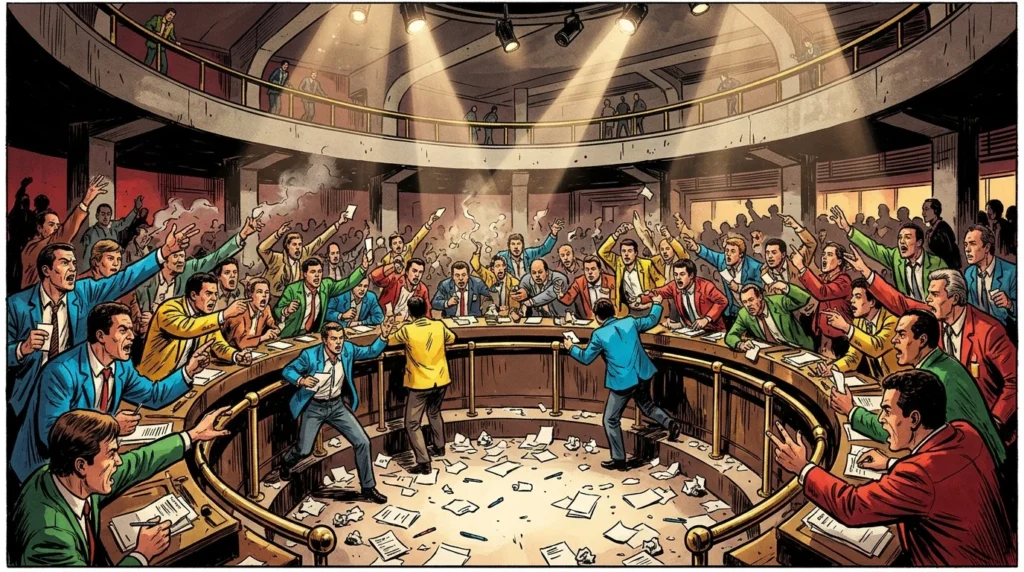
By mid-1929, following two consecutive mammoth harvests of 27 million and 29 million bags, São Paulo’s interior regulating warehouses were bursting with more than 19 million bags of unsold coffee—exceeding an entire year of world import demand. Then, in October 1929, the Wall Street stock market crash froze international capital markets simultaneously with a sharp contraction in North American and European consumer credit. [8]
Within days of the October 1929 crash, Lazard Brothers informed the São Paulo Coffee Institute that it could no longer renew maturing short-term advances unless the state pledged virtually its entire remaining coffee stockpile on punitive terms. Simultaneously, President Washington Luís—committed doggedly to defending the gold-convertible stabilization standard of the mil-réis—refused to print federal currency to bail out the paulista planters. Deprived of both London credit and federal rediscounts, Banespa halted advances against warehouse receipts, and the Bolsa de Santos descended into panic. Between September 1929 and late 1930, the New York and Santos price of Santos No. 4 coffee plunged from 22.5 cents to 8 cents per pound. In April 1930, São Paulo was forced to accept a desperate £20 million Coffee Realisation Loan underwritten by Schröders, Barings, Rothschilds, and Lazard on condition that Brazil liquidate its stockpiles over ten years and abandon permanent retention. Six months later, in October 1930, furious regional elites and military officers overthrew the Old Republic in the Revolution of 1930, installing Getúlio Vargas as provisional president.
Getúlio Vargas and the Great Burning of 78.2 Million Bags (1931–1944)
When Vargas and Finance Minister José Maria Whitaker took office—soon visited by Bank of England adviser Sir Otto Niemeyer in 1931—unsold coffee stocks had swollen past 26 million bags while the 1931 harvest promised another 28 million. Storage warehouses were full to the rafters, foreign loans were unavailable, and dumping the surplus onto world markets would have driven coffee prices to zero. In February 1931, the federal government created the Conselho Nacional do Café (succeeded in February 1933 by the directly controlled Departamento Nacional do Café, or DNC) and inaugurated a radical solution: physical destruction.
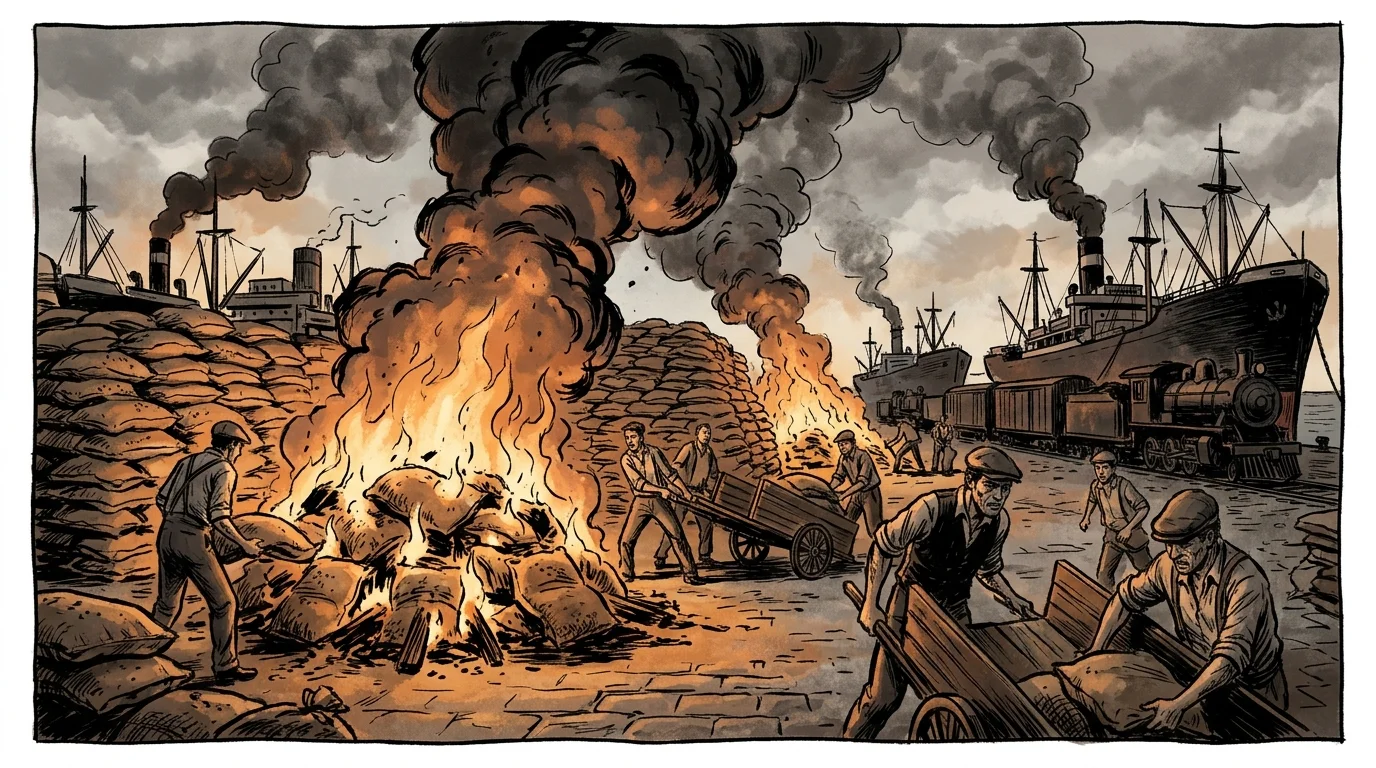
Beginning in June 1931 on the marshlands outside Santos, the DNC imposed a stiff export tax in foreign exchange (initially 10 shillings, later 15 shillings per bag) and compulsory “sacrifice quotas” that confiscated 30 to 40 percent of every planter’s harvest at token prices. Day after day for thirteen years, DNC crews heaped mountains of green coffee beans onto open fields, doused them with kerosene or crude oil, and set them ablaze under thick palls of sweet, acrid smoke that drifted for miles across São Paulo and Guanabara Bay. Millions of additional bags were dumped from barges into the South Atlantic (until fishermen complained of poisoned coastal waters) or compressed into briquettes to fire the boilers of Brazilian railway locomotives and factories.
As the celebrated Brazilian economist Celso Furtado later observed in The Economic Growth of Brazil, Vargas’s coffee-burning program inadvertently acted as a massive, homegrown Keynesian stimulus four years before John Maynard Keynes published his General Theory: by purchasing and burning unsaleable crops with domestic credit and export taxes, the state sustained domestic employment and purchasing power, which spilled over into import-substituting domestic manufacturing and propelled Brazilian industrial output forward by the mid-1930s. By the time Vargas formally ended the pyres in July 1944, Brazil had incinerated 78,214,253 sixty-kilogram bags of coffee—4.69 million metric tons, or roughly three full years of global consumption—permanently ending the era of the paulista coffee barons.
Theoretical & Balance-Sheet Transmission Mechanism
In the Kindleberger–Minsky taxonomy of financial instability (Kindleberger, 1978; Minsky, 1986) and Irving Fisher’s (1933) debt-deflation framework, speculative asset booms become systemic crises when credit expansion shifts balance sheets from hedge finance (cash flows covering principal and interest) to speculative and Ponzi finance (relying on rising asset prices and short-term margin roll-overs).
Once monetary tightening or an exogenous shock halts price appreciation, forced margin liquidations trigger Fisherian debt-deflation: fire-sale asset discounts erode bank collateral values, contracting credit supply across the real economy.
Sources and Further Reading
- Maria Teresa Ribeiro de Oliveira, “Coffee Valorization Policies in Brazil and International Finance (1906–1930),” University of Oxford Latin American Centre, 2000. Peer-Reviewed / Academic Research
- Maria Letícia Corrêa, “State Intervention, Foreign Loans, and Coffee Defense in Brazil,” Universidad de Buenos Aires Economic History Working Papers, 2017. Historical & Financial Reference
- Gustavo Pereira da Silva, “Estrangeiras e nacionais: as maiores casas exportadoras de café em Santos (1897–1930),” Estudos Econômicos (USP / SciELO Brasil), 2023. Historical & Financial Reference
- Marcelo de Paiva Abreu, “A Missão Niemeyer e a crise financeira brasileira de 1930–1931,” Revista de Administração de Empresas (FGV / SciELO Brasil), 1974. Historical & Financial Reference
- University of Glasgow Economic History Repository, “British Merchant Banking, Lazard Brothers, and Brazilian Coffee Valorization Loans in the Interwar Period,” University of Glasgow Theses Archive, 2018. Peer-Reviewed / Academic Research
- João Manuel Cardoso de Mello, “O Capitalismo Tardio: Acumulação Cafeeira, Crise de 1929 e Defesa do Café,” Universidade Estadual de Campinas (UNICAMP), 1982. Historical & Financial Reference
- Irving Fisher — "The Debt-Deflation Theory of Great Depressions," Econometrica 1, no. 4 (FRASER Federal Reserve Archive, 1933): 337–357 Central Bank / Monetary Authority
- Charles P. Kindleberger & Robert Z. Aliber — Manias, Panics, and Crashes: A History of Financial Crises (Palgrave Macmillan) Peer-Reviewed / Academic Research
Cite This Historical Dossier (APA / Chicago)
APA (7th ed.): Ç., S. (Ed.). (2026). Brazil's Coffee Valorization Bubble, the 1929 Santos Crash, and Burning 78M Bags. In Forgotten Fortunes Historical Monograph Series (Forgotten Fortunes Editorial Desk). https://forgottenfortunes.net/brazil-coffee-valorization-crash/
MLA (9th ed.): Ç., Soner, ed. "Brazil's Coffee Valorization Bubble, the 1929 Santos Crash, and Burning 78M Bags." Forgotten Fortunes: Financial & Monetary History Archive, 2026, https://forgottenfortunes.net/brazil-coffee-valorization-crash/.
Chicago (17th ed.): Ç., Soner, ed. "Brazil's Coffee Valorization Bubble, the 1929 Santos Crash, and Burning 78M Bags." Forgotten Fortunes Historical Monograph Series (Forgotten Fortunes Editorial Desk), September 20, 2026. https://forgottenfortunes.net/brazil-coffee-valorization-crash/.
Have an idea for another financial history documentary or article? Request a story →