In This Article
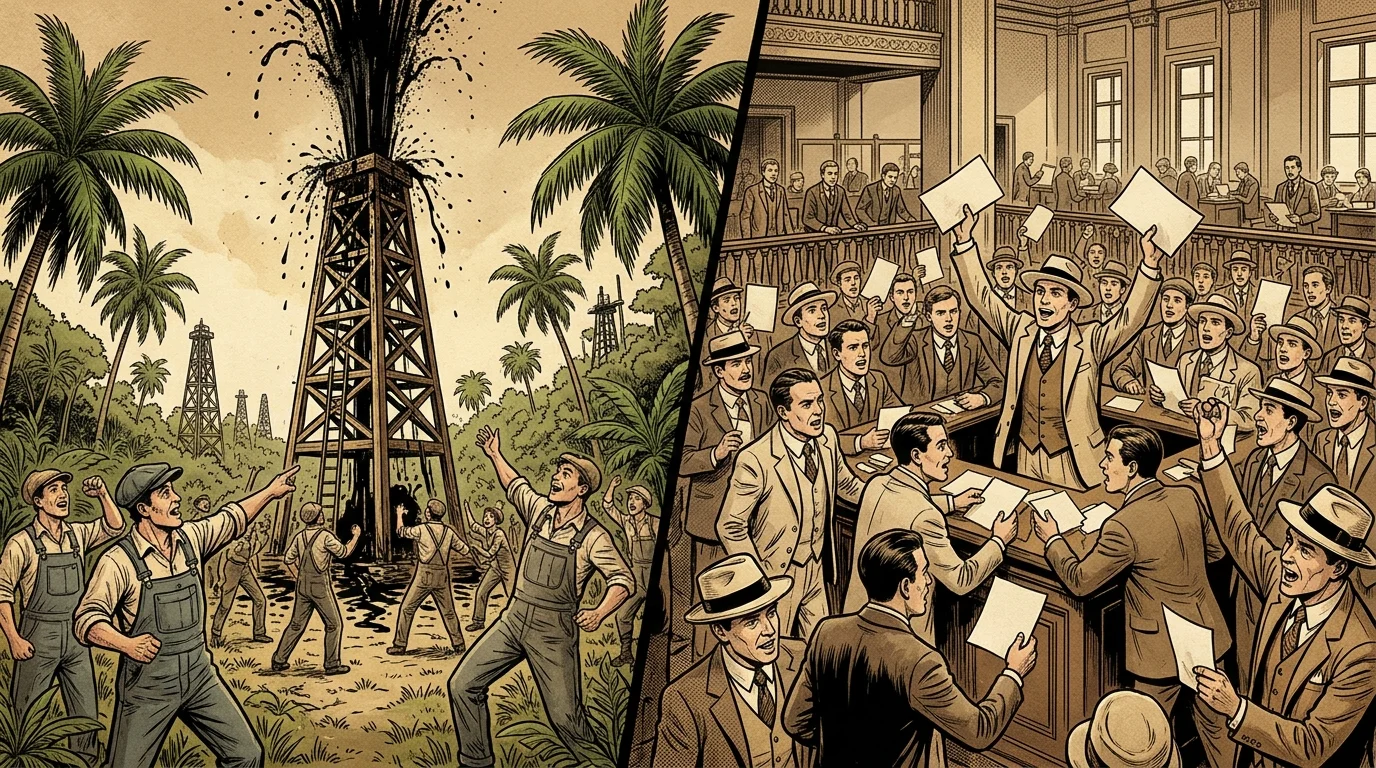
Between 1910 and 1934, Mexico’s financial markets endured one of the most dramatic cycles of monetary disintegration, resource speculation, and institutional reconstruction in modern economic history. When the Mexican Revolution erupted against President Porfirio Díaz in November 1910, Mexico City possessed a nascent stock market—the Bolsa de Valores de México, originally organized on Plateros Street in 1894–1895 around silver mining shares—and a gold-backed banking system anchored by the Monetary Reform of 1905. Within five years, civil war had driven gold and silver coinage underground, flooded the country with more than twenty competing military paper currencies derisively known as bilimbiques, and paralyzed domestic stock trading. Even as domestic credit collapsed, an extraordinary petroleum boom along the Gulf Coast’s Faja de Oro (“Golden Lane”) south of Tampico turned Mexican oil shares in New York and London into objects of frenzied speculation—until abrupt saltwater intrusion into the limestone reefs in 1921–1922 collapsed well output. Only in 1932–1934 did Finance Minister Alberto J. Pani and jurist Manuel Gómez Morín construct the legal and institutional foundations of modern Mexican capital markets. [1]
From Plateros Street Mining Shares to Revolutionary Bilimbiques
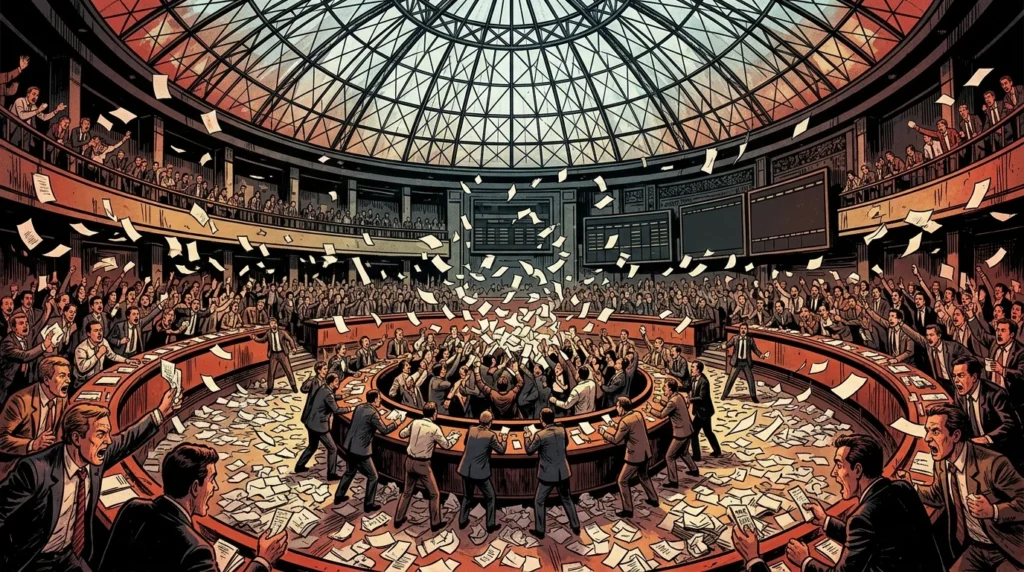
During the late Porfiriato, Mexico’s formal securities trading revolved around foreign-financed railways, banks of issue, and high-grade silver and gold mines in Hidalgo, Guanajuato, and Chihuahua. Brokers who had gathered informally outside the offices of the widow of Genaro Struck on Plateros Street (now Francisco I. Madero Avenue) chartered the Bolsa de México in October 1894, reorganizing it in 1907 as the Bolsa Privada de México S.C.L. Yet the exchange remained thin and vulnerable to political shocks. Following the overthrow of President Francisco I. Madero by General Victoriano Huerta in February 1913, the federal regime forced Mexico City’s commercial banks of issue to extend massive unbacked loans and suspended the convertibility of banknotes into metallic coin. [2]
As Gresham’s Law took hold with ruthless speed, silver pesos and gold hidalgos vanished into private hoards or fled across the United States border. To pay soldiers and requisition grain and cattle, rival revolutionary armies, state governors, and military commanders turned to printing presses. Across northern and central Mexico, more than twenty distinct military authorities issued unbacked fiat paper scrip. In Sonora, where an American mine paymaster named William Weeks had paid copper miners at Greene Cananea in paper chits that locals pronounced “bilimbiques,” the nickname spread nationwide as a popular epithet for all revolutionary paper money.
The monetary chaos reached its height between 1913 and 1916. In Chihuahua, General Francisco “Pancho” Villa printed hundreds of millions of pesos in large, thin sheets known as sábanas (“bedsheets”) and later dos caras (“two-faces”), enforcing their acceptance at gunpoint. Simultaneously, Venustiano Carranza’s Constitutionalist movement issued its own competing paper from Monclova, Veracruz, and Mexico City, while Emiliano Zapata circulated stamped cardboard and metal tokens in Morelos. Because each military reversal rendered the losing faction’s currency worthless overnight—and because crude lithography invited industrial-scale counterfeiting—merchants quoted prices in multiple parallel exchange rates and refused paper scrip whenever troops marched out of town. [3]
The 1916 Infalsificables Crash and the Return to Gold Coin
Once Carranza’s Constitutionalist forces secured control of Mexico City in late 1915, Finance Secretary Luis Cabrera attempted to extinguish the competing bilimbiques through a single, standardized national currency. To defeat counterfeiters, the Carranza government contracted the American Bank Note Company in New York to engrave 500 million pesos of high-security intaglio notes officially heralded as infalsificables (“uncounterfeitables”). Introduced into circulation in May 1916 with an official promise of backing at 20 centavos gold per paper peso, the infalsificables were intended to retire the older Veracruz and Constitutionalist issues. [4]
Without sufficient metallic reserves in the treasury or fiscal discipline to halt military deficit spending, however, fine New York engraving could not manufacture monetary credibility. Within weeks of their debut in May 1916, the infalsificables began a catastrophic freefall against gold and U.S. dollars. By August 1916, a paper peso fetched barely three centavos in gold; by November 1916, its market value had fallen below a fraction of a centavo, triggering bread riots and strikes across Mexico City as workers demanded wages in silver or gold coin. Late in November 1916, Carranza bowed to reality and decreed that taxes, wages, and commercial obligations must be paid exclusively in metallic coin. For the next nine years—until the founding of the Banco de México in September 1925—Mexico operated almost entirely on a hard-money regime of gold and silver coins, starving domestic banking and freezing the Mexico City stock exchange. [5]
Tampico’s Faja de Oro: The Global Mania for Mexican Oil Shares
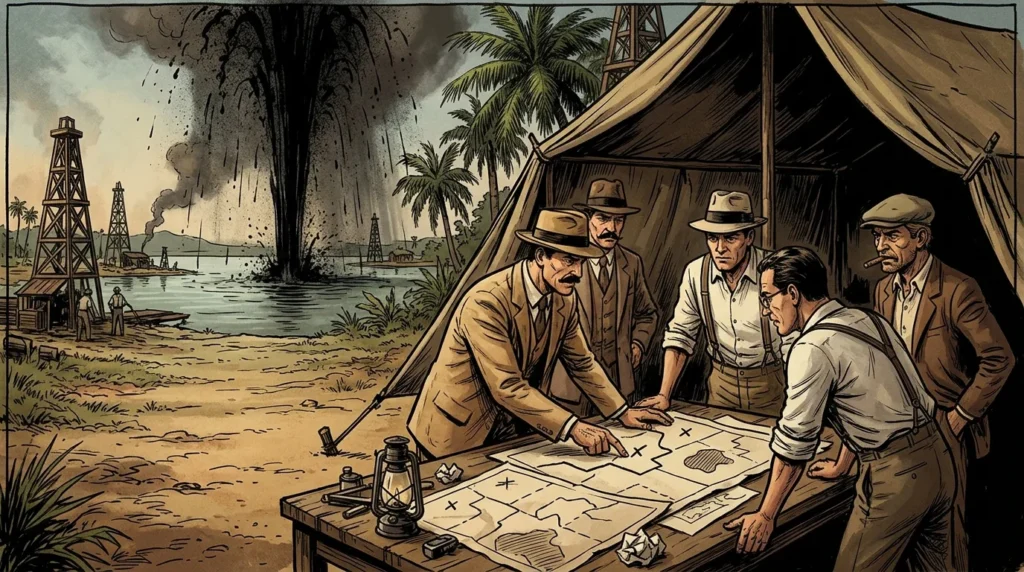
While revolutionary warfare and currency collapse crippled Mexico’s interior economy, an enclave along the northern Veracruz coast experienced one of the most lucrative commodity booms of the twentieth century. Beginning in 1901 across the Ebano heavy-oil seeps west of Tampico, Californian prospector Edward L. Doheny—founder of the Mexican Petroleum Company and its operating subsidiary, the Huasteca Petroleum Company—and British engineering contractor Weetman Pearson (Lord Cowdray), founder of the Compañía Mexicana de Petróleo El Águila (Mexican Eagle Oil Company), unlocked a subterranean fortune. [6]
The geological prize was the Faja de Oro (“Golden Lane”), a narrow, 80-kilometer crescent-shaped subterranean limestone atoll reef running southward from Dos Bocas toward Tuxpan. Because the cavernous El Abra limestone was extraordinarily porous and sat atop a high-pressure subterranean aquifer, wells drilled into the crest of the reef did not require mechanical pumping; pressurized underground water drove stupendous gushers to the surface. After Pearson’s Dos Bocas No. 3 well blew out in a legendary inferno in July 1908, both Pearson and Doheny struck historic gushers in 1910 at Potrero del Llano No. 4 and Juan Casiano No. 7. In February 1916, at the height of World War I demand for naval fuel oil, Doheny’s geologist Ezequiel Ordóñez brought in Cerro Azul No. 4—the world’s most famous oil gusher, which shot a column of crude 180 meters into the air and flowed at a measured rate exceeding 260,000 barrels per day. [7]
Because the Tampico oil zone was shielded by coastal lagoons, private armed guards, and British and American warships anchored offshore, export volumes soared throughout the revolution. On the New York, London, and Paris stock exchanges, shares of Doheny’s Mexican Petroleum (“Mex Pete”) and Pearson’s Mexican Eagle (acquired by Royal Dutch Shell in 1919) became the premier speculative darlings of the postwar bull market. Between 1911 and 1921, Mexican crude output vaulted from 12.5 million barrels to an all-time peak of 193.4 million barrels in 1921—accounting for roughly a quarter of total world oil production and making Mexico the second-largest oil producer on earth behind the United States. [8]
The 1921–1922 Saltwater Invasion and the Oil Share Crash
The very geological mechanism that made the Golden Lane gushers so prolific—hydrostatic pressure from an underlying saltwater aquifer—also engineered their sudden financial ruin. Unlike sandstone reservoirs that decline gradually over decades, the cavernous limestone pools of Amatlán, Chinampa, and Zacamixtle held oil floating directly atop a vast body of hot underground brine. Fearful both of rival drillers draining shared pools and of Article 27 of the 1917 Mexican Constitution, which asserted national ownership of subsoil minerals, dozens of foreign oil companies drilled offset wells inches from property lines and opened valves at maximum flow.
As early as 1918–1919, Potrero del Llano and Juan Casiano abruptly turned to emulsion and brine. By mid-1921 and 1922, as intensive extraction depressurized the central pools of Amatlán, Toteco, and Zacamixtle, the underlying saltwater table surged upward across the entire Golden Lane. Gushers yielding 40,000 barrels of pure crude one morning yielded 95 percent steaming saltwater the next. On Wall Street, where short-sellers and insiders traded frantically on telegraphed rumors of brine percentages from Tampico, Mexican oil equities crashed violently. Mexico’s national petroleum output fell by more than half between 1921 and 1926, and fell below 33 million barrels by 1932 as foreign majors shifted drilling rigs to Venezuela’s Lake Maracaibo.
The 1932–1934 Financial Laws, Nacional Financiera, and the New Bolsa
When the Great Depression struck in 1929, collapsing silver and oil exports forced Mexico off the gold standard under the Calles Law of July 1931. Returning to the Finance Ministry in February 1932, Alberto J. Pani assembled a brilliant legislative drafting team led by Manuel Gómez Morín, Eduardo Suárez, and Miguel Palacios Macedo to overhaul Mexico’s financial architecture from the ground up. In rapid succession, they enacted the 1932 reform of the Banco de México Charter, the General Law of Credit Institutions (Ley General de Instituciones de Crédito) of June 1932, and the General Law of Credit Instruments and Operations (Ley General de Títulos y Operaciones de Crédito) of August 1932.
For the first time since the revolution, the 1932–1933 laws granted formal legal status to stock exchanges as auxiliary credit organizations under federal supervision, leading directly to the official re-chartering of the Bolsa de Valores de México S.A. in 1933. To liquefy frozen bank real-estate assets and build a genuine market for public and industrial securities, the government established Nacional Financiera (Nafin) by decree in April 1934. Together, the 1932–1934 legal reforms, a strengthened Banco de México, and Nacional Financiera replaced revolutionary currency chaos and enclave oil speculation with a regulated domestic capital market.
Theoretical & Balance-Sheet Transmission Mechanism
In the Kindleberger–Minsky taxonomy of financial instability (Kindleberger, 1978; Minsky, 1986) and Irving Fisher’s (1933) debt-deflation framework, speculative asset booms become systemic crises when credit expansion shifts balance sheets from hedge finance (cash flows covering principal and interest) to speculative and Ponzi finance (relying on rising asset prices and short-term margin roll-overs).
Once monetary tightening or an exogenous shock halts price appreciation, forced margin liquidations trigger Fisherian debt-deflation: fire-sale asset discounts erode bank collateral values, contracting credit supply across the real economy.
Sources and Further Reading
- Eduardo Turrent Díaz, “Las finanzas revolucionarias (Historia del Banco de México, Tomo I),” Banco de México, 1982. Central Bank / Monetary Authority
- María Eugenia Romero Sotelo, “El Infalsificable y el fracaso de la estabilización monetaria en el carrancismo: México, 1916,” Intersticios Sociales / SciELO México, 2014. Historical & Financial Reference
- Comisión Nacional para la Protección y Defensa de los Usuarios de Servicios Financieros, “Los bilimbiques: El dinero de la Revolución,” CONDUSEF Gobierno de México, 2015. Historical & Financial Reference
- Germán Vergara, “The Other Revolution: Oil in the Huasteca (Fueling Mexico: Energy and Environment, 1850–1950),” Cambridge University Press, 2021. Peer-Reviewed / Academic Research
- Eduardo Turrent Díaz, “El programa hacendario del bienio 1932–1933 (Historia del Banco de México, Tomo II),” Banco de México, 1982. Central Bank / Monetary Authority
- Secretaría de Hacienda y Crédito Público, “Diario Oficial de la Federación: Legislación de Instituciones de Crédito y Organizaciones Auxiliares,” Gobierno de México, 1932-12-16. Historical & Financial Reference
- Irving Fisher — "The Debt-Deflation Theory of Great Depressions," Econometrica 1, no. 4 (FRASER Federal Reserve Archive, 1933): 337–357 Central Bank / Monetary Authority
- Charles P. Kindleberger & Robert Z. Aliber — Manias, Panics, and Crashes: A History of Financial Crises (Palgrave Macmillan) Peer-Reviewed / Academic Research
Cite This Historical Dossier (APA / Chicago)
APA (7th ed.): Ç., S. (Ed.). (2026). Bilimbiques, the Tampico Golden Lane Oil Mania, and Rebuilding Mexico's Bolsa. In Forgotten Fortunes Historical Monograph Series (Forgotten Fortunes Editorial Desk). https://forgottenfortunes.net/mexico-bilimbiques-tampico-oil/
MLA (9th ed.): Ç., Soner, ed. "Bilimbiques, the Tampico Golden Lane Oil Mania, and Rebuilding Mexico's Bolsa." Forgotten Fortunes: Financial & Monetary History Archive, 2026, https://forgottenfortunes.net/mexico-bilimbiques-tampico-oil/.
Chicago (17th ed.): Ç., Soner, ed. "Bilimbiques, the Tampico Golden Lane Oil Mania, and Rebuilding Mexico's Bolsa." Forgotten Fortunes Historical Monograph Series (Forgotten Fortunes Editorial Desk), September 20, 2026. https://forgottenfortunes.net/mexico-bilimbiques-tampico-oil/.
Have an idea for another financial history documentary or article? Request a story →