In This Article
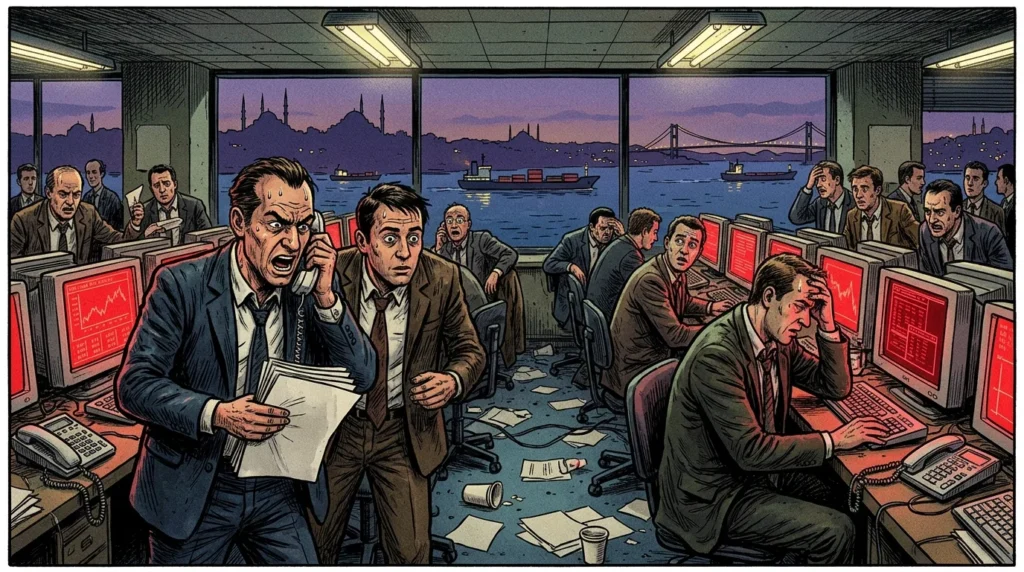
On August 2, 1914—the day the Ottoman Empire ordered general mobilization on the eve of its entry into the First World War—imperial authorities shuttered the trading floor of the Dersaadet Tahvilat Borsası (Constantinople Bond Exchange) in the financial district of Galata. For nearly five decades, the bustling exchange in Komisyon Han and Havyar Han had served as the nerve center of late Ottoman sovereign finance, pricing European-held Ottoman public debt, railway lottery bonds, and foreign bills of exchange. Yet the official suspension of trading did not halt speculation. Throughout the war and the Allied occupation of 1918–1922, unlicensed curb brokers gathered in the courtyards of Galata and Bahçekapı to wager on the fluctuating gold value of Ottoman wartime paper currency (Evrak-ı Nakdiye), Russian rubles, German marks, and British pounds sterling. [1]

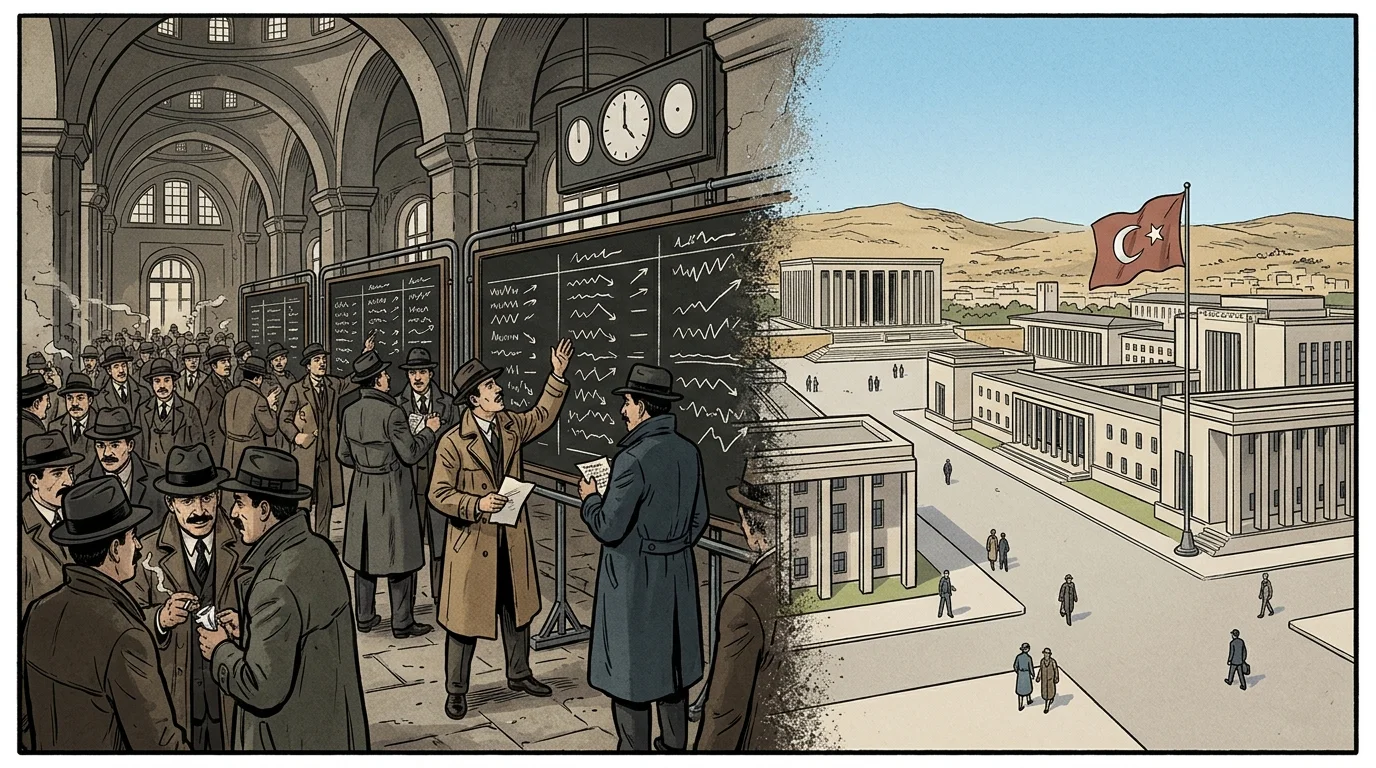
Over the next quarter-century, the young Republic of Türkiye waged a determined institutional campaign to bring Galata’s speculative money and securities market under sovereign discipline. From the 1926 transfer of the exchange to the Fourth Vakıf Han in Bahçekapı and the enactment of Law No. 1447 in May 1929 to the currency crisis of December 1929 and the 1933 Ergani Copper domestic bond issue, Republican finance ministers reshaped the bourse into an instrument of national monetary defense. That statist transformation took effect on April 1, 1938, when the Council of Ministers closed the trading floor in Istanbul and relocated the nation’s only stock and foreign-exchange market to the inland capital of Ankara for three tumultuous years. [2]
Wartime Closure, Evrak-ı Nakdiye Speculation, and the 1923–1926 Transition
Originally institutionalized by imperial regulation in December 1873 as the Dersaadet Tahvilat Borsası and reorganized in 1906 as the Esham ve Tahvilat Borsası (Stocks and Bonds Exchange), the Ottoman bourse was dominated by cosmopolitan Galata bankers, European levantines, and non-Muslim brokerage houses dealing in external debt instruments overseen by the Ottoman Public Debt Administration. When war broke out in August 1914, the Ottoman Ministry of Finance declared a general debt moratorium and ordered the official exchange closed to prevent a catastrophic collapse in sovereign bond prices and a flight from imperial currency. [3]
In place of organized bond trading, wartime finance shifted to an unbacked paper money experiment. Between 1915 and 1918, the Ottoman government issued seven tranches of treasury currency notes known as Evrak-ı Nakdiye, backed not by physical gold in Constantinople but by German Reichsmark treasury bills deposited in Berlin. As war inflation eroded the purchasing power of paper notes to less than one-fifth of their face value in gold coins, an unruly curb market flourished inside Galata’s Havyar Han and Komisyon Han. Curb dealers arbitraged daily military news from the Dardanelles, Palestine, and the Russian front, turning foreign bank notes and gold liras into volatile speculative chips. [4]
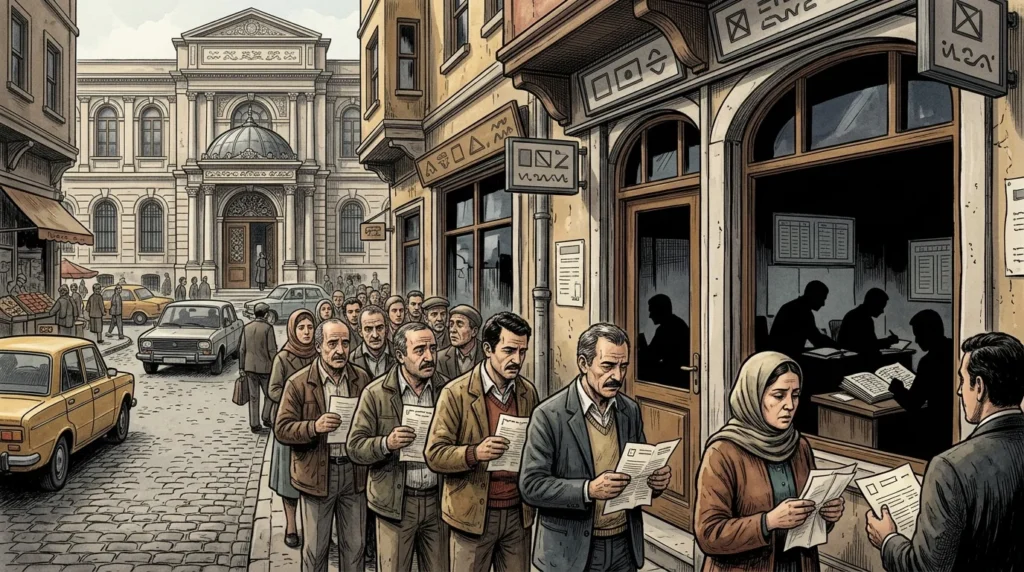
Following the proclamation of the Republic of Türkiye in October 1923, Ankara moved swiftly to purge unlicensed curb speculators and assertion regulatory oversight over Istanbul’s financial intermediaries. Under a temporary regulation issued in 1926, the Ministry of Finance restricted floor access to vetted Turkish citizens, imposed strict capital and surety requirements on licensed brokers (mubayaacı and simsar), and on April 1, 1926, moved the reorganized exchange across the Golden Horn from Galata to the monumental Fourth Vakıf Han in Bahçekapı. [5]
Law No. 1447 of May 1929 and the December 1929 Lira Crisis
As the foundational treaties of Lausanne expired and Türkiye prepared to regain tariff autonomy in 1929, Republican lawmakers sought to replace piecemeal Ottoman decrees with a modern statutory capital market code. On May 30, 1929, the Grand National Assembly enacted Law No. 1447 on Securities and Foreign Exchange Bourses (Menkul Kıymetler ve Kambiyo Borsaları Kanunu). Modeled closely on the French Parquet system, Law No. 1447 renamed the institution the İstanbul Menkul Kıymetler ve Kambiyo Borsası (Istanbul Securities and Foreign Exchange Bourse) and placed it under the direct administrative supervision of a Ministry of Finance commissioner with an annually approved special budget. [6]
Barely five months after Law No. 1447 took effect, the Wall Street crash of October 1929 and the onset of the Great Depression triggered an acute balance-of-payments shock in Türkiye. Prices for Turkish agricultural exports—tobacco, figs, raisins, hazelnuts, and cotton—plunged on world markets just as Istanbul importers stockpiled foreign goods ahead of the new October 1929 customs tariff and the Treasury remitted gold payments on restructured Ottoman debt annuities. On the foreign-exchange counter of the Istanbul bourse, the Turkish lira entered a tailspin against the British pound sterling, depreciating from roughly 980 kuruş per pound in early 1929 to nearly 1,100 kuruş by December 1929. [7]
Prime Minister İsmet İnönü and Minister of Finance Şükrü Saracoğlu attributed the December 1929 currency panic not merely to trade deficits, but to bear raids and short-selling of the lira orchestrated by foreign banks and Galata currency brokers on the Istanbul exchange. In response, the government established a consortium with national and foreign banks to intervene in the currency market and, on February 20, 1930, passed the landmark Law No. 1567 on the Protection of the Value of the Turkish Currency (Türk Parasını Koruma Hakkında Kanun). Law No. 1567 criminalized unauthorized foreign-exchange speculation, subjected all currency and precious-metal transactions to state permit requirements, and paved the way for the founding of the Central Bank of the Republic of Türkiye in October 1931—which gradually absorbed the foreign-exchange clearing functions that had once made the Istanbul bourse the center of currency speculation.
Statist Industrialization and the 1933 Ergani Copper Domestic Loan
With foreign-exchange speculation suppressed under Law No. 1567 and private joint-stock equity issuance still nascent—aside from flagship Republican institutions such as Türkiye İş Bankası, the Central Bank, and Anatolian railway and utility concessions—the Istanbul bourse pivoted during the 1930s toward pricing domestic sovereign development bonds. Having foresworn new foreign commercial borrowing after the bitter legacy of the Ottoman Public Debt Administration, the Republican government launched its first major domestic bond issue in 1933: the 12-million-lira Ergani Internal Loan (Ergani İstikrazı), issued at 5 percent interest with lottery prizes to finance the Fevzipaşa–Diyarbakır railway line connecting the strategic Ergani copper mines in eastern Anatolia to national transport networks.
Supported by a nationwide patriotic savings campaign and active liquidity management by state-affiliated banks, the 1933 Ergani bonds—soon followed by the Sivas–Erzurum railway bonds and subsequent national defense loans—traded at steady par or premium prices on the Istanbul bourse. Yet the transformation of the exchange from a freewheeling international currency market into a tightly regulated secondary venue for state debt and nationalized railway shares sharply reduced private brokerage commissions, leaving Istanbul’s traditional floor brokers struggling to cover their annual agency fees.
The 1938–1941 Relocation to Ankara: The Capital Bourse Experiment
As geopolitical tensions mounted across Europe in 1938 and the Turkish state tightened control over monetary and fiscal policy, officials in the Ministry of Finance concluded that the nation’s securities market belonged in the political capital alongside the Treasury, the Central Bank, and state economic enterprises. Critics in Ankara had long viewed Istanbul’s financial community with suspicion, arguing that the surviving Galata and Bahçekapı brokerage network remained prone to rumor-mongering in foreign gold and sovereign debt prices. By Decree No. 2/8033, published in the Official Gazette on January 19, 1938, the Council of Ministers ordered the Istanbul bourse closed for three years from April 1, 1938 and established its counterpart in Ankara under the name Kambiyo, Esham ve Tahvilat Borsası (Foreign Exchange, Stocks, and Bonds Bourse, also referred to as the Ankara Kıymetli Esham ve Tahvilat Borsası).
Opened in the Ulus district of Ankara on April 1, 1938, the relocated exchange immediately collided with economic reality. Although Ankara housed the ministries that issued government bonds and the headquarters of state banks, the vast majority of Türkiye’s private savers, commercial banks, joint-stock companies, and experienced securities dealers remained in Istanbul. Only a handful of Istanbul’s licensed exchange agents agreed to move to the Anatolian plateau. With the outbreak of the Second World War in September 1939, transaction volumes on the Ankara floor dried up almost completely, while an informal over-the-counter market in government bonds and corporate shares quietly re-emerged among bank counters back in Istanbul.
Recognizing that administrative fiat could not sever a securities market from its commercial and savings base—and needing deep retail and institutional liquidity in Istanbul to place wartime National Defense Bonds—the government reversed course after less than three years. In April 1941, the bourse returned to the Fourth Vakıf Han in Bahçekapı as the İstanbul Menkul Kıymetler ve Kambiyo Borsası, where it continued to operate under Law No. 1447 until the modern Istanbul Stock Exchange (İMKB, now Borsa İstanbul) was inaugurated in December 1985.
Theoretical & Balance-Sheet Transmission Mechanism
In the Kindleberger–Minsky taxonomy of financial instability (Kindleberger, 1978; Minsky, 1986) and Irving Fisher’s (1933) debt-deflation framework, speculative asset booms become systemic crises when credit expansion shifts balance sheets from hedge finance (cash flows covering principal and interest) to speculative and Ponzi finance (relying on rising asset prices and short-term margin roll-overs).
Once monetary tightening or an exogenous shock halts price appreciation, forced margin liquidations trigger Fisherian debt-deflation: fire-sale asset discounts erode bank collateral values, contracting credit supply across the real economy.
Sources and Further Reading
- Borsa İstanbul, “Borsa İstanbul 25. Yıl: Tarihçe (1866–1985),” Borsa İstanbul, 2011. Historical & Financial Reference
- Ece Deniz Günay and Gözde Engin Günay, “Osmanlı Döneminden Günümüze Sermaye Piyasaları Özelinde Aracılık Faaliyetlerinin Tarihsel Gelişimleri Üzerine Düşünceler,” ASBÜ Hukuk Fakültesi Dergisi, 2024. Historical & Financial Reference
- Muhasebe ve Finans Tarihi Araştırmaları Dergisi, “Menkul Kıymetler ve Kambiyo Borsası Bütçeleri (1931–1975),” Muhasebe ve Finans Tarihi Araştırmaları Dergisi, 2020. Historical & Financial Reference
- Ankara Üniversitesi, “Cumhuriyet Döneminde Menkul Kıymetler ve Borsa,” Ankara University Open Access Repository, 2005. Peer-Reviewed / Academic Research
- Sermaye Piyasaları Araştırma Merkezi (SEPAM), “Borsacılık Tarihi Nereden Başlamalı?,” SEPAM, 2017. Historical & Financial Reference
- Irving Fisher — "The Debt-Deflation Theory of Great Depressions," Econometrica 1, no. 4 (FRASER Federal Reserve Archive, 1933): 337–357 Central Bank / Monetary Authority
- Charles P. Kindleberger & Robert Z. Aliber — Manias, Panics, and Crashes: A History of Financial Crises (Palgrave Macmillan) Peer-Reviewed / Academic Research
Cite This Historical Dossier (APA / Chicago)
APA (7th ed.): Ç., S. (Ed.). (2026). From the 1914 Galata Exchange Closure to the 1938 Relocation of Istanbul's Bourse to Ankara. In Forgotten Fortunes Historical Monograph Series (Forgotten Fortunes Editorial Desk). https://forgottenfortunes.net/dersaadet-borsasi-1938-ankara/
MLA (9th ed.): Ç., Soner, ed. "From the 1914 Galata Exchange Closure to the 1938 Relocation of Istanbul's Bourse to Ankara." Forgotten Fortunes: Financial & Monetary History Archive, 2026, https://forgottenfortunes.net/dersaadet-borsasi-1938-ankara/.
Chicago (17th ed.): Ç., Soner, ed. "From the 1914 Galata Exchange Closure to the 1938 Relocation of Istanbul's Bourse to Ankara." Forgotten Fortunes Historical Monograph Series (Forgotten Fortunes Editorial Desk), September 20, 2026. https://forgottenfortunes.net/dersaadet-borsasi-1938-ankara/.
Have an idea for another financial history documentary or article? Request a story →