In This Article
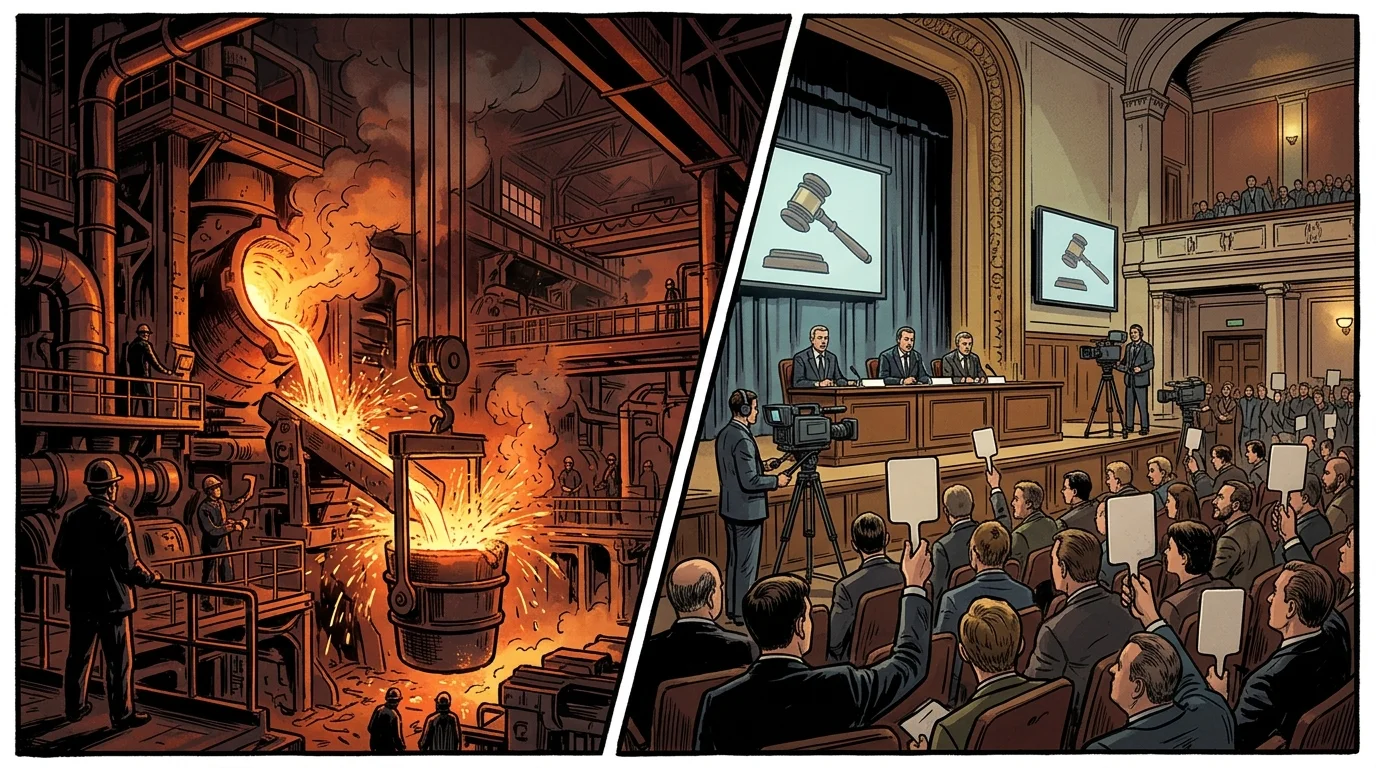
On the morning of October 24, 2005, millions of Ukrainians tuned in to live national television to watch a spectacle unprecedented in post-Soviet economic history: an open, competitive auction for a 93.02 percent stake in Kryvorizhstal, the country’s largest integrated steelworks. Just sixteen months earlier, under the outgoing administration of President Leonid Kuchma, the sprawling metallurgical complex in Kryvyi Rih had been sold in a rigged tender for $800 million to a domestic consortium controlled by Rinat Akhmetov and Kuchma’s son-in-law, Viktor Pinchuk. Following the Orange Revolution, President Viktor Yushchenko and Prime Minister Yulia Tymoshenko annulled that insider transaction through the courts and put the steel giant back on the block with a starting price of 10 billion hryvnias ($2 billion). After a tense bidding battle with a rival consortium led by Arcelor, billionaire Lakshmi Mittal’s Mittal Steel secured Kryvorizhstal with a final bid of 24.2 billion hryvnias ($4.8 billion)—six times the price of the 2004 insider sale. [1]

That single televised auction became the defining pivot of Ukraine’s post-Soviet capital market history. It exposed the vast valuation gap created during the 1995–1998 mass certificate privatization era, when tens of millions of citizens exchanged paper vouchers for tiny fractions of industrial enterprises while factory insiders and nascent financial-industrial groups quietly consolidated control on the over-the-counter PFTS Stock Exchange. At the same time, the $4.8 billion windfall ignited a euphoric three-year foreign investment boom that propelled the PFTS index past 1,200 points in 2007—only for the global steel and credit collapse of 2008 to wipe out roughly 75 percent of Ukrainian equity values inside a single year. [2]
Hyperinflation, Red Directors, and the 1995–1998 Mass Certificate Privatization
When Ukraine declared independence from the Soviet Union in August 1991, it inherited one of the largest concentrations of heavy industry in Eurasia, encompassing more than 10,000 medium and large state enterprises and over 100,000 smaller workshops across metallurgy, coal, heavy machinery, chemicals, and power generation. Unlike Russia, which launched a rapid voucher privatization program in 1992, Ukrainian lawmakers stalled for three years amid fierce disputes between reformist economists and the powerful parliamentary lobby of state enterprise managers known as “red directors.” While privatization remained deadlocked, the central bank financed state factories through unbacked credit emissions, driving consumer price inflation to roughly 5,000 percent in 1993 and shrinking official gross domestic product by nearly 40 percent compared with 1989 levels. [3]
Only after a March 1994 multidonor Memorandum of Understanding backed by the World Bank, the International Monetary Fund, and the United States Agency for International Development—followed by President Leonid Kuchma’s October 1994 macroeconomic stabilization program—did the State Property Fund of Ukraine (SPFU) activate nationwide mass privatization. Beginning in January 1995 and running through 1998, the state issued non-transferable paper privatization property certificates (pryvatyzatsiyni maynovi sertyfikaty) with a nominal face value equivalent to roughly $50 to every Ukrainian citizen, alongside supplementary compensation certificates created to offset hyperinflationary losses in Soviet-era savings accounts. [4]
More than 46 million citizens—out of roughly 50 million eligible residents—ultimately collected their certificates and tendered them at regional certificate auction centers, converting nearly 9,500 medium and large state enterprises into open joint-stock companies. Yet mass ownership on paper quickly diverged from corporate control in practice. Ordinary households held minuscule stakes in factories plagued by barter trade, wage arrears, and opaque accounting, and received virtually no cash dividends. Operating in a weak legal environment with minimal minority-shareholder protections, factory directors teamed up with unlicensed street brokers, trust companies, and regional trading houses to buy up employee shares and voucher pools for pennies on the dollar. By the end of the 1990s, dispersed citizen ownership had crystallized into concentrated industrial empires controlled by regional oligarchic clans in Donetsk, Dnipropetrovsk, and Kyiv. [5]
| Documented Figure / Metric | Historical Significance & Archival Context |
|---|---|
| 10 percent | Most major industrial holdings kept only 1 to 10 percent of their shares in free float, locking the remaining 90 percent inside offshore holding vehicles in Cyprus or the British Virgin Islands. |
| $1.5 billion | Steel, whose indicative bids exceeded $1.5 billion, leaving the Industrial Investment Consortium—jointly owned by Rinat Akhmetov's System Capital Management and Viktor Pinchuk's Interpipe—to acquire the complex for 4.26 billion hryvnias ($800 million). |
| 60 percent | Driven by surging global steel prices and domestic foreign-currency credit growth exceeding 60 percent per year, the PFTS Index soared more than threefold from roughly 350 points in late 2005 to an all-time peak above 1,200 points in early 2008. |
| 40 percent | That speculative boom rested on fragile foundations: unhedged external corporate and bank borrowing coupled with extreme dependence on commodity steel exports, which generated roughly 40 percent of Ukraine's export earnings. |
The Birth of the PFTS Exchange and the Over-the-Counter Equity Market
As millions of privatized corporate shares changed hands after the certificate auctions, Ukraine urgently needed a secondary trading venue to price and clear equity transactions. In February 1996, a self-regulatory association of licensed Ukrainian securities dealers established the PFTS Technical Center (Persha Fondova Torgova Systema, or First Stock Trading System) with technical assistance from international development donors. Built on an electronic quote-driven over-the-counter dealer model inspired by the early NASDAQ system, PFTS received Trading and Information System License No. 1 from the newly created Securities and Stock Market State Commission. [6]
The electronic platform grew rapidly as post-privatization consolidation accelerated. In 1996, PFTS accounted for just 6.48 percent of organized Ukrainian securities turnover, ranking third behind traditional floor exchanges. By 1997, its market share jumped to 46.01 percent—second only to the Ukrainian Interbank Currency Exchange—and on October 1, 1997, the exchange launched the benchmark PFTS Index at a base value of 100 points. Following the August 1998 regional sovereign debt crisis, PFTS captured 64.74 percent of national securities trading volume, cementing its position as the undisputed center of Ukrainian equity and corporate bond trading before formally converting into the licensed JSC Stock Exchange PFTS under revised securities legislation in 2006. [7]
Despite its technological sophistication, the early PFTS market reflected the structural distortions of Ukrainian capitalism. Most major industrial holdings kept only 1 to 10 percent of their shares in free float, locking the remaining 90 percent inside offshore holding vehicles in Cyprus or the British Virgin Islands. Domestic financial-industrial groups—including System Capital Management in Donetsk, Interpipe in Dnipropetrovsk, and the Privat Group—preferred to acquire strategic enterprises through bespoke state privatization tenders whose qualification rules were tailored to exclude foreign multinational bidders. [8]
The 2004 Insider Sale and the 2005 Televised Re-Auction of Kryvorizhstal
No transaction illustrated the mechanics of insider privatization more starkly than the June 2004 sale of Kryvorizhstal. Producing roughly 7 million metric tons of crude steel annually—about one-fifth of Ukraine’s total steel output—with its own captive iron ore mines and coking coal facilities, Kryvorizhstal was the crown jewel of the State Property Fund’s remaining portfolio. In the run-up to the contentious 2004 presidential election, the SPFU structured the tender terms for a 93.02 percent stake to require that any bidder must already have produced coke in Ukraine for several consecutive years. That single technical stipulation disqualified global steelmakers such as Mittal Steel, Arcelor, and U.S. Steel, whose indicative bids exceeded $1.5 billion, leaving the Industrial Investment Consortium—jointly owned by Rinat Akhmetov’s System Capital Management and Viktor Pinchuk’s Interpipe—to acquire the complex for 4.26 billion hryvnias ($800 million).
During the winter 2004 Orange Revolution protests, opposition leader Viktor Yushchenko repeatedly denounced the Kryvorizhstal deal as outright state theft. After taking office in early 2005 alongside Prime Minister Yulia Tymoshenko, the new administration challenged the transaction in commercial courts, revoked the 2004 sale, and ordered a transparent re-privatization auction open to international investors. Even after Tymoshenko left office in September 2005 and parliament passed a non-binding resolution attempting to halt the sale, Yushchenko pressed ahead with the televised bidding on October 24, 2005.
Three pre-qualified contenders—Mittal Steel (registered via its Dutch and German subsidiaries), the Arcelor-led Industrial Group consortium, and the Russian-backed LLC Smart-Group—placed sealed initial bids into a transparent glass box in front of television cameras, with Arcelor opening at 12.6 billion hryvnias ($2.5 billion). Over the next hour, the auctioneer raised the price in 100-million-hryvnia increments across 78 rounds of placard bidding until Mittal Steel won the 93.02 percent stake at 24.2 billion hryvnias ($4.8 billion). That single receipt exceeded the cumulative total of all privatization revenues collected by the Ukrainian state between 1992 and 2004.
The 2005–2007 Foreign Investment Euphoria and the 2008 Steel and Credit Crash
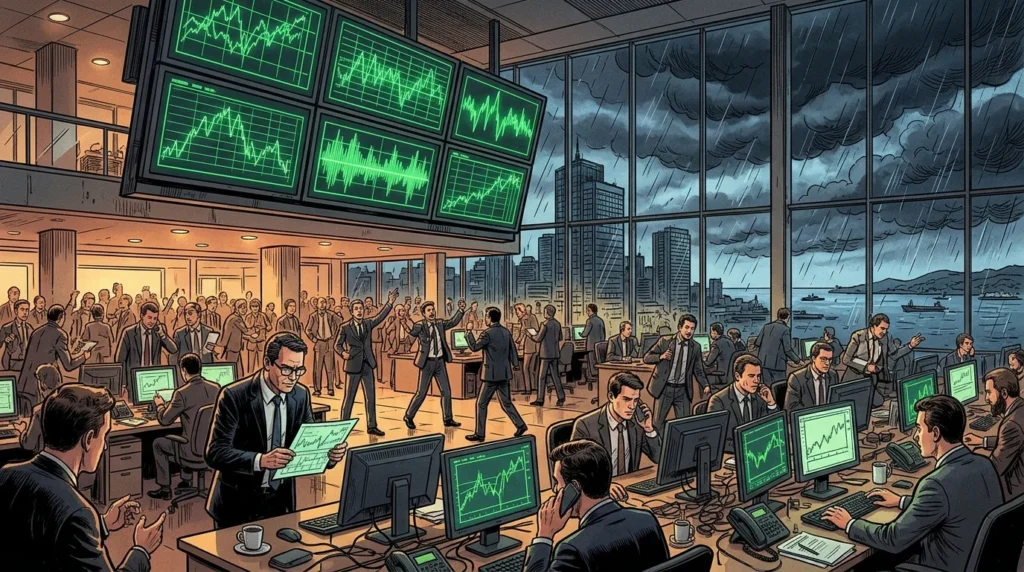
The Kryvorizhstal auction triggered an immediate repricing of Ukrainian corporate and banking assets. Convinced that Ukraine was converging toward Central European valuation multiples, Western banking groups—including Raiffeisen, BNP Paribas, UniCredit, and Commerzbank—paid between three and five times book value to acquire Ukrainian commercial banks in 2005–2007. Foreign portfolio funds poured capital into the thin free float of metallurgical, energy, and machine-building stocks on the PFTS exchange. Driven by surging global steel prices and domestic foreign-currency credit growth exceeding 60 percent per year, the PFTS Index soared more than threefold from roughly 350 points in late 2005 to an all-time peak above 1,200 points in early 2008.
That speculative boom rested on fragile foundations: unhedged external corporate and bank borrowing coupled with extreme dependence on commodity steel exports, which generated roughly 40 percent of Ukraine’s export earnings. When the global financial crisis erupted in September 2008, world steel prices plunged by nearly 70 percent in the second half of the year, Ukrainian metallurgical output contracted sharply, and international interbank credit lines froze overnight. A depositor run on Prominvestbank in October 2008 prompted the National Bank of Ukraine to impose emergency liquidity controls while the hryvnia lost nearly 40 percent of its value against the U.S. dollar, forcing Kyiv to seek an emergency $16.4 billion International Monetary Fund Stand-By Arrangement.
On the equity market, foreign institutional investors rushed for the exits simultaneously. Because the PFTS quote-driven system lacked deep domestic institutional buyers, bid prices evaporated across blue-chip steel, energy, and banking shares. Trading had to be repeatedly halted by regulators as the PFTS Index collapsed by roughly 75 percent over the course of 2008, plunging below 300 points by year-end—one of the steepest equity market contractions anywhere in the world.
The Ukrainian Exchange, Geopolitical Shocks, and Wartime Freezes
Frustrated by technical bottlenecks and settlement delays during the 2008 sell-off, major Kyiv brokerage houses partnered with Russian exchange operators in 2008–2009 to launch a rival order-driven venue, the Ukrainian Exchange (UX), complete with electronic internet trading and a central counterparty clearing mechanism. Although the UX Index briefly revived domestic retail and institutional turnover between 2009 and 2011, Ukraine’s equity market never regained its pre-2008 capitalization.
Successive geopolitical shocks further hollowed out public equity trading. Russia’s annexation of Crimea and the outbreak of war in the industrial Donbas basin in 2014 physically severed or damaged major coal, steel, and power plants that formed the core of the PFTS and UX indices, while currency controls and sanctions curtailed cross-border capital flows. When Russia launched its full-scale invasion of Ukraine on February 24, 2022, the National Securities and Stock Market Commission (NSSMC) immediately suspended all equity circulation to prevent panic liquidation, redirecting the surviving PFTS and UX infrastructure almost exclusively toward domestic wartime government bonds.
Theoretical & Balance-Sheet Transmission Mechanism
In the Kindleberger–Minsky taxonomy of financial instability (Kindleberger, 1978; Minsky, 1986) and Irving Fisher’s (1933) debt-deflation framework, speculative asset booms become systemic crises when credit expansion shifts balance sheets from hedge finance (cash flows covering principal and interest) to speculative and Ponzi finance (relying on rising asset prices and short-term margin roll-overs).
Once monetary tightening or an exogenous shock halts price appreciation, forced margin liquidations trigger Fisherian debt-deflation: fire-sale asset discounts erode bank collateral values, contracting credit supply across the real economy.
Sources and Further Reading
- Ira W. Lieberman et al., “Mass Privatization in Ukraine: Waiting for Launch,” World Bank FPD Note No. 8, 1994. International Financial Institution
- PFTS Stock Exchange, “About PFTS Stock Exchange,” JSC Stock Exchange PFTS, 2024. Historical & Financial Reference
- Radio Free Europe/Radio Liberty, “Dutch Firm Buys Major Ukrainian Steel Mill,” RFE/RL, 2005-10-24. Historical & Financial Reference
- Al Jazeera, “Mittal Steel Wins Ukraine Auction,” Al Jazeera English, 2005-10-24. Historical & Financial Reference
- David Gow, “Mittal Buys Ukraine Steel Mill in Reality TV Auction,” The Guardian, 2005-10-25. Historical & Financial Reference
- Vasily Astrov, “Ukraine: In the Midst of Economic Meltdown,” Vienna Institute for International Economic Studies (wiiw), 2009. Historical & Financial Reference
- Irving Fisher — "The Debt-Deflation Theory of Great Depressions," Econometrica 1, no. 4 (FRASER Federal Reserve Archive, 1933): 337–357 Central Bank / Monetary Authority
- Charles P. Kindleberger & Robert Z. Aliber — Manias, Panics, and Crashes: A History of Financial Crises (Palgrave Macmillan) Peer-Reviewed / Academic Research
Cite This Historical Dossier (APA / Chicago)
APA (7th ed.): Ç., S. (Ed.). (2026). Ukraine's Voucher Privatization, the $4.8 Billion Kryvorizhstal Auction, and the PFTS Crash. In Forgotten Fortunes Historical Monograph Series (Forgotten Fortunes Editorial Desk). https://forgottenfortunes.net/ukraine-kryvorizhstal-auction/
MLA (9th ed.): Ç., Soner, ed. "Ukraine's Voucher Privatization, the $4.8 Billion Kryvorizhstal Auction, and the PFTS Crash." Forgotten Fortunes: Financial & Monetary History Archive, 2026, https://forgottenfortunes.net/ukraine-kryvorizhstal-auction/.
Chicago (17th ed.): Ç., Soner, ed. "Ukraine's Voucher Privatization, the $4.8 Billion Kryvorizhstal Auction, and the PFTS Crash." Forgotten Fortunes Historical Monograph Series (Forgotten Fortunes Editorial Desk), September 20, 2026. https://forgottenfortunes.net/ukraine-kryvorizhstal-auction/.
Have an idea for another financial history documentary or article? Request a story →