In This Article
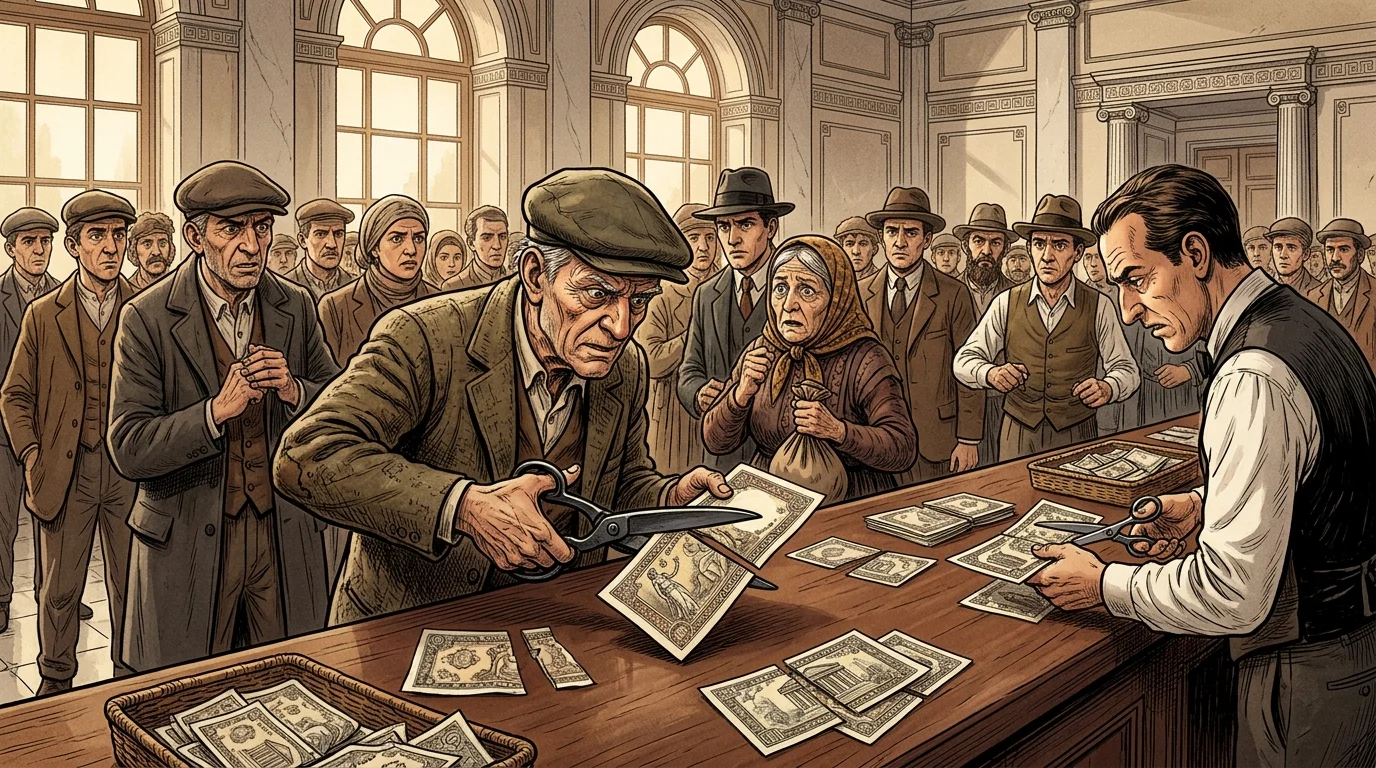
Few episodes in modern monetary history rival the audacity of the fiscal decree enacted in Athens in the spring of 1922. Exhausted by a decade of continuous warfare and cut off from Allied credit in London and Paris while fighting the Asia Minor Campaign, the Kingdom of Greece faced imminent state bankruptcy. Rather than surrendering to hyperinflation by running the printing presses unchecked, Finance Minister Petros Protopapadakis unveiled a startling mechanical solution known as the Dichotomisis (“cutting in two”): under Law 2749 of March 25, 1922 (Julian calendar; April 7, 1922 Gregorian), every Greek citizen was ordered to take a pair of scissors and physically slice their paper drachma banknotes in half. The left half of each note, bearing the portrait of National Bank of Greece founder Georgios Stavros, continued to circulate as legal tender at 50 percent of its original face value, while the right half, bearing the Royal Coat of Arms, was converted overnight into a compulsory 20-year, 6.5 percent government bond that raised 1.6 billion drachmas for the treasury. That extraordinary emergency loan inaugurated a turbulent interwar decade that carried Greece from the Asia Minor Catastrophe and a refugee-driven industrial boom on the Athens Stock Exchange (Chrimatistirio Athinon) between 1924 and 1928 to the creation of the Bank of Greece at 375 drachmas per pound sterling—only to end in a fifteen-month stock market shutdown when Britain abandoned the gold standard on September 21, 1931, culminating in Greece’s sovereign default of May 1932. [1]

War Exhaustion and the Allied Credit Blockade (1919–1922)
To understand why a modern European finance minister ordered an entire population to cut its currency in half with scissors, one must examine the fiscal trap that closed around Athens between 1919 and early 1922. Since the outbreak of the First Balkan War in 1912, Greece had been mobilized on a near-continuous war footing for ten years. In May 1919, with the encouragement of British Prime Minister David Lloyd George, Greek forces landed at Smyrna (Izmir) to enforce territorial claims in western Anatolia following the collapse of the Ottoman Empire. However, after King Constantine I was restored to the Greek throne in the November 1920 plebiscite following the electoral defeat of Prime Minister Eleftherios Venizelos, Britain, France, and the United States imposed a strict financial blockade on Athens, freezing the remaining tranches of the 1918 Allied wartime credits and barring the Greek government from floating sovereign bonds on the London and Paris capital markets. [2]
By the winter of 1921–1922, maintaining an expeditionary army of more than 200,000 soldiers deep inside Anatolia was consuming over 8 million drachmas per day. The state budget deficit had swollen past 1.6 billion drachmas, the foreign exchange value of the drachma in London had fallen to less than one-fifth of its pre-war Latin Monetary Union gold parity, and the commercial National Bank of Greece (ETHNIKI)—which still held the monopoly on issuing Greek banknotes—had already exhausted its statutory note-issuing reserves by extending short-term advances to the treasury. In early 1922, Prime Minister Dimitrios Gounaris traveled to London in a desperate effort to persuade British Chancellor of the Exchequer Sir Robert Horne to authorize a £15 million commercial loan on the London market, only to return to Athens empty-handed. [3]
| Documented Figure / Metric | Historical Significance & Archival Context |
|---|---|
| 25 percent | Ironically, the technique proved so effective that Greece's revolutionary successors repeated a smaller 25 percent banknote haircut—requiring no scissors—in a second forced loan in January 1926. |
| £9 million | As a condition for a new £9 million international stabilization and refugee loan, the National Bank of Greece was required to surrender its century-old note-issuing privilege and transfer its central banking assets to a newly created, independent central bank: the Bank of Greece (Trapeza tis Ellados). |
| $35 million | For the next seven months, the Bank of Greece fought a losing battle to defend the gold-dollar peg as its foreign exchange reserves evaporated from over $35 million to less than $6 million. |
Petros Protopapadakis and the March 1922 Dichotomisis Decree
Faced with an empty treasury and troops lacking food and ammunition at the front, Finance Minister Petros Protopapadakis—a distinguished Parisian-trained mathematician, civil engineer, and professor at the Evelpidon Military Academy—presented Law 2749 to the Greek Parliament on March 25, 1922 (Old Style; April 7, 1922 on the Gregorian calendar, which Greece formally adopted the following year). Protopapadakis reasoned that if the state simply ordered the National Bank of Greece to print another 1.6 billion drachmas in unbacked paper currency, velocity and panic would immediately double domestic prices and trigger a Weimar-style hyperinflationary spiral. Conversely, a voluntary domestic war bond would fail because nervous Greek merchants and peasants were hoarding cash in mattresses rather than trusting state debt. [4]
Protopapadakis’s solution was a self-enforcing compulsory internal loan executed directly on the physical money stock. At the moment the law took effect, approximately 3.1 billion drachmas in paper banknotes issued by the National Bank of Greece (in denominations of 5, 10, 25, 50, 100, 500, and 1,000 drachmas) were circulating across the kingdom. Under the Dichotomisis decree, every banknote was legally bisected down its vertical axis: [5]
- The Left Half (“Stavros”): Bearing the engraved portrait of Georgios Stavros, first governor of the National Bank of Greece, the left half remained in the hands of the citizen as legal tender, but its purchasing face value was cut strictly to 50 percent of the original denomination (so the left half of a 100-drachma note circulated as 50 drachmas).
- The Right Half (“Stemma” or Crown): Bearing the Royal Coat of Arms, the right half ceased to be legal money and was transformed into a provisional bearer scrip representing a compulsory 20-year state bond paying 6.5 percent annual interest (later supplemented by lottery drawings). Citizens were required to surrender their right halves at banks and post offices in exchange for formal 100-drachma definitive bond certificates, while the state simultaneously instructed the National Bank of Greece to print 1.6 billion drachmas in new overprinted banknotes for the treasury’s military expenses.
In a stroke of mathematical ingenuity, Protopapadakis reduced the public’s liquid money balances from 3.1 billion to roughly 1.55 billion drachmas and immediately replenished the total money stock back to 3.1 billion drachmas in the hands of the state treasury—raising 1.6 billion drachmas in cash overnight without increasing the aggregate nominal supply of currency in circulation by a single drachma. Because merchants instantaneously realized that prices had not doubled and that the “Stavros” left halves were universally required to pay taxes and settle debts, the bisected banknotes circulated smoothly across Greece. Foreign financial observers, including economists studied by the Federal Reserve and British diplomatic attaches, marveled at the mechanical success of the operation. Yet the fiscal reprieve could not alter the military balance in Anatolia: in August and September 1922, Turkish nationalist forces routed the Greek army and captured Smyrna. Following a military revolt in Athens, Petros Protopapadakis (who had served briefly as Prime Minister in May–August 1922) was arrested alongside Gounaris and four other leaders, convicted of high treason by a revolutionary court-martial in the notorious “Trial of the Six,” and executed by firing squad at Goudi on November 15/28, 1922. Ironically, the technique proved so effective that Greece’s revolutionary successors repeated a smaller 25 percent banknote haircut—requiring no scissors—in a second forced loan in January 1926. [6]
The 1924–1928 Refugee Reconstruction Boom on the Athens Stock Exchange
In the immediate aftermath of the 1922 Asia Minor Catastrophe and the 1923 Treaty of Lausanne, Greece absorbed more than 1.2 million Greek Orthodox refugees from Anatolia, Pontus, and Eastern Thrace—expanding the country’s population by nearly 25 percent in a matter of months. What initially appeared to be an insurmountable humanitarian emergency soon catalyzed one of the most dynamic industrial and stock market expansions in modern Greek history. Backed by the League of Nations Financial Committee and the Bank of England, Athens floated the £12.3 million 7 percent Greek Refugee Loan of December 1924 on the London, New York, and Athens markets, administered by the autonomous Refugee Settlement Commission (RSC) to build housing, drain malarial plains in Macedonia, and establish urban workshops. [7]
The sudden arrival of an urban, commercially skilled refugee workforce from Smyrna and Constantinople—combined with protective import tariffs, abundant low-wage labor, and surging domestic demand for textiles, carpets, cement, chemicals, tobacco processing, and electric power—ignited an industrial promotion boom between 1924 and 1928. Hundreds of family partnerships reorganized as joint-stock corporations (anonymes etairies) and listed their shares on the Athens Stock Exchange (Chrimatistirio Athinon) on Sophocleous Street. Between 1923 and 1928, more than 230 new industrial and commercial corporations were founded in Greece, and the market capitalization and trading volume of banking, shipping, textile, and construction equities on the Athens Exchange surged more than threefold in drachma terms.
To anchor this expansion and unlock fresh foreign infrastructure loans for roadbuilding and land reclamation, Governor Emmanuel Tsouderos and Finance Minister Georgios Kafantaris negotiated the landmark 1927 Geneva Protocol with the League of Nations. As a condition for a new £9 million international stabilization and refugee loan, the National Bank of Greece was required to surrender its century-old note-issuing privilege and transfer its central banking assets to a newly created, independent central bank: the Bank of Greece (Trapeza tis Ellados). On May 12, 1928, the Greek government legally stabilized the drachma on the international gold-exchange standard at a fixed rate of 375 drachmas per British pound sterling (roughly one-fifteenth of its pre-1914 gold parity), and two days later, on May 14, 1928, the Bank of Greece opened its doors for business—with its own shares listing on the Athens Stock Exchange, where banking and industrial equities reached their interwar zenith later that year.
Britain’s September 1931 Gold Exit and the 15-Month Exchange Shutdown
The stabilization of May 1928 rested on a fragile external pillar: under the gold-exchange standard championed by Bank of England Governor Montagu Norman, the Bank of Greece held the bulk of its statutory reserve cover not in physical gold bars in Athens, but in interest-bearing pound sterling balances in London and US dollars in New York. Furthermore, the Prime Ministership of Eleftherios Venizelos (1928–1932) embarked on an ambitious public-works borrowing program just as the October 1929 Wall Street crash depressed world agricultural prices, devastating Greece’s vital export revenues from currants, raisins, olive oil, and Oriental tobacco, while remittances from Greek emigrants in America and earnings from the Greek merchant fleet plummeted.
Despite the global downturn, the Bank of Greece defended the 375-drachma-per-pound parity rigorously until Sunday, September 20, 1931, when the British government stunned international markets by suspending the gold convertibility of the pound sterling, causing sterling to depreciate immediately by more than 20 percent against gold and the US dollar. The news reached Athens on the morning of Monday, September 21, 1931, and triggered an instant financial panic. Because the Bank of Greece held vast reserves in London, the sterling devaluation inflicted immediate capital losses on the central bank’s reserve cover, while Greek savers and merchants rushed to convert drachmas into physical gold sovereigns and US dollars.
To prevent a catastrophic collapse of equity prices, margin-loan defaults at Greek commercial banks, and massive capital flight through securities liquidation, the Venizelos government took emergency action on September 21, 1931: it ordered the immediate closure of the Athens Stock Exchange and switched the drachma’s peg from the floating pound sterling to the gold-backed US dollar (at approximately 77.05 drachmas per dollar), backed by strict foreign-exchange controls Enacted under Emergency Law of September 28, 1931.
For the next seven months, the Bank of Greece fought a losing battle to defend the gold-dollar peg as its foreign exchange reserves evaporated from over $35 million to less than $6 million. After the League of Nations and European powers refused Venizelos’s appeal for a $50 million emergency credit and five-year debt moratorium in early 1932, Greece’s interwar financial architecture collapsed. On April 26, 1932, Greece formally abandoned the gold-exchange standard—allowing the drachma to depreciate by nearly 60 percent—and on May 1, 1932, Athens declared a sovereign default, suspending all sinking-fund payments and foreign-currency interest transfers on its external public debt (which consumed over 40 percent of the state budget). The Athens Stock Exchange remained completely shuttered for fifteen months, finally reopening for regular trading only in December 1932 into a transformed economy of autarky, import quotas, and compulsory conversion of domestic dollar deposits into paper drachmas—closing the dramatic interwar cycle that had begun a decade earlier with Petros Protopapadakis’s scissors.
Theoretical & Balance-Sheet Transmission Mechanism
In the Kindleberger–Minsky taxonomy of financial instability (Kindleberger, 1978; Minsky, 1986) and Irving Fisher’s (1933) debt-deflation framework, speculative asset booms become systemic crises when credit expansion shifts balance sheets from hedge finance (cash flows covering principal and interest) to speculative and Ponzi finance (relying on rising asset prices and short-term margin roll-overs).
Once monetary tightening or an exogenous shock halts price appreciation, forced margin liquidations trigger Fisherian debt-deflation: fire-sale asset discounts erode bank collateral values, contracting credit supply across the real economy.
Sources and Further Reading
- Paper Money Guaranty (PMG), “The Greek Financial Crises: Getting by with the Half-Drachmai,” Paper Money Guaranty (PMG), 2019-02-19. Historical & Financial Reference
- The National Herald, “Historical Observations: Petros Protopapadakis, Prime Minister in 1922,” The National Herald, 2022. Historical & Financial Reference
- Institute for Balkan Studies, “The Greek Economy and the Interwar Financial Crises (1922–1932),” Balkan Studies (University of Macedonia), 1995. Historical & Financial Reference
- Bryan Taylor, “The Volatile History of the Greek Stock Market,” Finaeon (Global Financial Data), 2023. Historical & Financial Reference
- World Gold Council Archival Series, “After the Gold Standard: The International Monetary Crisis of 1931–1932,” World Gold Council, 1932-01-21. Historical & Financial Reference
- Irving Fisher — "The Debt-Deflation Theory of Great Depressions," Econometrica 1, no. 4 (FRASER Federal Reserve Archive, 1933): 337–357 Central Bank / Monetary Authority
- Charles P. Kindleberger & Robert Z. Aliber — Manias, Panics, and Crashes: A History of Financial Crises (Palgrave Macmillan) Peer-Reviewed / Academic Research
Cite This Historical Dossier (APA / Chicago)
APA (7th ed.): Ç., S. (Ed.). (2026). Scissors as Monetary Policy: Greece's 1922 Halved Banknotes and the 1931 Crash. In Forgotten Fortunes Historical Monograph Series (Forgotten Fortunes Editorial Desk). https://forgottenfortunes.net/greece-1922-dichotomisis-loan/
MLA (9th ed.): Ç., Soner, ed. "Scissors as Monetary Policy: Greece's 1922 Halved Banknotes and the 1931 Crash." Forgotten Fortunes: Financial & Monetary History Archive, 2026, https://forgottenfortunes.net/greece-1922-dichotomisis-loan/.
Chicago (17th ed.): Ç., Soner, ed. "Scissors as Monetary Policy: Greece's 1922 Halved Banknotes and the 1931 Crash." Forgotten Fortunes Historical Monograph Series (Forgotten Fortunes Editorial Desk), September 19, 2026. https://forgottenfortunes.net/greece-1922-dichotomisis-loan/.
Have an idea for another financial history documentary or article? Request a story →