In This Article
Throughout the sixth and early fifth centuries BCE, the rise of Athens from a land-scarce agrarian backwater into the commercial and naval hegemon of the Aegean was driven by an acute ecological constraint: the rocky peninsula of Attica could not grow enough cereal grain to feed its own population. Between Solon’s archonship in 594/593 BCE and the Persian invasion of 480 BCE, Athenian lawmakers and statesmen engineered a cohesive economic transformation. By banning the export of all agricultural produce except olive oil, calibrating political office to four property classes measured in physical bushels (medimnoi), organizing a regulated retail and wholesale marketplace in the Athenian Agora, and channeling the 483 BCE Laurion silver strike into a fleet of warships and high-purity silver “owl” tetradrachms, Archaic Athens converted a domestic food deficit into Mediterranean trade dominance. [1]
Attica’s Grain Deficit and Solon’s First-Axle Export Ban (594 BCE)
In the words of Thucydides, early Attica had long enjoyed immunity from foreign conquest precisely because of the poverty of its thin, stony limestone soil (leptogeos). Receiving an average of only 400 millimeters of erratic winter rainfall per year and broken by steep marble ridges, less than a third of Attica’s roughly 2,400 square kilometers was arable. While drought-tolerant six-row barley (krithe) could be grown on terraced slopes and the plains of Eleusis, Marathon, and Mesogaia, moisture-demanding bread wheat (pyros) yielded poorly and failed altogether roughly one year in four. As Attica’s population expanded in the late seventh century BCE, wealthy Eupatridai landowners discovered that they could earn far higher silver prices by shipping their barley, wheat, and figs to grain-hungry Ionian and island markets than by selling them locally, triggering severe domestic food shortages and price spikes for Athenian smallholders and urban artisans. [2]
Upon taking office as archon in 594/593 BCE, Solon attacked this structural supply crisis directly. As Plutarch records in chapter 24 of his Life of Solon—citing the statutory text inscribed on the very first rotating wooden tablet (axon) of Solon’s law code—Solon prohibited the export from Attica of any agricultural commodity whatsoever, with the sole exception of olive oil. No grain, figs, wool, timber, or pitch could legally leave Attic harbors. To enforce the embargo, Solon’s law commanded the eponymous archon to pronounce solemn public curses (arai) against any landowner or merchant who exported forbidden foodstuffs, or else personally pay a heavy fine of 100 silver drachmas into the public treasury. [3]
Solon’s first-axle statute achieved two simultaneous economic goals. First, by trapping the entire domestic harvest of barley, wheat, and figs inside Attica’s borders, it insulated local consumers from external price arbitrage and lowered subsistence costs for urban craftsmen (whom Solon actively recruited by offering Athenian citizenship to foreign immigrant artisans who relocated to Athens with their entire families to practice a trade). Second, by leaving olive oil as the only legal agricultural export, the law steered capital investment toward Attica’s supreme comparative advantage. Deep-rooted olive trees (Olea europaea) thrived on rocky, dry limestone hillsides where cereals withered. Protected by strict religious and civil statutes—and soon celebrated via the state-commissioned Panathenaic prize amphorae introduced around 566 BCE, each filled with roughly 39 liters of oil pressed from the sacred moriai groves of Athena—Attic olive oil became the Mediterranean’s premier cash crop, packaged and shipped alongside prized Athenian black-figure and red-figure fineware pottery from the Kerameikos quarter. [4]
The Four Census Classes Measured in Medimnoi and Metretai
To align political authority with productive agricultural wealth rather than hereditary aristocratic bloodlines, Solon reorganized the citizen body into four census classes (tele) defined strictly by quantitative physical output. Because coined money had barely begun to circulate in mainland Greece in 594 BCE, Solon calibrated his wealth thresholds in standard dry and liquid capacity measures: the dry medimnos (plural medimnoi, equal to 48 choinikes or approximately 51.8 to 52.2 liters of barley or wheat) and the liquid metretes (plural metretai, equal to 12 choes or approximately 39.4 liters of olive oil or wine). As documented in Aristotle’s Athenaion Politeia (chapter 7.3–4) and Plutarch’s Solon (chapter 18.1–2), a citizen’s class depended on the combined annual yield of dry and liquid produce harvested from his estate: [5]
- Pentakosiomedimnoi (“Five-Hundred-Bushel Men”): The wealthiest tier, comprising citizens whose estates produced a combined annual harvest of at least 500 medimnoi of dry grain and metretai of olive oil or wine. Members of this class alone were eligible for the highest financial magistracies, notably the ten Treasurers of Athena (tamiai) on the Acropolis, and shared eligibility for the nine archonships and the Council of the Areopagus.
- Hippeis (“Horsemen” or Knights): Citizens whose estates yielded between 300 and 499 dry and liquid measures per year—an income sufficient to purchase, stable, and feed a warhorse in grain-scarce Attica and serve in the Athenian cavalry, while holding eligibility for major magistracies.
- Zeugitai (“Yoke-Men”): Smallholder proprietors producing between 200 and 299 medimnoi or metretai annually. Named for their ability to maintain a yoke (zeugos) of two plow oxen, the zeugitai formed the backbone of the heavy infantry phalanx, purchasing their own bronze hoplite shield, spear, helmet, and cuirass and qualifying for minor civic boards and the Council of Four Hundred (Boule).
- Thetes: All citizens whose land yielded fewer than 200 measures per year, together with landless wage laborers, urban potters, smiths, and maritime workers. Although excluded from holding individual magistracies, the thetes were exempted from hoplite armament expenses, served the state as light-armed troops or naval oarsmen, and gained the decisive constitutional right to vote in the sovereign Popular Assembly (Ekklesia) and sit as paid jurors in the popular appellate court (Heliaia).
Solon’s Price Equivalencies: One Medimnos Equals One Drachma
To bridge the gap between physical agricultural measures and silver weight-money in public finance, Solon enacted a statutory table of monetary equivalencies on his sixteen wooden axones. Whenever a citizen owed a traditional religious sacrifice, public levy, or statutory fine stated in livestock or grain, Solon’s tariff established the exact conversion rate in silver drachmas (~4.3 grams of silver per Attic drachma). As Plutarch records directly from the axones in Life of Solon (chapter 23.3): [6]
- 1 sheep = 1 silver drachma.
- 1 medimnos (~52 liters) of grain = 1 silver drachma.
- 1 choice sacrificial ox = 5 silver drachmas.
- Bounty for killing a wolf = 5 drachmas for a male wolf, 1 drachma for a female wolf (the prices of an ox and a sheep respectively, protecting Attic flocks).
- Civic cash prizes for Panhellenic athletic victors: 100 drachmas for a winner at the Isthmian Games; 500 drachmas for a winner at the Olympic Games.
This official 1-to-1 parity—where one dry medimnos of grain, one liquid metretes of oil, and one live sheep each equaled exactly one silver drachma—had profound fiscal consequences. It enabled the Athenian state to assess property status and religious obligations seamlessly across grain-growers, olive-oil producers, pastoralists, and silver-holding merchants. Moreover, as Plutarch observed, the fact that an entire 52-liter bushel of grain or a full-grown sheep cost only a single silver drachma in 594 BCE illustrates how scarce silver bullion remained in early sixth-century Attica prior to the deep exploitation of the Laurion mines. Over the next two centuries, as silver flooded into circulation while Athens’s population swelled, the market price of a medimnos of wheat rose from 1 drachma under Solon to 3 drachmas in the fifth century BCE and 5 to 6 drachmas in the fourth century BCE. [7]
The Peisistratid Agora and Standardized Weights and Measures
Solon’s export and metrological laws required a physical civic marketplace where prices, weights, and measures could be publicly policed. During the middle and late sixth century BCE—first under the tyranny of Peisistratus and his sons Hippias and Hipparchus (c. 561–510 BCE) and subsequently under the democratic reforms of Cleisthenes (508/507 BCE)—Athens systematically developed the Classical Agora on the gently sloping ground northwest of the Acropolis. Private wells were filled in, early ironworking kilns and graves were cleared away, the great stone drainage canal was cut through the square, and inscribed white marble boundary pillars (horoi) bearing the chiselled declaration “I am the boundary of the Agora” were erected at the entrances to demarcate the sacred and commercial precinct.
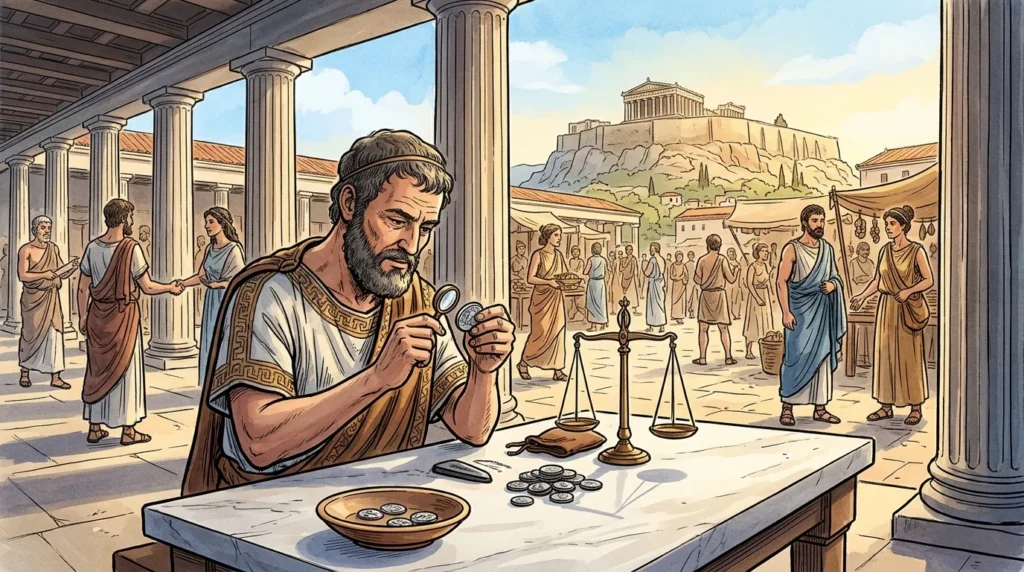
Inside the Agora, Athenian magistrates enforced strict metrological uniformity across retail and wholesale trade. Excavation by the American School of Classical Studies at Athens has recovered numerous official bronze and lead balance weights stamped with civic emblems—such as the turtle, amphora, astragalos (knucklebone), dolphin, or owl—alongside cylindrical terracotta and bronze capacity vessels inscribed DEMOSION (“Public Property”) and marked with the painted owl of Athena. Master reference standards of the medimnos, choinix, metretes, and kotyle, as well as the silver talent, mina, and drachma, were stored under guard on the Acropolis and in the Agora’s administrative buildings. Ten market commissioners (agoranomoi) and ten controllers of weights and measures (metronomoi)—split evenly between the urban Agora and the harbor port of Piraeus—inspected merchants’ scales and measuring vessels to prevent short-measuring or grain adulteration. Meanwhile, Athens transitioned around the 540s–510s BCE from early heraldic silver coins (Wappenmünzen) struck on the Euboic-Attic standard to the world-famous tetradrachms (4-drachma pieces of ~17.2 grams) bearing the helmeted head of Athena on the obverse and her nocturnal owl, an olive spray, and the legend AOE on the reverse.
The 483 BCE Laurion Silver Strike and Athenian Purchasing Power
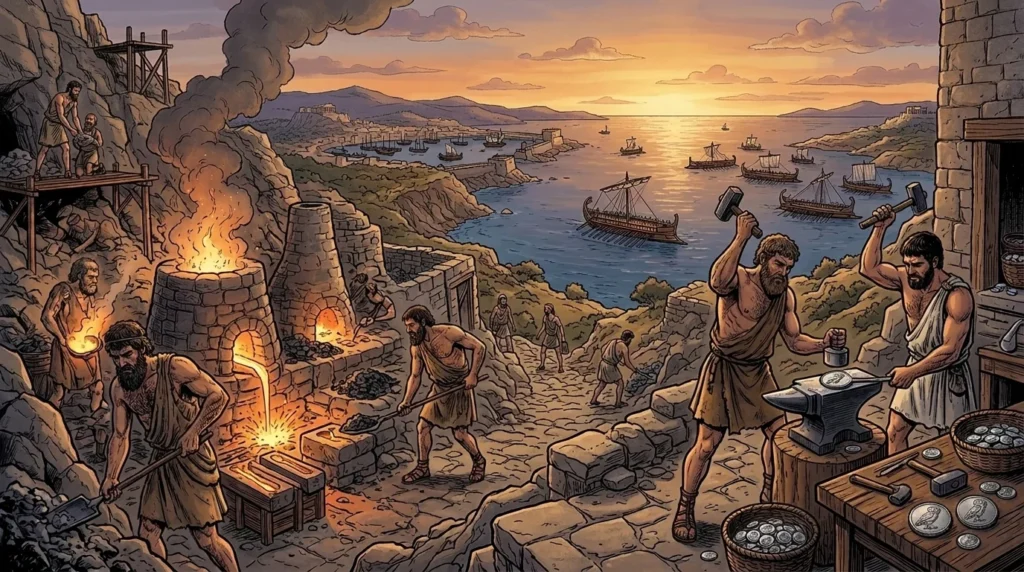
The decisive catalyst that turned Athenian silver currency and Agora commerce into an international powerhouse arrived in 483/482 BCE (the archonship of Nicodemus) in the rugged mining district of Laurion (Laurium) at the southeastern tip of Attica. Although surface outcroppings of argentiferous galena (lead-silver sulfide ore) had been worked since the Bronze Age, mining entrepreneurs leasing state-owned mineral concessions at Maroneia broke through a hard limestone layer into the extraordinarily rich “Third Contact” ore body deeply embedded below ground. Smelted in high-temperature furnaces and refined via cupellation—which oxidized the lead into litharge while leaving behind silver bullion of 98 to 99 percent purity—the Maroneia strike delivered a sudden windfall of 100 talents of silver (600,000 drachmas, or roughly 2.6 metric tons of pure silver) directly into the Athenian state treasury.
As recorded by Herodotus (7.144) and Aristotle’s Athenaion Politeia (22.7), conservative politicians proposed dividing the 100-talent windfall equally among the entire adult male citizen population at a rate of 10 drachmas per man—the equivalent of ten medimnoi of grain at Solon’s traditional valuation. Instead, the visionary statesman Themistocles persuaded the Assembly to forego the personal dividend and loan the 100 talents to the hundred wealthiest citizens of the pentakosiomedimnoi class (one talent each) to construct a fleet of 100 (or, incorporating existing and subsequent hulls, 200) state-of-the-art trireme warships, nominally for the ongoing war against neighboring Aegina but strategically preparing for King Xerxes’s Persian invasion.
When those 200 Athenian triremes shattered the Persian armada in the narrows of Salamis in September 480 BCE, the economic loop initiated by Solon a century earlier closed in triumph. Protected by the unmatched naval power of the Athenian fleet, the “owl” tetradrachms minted from Laurion silver became the universally accepted hard currency of the Aegean, Egypt, the Levant, and the Black Sea. Foreign grain merchants eagerly sailed to Athens not merely to exchange Pontic wheat for prized Attic olive oil and painted pottery, but because returning with a cargo of pure Laurion silver coins yielded immediate purchasing power in every port of the ancient world.
Theoretical & Balance-Sheet Transmission Mechanism
In the Kindleberger–Minsky taxonomy of financial instability (Kindleberger, 1978; Minsky, 1986) and Irving Fisher’s (1933) debt-deflation framework, speculative asset booms become systemic crises when credit expansion shifts balance sheets from hedge finance (cash flows covering principal and interest) to speculative and Ponzi finance (relying on rising asset prices and short-term margin roll-overs).
Once monetary tightening or an exogenous shock halts price appreciation, forced margin liquidations trigger Fisherian debt-deflation: fire-sale asset discounts erode bank collateral values, contracting credit supply across the real economy.
Sources and Further Reading
- Foundation of the Hellenic World, “Archaic Period Society: Classes by Income,” Chronos: Hellenic History on the Internet, Athens. Historical & Financial Reference
- American School of Classical Studies at Athens, “Commercial Measures, Amphorae, and Market Regulation in the Athenian Agora,” Hesperia: The Journal of the American School of Classical Studies at Athens, Athens. Peer-Reviewed / Academic Research
- Ian Morris, Richard Saller, and Walter Scheidel (eds.), “Classical Greece: Production,” in The Cambridge Economic History of the Greco-Roman World, Chapter 12, Cambridge University Press, 2007. Peer-Reviewed / Academic Research
- Jenifer Neils and Dylan K. Rogers (eds.), “Business and Commerce in Ancient Athens,” in The Cambridge Companion to Ancient Athens, Cambridge University Press, 2021. Peer-Reviewed / Academic Research
- Aristotle (trans. Frederic G. Kenyon), “The Athenian Constitution (Athenaion Politeia),” Project Gutenberg Classical Edition. Historical & Financial Reference
- Irving Fisher — "The Debt-Deflation Theory of Great Depressions," Econometrica 1, no. 4 (FRASER Federal Reserve Archive, 1933): 337–357 Central Bank / Monetary Authority
- Charles P. Kindleberger & Robert Z. Aliber — Manias, Panics, and Crashes: A History of Financial Crises (Palgrave Macmillan) Peer-Reviewed / Academic Research
Cite This Historical Dossier (APA / Chicago)
APA (7th ed.): Ç., S. (Ed.). (2026). Solon's Olive Oil Export Ban, the Medimnos Census Classes, and Laurion Silver. In Forgotten Fortunes Historical Monograph Series (Forgotten Fortunes Editorial Desk). https://forgottenfortunes.net/solon-olive-oil-export-ban/
MLA (9th ed.): Ç., Soner, ed. "Solon's Olive Oil Export Ban, the Medimnos Census Classes, and Laurion Silver." Forgotten Fortunes: Financial & Monetary History Archive, 2026, https://forgottenfortunes.net/solon-olive-oil-export-ban/.
Chicago (17th ed.): Ç., Soner, ed. "Solon's Olive Oil Export Ban, the Medimnos Census Classes, and Laurion Silver." Forgotten Fortunes Historical Monograph Series (Forgotten Fortunes Editorial Desk), September 14, 2026. https://forgottenfortunes.net/solon-olive-oil-export-ban/.
Have an idea for another financial history documentary or article? Request a story →