

In This Article
In the late winter of 386 BCE, an unnamed member of the Athenian Council of Five Hundred (Boule) rose before a popular jury court to demand the death penalty for a cartel of resident alien retail grain dealers (sitopolai). Preserved as Oration 22 of the Attic speechwriter Lysias (Against the Grain Dealers), the prosecution exposed the razor-thin margin separating urban survival from famine in Classical Athens. Under cross-examination before the council, the accused dealers admitted that they had banded together to buy up more than fifty baskets (phormoi) of grain from maritime importers, violating a capital statute designed to prevent market cornering. Even more shockingly, the prosecutor testified that the defendants had manipulated prices so aggressively during wartime rumor cycles that they frequently raised retail wheat prices by an entire silver drachma—six obols—within a single day, six times the maximum legal markup of one obol per medimnos. [1]
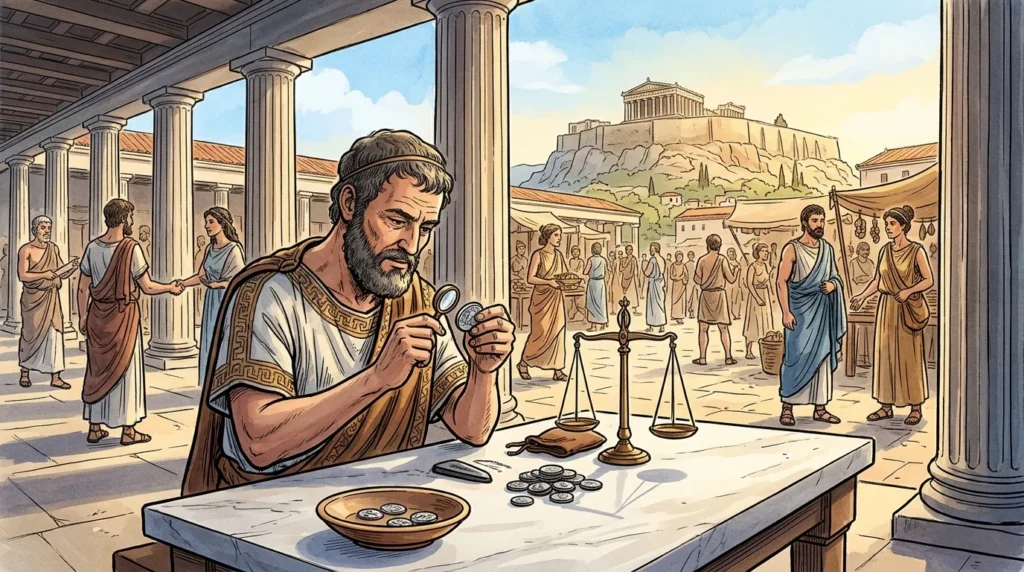
The courtroom drama of 386 BCE illuminates the institutional machinery through which Classical Athens (480–322 BCE) managed prices, food shortages, and real purchasing power. Because the rocky limestone soils of Attica yielded primarily drought-resistant barley and olive oil rather than sufficient bread wheat for a population of roughly 250,000 to 300,000 residents, the Athenian democracy depended on seaborne grain imports for more than half of its caloric consumption. Rather than relying on state-owned merchant fleets or comprehensive price schedules across the entire economy, Athens combined strict statutory mandates on maritime shipping and credit with specialized boards of market magistrates—most notably the Grain Guardians (Sitophylakes)—while benchmarking civic purchasing power against the standard one-drachma daily wage immortalized in the Erechtheion building accounts of 409–407 BCE. [2]
Attica’s Structural Grain Deficit and Pontic Supply Lines
Throughout the fifth and fourth centuries BCE, no issue occupied the Athenian Assembly (Ekklesia) more persistently than the grain supply (trophe). Perfunctory agenda rules encoded in the fourth-century Athenaion Politeia (Constitution of the Athenians) required the Assembly to vote on the security of the grain supply at the principal sovereign meeting (kyria ekklesia) of every single prytany—ten times a year. Domestic Attic farms produced significant harvests of barley (krithai) in dry years, yet recurring droughts and demographic concentration inside the Long Walls linking Athens to the port of Piraeus created a structural deficit of several hundred thousand medimnoi annually (one Attic medimnos equaled roughly 51.8 to 52.5 liters, or approximately 40 kilograms of wheat and 33 kilograms of barley). [3]
To bridge this gap, Athenian wholesalers (emporoi) and shipowners (naukleroi) sourced grain from Sicily, Egypt, Cyprus, and Euboea, but their single most critical granary was the Bosporan Kingdom under the Spartocid dynasty on the northern shores of the Black Sea (the Crimean and Taman peninsulas). In the courtroom speech Against Leptines (355 BCE), the orator Demosthenes reminded Athenian jurors that the grain imported from the Pontus exceeded the combined volume arriving from all other foreign ports, estimating Bosporan exports to Athens at roughly 400,000 medimnoi per year—enough to feed well over 100,000 people for twelve months. Because every Pontic grain freighter had to thread the narrow chokepoints of the Bosporus and Hellespont (Dardanelles), naval blockades or rumors of Spartan, Macedonian, or Byzantine fleet movements triggered immediate price panics in the Piraeus wholesale mart (Emporion). [4]
Statutory Compulsion in the Piraeus Emporion
Because the Athenian state lacked a bureaucratic commissariat capable of purchasing and shipping hundreds of thousands of tons of foreign grain on public account, it harnessed private merchant capital through draconian legal compulsion. Three foundational statutes governed maritime commerce in fourth-century Athens:
- The Piraeus Destination Mandate: No Athenian citizen or resident alien (metoikos), nor any person under their legal control, was permitted to transport grain to any harbor in the Mediterranean other than the Piraeus. Violators faced confiscation of their cargo and ships alongside capital prosecution.
- The Bottomry Loan Restriction: As documented in Demosthenes’ maritime speeches (such as Against Lacritus and Against Phormio), no person residing in Athens was allowed to lend money on a maritime bottomry contract (nautikon daneion) unless the vessel was contractually bound to bring a return cargo of grain—or other designated strategic commodities—directly back to Athens.
- The Two-Thirds City Quota: Once a grain ship docked inside the demarcated wholesale boundary of the Piraeus Emporion, ten Overseers of the Mart (Epimeletai tou Emporiou) enforced a statutory rule requiring importers to bring two-thirds of every grain cargo up the five-mile road to the city Agora of Athens, leaving at most one-third to be sold in the port of Piraeus.
In 374/3 BCE, the democratic reformer Agyrrhios further supplemented market imports with the Grain-Tax Law regarding Lemnos, Imbros, and Skyros (preserved on a marble stele discovered in the Athenian Agora, RO 26). Rather than collecting the 8.33 percent (dodekate) agricultural tax on those three Athenian-controlled Aegean islands in silver coin, Agyrrhios’s law required tax farmers to bid and deliver the tribute in physical wheat and barley, which was stored in the public Sanctuary of the Heroes (Aiakeion) and sold to citizens at a subsidized price chosen by the Assembly each spring before the sailing season reopened. [5]
The Sitophylakes and the Trial of the Grain Dealers (386 BCE)
Within the wholesale Piraeus mart and the retail stalls of the Athenian Agora, price enforcement fell to the Grain Guardians (Sitophylakes), a board of magistrates selected by lot. Originally numbering ten officials—five stationed in Piraeus and five in the city—the board was expanded in the mid-fourth century BCE to thirty-five commissioners (twenty in the city of Athens and fifteen in Piraeus), reflecting the escalating complexity of policing urban food prices. According to Chapter 51 of the Aristotelian Athenaion Politeia, the Sitophylakes had three primary duties: first, to ensure that unground grain in the market was sold at a fair and just price; second, to verify that millers sold barley meal (alphita) at prices strictly proportional to the raw barley price; and third, to compel bakers (artopolai) to sell wheat loaves of a statutory weight corresponding to the prevailing price of wheat. [6]
While the Sitophylakes supervised the weights and retail margins of millers and bakers, Athenian law drew a sharp legal distinction between wholesale maritime importers (emporoi)—whom the city courted with honors and port access—and domestic retail dealers (sitopolai), whom citizens viewed as predatory middlemen. To prevent local dealers from forming buyer cartels against incoming ships or hoarding grain in private warehouses during supply bottlenecks, Athenian law restricted grain dealers from purchasing more than fifty phormoi, although scholars disagree whether this meant each purchase or the stock held, and the exact size of a phormos is uncertain. A separate regulation capped the retail profit margin at one obol per medimnos.
In 386 BCE, near the close of the Corinthian War, the metic grain dealers prosecuted in Lysias 22 attempted to turn this regulatory apparatus to their own advantage. When summoned before the Council, the dealers claimed they had formed a purchasing pool exceeding the fifty-basket limit not out of greed, but on the informal advice of the Sitophylakes of the previous year, ostensibly to stop bidding wars among themselves so they could buy wholesale wheat cheaply from the emporoi and pass the savings on to Athenian consumers. Calling the former magistrate Anytus to the stand, the prosecutor demolished this defense: Anytus testified that he had merely advised the dealers to stop fighting and bidding up wholesale prices against one another, never authorizing them to form an illegal cartel to hoard grain or charge one-drachma daily price hikes whenever rumors of naval disasters reached the Piraeus. Reminding the jurors that Athens had previously executed even the Sitophylakes themselves for failing to restrain dealer corruption, the prosecutor urged the court to convict the cartel so that retail grain would remain cheaper across the city. [7]
The Erechtheion Accounts and the 1-Drachma Daily Wage
Why did a one-obol or one-drachma movement in the price of a medimnos of grain provoke capital prosecutions in Classical Athens? The answer lies in the structure of Athenian wages and silver coinage, recorded with extraordinary precision in the marble building accounts of the Erechtheion on the Acropolis (IG I³ 474–479, especially IG I³ 476 for the archonship of Diokles in 409/8 and 408/7 BCE). Carved by the temple building commissioners (epistatai) during the final years of the Peloponnesian War, these inscriptions itemize every payment made to masons, carpenters, sculptors, sawyers, painters, and laborers. [8]
Across hundreds of lines of accounts, the Erechtheion inscriptions establish that the standard daily wage for skilled construction work and day labor in late fifth-century Athens was exactly one silver drachma (six obols) per day—the exact same rate paid to rowers in the Athenian war fleet, jurors after Cleon’s raises (three obols), and the temple’s own resident architect, Philokles of Acharnai, who received a salary of one drachma per day (36 to 37 drachmas per prytany). Even more remarkably, the building commissioners recorded the civic status of every artisan alongside his payment, proving that Classical Athens paid equal wages for equal work regardless of legal status:
- Athenian Citizens: Identified by name and Attic deme, such as the citizen sculptor Phyromachos of Kephisia, who earned 60 drachmas for carving a draped youth and horse on the temple frieze.
- Resident Aliens (Metoikoi): Identified by the Attic deme in which they resided (oikon en…), such as the metic sculptor Agathanor residing in Alopeke or the metic carpenter Manis residing in Kollytos, who worked on the same scaffolding for the same one-drachma daily rate or identical piecework tariffs.
- Enslaved Artisans: Identified alongside their owners—such as Kroisos, enslaved to Philokles, or Somenes and Sindron, enslaved to the citizen master Simias—who fluted marble columns alongside their own masters and free citizens and were credited in the public ledger with the identical one-drachma daily wage (from which their masters typically collected a fixed maintenance remittance, or apophora).
Purchasing Power, Price Spikes, and the Crisis of the 320s BCE
Measured against the Erechtheion baseline of one drachma per day—rising to 1.5 drachmas for unskilled labor and 2 to 2.5 drachmas for master craftsmen in the Eleusinian accounts of 329/8 BCE (IG II² 1672)—normal fifth- and fourth-century grain prices gave Athenian wage earners substantial real purchasing power. In ordinary harvest years during the early fourth century, a medimnos of barley sold for roughly 3 drachmas and a medimnos of wheat for 5 to 6 drachmas. Because an active adult male consumed roughly 6 to 7.5 medimnoi of wheat per year (about half a medimnos per month), a skilled worker earning one drachma a day could purchase a full month’s subsistence wheat with three days’ wages, or feed a family of four on barley and wheat with roughly 120 to 150 drachmas per year.
When maritime bottlenecks or harvest failures struck, however, price inelasticity turned the one-drachma wage into a poverty trap. If retail dealers violated the one-obol markup cap and drove wheat from 5 drachmas up to 16 drachmas per medimnos—the crisis price documented across the Aegean during the severe grain shortage of circa 330–326 BCE—feeding a family of four suddenly consumed more than 300 drachmas a year, exhausting the entire annual income of a fully employed artisan. During that late fourth-century crisis, recorded in Demosthenes’ speech Against Phormio (Oration 34.39), wealthy benefactors like Chrysippus and his brother earned civic renown by subsidizing imported wheat at the “normal” official rate of 5 drachmas per medimnos when market prices had tripled. By combining strict port compulsion, the thirty-five Sitophylakes, and capital penalties against fifty-basket hoarding cartels, Classical Athens forged one of antiquity’s most sophisticated regulatory systems to defend the purchasing power of the silver drachma.
Theoretical & Balance-Sheet Transmission Mechanism
In the Kindleberger–Minsky taxonomy of financial instability (Kindleberger, 1978; Minsky, 1986) and Irving Fisher’s (1933) debt-deflation framework, speculative asset booms become systemic crises when credit expansion shifts balance sheets from hedge finance (cash flows covering principal and interest) to speculative and Ponzi finance (relying on rising asset prices and short-term margin roll-overs).
Once monetary tightening or an exogenous shock halts price appreciation, forced margin liquidations trigger Fisherian debt-deflation: fire-sale asset discounts erode bank collateral values, contracting credit supply across the real economy.
Sources and Further Reading
- Lysias, “Against the Corn-Dealers (Oration 22, trans. W. R. M. Lamb),” Perseus Digital Library / Loeb Classical Library, 1930. Historical & Financial Reference
- Aristotle, “Athenian Constitution (Athenaion Politeia 51.1–51.4, trans. H. Rackham),” Perseus Digital Library / Harvard University Press, 1952. Peer-Reviewed / Academic Research
- Stephen Lambert and P. J. Rhodes, “IG I³ 476: Erechtheion Building Accounts (408/7 BC),” Attic Inscriptions Online, 2018. Historical & Financial Reference
- Stephen Lambert and Robin Osborne, “RO 26: Law of Agyrrhios on the Grain-Tax of Lemnos, Imbros and Skyros (374/3 BC),” Attic Inscriptions Online, 2012. Historical & Financial Reference
- Thomas J. Figueira, “Sitopolai and Sitophylakes in Lysias’ Against the Graindealers: Governmental Intervention in the Athenian Economy,” Phoenix (Classical Association of Canada / JSTOR), 1986. Peer-Reviewed / Academic Research
- P. J. Rhodes, “The Organization of Athenian Public Finance,” Greece & Rome (Cambridge University Press), 2013. Peer-Reviewed / Academic Research
- Irving Fisher — "The Debt-Deflation Theory of Great Depressions," Econometrica 1, no. 4 (FRASER Federal Reserve Archive, 1933): 337–357 Central Bank / Monetary Authority
- Charles P. Kindleberger & Robert Z. Aliber — Manias, Panics, and Crashes: A History of Financial Crises (Palgrave Macmillan) Peer-Reviewed / Academic Research
Cite This Historical Dossier (APA / Chicago)
APA (7th ed.): Ç., S. (Ed.). (2026). Athenian Grain Guardians: The 50-Phormoi Rule and a Drachma a Day. In Forgotten Fortunes Historical Monograph Series (Forgotten Fortunes Editorial Desk). https://forgottenfortunes.net/ancient-athens-grain-guardians/
MLA (9th ed.): Ç., Soner, ed. "Athenian Grain Guardians: The 50-Phormoi Rule and a Drachma a Day." Forgotten Fortunes: Financial & Monetary History Archive, 2026, https://forgottenfortunes.net/ancient-athens-grain-guardians/.
Chicago (17th ed.): Ç., Soner, ed. "Athenian Grain Guardians: The 50-Phormoi Rule and a Drachma a Day." Forgotten Fortunes Historical Monograph Series (Forgotten Fortunes Editorial Desk), September 14, 2026. https://forgottenfortunes.net/ancient-athens-grain-guardians/.
Have an idea for another financial history documentary or article? Request a story →


