In This Article
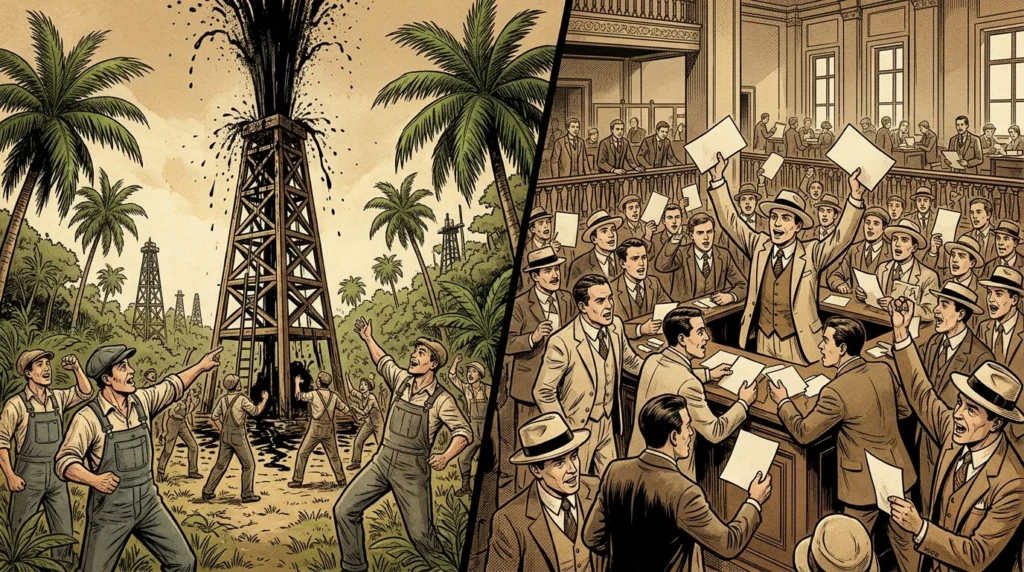
Between January and October 1987, the Mexican Stock Exchange (Bolsa Mexicana de Valores, or BMV) staged the most explosive equity rally in the world, only to suffer one of the most devastating retail market collapses in Latin American history. Even as the Mexican economy wrestled with triple-digit annual inflation, stagnant real wages, and the lingering trauma of the 1982 sovereign debt default, the BMV’s benchmark Price and Quotations Index (Indice de Precios y Cotizaciones, or IPC) surged from approximately 47,000 points at the start of 1987 to an all-time intraday peak of 373,216 points on October 6, 1987—a nominal gain of nearly 700 percent in nine months. [1]
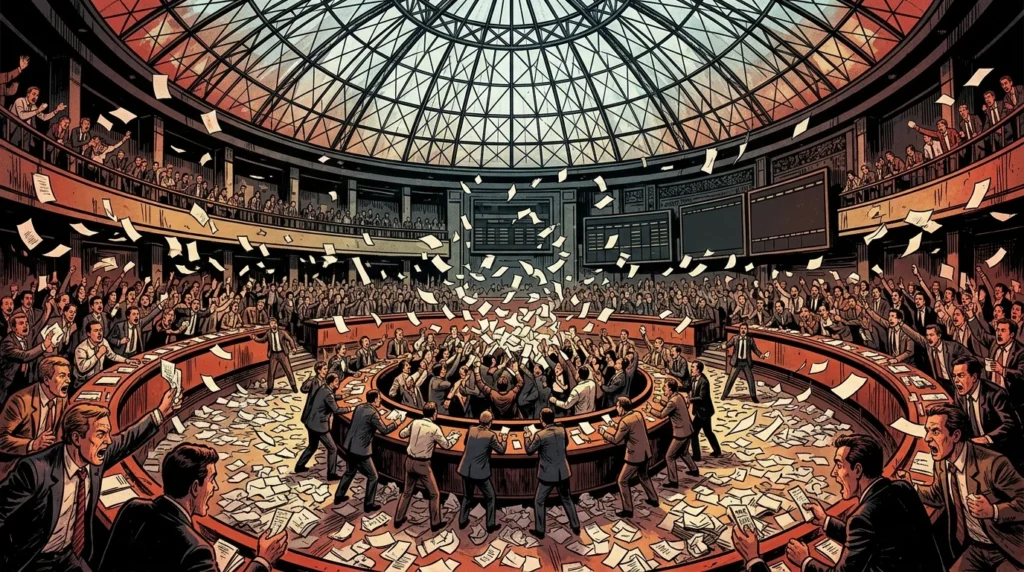
When Wall Street’s “Black Monday” crash struck on October 19, 1987, Mexico’s hyper-leveraged speculative bubble imploded with catastrophic speed. Within six weeks, by November 17, 1987, the IPC index plunged roughly 75 percent to 95,484 points, wiping out the life savings of hundreds of thousands of middle-class retail investors, triggering a sovereign peso devaluation in November 1987, and culminating in the unprecedented criminal conviction of Eduardo Legorreta Chauvet, chairman of Mexico’s largest brokerage house, Operadora de Bolsa (OBSA). Far from being a simple echo of Wall Street’s sell-off, Mexico’s Crack Bursatil del 87 was the direct institutional product of two structural transformations over the preceding dozen years: the 1975 Securities Market Law (Ley del Mercado de Valores) and President Jose Lopez Portillo’s September 1, 1982 nationalization of private commercial banks. [2]
The 1975 Ley del Mercado de Valores and Consolidation of the Bolsa Mexicana
For the first seven decades of the twentieth century, Mexico’s equity market remained small, fragmented, and dominated by family-owned industrial-banking conglomerates (grupos financieros) that preferred closed bank loans over public share offerings. Three separate exchanges operated across the republic: the historic Bolsa de Valores de Mexico in Mexico City (tracing its roots to 1894), the Bolsa de Valores de Monterrey (founded in 1950 in the industrial capital of Nuevo Leon), and the Bolsa de Valores de Occidente in Guadalajara (founded in 1960). Trading volumes were thin, regulatory oversight by the National Securities Commission (Comision Nacional de Valores, or CNV) was rudimentary, and commercial banks frequently crossed stock trades internally without passing through an open exchange floor. [3]
To modernize domestic capital formation and create a liquid market capable of absorbing government treasury bills, Finance Minister Jose Lopez Portillo and Banco de Mexico spearheaded the enactment of the landmark Securities Market Law (Ley del Mercado de Valores), published in the Diario Oficial de la Federacion on January 2, 1975. The 1975 statute fundamentally redesigned Mexico’s financial architecture: [4]
- Institutionalizing the Casas de Bolsa: Previously, stockbrokers operated as individual concessionaires. The 1975 law required brokers to incorporate as capitalized corporate brokerage houses (casas de bolsa), granted them an exclusive legal monopoly over stock-exchange intermediation, and separated securities dealing from traditional commercial deposit banking.
- Unification of the National Exchange: Following the 1975 reform, the regional exchanges in Monterrey and Guadalajara were merged into the Mexico City exchange in 1975–1976 to form a single unified national marketplace, renamed the Bolsa Mexicana de Valores, S.A. de C.V. (BMV).
- Creation of the CETES Market and IPC Index: In January 1978, the federal government launched Federal Treasury Certificates (Certificados de la Tesoreria de la Federacion, or CETES), auctioned through the casas de bolsa, while the BMV introduced its modern 40-stock Price and Quotations Index (IPC) in October 1978 (later rebased in 1980).
| Documented Figure / Metric | Historical Significance & Archival Context |
|---|---|
| 14 percent | In fact, insiders had already begun distributing shares into retail buying on October 7, causing the IPC to slip roughly 14 percent over the next ten days. |
| 74.4 percent | Within a single month, by November 17, 1987, the IPC index hit a trough of 95,484 points—wiping out 74.4 percent of its peak nominal value (and over 80 percent in real inflation-adjusted terms). |
The September 1982 Bank Nationalization and the Rise of the “Banca Paralela”
Although the 1975 law created the legal shell of a modern brokerage industry, commercial banks still controlled the vast majority of Mexican financial assets—including many of the casas de bolsa themselves—until the watershed shock of 1982. After collapsing world oil prices and soaring U.S. interest rates forced Mexico to declare a moratorium on foreign sovereign debt principal in August 1982, outgoing President Jose Lopez Portillo delivered his final annual address on September 1, 1982, stunning the nation by decreeing the immediate expropriation and nationalization of all private Mexican commercial banks and imposing strict exchange controls. [5]
When President Miguel de la Madrid Hurtado took office in December 1982, his administration faced deep hostility from Mexico’s dispossessed banking families—led by prominent financiers such as Carlos Trouyet, Agustin Legorreta Chauvet (former head of Banamex), Manuel Espinosa Yglesias (former head of Bancomer), and Alberto Bailleres. Seeking to restore private-sector confidence and finance a massive federal fiscal deficit without repealing the constitutional bank nationalization directly, the de la Madrid administration made a fateful compromise in 1983–1984: while keeping commercial banks in state hands, the government reprivatized the banks’ non-bank financial subsidiaries—including the casas de bolsa, insurance companies, and leasing firms—selling them back to the former bank owners and paying generous indemnification bonds for the expropriated banks. [6]
Armed with bank indemnification capital and shielded from the rigid interest-rate ceilings and reserve requirements imposed on the nationalized banks, the private casas de bolsa grew explosively into an unregulated parallel banking system (banca paralela). Through high-yield money-market accounts, commercial paper, and exclusive dominance over CETES trading, brokerage firms such as Operadora de Bolsa (OBSA)—chaired by Eduardo “El Bayo” Legorreta Chauvet, brother of former Banamex chief Agustin Legorreta—Inverlat, Acciones y Valores de Mexico (Accival, led by Roberto Hernandez and Alfredo Harp Helu), Probursa, and Estrategia Bursatil captured a surging share of national savings. While casas de bolsa managed less than 3 percent of Mexican financial-system assets in 1982, their share exceeded 36 percent by 1986–1987. [7]
The 1987 Margin-Credit Mania and the October 6 Peak at 373,216 Points
By late 1986 and early 1987, several macroeconomic forces converged to ignite a speculative frenzy on the BMV’s trading floor on Calle Uruguay in downtown Mexico City. Consumer price inflation accelerated toward an all-time high of 159.2 percent in 1987, while the de la Madrid government allowed the controlled peso exchange rate to depreciate faster than foreign interest rates, encouraging capital repatriation. Meanwhile, nationalized commercial banks began issuing minority public equity stakes known as Certificados de Aportacion Patrimonial (CAPs), which instantly tripled and quadrupled in price after listing. [8]
Seeing the BMV IPC index quadruple during 1986 to close at roughly 47,101 points, Mexico’s urban middle class rushed into equities to outrun inflation. The total number of individual brokerage accounts in Mexico swelled from roughly 50,000 in 1982 to nearly 400,000 by autumn 1987. Crucially, the largest casas de bolsa fueled the final parabolic phase of the bubble through aggressive, weakly supervised margin lending—known as operaciones a plazo (forward/margin contracts) and credit-backed equity funds. Retail clients were encouraged to pledge their existing stock portfolios as collateral to borrow fresh funds from the brokerages to buy even more shares, while listed industrial companies diverted working capital from factories into speculative stock portfolios.
Throughout the summer of 1987, the BMV decoupled completely from Mexico’s depressed real economy. On October 4, 1987, the ruling Institutional Revolutionary Party (PRI) announced that Planning and Budget Secretary Carlos Salinas de Gortari—architect of the administration’s market-oriented economic policy—would be its presidential candidate for 1988. When the BMV opened on Monday, October 5, euphoric buying drove the market up so violently that exchange authorities temporarily halted trading. The next day, October 6, 1987, the IPC index touched its historic peak of 373,216.18 points—representing a nominal gain of nearly 692 percent since January 1987 and a price-to-earnings multiple that rivaled Tokyo’s bubble market.
Black Monday, the 75% Collapse, and the Prosecution of Eduardo Legorreta
In fact, insiders had already begun distributing shares into retail buying on October 7, causing the IPC to slip roughly 14 percent over the next ten days. Then came Monday, October 19, 1987 (“Black Monday”). As the Dow Jones Industrial Average plunged 22.6 percent in New York, panic engulfed Mexico City. The BMV IPC dropped 16.5 percent on October 19 alone and continued to crater day after day as automatic margin calls triggered forced liquidations across the operaciones a plazo accounts.
Because the physical trading floor lacked automated settlement capacity for panic volumes and buyers vanished altogether, brokerage clerks could not execute sell orders before margin collateral fell below loan balances. Within a single month, by November 17, 1987, the IPC index hit a trough of 95,484 points—wiping out 74.4 percent of its peak nominal value (and over 80 percent in real inflation-adjusted terms). Terrified investors who dumped pesos for U.S. dollars drained Banco de Mexico’s foreign reserves, forcing the central bank to withdraw from the free foreign-exchange market on November 18, 1987, when the peso plunged more than 30 percent in a single day, and prompting the December 1987 Economic Solidarity Pact (Pacto de Solidaridad Economica).
In the aftermath of the crash, thousands of ruined retail investors filed complaints with the National Securities Commission alleging that brokerage houses had executed unauthorized margin trades, dumped house-account losses into client accounts, and sold unregistered commercial paper. Following his inauguration in December 1988, President Carlos Salinas de Gortari ordered a dramatic enforcement crackdown to demonstrate that the financial elite was not above the law. On February 13, 1989, federal judicial police arrested Eduardo Legorreta Chauvet, chairman of Operadora de Bolsa, along with three other brokerage executives, charging them with criminal violations of the Ley del Mercado de Valores for selling nonexistent or expired Treasury certificates (CETES) and falsifying client records during the post-crash liquidity crunch. Convicted in July 1990 before being released in 1991 after regulatory reforms restructured Mexico’s securities oversight, Legorreta became the permanent symbol of Mexico’s 1980s parallel-banking boom and the great 1987 Bolsa crash.
Theoretical & Balance-Sheet Transmission Mechanism
In the Kindleberger–Minsky taxonomy of financial instability (Kindleberger, 1978; Minsky, 1986) and Irving Fisher’s (1933) debt-deflation framework, speculative asset booms become systemic crises when credit expansion shifts balance sheets from hedge finance (cash flows covering principal and interest) to speculative and Ponzi finance (relying on rising asset prices and short-term margin roll-overs).
Once monetary tightening or an exogenous shock halts price appreciation, forced margin liquidations trigger Fisherian debt-deflation: fire-sale asset discounts erode bank collateral values, contracting credit supply across the real economy.
Sources and Further Reading
- Banco de Mexico, “ Informe Anual 1987,” Banco de Mexico, 1988. Central Bank / Monetary Authority
- Gustavo del Angel Mobarak and Carlos Marichal (eds.), “ La nacionalizacion bancaria, 1982: Documentos y analisis,” Centro de Estudios Espinosa Yglesias (CEEY), 2018. Historical & Financial Reference
- Juanita Darling, “ Leading Mexican Stockbroker Convicted of Fraud,” Los Angeles Times, 1990-07-05. Historical & Financial Reference
- ITESO Institutional Repository, “ El Crack Bursatil de 1987 en la Bolsa Mexicana de Valores,” Instituto Tecnologico y de Estudios Superiores de Occidente, 1988. Historical & Financial Reference
- Expansion, “ Profundo carmesi: El crack de 1987,” Grupo Expansion, 2011-09-14. Historical & Financial Reference
- Al Momento, “ A 35 anos del crack del 87,” Al Momento Mexico, 2022-10-19. Historical & Financial Reference
- Irving Fisher — "The Debt-Deflation Theory of Great Depressions," Econometrica 1, no. 4 (FRASER Federal Reserve Archive, 1933): 337–357 Central Bank / Monetary Authority
- Charles P. Kindleberger & Robert Z. Aliber — Manias, Panics, and Crashes: A History of Financial Crises (Palgrave Macmillan) Peer-Reviewed / Academic Research
Cite This Historical Dossier (APA / Chicago)
APA (7th ed.): Ç., S. (Ed.). (2026). Mexico’s 1987 Stock Market Crash and the Brokerage Boom. In Forgotten Fortunes Historical Monograph Series (Forgotten Fortunes Editorial Desk). https://forgottenfortunes.net/mexico-1987-stock-market-crash/
MLA (9th ed.): Ç., Soner, ed. "Mexico’s 1987 Stock Market Crash and the Brokerage Boom." Forgotten Fortunes: Financial & Monetary History Archive, 2026, https://forgottenfortunes.net/mexico-1987-stock-market-crash/.
Chicago (17th ed.): Ç., Soner, ed. "Mexico’s 1987 Stock Market Crash and the Brokerage Boom." Forgotten Fortunes Historical Monograph Series (Forgotten Fortunes Editorial Desk), September 17, 2026. https://forgottenfortunes.net/mexico-1987-stock-market-crash/.
Have an idea for another financial history documentary or article? Request a story →