In This Article
On Saturday, February 25, 2006, the Tadawul All-Share Index (TASI) of the Saudi Stock Exchange closed at an all-time record of 20,634.86 points, having touched an intraday peak of 20,966.58. Over the preceding three years, surging crude oil prices, repatriated Gulf capital, and aggressive personal lending by domestic commercial banks had transformed equity trading from an elite pastime into a nationwide obsession in which nearly half of all Saudi adults participated. With total market capitalization surpassing 3 trillion Saudi riyals ($800 billion)—more than double Saudi Arabia’s gross domestic product—the exchange traded at price-to-earnings multiples exceeding 40 times trailing profits. The very next day, after the Capital Market Authority (CMA) tightened daily price-fluctuation limits to cool speculation, the market went into free fall. Known across the Kingdom as “Black February,” the 2006 crash erased more than 65 percent of the market’s value (over $450 billion in nominal wealth) by year-end, devastated leveraged middle-class households, and forced a thirteen-year institutional overhaul that ultimately enabled Tadawul to host the December 2019 listing of Saudi Aramco—at $29.4 billion, the largest initial public offering in world history. [1]

Oil Revenues, Bank Consumer Loans, and the 2003–2006 Tadawul Mania
For decades after informal share trading began in the 1930s with the Arab Automobile Company and expanded in the 1970s through joint-stock electricity, cement, and banking firms, Saudi Arabia lacked an independent securities regulator or a centralized stock exchange floor. Beginning in 1984, the Saudi Arabian Monetary Agency (SAMA) supervised bank-operated share trading, launching the Electronic Securities Information System (ESIS) in 1990 and replacing it in October 2001 with *Tadawul*, a real-time electronic trading, clearing, and settlement network linking Saudi commercial banks. [2]
Two powerful catalysts converged in 2003 to ignite the Tadawul boom. First, global crude oil prices entered a sustained structural bull market, climbing from roughly $25 per barrel in 2002 to over $60 per barrel by 2005 and swelling Saudi Arabia’s annual oil export revenues from $64 billion in 2002 to more than $160 billion in 2005. Simultaneously, in the aftermath of the September 11, 2001 attacks in the United States, wealthy Saudi investors repatriated tens of billions of dollars in private capital from Western financial centers into the domestic economy. Second, the Saudi government enacted the Capital Market Law by Royal Decree M/30 in June 2003 (establishing the independent Capital Market Authority in July 2004) and began floating heavily oversubscribed initial public offerings of state-linked giants—starting with Saudi Telecom Company (STC) in 2003, Sahara Petrochemical, Ettihad Etisalat (Mobily), and Bank Albilad—at low par values that regularly tripled or quadrupled on their first day of trading. [3]
Seeing effortless windfalls in IPO allocations, millions of ordinary citizens—civil servants, teachers, soldiers, retirees, and university students—opened brokerage accounts through their commercial banks. Because Saudi banks could automatically deduct loan repayments directly from government employees’ monthly salary deposits, lenders aggressively marketed personal consumer loans (*tawarruq* and murabaha facilities) and margin lines that borrowers immediately funneled into stocks. Between 2002 and 2005, commercial bank consumer loans to individuals soared more than threefold to roughly 180 billion riyals ($48 billion). Women, who faced strict social segregation in public workspaces, traded billions of riyals from home laptops and dedicated women-only bank VIP trading lounges. [4]
| Documented Figure / Metric | Historical Significance & Archival Context |
|---|---|
| 76 percent | From 2,518 points at the end of 2002, the TASI index rose 76 percent in 2003 (to 4,437), 85 percent in 2004 (to 8,206), and another 103.7 percent in 2005 to close the year at 16,712.64 points. |
| 10 percent | Most notably, the CMA prohibited listed companies from trading in the shares of other listed firms without prior approval and reduced the maximum daily price-fluctuation band from 10 percent to 5 percent, while simultaneously altering minimum tick sizes. |
| 5 percent | On Sunday, February 26, 2006, major *hamour* syndicates began liquidating positions, and stocks across the board hit the new 5 percent lower limit. |
| $450 billion | The sell-off continued through the remainder of the year: TASI closed 2006 at 7,933 points—a 61.5 percent drop from its February peak—and bottomed near 6,767 in early 2007, wiping out more than 1.7 trillion riyals (over $450 billion to $500 billion) in market capitalization. |
The 20,634.86 Peak and Speculation in the “Khashkhash” Penny Stocks
As trillions of riyals in retail liquidity chased a narrow float of just 76 to 80 listed companies—most of whose shares were tightly locked up by the state’s Public Investment Fund, pension funds, and founding merchant families—valuations detached completely from corporate fundamentals. From 2,518 points at the end of 2002, the TASI index rose 76 percent in 2003 (to 4,437), 85 percent in 2004 (to 8,206), and another 103.7 percent in 2005 to close the year at 16,712.64 points. [5]
At the height of the frenzy in early 2006, speculation centered not on profitable blue-chip giants like Saudi Basic Industries Corporation (SABIC) or Al Rajhi Bank, but on small-cap agricultural, fisheries, livestock, and service companies known colloquially in Saudi dialects as *ashum al-khashkhash* (“rattle” or “poppy” penny stocks). Organized syndicates of wealthy manipulators (*hamour*, or “grouper sharks”) cornered the tiny free floats of loss-making agricultural and shipping firms through wash trades across multiple nominee accounts, driving their share prices to more than 100 times earnings before dumping the stock onto retail day traders following tips in internet chatrooms and SMS groups. [6]
By February 25, 2006, when TASI closed at its historic zenith of 20,634.86 points, roughly 3 to 4 million Saudi citizens (in a total national population of around 23 million) held active stock portfolios or IPO subscriptions. Stories proliferated across Riyadh and Jeddah of middle-class citizens who had mortgaged family homes, sold wedding gold, or liquidated small businesses to trade on five-to-one informal margin. [7]
“Black February” 2006 and the $450+ Billion Wealth Wipeout
Alarmed by the vertical trajectory of the index and the rampant manipulation of small-cap stocks, the Capital Market Authority under Chairman Jammaz al-Suhaimi implemented a series of technical cooling measures in late February 2006. Most notably, the CMA prohibited listed companies from trading in the shares of other listed firms without prior approval and reduced the maximum daily price-fluctuation band from 10 percent to 5 percent, while simultaneously altering minimum tick sizes. [8]
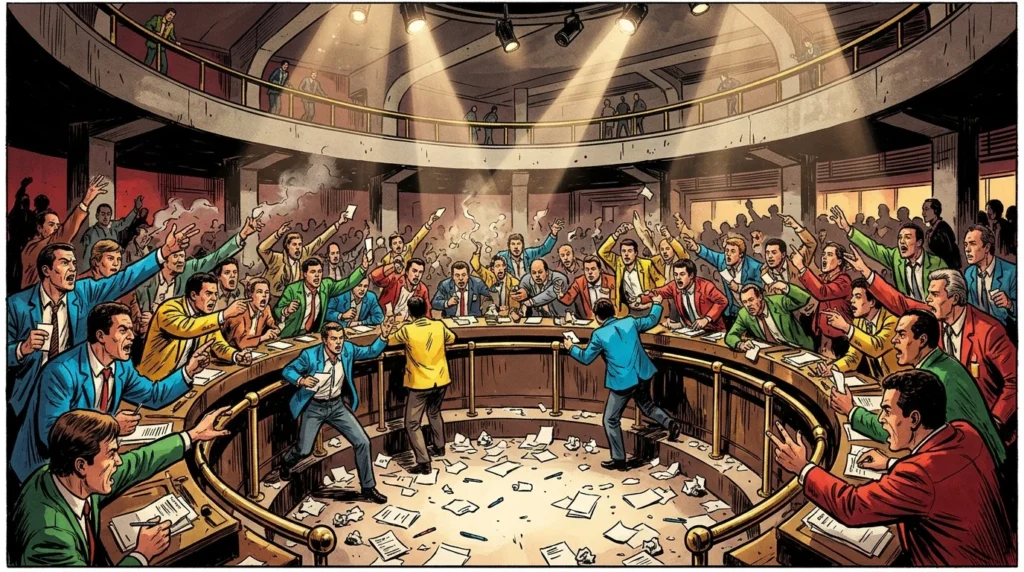
Instead of engineering a soft landing, the regulatory intervention punctured the momentum that leveraged speculators relied upon. On Sunday, February 26, 2006, major *hamour* syndicates began liquidating positions, and stocks across the board hit the new 5 percent lower limit. Because Saudi commercial banks had extended tens of billions of riyals in margin credit secured by pledged shares, falling prices automatically triggered algorithmic bank margin calls. With stocks locked limit-down and illiquid in the speculative small-cap sector, banks forcibly sold their clients’ liquid blue-chip holdings—such as SABIC, Saudi Telecom, and major banks—to cover margin deficits, dragging the entire market into a violent downward spiral.
Between February 25 and mid-May 2006, TASI plunged by more than 50 percent, falling below 10,000 points despite emergency interventions that included a 5-for-1 stock split to make share prices more affordable to small buyers, permission for foreign residents (*expatriates*) in Saudi Arabia to trade stocks directly, and public pledges of support by Prince Alwaleed bin Talal and King Abdullah. On May 12, 2006, a Royal Decree replaced CMA Chairman Jammaz al-Suhaimi with Abdulrahman al-Tuwaijri. The sell-off continued through the remainder of the year: TASI closed 2006 at 7,933 points—a 61.5 percent drop from its February peak—and bottomed near 6,767 in early 2007, wiping out more than 1.7 trillion riyals (over $450 billion to $500 billion) in market capitalization.
Institutional Modernization and the December 2019 Saudi Aramco IPO
The trauma of the 2006 crash fundamentally reshaped Saudi capital market regulation. Over the following decade, the CMA prosecuted scores of market manipulators, banned unlicensed portfolio management, imposed strict debt-to-income caps on bank personal loans in coordination with SAMA, converted the Saudi Stock Exchange (Tadawul) into a formal joint-stock company in March 2007, and systematically reduced retail dominance in favor of institutional asset managers. In June 2015, Tadawul opened direct market access to Qualified Foreign Investors (QFIs), and between 2018 and 2019, global index providers FTSE Russell, S&P Dow Jones, and MSCI upgraded Saudi Arabia to Emerging Market status.
This modernized market infrastructure faced its ultimate test under Crown Prince Mohammed bin Salman’s “Vision 2030” economic blueprint, announced in April 2016, which proposed selling a small stake in the state oil monopoly, Saudi Arabian Oil Company (Saudi Aramco), and transferring the proceeds to the Public Investment Fund (PIF) to finance non-oil industrial and tourism megaprojects. After nearly four years of debate over international listing venues in New York, London, Hong Kong, or Tokyo—complicated by sovereign-immunity concerns, litigation risks, and disagreements with Western institutional investors over Crown Prince Mohammed’s target $2 trillion valuation—the Saudi government decided in late 2019 to anchor the offering exclusively on the domestic Tadawul exchange.
To prevent a repeat of the 2006 debt-fueled crash while ensuring a triumphant domestic reception, Saudi regulators and banks offered carefully calibrated retail incentives, including one bonus share for every ten shares held continuously for 180 days by Saudi citizens, alongside substantial commitments from wealthy Saudi merchant families, domestic institutions, and Gulf sovereign wealth funds in Abu Dhabi and Kuwait. On December 5, 2019, Saudi Aramco priced its initial sale of 3 billion shares (a 1.5 percent stake) at 32 Saudi riyals ($8.53) per share, raising an initial $25.6 billion—surpassing Alibaba Group’s $25 billion New York listing in 2014—and valuing the company at $1.7 trillion.
When trading commenced on Tadawul under ticker symbol 2222 on December 11, 2019, Saudi Aramco shares jumped the maximum daily limit of 10 percent to 35.2 riyals, and the following day touched 38.7 riyals, briefly fulfilling the Crown Prince’s $2.0 trillion valuation target. On January 12, 2020, stabilizing manager Goldman Sachs exercised the 450-million-share “greenshoe” over-allotment option in full, lifting total proceeds from the IPO to 110.4 billion riyals ($29.4 billion). Thirteen years after the retail bubble of 2006 nearly crippled household balance sheets across the Kingdom, the record-breaking Aramco listing cemented Tadawul among the ten largest stock exchanges on earth by market capitalization.
Theoretical & Balance-Sheet Transmission Mechanism
In the Kindleberger–Minsky taxonomy of financial instability (Kindleberger, 1978; Minsky, 1986) and Irving Fisher’s (1933) debt-deflation framework, speculative asset booms become systemic crises when credit expansion shifts balance sheets from hedge finance (cash flows covering principal and interest) to speculative and Ponzi finance (relying on rising asset prices and short-term margin roll-overs).
Once monetary tightening or an exogenous shock halts price appreciation, forced margin liquidations trigger Fisherian debt-deflation: fire-sale asset discounts erode bank collateral values, contracting credit supply across the real economy.
Sources and Further Reading
- Capital Market Authority of Saudi Arabia, “ The Saudi Stock Market: Structural Development and the 2006 Market Correction,” Capital Market Authority (CMA), 2006. Official / State Archive
- Al Jazeera, “ Stock Crash Shatters Saudi Dreams,” Al Jazeera, 2006-05-03. Historical & Financial Reference
- Al Jazeera, “ Arab Stock Markets Hit by Losses,” Al Jazeera, 2006-03-15. Historical & Financial Reference
- Saudi Gazette, “ The Story of the Saudi Stock Market,” Saudi Gazette, 2017-12-08. Historical & Financial Reference
- Voice of America, “ Saudi Oil Giant Aramco Pushes IPO to Record $29.4 Billion,” Voice of America, 2020-01-12. Historical & Financial Reference
- Argaam Financial Network, “ Saudi Aramco Exercises Greenshoe Option, Raising Total IPO Size to SAR 110.4 Billion ($29.4 Billion),” Argaam, 2020-01-12. Historical & Financial Reference
- Irving Fisher — "The Debt-Deflation Theory of Great Depressions," Econometrica 1, no. 4 (FRASER Federal Reserve Archive, 1933): 337–357 Central Bank / Monetary Authority
- Charles P. Kindleberger & Robert Z. Aliber — Manias, Panics, and Crashes: A History of Financial Crises (Palgrave Macmillan) Peer-Reviewed / Academic Research
Cite This Historical Dossier (APA / Chicago)
APA (7th ed.): Ç., S. (Ed.). (2026). Saudi Arabia’s 2006 Stock Crash and the Aramco IPO. In Forgotten Fortunes Historical Monograph Series (Forgotten Fortunes Editorial Desk). https://forgottenfortunes.net/saudi-2006-stock-crash-aramco-ipo/
MLA (9th ed.): Ç., Soner, ed. "Saudi Arabia’s 2006 Stock Crash and the Aramco IPO." Forgotten Fortunes: Financial & Monetary History Archive, 2026, https://forgottenfortunes.net/saudi-2006-stock-crash-aramco-ipo/.
Chicago (17th ed.): Ç., Soner, ed. "Saudi Arabia’s 2006 Stock Crash and the Aramco IPO." Forgotten Fortunes Historical Monograph Series (Forgotten Fortunes Editorial Desk), September 18, 2026. https://forgottenfortunes.net/saudi-2006-stock-crash-aramco-ipo/.
Have an idea for another financial history documentary or article? Request a story →