

In This Article
Long before Rome commanded overseas tribute from provincial breadbaskets in Sicily, Sardinia, and North Africa, the early Roman Republic (509–264 BCE) existed on the knife-edge of subsistence. Hemmed in by hostile Latin, Volscian, Aequian, and Etruscan neighbors across the narrow plain of Latium, fifth- and fourth-century BCE Rome suffered recurrent harvest failures and wartime supply blockades that sent the price of wheat and spelt soaring—a crisis Roman annalists termed caritas annonae (“dearness of the grain supply”). Whenever drought or raiding armies emptied the city’s granaries, the Senate scrambled to dispatch emergency purchasing embassies down the Tiber and along the Tyrrhenian coast while Empowering magistrates to police hoarding in the Forum. In 440–439 BCE, that fragile fiscal balance shattered when a wealthy equestrian merchant named Spurius Maelius used his private fortune to outbuy the Roman state’s own grain commissioner, triggering a constitutional panic that ended with Maelius’s summary execution and the state liquidation of his wheat reserves at one bronze as per modius. [1]
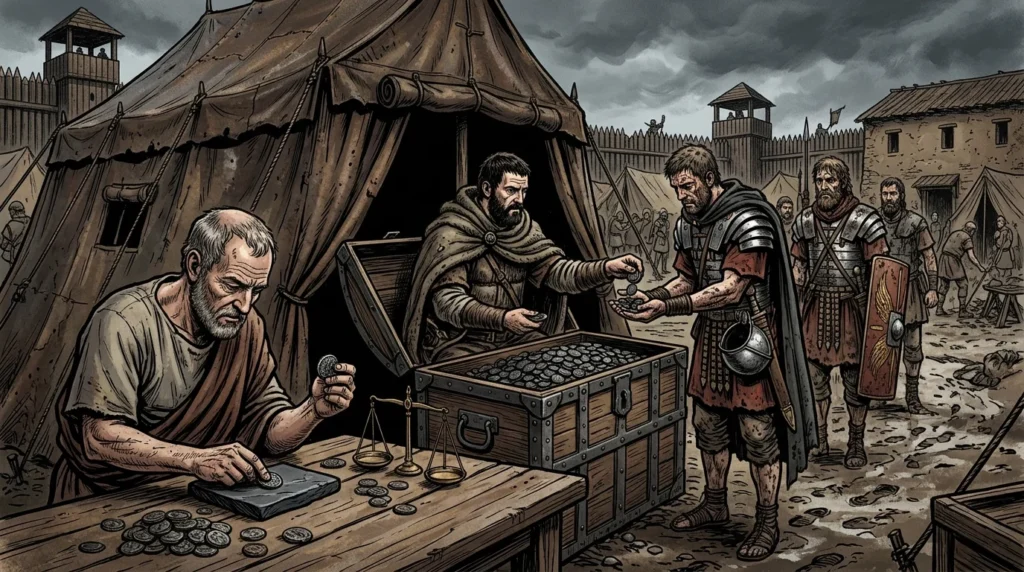
Subsistence Shocks and Senatorial Grain Embassies (508–411 BCE)
In the early Republic, Rome’s urban population and citizen militia relied overwhelmingly on cereal cultivation—chiefly husked emmer wheat (far) and naked wheat (triticum)—harvested within a few days’ ox-cart haul of the Seven Hills. Because land transport of bulk grain was prohibitively expensive compared to riverine or coastal shipping, any localized crop blight, autumn flood of the Tiber, or summer military mobilization could trigger acute famine (inopia ac fames). Evidence preserved in the Etruscan-derived Brontoscopic Calendar (translated into Latin in the first century BCE by Publius Nigidius Figulus) and the pontifical chronicle entries (tabulae dealbatae) cited by Livy and Dionysius of Halicarnassus demonstrates that fifth-century Romans tracked harvest failure, locust swarms, and grain inflation with obsessive anxiety.
Because early Rome lacked a standing state fleet or permanent overseas provinces, the Senate responded to severe supply shocks by appointing extraordinary purchasing envoys to buy grain with treasury bullion (aerarium) from foreign markets:
- The Siege Crisis of 508 BCE: During Lars Porsenna’s Etruscan blockade of Rome, the consuls sent envoys to the Volscian plain and the Greek colony of Cumae on the Bay of Naples to purchase grain and salt, selling provisions to the citizenry at moderate regulated prices to prevent starvation and defection.
- The Great Famine of 492–491 BCE: After the First Secession of the Plebs left Roman fields unseeded during the autumn sowing season, a catastrophic famine struck the city. The Senate dispatched envoys to Etruria, the Pomptine marshes, Cumae, and as far south as Greek Sicily. At Cumae, the tyrant Aristodemus seized the Roman ambassadors’ ships in retaliation for Rome’s confiscation of the exiled Tarquin dynasty’s property, while in the Pomptine territory Volscian hostility nearly cost the envoys their lives. Only timely shipments floated down the Tiber from Etruria and the arrival of fifty thousand medimni of Sicilian wheat—half purchased at a low price and half gifted by the Sicilian tyrant Gelon of Syracuse—saved the city, setting the stage for Gaius Marcius Coriolanus’s notorious proposal to withhold the Sicilian corn unless the plebs surrendered their newly created tribunate.
- Recurring Fourth- and Fifth-Century Crises (477, 456, 440, 411, and 384 BCE): Similar subsistence shocks recurred in 477 BCE, 456 BCE, 433 BCE, and 411 BCE, when epidemic disease paralyzed cultivation and the Senate again sent embassies to Etruria, Samnium, and Sicily to procure emergency cargoes via the Tiber port of Ostia.
The Famine of 440–439 BCE and Lucius Minucius’s Rationing Regime
The most politically explosive food crisis of the early Republic erupted in 440 BCE under the consulship of Proculus Geganius Macerinus and Lucius Menenius Lanatus. Whether triggered by prolonged drought or agricultural neglect during social strife, the harvest failure was so severe that Livy recorded desperate plebeians covering their heads and throwing themselves into the Tiber River rather than endure slow starvation after their household stores ran out. [2]
With the regular magistrates unable to stem the panic, the Senate approved the appointment of an extraordinary commissioner of the grain supply—praefectus annonae—naming the patrician Lucius Minucius Augurinus to the post. Minucius immediately dispatched purchasing agents by land and sea to neighboring peoples, yet his official missions met with widespread failure; apart from a modest trickle of grain floated down from Etruria, foreign suppliers either lacked surpluses or refused official Roman terms.
Forced to manage an acute domestic shortage without external imports, Minucius fell back on coercive price and inventory controls inside Rome. He ordered all residents to declare their private cereal stocks above a single month’s subsistence requirement, compelled holders of surplus wheat to sell their reserves at state-fixed ceilings, reduced the daily bread rations allotted to enslaved household workers, and brought harsh prosecutions against retail corn-dealers (frumentarii), exposing them to the fury of the hungry populace. Rather than lowering prices, Minucius’s draconian inquisitions publicized the severity of the deficit and drove remaining private stocks further underground.
Spurius Maelius’s Private Corner on Etruscan and Campanian Wheat
Where the Roman state’s diplomatic embassies stalled, private mercantile capital succeeded. Spurius Maelius, a remarkably wealthy plebeian member of the equestrian order (ordo equester) who had recently inherited his father’s fortune and bore the popular nickname Felix (“the Fortunate”), stepped directly into the market vacuum. Barred by his plebeian birth from competing for the patrician consulship, Maelius recognized that private mastery of the grain supply offered unprecedented political leverage.
Drawing on his personal liquid wealth and an extensive network of guest-friendships (hospitia) and business clients across Etruria and Campania, Maelius bypassed official bottlenecks. According to Livy and Dionysius of Halicarnassus, Maelius traveled personally to Tyrrhenia (Etruria) and made multiple maritime voyages to Cumae and the harbors around Misenum, chartering merchant vessels that sailed into Ostia and up the Tiber laden with private wheat. Because Maelius offered immediate hard payment through established commercial contacts, he succeeded in buying up the very regional surpluses that Minucius’s state envoys had failed to secure.
Instead of selling his imported cargoes at famine market rates to maximize profit, Maelius turned his granaries into an engine of political patronage (largitio). Dionysius reports that whereas scarcity had driven the market price of grain to twelve drachmae per modius (a standard Roman dry measure of roughly 8.7 liters, or one-sixth of a Greek medimnus), Maelius sold wheat to citizens at just two drachmae per modius and distributed rations completely free of charge to the destitute. Whenever Maelius walked through the Forum, grateful crowds escorted him like a sovereign, openly promising to elevate him to the highest offices of the state regardless of patrician constitutional barriers. [3]
The Assassination of Maelius and the One-As-Per-Modius Liquidation
By the spring of 439 BCE, when Titus Quinctius Capitolinus and Agrippa Menenius Lanatus entered the consulship and the Senate renewed Lucius Minucius’s commission as praefectus annonae, Maelius’s private relief operation had created a dual power crisis in Rome. Humiliated in his official capacity and alarmed by Maelius’s mass following, Minucius appeared before the Senate to denounce the equestrian philanthropist. Minucius alleged that Maelius had converted his private house into an arsenal, held nocturnal assemblies, bribed plebeian tribunes, and conspired to overthrow the Republic and crown himself king (rex)—trading a few pounds of spelt and wheat for the civic liberty of the Roman people. [4]
Accepting Minucius’s accusation as an existential emergency, the consuls and Senate invoked the ultimate constitutional weapon: they nominated the aged patrician hero Lucius Quinctius Cincinnatus as Dictator, because a dictator’s supreme power (imperium) was exempt from the plebeian tribunes’ veto and the citizen’s right of appeal (provocatio). Cincinnatus immediately appointed Gaius Servilius Ahala as his Master of the Horse (magister equitum) and convened his tribunal in the Forum the next morning.
When Ahala summoned Maelius to answer Minucius’s charges before the Dictator, Maelius panicked, seized a butcher’s knife or retreated into the crowd of his plebeian supporters, and cried out that the patricians were persecuting him solely because he had fed the starving people. As the crowd surged to protect their benefactor, Servilius Ahala drew a concealed dagger, charged into the throng, and struck Maelius dead on the spot. Cincinnatus formally pronounced that Maelius had been justly slain (iure caesum) as an aspiring tyrant even without a trial.
The Roman state moved swiftly to erase Maelius’s memory while appropriating his economic assets to pacify the plebs:
- Confiscation and Demolition (Aequimaelium): Cincinnatus ordered Maelius’s fortune confiscated to the public treasury (aerarium) and commanded the aediles to raze his house to the ground so that the leveled vacant plot—known for centuries afterward as the Aequimaelium below the Capitol—would stand as a permanent warning against private munificence aimed at tyranny.
- State Sale at One As per Modius: To prevent a plebeian uprising over their champion’s murder, Lucius Minucius took possession of the vast wheat stockpiles found in Maelius’s warehouses and distributed the grain to the citizenry at the nominal token price of one bronze as per modius. For his role in crushing Maelius and distributing the seized corn, Minucius was honored with a gilded bronze ox and a commemorative column outside the Porta Trigemina (celebrated on second-century BCE silver denarii minted by his descendants in the gens Minucia).
The Aediles, Market Weights, and Policing the Dardanarii
The Maelius affair convinced the Roman senatorial elite that the city’s food supply (cura annonae) could neither be left to unregulated market distress nor ceded to ambitious private financiers. For the remainder of the Republic, ordinary day-to-day supervision of Rome’s grain markets rested with the aediles—originally the two plebeian aediles (aediles plebis) instituted in 494 BCE at the Temple of Ceres, the goddess of grain, and supplemented from 367 BCE onward by two patrician curule aediles (aediles curules). [5]
While consuls, quaestors, and occasional emergency prefects handled external procurement during wartime shortages, the four aediles policed the retail mechanics of the Roman Forum and the Tiber river wharves (Emporium). Aediles verified the accuracy of bronze and stone dry measures—specifically the standard modius and semimodius—confiscating and smashing fraudulent containers used by dishonest merchants. Even more critically, the aediles prosecuted grain speculators and forestallers known in Roman legal sources as frumentarii and later dardanarii: merchants and wealthy landowners who bought up cargoes on arrival or withheld their own harvests from the market (annonam comprimere or onerare) to engineer artificial scarcity and price spikes. Livy records multiple third- and second-century BCE prosecutions in which curule and plebeian aediles levied heavy monetary fines on convicted grain hoarders (ob annonam compressam), using the seized penalty funds to dedicate gilded bronze shields, temple statues, and public works on the Capitol—institutionalizing the principle that the Roman grain market was a public trust rather than a playground for private monopoly.
Theoretical & Balance-Sheet Transmission Mechanism
In the Kindleberger–Minsky taxonomy of financial instability (Kindleberger, 1978; Minsky, 1986) and Irving Fisher’s (1933) debt-deflation framework, speculative asset booms become systemic crises when credit expansion shifts balance sheets from hedge finance (cash flows covering principal and interest) to speculative and Ponzi finance (relying on rising asset prices and short-term margin roll-overs). [6]
Once monetary tightening or an exogenous shock halts price appreciation, forced margin liquidations trigger Fisherian debt-deflation: fire-sale asset discounts erode bank collateral values, contracting credit supply across the real economy.
Sources and Further Reading
- Dionysius of Halicarnassus, “ Roman Antiquities, Book XII (Chapters 1–4: The Famine of 440–439 BCE and Spurius Maelius),” Loeb Classical Library / LacusCurtius, University of Chicago, 1950. Peer-Reviewed / Academic Research
- Dionysius of Halicarnassus, “ Roman Antiquities, Book VII (Chapters 1–20: The Famine of 492–491 BCE and Grain Embassies to Cumae, Etruria, and Sicily),” Loeb Classical Library / LacusCurtius, University of Chicago, 1943. Peer-Reviewed / Academic Research
- William Smith (ed.), “ Frumentariae Leges,” A Dictionary of Greek and Roman Antiquities, John Murray, 1875 (LacusCurtius, University of Chicago). Peer-Reviewed / Academic Research
- William Smith (ed.), “ Aediles,” A Dictionary of Greek and Roman Antiquities, John Murray, 1875 (LacusCurtius, University of Chicago). Peer-Reviewed / Academic Research
- William Smith (ed.), “ Dictator,” A Dictionary of Greek and Roman Antiquities, John Murray, 1875 (LacusCurtius, University of Chicago). Peer-Reviewed / Academic Research
- Jared Kreiner, “ Food Insecurity in Early Rome,” Ancient World Magazine, 2019. Historical & Financial Reference
- Irving Fisher — "The Debt-Deflation Theory of Great Depressions," Econometrica 1, no. 4 (FRASER Federal Reserve Archive, 1933): 337–357 Central Bank / Monetary Authority
- Charles P. Kindleberger & Robert Z. Aliber — Manias, Panics, and Crashes: A History of Financial Crises (Palgrave Macmillan) Peer-Reviewed / Academic Research
Cite This Historical Dossier (APA / Chicago)
APA (7th ed.): Ç., S. (Ed.). (2026). Rome’s Grain Crisis and the Death of Spurius Maelius. In Forgotten Fortunes Historical Monograph Series (Forgotten Fortunes Editorial Desk). https://forgottenfortunes.net/rome-spurius-maelius-grain-crisis/
MLA (9th ed.): Ç., Soner, ed. "Rome’s Grain Crisis and the Death of Spurius Maelius." Forgotten Fortunes: Financial & Monetary History Archive, 2026, https://forgottenfortunes.net/rome-spurius-maelius-grain-crisis/.
Chicago (17th ed.): Ç., Soner, ed. "Rome’s Grain Crisis and the Death of Spurius Maelius." Forgotten Fortunes Historical Monograph Series (Forgotten Fortunes Editorial Desk), September 18, 2026. https://forgottenfortunes.net/rome-spurius-maelius-grain-crisis/.
Have an idea for another financial history documentary or article? Request a story →


