In This Article
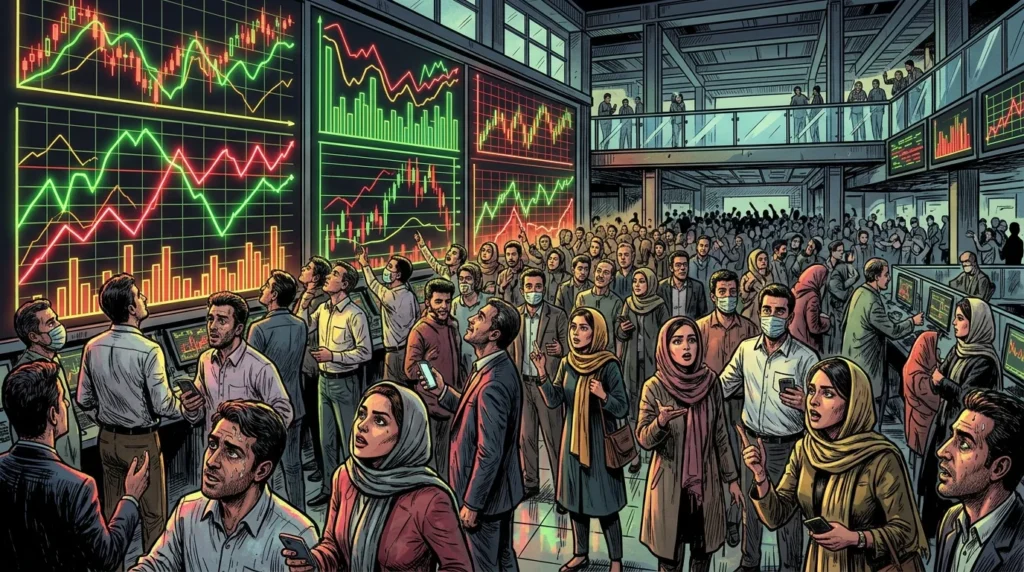
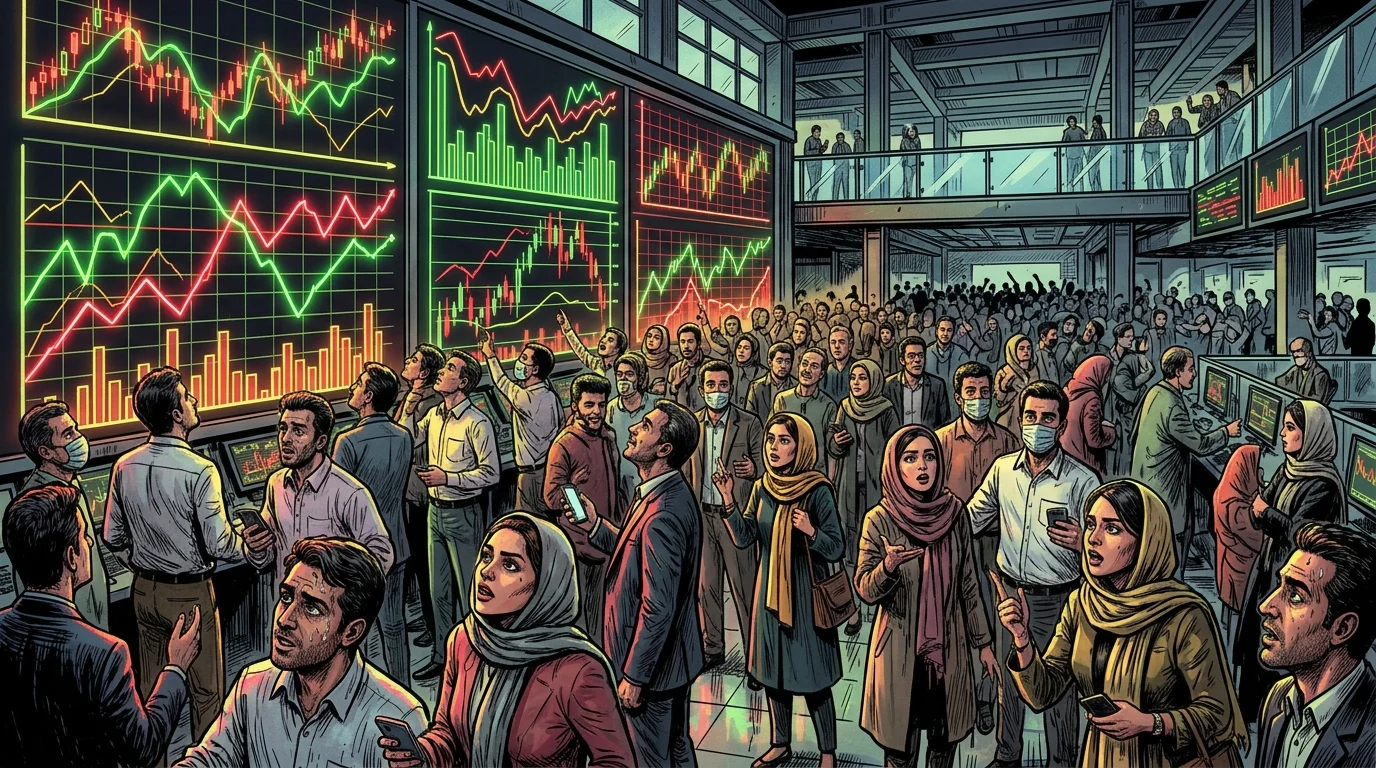
On August 9, 2020, the benchmark index of the Tehran Stock Exchange (TEDPIX) reached an all-time high of 2,078,546 points—capping a more than 300 percent nominal surge since the start of the Iranian calendar year in March 2020 and a nearly twenty-fold climb over two years. Even as the Iranian economy contracted under the weight of United States “maximum pressure” sanctions, plunging oil exports, and the COVID-19 pandemic, millions of ordinary Iranian households poured their life savings, gold coins, and proceeds from sold cars into the Tehran bourse at the urging of President Hassan Rouhani’s administration. Days after crossing the 2 million threshold, the bubble burst. As state-linked institutional funds and insiders cashed out, TEDPIX plummeted by more than 40 percent over the autumn of 2020, trapping retail investors behind daily five-percent downward price-limit locks and sparking furious protests outside the Securities and Exchange Organization (SEO) in Tehran. The 2020 crash was the culmination of a fifteen-year institutional experiment that began with the 2005–2006 reinterpretation of Article 44 of the Iranian Constitution and the distribution of “Justice Shares” (*Saham-e Edalat*) to 49 million citizens. [1]

Article 44 of the Constitution and the Rise of the “Subcontractor State”
Following the 1979 Islamic Revolution, the revolutionary government nationalized Iran’s private commercial banks, insurance companies, and major industrial enterprises owned by exiled industrialists. Enshrined in Article 44 of the 1979 Constitution, the Iranian economy was divided into three sectors—state, cooperative, and private—with the state mandated to own and administer all “mother industries,” foreign trade, banking, insurance, energy, dams, telecommunications, and heavy metals, while the private sector was explicitly relegated to “supplementing” the state and cooperative sectors. [2]
By the early 2000s, the sprawl of loss-making state-owned enterprises (SOEs) and implicit energy and credit subsidies had become a chronic fiscal burden. Beginning in May 2005 and formally promulgated by decree in July 2006, Supreme Leader Ayatollah Ali Khamenei issued the “General Policies of Principle 44 of the Constitution,” drafted through the Expediency Discernment Council and later codified by the Iranian Parliament (Majlis) in 2008. The decree reversed three decades of constitutional orthodoxy by authorizing the state to divest 80 percent of its shares in major state-owned enterprises—including petrochemical complexes, steel mills, copper mines, downstream oil refineries, commercial banks, and the Telecommunication Company of Iran (TCI)—outside the upstream oil and gas monopoly of the National Iranian Oil Company. [3]
In practice, as sociologist Kevan Harris documented in his study of Iran’s “subcontractor state,” this massive asset transfer did not produce an independent private sector. Because Iran remained isolated from foreign institutional capital and domestic private entrepreneurs lacked the billions of dollars required to purchase industrial conglomerates on the Tehran Stock Exchange, the overwhelming majority of divested blocks were acquired through debt-for-equity swaps and non-competitive tenders by semi-state (*khedmati* or *khasoulati*) institutions. These buyers included public and military pension funds, revolutionary charitable foundations (*bonyads*) such as Setad and the Execution of Imam Khomeini’s Order (EIKO), and engineering conglomerates affiliated with the Islamic Revolutionary Guard Corps (IRGC)—most famously demonstrated in September 2009, when an IRGC-linked consortium acquired a 50 percent plus-one-share controlling stake in the Telecommunication Company of Iran for roughly $7.8 billion just minutes after its rival bidder was disqualified on security grounds. [4]
| Documented Figure / Metric | Historical Significance & Archival Context |
|---|---|
| 30 percent | Simultaneously, the government rolled out state-owned financial and refinery ETFs (*Dara First* and *Palayesh First*) at 20 to 30 percent discounts to market prices, encouraging every citizen with a national ID code to subscribe. |
| 305 percent | On August 9, 2020 (19 Mordad 1399), TEDPIX peaked at 2,078,546 points, representing a gain of more than 305 percent in fewer than five months and pushing the nominal market capitalization of the Tehran Stock Exchange at official exchange rates into the hundreds of billions of dollars. |
| 2 percent | Because virtually no shares traded, closing prices fell by less than 1 or 2 percent per day while stocks remained completely illiquid for weeks on end. |
Mahmoud Ahmadinejad and the “Justice Shares” (*Saham-e Edalat*) Program
To build populist support for the Article 44 divestitures, President Mahmoud Ahmadinejad (in office 2005–2013) linked privatization directly to wealth redistribution through the “Justice Shares” (*Saham-e Edalat*) program. Under the scheme, 40 percent of the equity of state-owned companies slated for privatization—composed largely of lucrative petrochemical, refining, metallurgical, and telecommunication enterprises—was earmarked for distribution at a 50 percent discount to the lowest six income deciles of the Iranian population. [5]
Between 2006 and 2010, the Iranian government registered approximately 49 million citizens—more than 60 percent of the national population, including rural villagers, nomadic tribes, public-sector retirees, civil servants, Basij paramilitary members, and low-income families covered by welfare foundations—as beneficiaries of Justice Shares. Each recipient was allocated a nominal share portfolio valued at roughly 5 million to 10 million rials (approximately $500 to $1,000 at 2006 exchange rates), with the purchase price scheduled to be paid back to the state automatically out of the companies’ future annual dividends over a ten-year period. [6]
Unlike the 1990s Russian voucher privatizations, in which citizens immediately sold their paper vouchers for cash to oligarchs, Iran locked Justice Shares inside 30 provincial cooperative investment companies and barred individual recipients from trading or selling their shares on the Tehran Stock Exchange for more than a decade. While the state intermittently paid out modest cash dividends ahead of elections, ordinary holders exercised zero corporate governance rights while state ministries and parastatal boards continued to control the underlying petrochemical and mining firms. [7]
Sanctions, Rial Depreciation, and the 2019–2020 Inflation-Hedge Mania
The structural transformation of the Tehran Stock Exchange into a nationwide retail mania began in May 2018, when the United States withdrew from the 2015 Joint Comprehensive Plan of Action (JCPOA) nuclear accord and reimposed sweeping secondary sanctions on Iranian crude oil exports, central bank clearing, and shipping. Between early 2018 and mid-2020, Iran’s crude oil exports fell from over 2.5 million barrels per day to below 400,000 barrels per day, while the open-market exchange rate of the Iranian rial collapsed from roughly 40,000 rials per U.S. dollar in late 2017 to more than 250,000 rials per dollar by the summer of 2020. [8]
With annual consumer price inflation running above 35 to 40 percent and regulated bank deposit rates capped between 15 and 18 percent—yielding deeply negative real interest rates—Iranian households desperately sought inflation hedges. Historically, savers turned to physical U.S. dollars, Bahar Azadi gold coins, housing, or domestic automobiles. However, in 2019 and early 2020, the Central Bank of Iran and security authorities imposed strict anti-speculation crackdowns on unlicensed currency dealers and gold buyers while introducing new taxes on vacant housing and car flipping.
At the same time, President Hassan Rouhani’s administration faced a severe fiscal deficit caused by the collapse of oil revenues and the February 2020 outbreak of COVID-19. Economic policymakers realized that steering domestic liquidity (*naghdinegi*) into the Tehran Stock Exchange (TSE) and the over-the-counter Iran Fara Bourse (IFB) served three simultaneous state objectives: diverting household rials away from the foreign exchange black market so they would not bid up the U.S. dollar, inflating the local-currency value of export-oriented petrochemical and metals firms (whose revenues earned hard currency abroad), and allowing the government to plug its budget deficit by selling off remaining state equity stakes and exchange-traded funds (ETFs).
Liberation of Justice Shares and the Surge to 2.08 Million on TEDPIX
In the spring of 2020, state television, cabinet ministers, and senior clerics launched an unprecedented campaign encouraging ordinary citizens to enter the stock market. On April 29, 2020, Ayatollah Khamenei issued a decree finally releasing Justice Shares from their fourteen-year freeze, allowing the 49 million surviving holders (roughly 19 million of whom chose “direct management”) to trade up to 30 percent—and later 60 percent—of their portfolios directly through domestic brokerage accounts and banking apps.
Simultaneously, the government rolled out state-owned financial and refinery ETFs (*Dara First* and *Palayesh First*) at 20 to 30 percent discounts to market prices, encouraging every citizen with a national ID code to subscribe. Millions of novice retail investors flooded the market: the number of active online trading codes issued by Iran’s Central Securities Depository surged by millions within months. Fueled by this tidal wave of retail liquidity, TEDPIX—which had stood near 180,000 points at the start of 2019 and 512,000 points at the start of the Iranian calendar year on March 20, 2020—crossed the historic 1,000,000 mark on May 9, 2020.
Even as economists inside and outside Iran warned that price-to-earnings multiples had detached completely from underlying corporate output—with several bankrupt or loss-making industrial firms seeing their share prices multiply tenfold strictly on nominal asset revaluations—President Rouhani publicly praised the bourse as a symbol of economic resilience against American sanctions. On August 9, 2020 (19 Mordad 1399), TEDPIX peaked at 2,078,546 points, representing a gain of more than 305 percent in fewer than five months and pushing the nominal market capitalization of the Tehran Stock Exchange at official exchange rates into the hundreds of billions of dollars.
The August 2020 Crash, Locked Sell Queues, and Political Fallout
The turning point arrived abruptly in mid-August 2020. An open public dispute erupted between the Ministry of Petroleum and the Ministry of Economic Affairs and Finance over the pricing and structure of the massive *Palayesh First* oil-refinery ETF, signaling to institutional insiders that state coordination behind the rally was fracturing. At the same time, the Central Bank of Iran—alarmed by explosive broad-money growth and surging interbank rates—tightened liquidity rules and allowed bond yields to rise, prompting large parastatal investment funds, pension funds, and petrochemical holding companies to dump tens of trillions of rials in overpriced shares onto retail buyers.
Once TEDPIX turned downward after August 9, the microstructure of the Tehran Stock Exchange turned a sharp correction into an inescapable trap for small savers. Under TSE rules, individual stock prices were subject to a strict daily fluctuation band of plus or minus 5 percent, coupled with a “base volume” (*hajm-e mabna*) requirement stipulating that a minimum percentage of a company’s total shares had to change hands before the closing reference price could adjust by the full 5 percent. As panic spread, millions of retail holders of ordinary stocks and newly unlocked Justice Shares placed market sell orders at the opening bell, forming massive unexecuted sell queues (*saf-e foroush*) with zero buyers on the other side. Because virtually no shares traded, closing prices fell by less than 1 or 2 percent per day while stocks remained completely illiquid for weeks on end.
By November 2020, TEDPIX had plunged below 1.2 million points—wiping out more than 40 percent of nominal index value and over 50 to 60 percent in real, dollar-adjusted purchasing power across most retail portfolios. When the Securities and Exchange Organization worsened the crisis in February 2021 by narrowing the downward daily price limit to minus 2 percent (against plus 6 percent on the upside), liquidity dried up almost entirely. Furious retail investors staged repeated street demonstrations outside the SEO building and the Majlis in Tehran, chanting slogans accusing the Rouhani administration of orchestrating a state-sponsored robbery to cover the government budget deficit. Amid parliamentary impeachment threats against Finance Minister Farhad Dejpasand, SEO Chairman Hassan Qalibaf-Asl resigned in January 2021, leaving the 2020 Tehran bourse crash as an enduring monument to the perils of sanctions-era financial repression and populist pseudo-privatization.
Theoretical & Balance-Sheet Transmission Mechanism
In the Kindleberger–Minsky taxonomy of financial instability (Kindleberger, 1978; Minsky, 1986) and Irving Fisher’s (1933) debt-deflation framework, speculative asset booms become systemic crises when credit expansion shifts balance sheets from hedge finance (cash flows covering principal and interest) to speculative and Ponzi finance (relying on rising asset prices and short-term margin roll-overs).
Once monetary tightening or an exogenous shock halts price appreciation, forced margin liquidations trigger Fisherian debt-deflation: fire-sale asset discounts erode bank collateral values, contracting credit supply across the real economy.
Sources and Further Reading
- Kevan Harris, “ The Rise of the Subcontractor State: Politics of Pseudo-Privatization in the Islamic Republic of Iran,” International Journal of Middle East Studies (Cambridge University Press), 2013. Peer-Reviewed / Academic Research
- Syracuse University Iran Data Portal, “ General Policies of Principle 44 of the Constitution of the Islamic Republic of Iran,” Syracuse University Maxwell School, 2006. Peer-Reviewed / Academic Research
- Kevan Harris, “ The Politics of Subsidy Reform in Iran,” Middle East Research and Information Project (MERIP), 2010. Historical & Financial Reference
- Esfandyar Batmanghelidj, “ Booming Stock Market in Iran Is a National Security Project,” Atlantic Council, 2020-08-11. Historical & Financial Reference
- Michael Lipin and Ramin Haghjoo, “ Iranian Stock Market Boom Prompts Bubble Warnings,” Voice of America, 2020-05-29. Historical & Financial Reference
- Maziar Motamedi, “ What Does Joe Biden’s Presidency Mean for Iran’s Stock Market?,” Al Jazeera, 2021-01-27. Historical & Financial Reference
- Irving Fisher — "The Debt-Deflation Theory of Great Depressions," Econometrica 1, no. 4 (FRASER Federal Reserve Archive, 1933): 337–357 Central Bank / Monetary Authority
- Charles P. Kindleberger & Robert Z. Aliber — Manias, Panics, and Crashes: A History of Financial Crises (Palgrave Macmillan) Peer-Reviewed / Academic Research
Cite This Historical Dossier (APA / Chicago)
APA (7th ed.): Ç., S. (Ed.). (2026). Iran’s Justice Shares and the 2020 Stock Market Crash. In Forgotten Fortunes Historical Monograph Series (Forgotten Fortunes Editorial Desk). https://forgottenfortunes.net/iran-2020-stock-crash-justice-shares/
MLA (9th ed.): Ç., Soner, ed. "Iran’s Justice Shares and the 2020 Stock Market Crash." Forgotten Fortunes: Financial & Monetary History Archive, 2026, https://forgottenfortunes.net/iran-2020-stock-crash-justice-shares/.
Chicago (17th ed.): Ç., Soner, ed. "Iran’s Justice Shares and the 2020 Stock Market Crash." Forgotten Fortunes Historical Monograph Series (Forgotten Fortunes Editorial Desk), September 18, 2026. https://forgottenfortunes.net/iran-2020-stock-crash-justice-shares/.
Have an idea for another financial history documentary or article? Request a story →