In This Article
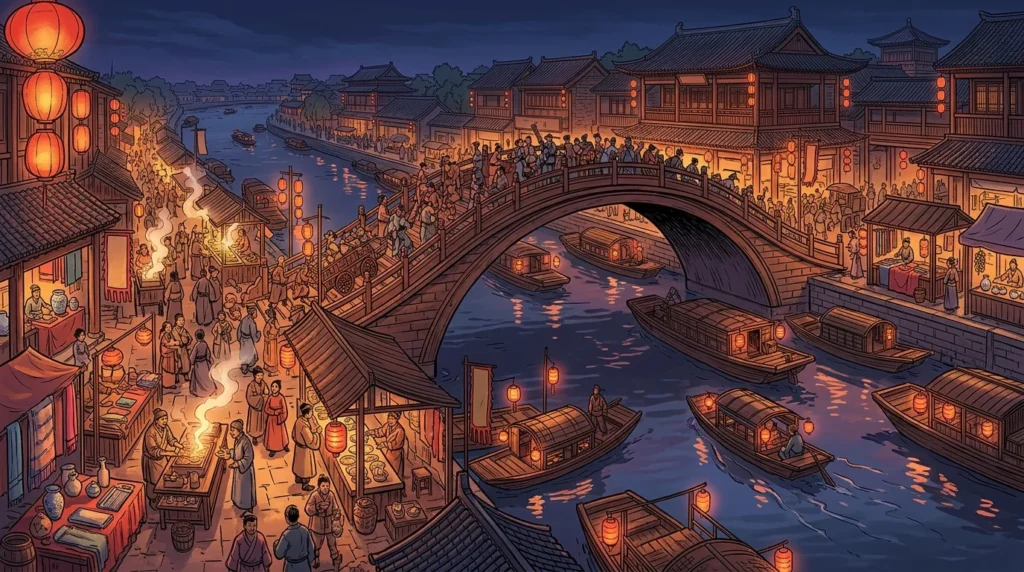
Between 960 and 1127 CE, the Northern Song capital of Bianjing (modern Kaifeng, Henan)—a metropolis whose population surpassed one million residents and imperial guardsmen—underwent one of the most consequential urban and market revolutions in premodern history. Breaking decisively with the regimented urban planning of the Tang Dynasty (618–907 CE), which had confined all retail trade to state-walled market precincts (shi) separated from walled residential wards (fang) and enforced a strict sunset-to-dawn drum curfew, the Song court allowed residential walls to be torn down and shops to open directly onto arterial streets and canal wharves. Commercial life in Kaifeng spilled across all hours of the day and night, giving rise to bustling night markets (yeshi) that operated until the third night watch (midnight) and dawn markets (guishi, literally “ghost markets”) that reopened at the fifth watch before sunrise. [1]
Feeding and provisioning an uncurfewed capital of over a million consumers—while simultaneously supplying more than a million frontier troops stationed along the northern steppes—required sophisticated state price-stabilization institutions and secondary financial markets. To prevent seasonal famines and speculative hoarding along the Bian Canal, the Northern Song state operated a network of Ever-Normal Granaries (Changpingcang) and enacted Chancellor Wang Anshi’s 1072 Equitable Tribute and Distribution Law (Junshufa). At the same time, imperial fiscal administrators linked frontier grain provisioning to a thriving secondary market in Kaifeng for transferable salt and tea monopoly certificates (jiaoyin and chayin), even as they partitioned the empire into distinct copper-coin and iron-coin currency zones that gave birth to the world’s first state paper money. [2]
Dismantling the Tang Fangshi System and Midnight Curfew in Bianjing
Under the Tang code that governed the earlier capital of Chang’an, urban commerce was tightly policed inside two walled official markets that opened at noon upon 300 beats of the market drum and closed three quarters of an hour before sunset upon 300 beats of the night gong. Anyone found walking the avenues of the residential wards (fang) after the street gates locked was subject to twenty strokes of the bamboo rod. By the late tenth and early eleventh centuries, however, rapid demographic growth and the convergence of four major waterways—chief among them the Bian Canal linking the Yellow River basin to the Huai and Yangtze valleys—overwhelmed Kaifeng’s inner and outer city walls. [3]
During the reigns of Emperor Zhenzong (r. 997–1022) and Emperor Renzong (r. 1022–1063), merchants and aristocrats routinely encroached upon public thoroughfares (qinlubiao), knocking down ward walls to build street-facing storefronts, multi-story wine pavilions (zhenglou), teahouses, and warehouses. In 1063, the imperial court formally abandoned the nocturnal curfew in Kaifeng, ceasing the enforcement of ward gates and permitting wine shops, entertainment precincts (wazi), and street bazaars around the Imperial Way and the Zhou Bridge to trade continuously from dusk until midnight, followed almost immediately by pre-dawn wholesale markets. [4]
As the physical walls of the Tang markets vanished, the traditional trade associations (hang or tuanhang)—which had originally designated single-commodity rows inside walled bazaars—evolved into citywide merchant guilds. Verified wholesale brokerage houses (yahang) registered with the municipal authorities mediated transactions between long-distance river convoys and Kaifeng’s retail shops, assessing quality grades, guaranteeing credit payments, and quoting daily spot prices for grain, silk, timber, coal, and livestock.
Ever-Normal Granaries (Changpingcang) and the 1072 Equitable Tribute Law (Junshufa)
Because Kaifeng’s survival depended on the annual arrival of six to seven million shi (roughly 400,000 to 500,000 metric tons) of tribute grain (caoliang) barged up the Bian Canal from the fertile Jiangnan delta, any winter freeze, canal siltation, or regional harvest failure could trigger explosive spikes in urban rice and wheat prices. To buffer both rural producers and metropolitan consumers against extreme price swings, Emperor Zhenzong established the Ever-Normal Granaries (Changpingcang) across all prefectures and in the capital starting in 1006 CE. [5]
Managed by specialized granary intendants with earmarked treasury capital, the Ever-Normal Granaries functioned as a counter-cyclical commodity buffer stock. During autumn bumper harvests when private grain brokers drove farmgate prices down below subsistence levels, the granaries stepped into the market to purchase grain above the prevailing market price, protecting smallholder incomes. Conversely, during spring lean months, floods, or urban dearths when retail grain prices surged, the granaries opened their doors to sell grain below market rates (pingtiao), breaking speculative corners in Kaifeng and provincial cities.
In the seventh lunar month of 1072, Chancellor Wang Anshi augmented the granary buffer system by enacting the Equitable Tribute and Distribution Law (Junshufa) across the six southeastern fiscal circuits that supplied Kaifeng. Historically, each prefecture had been forced to purchase and ship fixed quotas of specific local tribute commodities to the capital regardless of local crop failures or market prices, allowing metropolitan merchants to manipulate supply bottlenecks. Under the Junshufa, the Southeast Supply Commissioner (Fayunshi) was endowed with 5 million strings of copper cash and 3 million shi of rice to operate as a flexible state trading corporation: buying commodities where they were cheap and abundant, storing them in regional depots, and selling surpluses on the open market whenever prices rose. [6]
Frontier Provisioning and Secondary Markets for Salt and Tea Vouchers (Jiaoyin)
While the Bian Canal fed Kaifeng, the Northern Song state faced an acute logistical challenge along its landlocked northwestern and northern borders in Shaanxi, Shanxi, and Hebei, where hundreds of thousands of troops confronted the Tangut Western Xia and Khitan Liao empires. Hauling bulk grain overland by oxcart or pack mule for hundreds of miles cost the state several times the value of the grain itself. To solve this problem, the Song court institutionalized the “border delivery” system (kaizhong or riliang, “fold-in provisioning”), leveraging the state’s lucrative fiscal monopolies on salt (such as the Hedong salt ponds in Shanxi and Huainan sea salt) and southern tea.
Under this mechanism, private merchants contracted to transport grain, fodder, iron, or silver directly to military granaries along the northern frontier. Upon verifying delivery, frontier officials issued the merchant a bearer-transferable paper voucher—known generically as an exchange certificate (jiaoyin), or specifically as a salt certificate (yanyin) or tea certificate (chayin)—stamped with face values higher than the frontier grain cost to compensate for transport distance. Rather than traveling thousands of miles south to collect physical salt or tea themselves, frontier merchants carried these certificates to the capital of Kaifeng.
Along the banks of the Bian Canal in Kaifeng, specialized voucher-brokerage shops (jiaoyinpu) created a liquid secondary securities market. Frontier grain merchants sold their jiaoyin and chayin for immediate copper cash at a market discount to wholesale salt and tea syndicates, who then redeemed the certificates at the state monopoly warehouses in Huainan or Jiangnan. When over-issuance of frontier certificates during the Tangut wars of the 1040s caused voucher prices in Kaifeng to crash—a classic early sovereign paper depreciation crisis—the court established the Metropolitan Voucher Bureau (Jiaoyinku) to buy back surplus certificates with treasury cash and stabilize secondary market yields.
Copper and Iron Currency Zones and the Birth of State Paper Money
Underpinning Northern Song price movements was a uniquely segmented monetary geography. Although the Northern Song mints achieved the highest bronze coin output in premodern world history—casting more than 5 million strings (5 billion individual copper coins) annually during the 1070s under Wang Anshi, compared to roughly 320,000 strings per year under the Tang—the rapid expansion of domestic trade and illicit coin exports across East and Southeast Asia created recurring “coin famines” (qianhuang) in the heartland. [7]
To conserve scarce copper for the metropolitan core and prevent bronze coins from flowing across the borders into the Liao and Western Xia empires, the Song court partitioned the empire into distinct currency zones. While Kaifeng and the eastern and central circuits used copper cash (tongqian), the southwestern provinces of Sichuan and parts of frontier Shaanxi were restricted by law to circulating heavy, low-value iron coins (tieqian), with strict border checkpoints forbidding the export of copper coins into the iron zone.
In Sichuan, where ten iron coins were needed to equal the value of a single copper coin and buying one bolt of silk required hauling more than 130 pounds of iron cash over mountain roads, sixteen wealthy Chengdu merchant houses organized a syndicate to issue transferable paper deposit receipts called jiaozi (“exchange media”). When private over-issuance and liquidity defaults triggered credit panics and lawsuits in Chengdu, the Northern Song court stepped in during 1023–1024 CE, banning private note printing and establishing the Official Jiaozi Bureau (Yizhou Jiaozinkuang). Backed by a statutory reserve of 360,000 strings of iron coins and capped at 1.25 million strings per three-year redemption cycle (jie), the Sichuan jiaozi completed the Northern Song financial architecture—linking Kaifeng’s 24-hour physical markets, state commodity buffers, and monopoly voucher exchanges to the world’s first government fiat currency. [8]
Theoretical & Balance-Sheet Transmission Mechanism
In the Kindleberger–Minsky taxonomy of financial instability (Kindleberger, 1978; Minsky, 1986) and Irving Fisher’s (1933) debt-deflation framework, speculative asset booms become systemic crises when credit expansion shifts balance sheets from hedge finance (cash flows covering principal and interest) to speculative and Ponzi finance (relying on rising asset prices and short-term margin roll-overs).
Once monetary tightening or an exogenous shock halts price appreciation, forced margin liquidations trigger Fisherian debt-deflation: fire-sale asset discounts erode bank collateral values, contracting credit supply across the real economy.
Sources and Further Reading
- Asia for Educators, “ A New Kind of City: Kaifeng and Hangzhou in the Song Dynasty,” Columbia University Weatherhead East Asian Institute, 2008. Peer-Reviewed / Academic Research
- Asia for Educators, “ The Commercial Revolution in the Song: Paper Money and Currency,” Columbia University Weatherhead East Asian Institute, 2008. Peer-Reviewed / Academic Research
- Ulrich Theobald, “ Changpingcang 常平倉 — Ever-Normal Granaries,” ChinaKnowledge.de: An Encyclopaedia on Chinese History, Literature and Art, 2016. Historical & Financial Reference
- Ulrich Theobald, “ Junshufa 均輸法 — The Law on Equitable Tribute and Distribution,” ChinaKnowledge.de: An Encyclopaedia on Chinese History, Literature and Art, 2016. Historical & Financial Reference
- Ulrich Theobald, “ Jiaozi 交子 and Qianyin 錢引 — Northern Song Paper Money and Exchange Vouchers,” ChinaKnowledge.de: An Encyclopaedia on Chinese History, Literature and Art, 2016. Historical & Financial Reference
- Richard von Glahn, “ The Song-Yuan-Ming Transition in Chinese Economic History (Part II) — The Cambridge Economic History of China,” Cambridge University Press, 2022. Peer-Reviewed / Academic Research
- Irving Fisher — "The Debt-Deflation Theory of Great Depressions," Econometrica 1, no. 4 (FRASER Federal Reserve Archive, 1933): 337–357 Central Bank / Monetary Authority
- Charles P. Kindleberger & Robert Z. Aliber — Manias, Panics, and Crashes: A History of Financial Crises (Palgrave Macmillan) Peer-Reviewed / Academic Research
Cite This Historical Dossier (APA / Chicago)
APA (7th ed.): Ç., S. (Ed.). (2026). Kaifeng's 24-Hour Markets, Ever-Normal Granaries, and Salt Vouchers in Northern Song China. In Forgotten Fortunes Historical Monograph Series (Forgotten Fortunes Editorial Desk). https://forgottenfortunes.net/kaifeng-night-markets-song-finance/
MLA (9th ed.): Ç., Soner, ed. "Kaifeng's 24-Hour Markets, Ever-Normal Granaries, and Salt Vouchers in Northern Song China." Forgotten Fortunes: Financial & Monetary History Archive, 2026, https://forgottenfortunes.net/kaifeng-night-markets-song-finance/.
Chicago (17th ed.): Ç., Soner, ed. "Kaifeng's 24-Hour Markets, Ever-Normal Granaries, and Salt Vouchers in Northern Song China." Forgotten Fortunes Historical Monograph Series (Forgotten Fortunes Editorial Desk), September 16, 2026. https://forgottenfortunes.net/kaifeng-night-markets-song-finance/.
Have an idea for another financial history documentary or article? Request a story →