In This Article
A Strategic Stockpile Built by Private Arbitrage
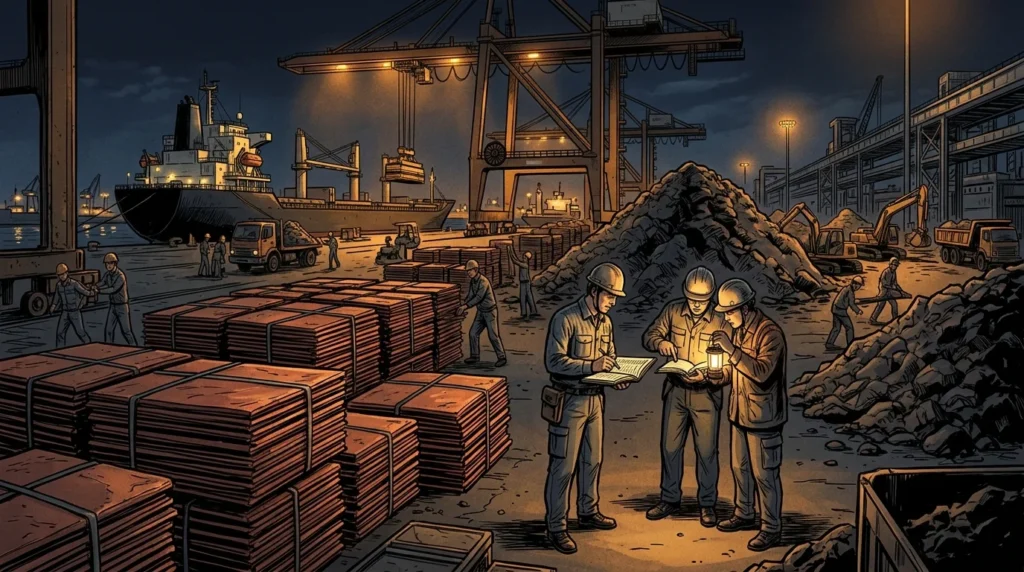
During the Cold War, when the United States accumulated millions of tons of industrial metals, the buyer was the federal government’s Defense National Stockpile Center. By October 2026, however, commodity strategists at Macquarie estimated that the United States was sitting on a massive commercial cushion of roughly 1.6 million metric tons of copper—yet Washington had not appropriated a single dollar to purchase it. [1]
Instead, the US copper stockpile was assembled entirely by private physical trading houses, investment banks, and industrial merchants responding to one of the most powerful forces in financial history: a policy-driven location arbitrage between New York and the rest of the world.
The Global Copper Triangle: COMEX, LME, and Shanghai
In normal markets, refined copper cathode trades across three primary futures exchanges: the London Metal Exchange (LME), which operates a global network of delivery warehouses across Europe, Asia, and the United States; the Shanghai Futures Exchange (SHFE), which reflects Chinese domestic industrial demand including VAT and import duties; and CME Group’s COMEX division, whose warehouses are located exclusively inside the United States (in hubs such as New Orleans, Baltimore, Detroit, El Paso, and Tucson).
When trade flows freely without tariffs, the price difference between a ton of copper on COMEX in New York and a ton of copper on the LME in London cannot exceed the physical cost of ocean freight, insurance, and port handling—roughly $50 to $100 per metric ton. If New York rises further above London, traders simply ship cathodes across the Atlantic until the spread narrows. [2]
How Tariff Uncertainty Created a $1,000-Per-Ton Magnet
That equilibrium shattered when U.S. trade policy introduced the prospect of broad import tariffs and a Section 232 national security investigation into refined copper imports. Because the United States relies on foreign suppliers—principally Chile, Canada, and Peru—for nearly half of its refined copper consumption, an import duty of 10% to 25% would immediately raise the domestic cleared price of copper inside U.S. borders relative to untaxed metal sitting in Rotterdam or Singapore. [3]
Futures traders on COMEX immediately priced in the probability of those tariffs. The COMEX–LME arbitrage spread—known on trading desks as the Arb—exploded from under $100 per metric ton to more than $1,000 to $1,500 per metric ton at peak distortions. [4]
For giant physical commodity merchants such as Trafigura, Glencore, Mercuria, and IXM, the arithmetic became irresistible. A trader could buy physical copper cathodes in South America or pull warrants out of LME warehouses in Europe and Asia, simultaneously sell a COMEX futures contract in New York to lock in the high American price, charter a bulk vessel, and clear the metal through U.S. customs before any tariff took effect.
What Happens When the Arbitrage Window Closes?
Month after month across 2025 and 2026, vessels discharged refined copper into New Orleans and Baltimore, swelling visible COMEX exchange stocks and off-exchange bonded and duty-paid storage to roughly 1.6 million metric tons—equivalent to nearly a full year of normal U.S. import requirements. Meanwhile, LME inventories outside the United States tightened artificially, even though global physical consumption had not surged by an equivalent amount. [5]
This artificial relocation created a classic commodity overhang question for 2026–2027: What happens if tariffs are delayed, exempted for Free Trade Agreement partners like Chile and Canada, or rolled back? The moment the COMEX premium over the LME collapses, the incentive to hoard metal inside American warehouses vanishes, turning a 1.6-million-ton domestic magnet into an inventory glut that must gradually be worked off by U.S. wire-rod mills and manufacturers. [6]
Theoretical & Balance-Sheet Transmission Mechanism
In the Kindleberger–Minsky taxonomy of financial instability (Kindleberger, 1978; Minsky, 1986) and Irving Fisher’s (1933) debt-deflation framework, speculative asset booms become systemic crises when credit expansion shifts balance sheets from hedge finance (cash flows covering principal and interest) to speculative and Ponzi finance (relying on rising asset prices and short-term margin roll-overs).
Once monetary tightening or an exogenous shock halts price appreciation, forced margin liquidations trigger Fisherian debt-deflation: fire-sale asset discounts erode bank collateral values, contracting credit supply across the real economy.
Sources and Further Reading
- CME Group (COMEX) — Daily Copper Warehouse Stocks and Deliverable Grade Reports (2024–2026). Historical & Financial Reference
- London Metal Exchange (LME) — Monthly Copper Stock and Off-Warrant Inventory Statistics. Historical & Financial Reference
- Macquarie Commodities Strategy — Global Copper Market Balances and US Onshore Inventory Estimates (October 2026). Historical & Financial Reference
- U.S. Geological Survey (USGS) — Mineral Commodity Summaries: Copper Production, Consumption, and Net Import Reliance. Historical & Financial Reference
- Irving Fisher — "The Debt-Deflation Theory of Great Depressions," Econometrica 1, no. 4 (FRASER Federal Reserve Archive, 1933): 337–357 Central Bank / Monetary Authority
- Charles P. Kindleberger & Robert Z. Aliber — Manias, Panics, and Crashes: A History of Financial Crises (Palgrave Macmillan) Peer-Reviewed / Academic Research
Cite This Historical Dossier (APA / Chicago)
APA (7th ed.): Ç., S. (Ed.). (2026). Why America Accumulated 1.6 Million Tons of Copper: COMEX Arbitrage and Tariff Risk. In Forgotten Fortunes Historical Monograph Series (Forgotten Fortunes Editorial Desk). https://forgottenfortunes.net/us-copper-stockpile-comex-lme-tariff-arbitrage/
MLA (9th ed.): Ç., Soner, ed. "Why America Accumulated 1.6 Million Tons of Copper: COMEX Arbitrage and Tariff Risk." Forgotten Fortunes: Financial & Monetary History Archive, 2026, https://forgottenfortunes.net/us-copper-stockpile-comex-lme-tariff-arbitrage/.
Chicago (17th ed.): Ç., Soner, ed. "Why America Accumulated 1.6 Million Tons of Copper: COMEX Arbitrage and Tariff Risk." Forgotten Fortunes Historical Monograph Series (Forgotten Fortunes Editorial Desk), October 15, 2026. https://forgottenfortunes.net/us-copper-stockpile-comex-lme-tariff-arbitrage/.
Have an idea for another financial history documentary or article? Request a story →