In This Article
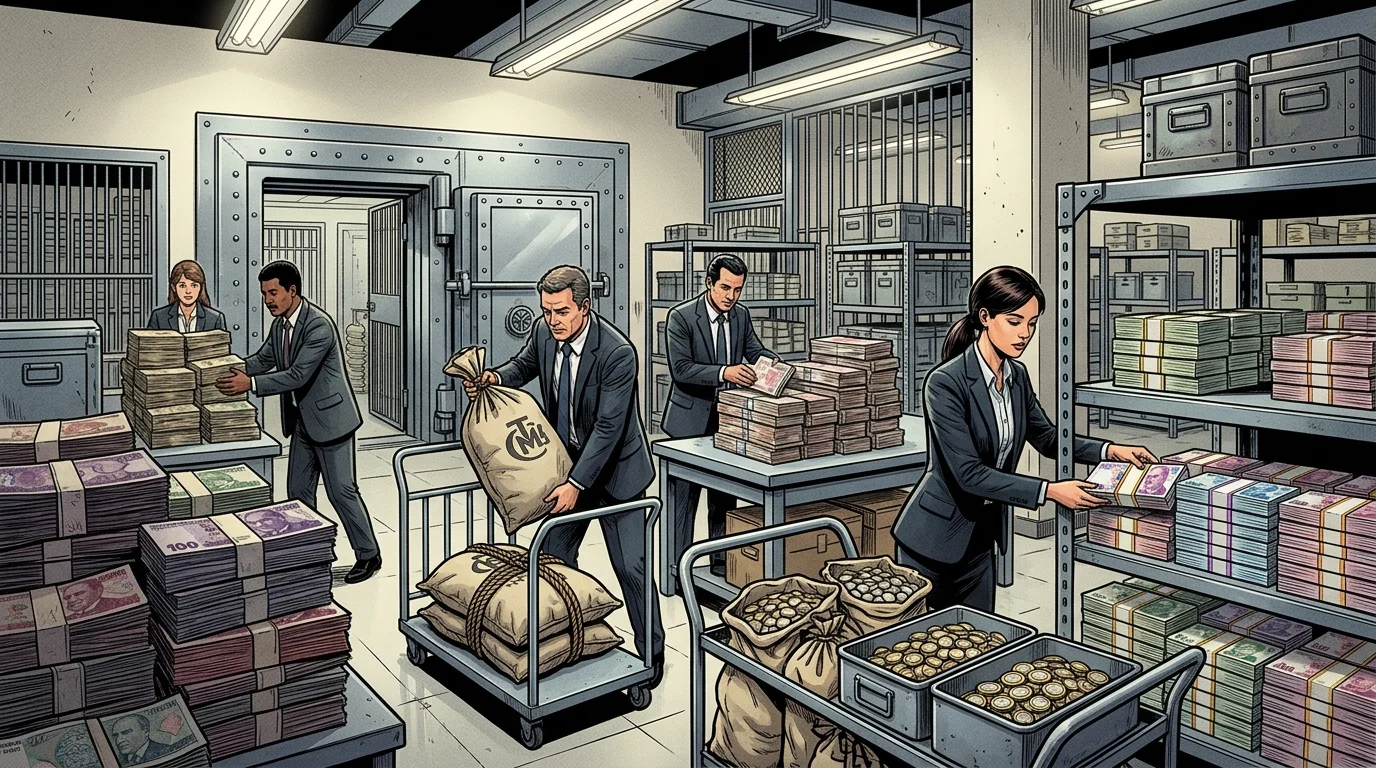
At the stroke of midnight on January 1, 2005, citizens across Türkiye ceased to be multi-millionaires on paper. Under Law No. 5083, the Central Bank of the Republic of Türkiye (Türkiye Cumhuriyet Merkez Bankası, or TCMB) stripped six zeros from the national currency, replacing 1,000,000 old Turkish liras (TL) with 1 New Turkish Lira (Yeni Türk Lirası, or YTL) and restoring the long-vanished kuruş coin to everyday commerce. Behind that historic redenomination lay one of modern monetary history’s most unusual episodes: nearly three decades in which Turkish inflation ratcheted from 20 percent to more than 100 percent per year without ever tipping into classic monthly hyperinflation, reducing the lira to the world’s least valuable currency unit at more than 1,650,000 TL per US dollar and forcing the issuance of 20,000,000-lira banknotes. Only after the devastating financial crisis of February 2001 prompted statutory Central Bank independence (Law No. 4651) and implicit inflation targeting under Governor Süreyya Serdengeçti did inflation fall back into single digits in 2004, making the six-zero currency reform credible. [1]
The Puzzle of Turkish Chronic High Inflation (1975–2000)
In the monetary history of emerging markets, twentieth-century Türkiye occupied a distinctive category. In Latin America during the 1980s and the former Soviet bloc during the early 1990s, sustained annual inflation above 60 to 100 percent almost invariably exploded into classic hyperinflation—defined by economist Phillip Cagan as price increases exceeding 50 percent per month. Türkiye defied that pattern for twenty-five years. Between the mid-1970s and 2001, Turkish consumer price inflation climbed in discrete, ratcheting plateaus: averaging roughly 20 percent in the early 1970s, jumping to 35–50 percent after the 1978–1980 balance-of-payments crisis, rising to 60–75 percent from 1988 to 1993, and settling into a chronic corridor of 70 to 106 percent throughout the mid- and late 1990s (with wholesale inflation briefly touching 120–125 percent after the April 1994 currency crash). [2]
Economists studying Türkiye’s protracted inflation plateau identified three interlocking fiscal and institutional mechanisms that fueled persistent price increases while preventing a total collapse of money demand:
- Fiscal Dominance and State Bank “Duty Losses” (Görev Zararları): Governed by a succession of fragile, short-lived parliamentary coalitions during the 1990s, Ankara relied on populist agricultural price supports, subsidized credit, and early retirement entitlements. Rather than recording all subsidies transparently in the central budget, governments ordered state-owned banks—principally Ziraat Bankası (agricultural credit) and Halkbank (small business credit)—to disburse subsidized loans and payments without Treasury reimbursement, accumulating off-budget “duty losses” that compounded at market interest rates to exceed 12 percent of gross national product by 2000.
- Monetization via Central Bank Advances and Debt Rollovers: Under the 1970 Central Bank Law (Law No. 1211), the TCMB lacked operational independence and was legally obligated to extend short-term cash advances to the Treasury of up to 15 percent of budget appropriations. When governments tried to curb direct money printing in the mid-1990s by issuing short-term domestic Treasury bills, real interest rates climbed to 25–40 percent, creating a vicious debt-service spiral that repeatedly forced monetary accommodation.
- Adaptive Indexation and Dollarization: Turkish society developed sophisticated coping mechanisms. Civil service salaries, union wages, and tax brackets were adjusted semi-annually to past inflation; urban landlords priced apartment leases and real estate in German marks or US dollars; and households held roughly half of their bank deposits in foreign-exchange accounts (Döviz Tevdiat Hesapları) while parking working lira balances in overnight repurchase agreements (repo). This pervasive backward-looking indexation kept the real economy functioning but entrenched 70 percent inflation expectations into every contract.
Million-Lira Banknotes and the World’s Least-Valued Currency Unit
The cumulative arithmetic of thirty years of high inflation transformed the physical and accounting landscape of Turkish money. In 1969, one US dollar bought 9 Turkish liras, and the highest banknote in circulation was 1,000 TL. By January 1980, the exchange rate stood at 70 TL per dollar; by 1990, 2,609 TL; by 1996, over 100,000 TL; and by late 2001, the exchange rate crossed 1,650,000 TL per US dollar. [3]
To prevent commerce from grinding to a halt under bricks of small-denomination paper, the Central Bank continuously appended higher denominations to its Seventh Emission (E7) banknote series, which had originally launched in 1979 with 10- and 100-lira notes. Across twenty-two years, the E7 series expanded to an unprecedented seventeen denominations: 1,000 TL and 5,000 TL (1981), 10,000 TL (1982), 20,000 TL (1988), 50,000 TL (1989), 100,000 TL (1991), 250,000 TL (1992), 500,000 TL (1993), 1,000,000 TL (1995), 5,000,000 TL (1997), 10,000,000 TL (1999), and finally the 20,000,000-lira banknote placed into circulation on November 5, 2001—worth barely $12.50 on the day it was issued. [4]
In both 1995–1996 and 1999–2004, the Guinness Book of World Records officially certified the Turkish lira as the world’s least valuable currency unit. The proliferation of zeros imposed tangible deadweight costs across the economy. Standard eight- and ten-digit pocket calculators, cash registers, and bank mainframe systems overflowed when entering corporate balance sheets measured in trillions (1012) and national budget totals measured in quadrillions (1015) of liras. Bookkeepers routinely omitted the final six zeros on ledgers or invented hybrid shorthand units such as “billion millions.” Coins in kuruş (1/100th of a lira) had disappeared from circulation in the late 1970s, and even 50,000- and 100,000-lira coins minted in the late 1990s were used primarily to pay for bread or public transit tokens. [5]
The February 2001 Crisis and Central Bank Independence (Law No. 4651)
In December 1999, Prime Minister Bülent Ecevit’s three-party coalition launched an ambitious three-year IMF-backed disinflation program for 2000–2002 anchored by a pre-announced crawling-peg exchange rate. Although inflation initially slowed during 2000, it fell more slowly than the pre-set depreciation path of the lira, causing strong real currency appreciation and a surging current-account deficit. Worse, private Turkish commercial banks—most notably Demirbank—had borrowed heavily in short-term foreign currency and overnight interbank funds to amass huge portfolios of fixed-rate Turkish Treasury bonds, while state banks sat on $20+ billion in unrecorded duty-loss receivables. [6]
After a severe banking liquidity squeeze in November 2000 required an emergency $7.5 billion IMF Supplemental Reserve Facility, the crawling peg collapsed on February 19, 2001 (“Black Wednesday”). When President Ahmet Necdet Sezer and Prime Minister Ecevit clashed angrily over bank corruption audits during a National Security Council meeting—prompting Ecevit to walk out and declare a “serious crisis” before television cameras—investors stampeded out of the lira. Overnight interbank interest rates spiked above 4,000 to 6,200 percent, the Central Bank lost more than $5 billion in reserves within hours, and on February 22, 2001, the government abandoned the peg and allowed the Turkish lira to float freely. Real GDP contracted by nearly 6 percent in 2001, nineteen private banks were taken over by the Savings Deposit Insurance Fund (TMSF), and the state spent roughly $47 billion (nearly one-third of national income) to recapitalize the banking system and extinguish state-bank duty losses. [7]
Out of this systemic collapse emerged the institutional overhaul that finally broke Türkiye’s inflation cycle. Invited from the World Bank in March 2001 as Minister of State for Economic Affairs, Kemal Derviş designed the “Transition to a Strong Economy” (Güçlü Ekonomiye Geçiş) program in tandem with newly appointed Central Bank Governor Süreyya Serdengeçti, a veteran career TCMB economist who took office in March 2001. [8]
On April 25, 2001 (published in the Official Gazette on May 5, 2001), the Grand National Assembly enacted Law No. 4651, fundamentally rewriting the Central Bank Law No. 1211. Law No. 4651 established three pillars of modern monetary governance: [9]
- Price Stability Mandate: The law declared unequivocally that the primary objective of the Central Bank of the Republic of Türkiye is to achieve and maintain price stability.
- Instrument Independence and the Monetary Policy Committee: The TCMB was granted sole, autonomous authority to determine the monetary policy strategy and policy interest rates needed to achieve inflation targets, establishing an institutional Monetary Policy Committee (Para Politikası Kurulu) and fixing the terms of the Governor and Vice Governors to shield them from arbitrary political dismissal.
- Prohibition of Fiscal Monetization: Crucially, Law No. 4651 repealed all provisions allowing the Central Bank to grant short-term advances or credit to the Treasury and public institutions, and prohibited the TCMB from purchasing government debt instruments in the primary market.
Implicit Inflation Targeting Under Süreyya Serdengeçti (2002–2005)
With the exchange rate floating and the fiscal printing press legally padlocked, Governor Serdengeçti and the TCMB research department—including economists such as Hakan Kara—designed a phased transition to inflation targeting. Because the post-February 2001 devaluation had temporarily pushed annual CPI inflation back up to 68.5 percent at the end of 2001, and because high public debt ratios still created concerns over fiscal dominance, the Central Bank announced that it would implement “Implicit Inflation Targeting” (Örtük Enflasyon Hedeflemesi) beginning in January 2002 before transitioning to full-fledged formal targeting once preconditions were met. [10]
Under the implicit regime (2002–2005), the TCMB and the government jointly announced annual year-end consumer price inflation targets. While maintaining base-money ceilings as an additional performance criterion under the IMF standby arrangement, the Central Bank actively used its short-term overnight borrowing and lending rates as its primary policy instrument, published regular inflation forecasts and expectation surveys, and communicated openly that interest rates would be adjusted purely in response to forward-looking inflation dynamics. Crucially, monetary discipline was backed by unprecedented fiscal consolidation—first under Derviş in 2001–2002 and then maintained by Economy Minister Ali Babacan after the November 2002 election—which generated public-sector primary surpluses of 5 to 6.5 percent of GNP per year.
The credibility gain produced one of the fastest disinflations in modern emerging-market history, beating the official inflation target for four consecutive years:
- In 2002, annual CPI inflation plunged from 68.5 percent to 29.7 percent, beating the 35 percent year-end target;
- In 2003, inflation fell to 18.4 percent, undercutting the 20 percent target;
- In 2004, consumer price inflation dropped to 9.3 percent (against a 12 percent target), returning Türkiye to single-digit inflation for the first time in thirty-four years;
- In 2005, inflation declined further to 7.7 percent (below the 8 percent target), enabling the TCMB to launch formal, full-fledged inflation targeting on January 1, 2006.
Law No. 5083 and the January 1, 2005 New Turkish Lira Redenomination
Central Bank officials had studied removing zeros from the Turkish lira as early as 1998 and 2000, even printing specimen layouts. Yet Governor Serdengeçti and his predecessors had consistently opposed redenomination while inflation remained high, pointing to the cautionary experiences of Brazil and Argentina in the 1980s, where governments repeatedly lopped three or four zeros off their currencies without curing underlying fiscal deficits, only to see zeros multiply again within months.
By late 2003, with inflation firmly on track toward single digits and fiscal dominance broken, the TCMB judged that redenomination would lock in psychological credibility and eliminate the accounting inefficiencies of six-digit price tags. On January 28, 2004 (published January 31, 2004), Parliament enacted Law No. 5083, the Law on the Currency Unit of the Republic of Türkiye (Türkiye Cumhuriyeti Devletinin Para Birimi Hakkında Kanun).
Under Law No. 5083, a two-stage currency transition began on January 1, 2005:
- Stage One — The New Turkish Lira (YTL, 2005–2008): Exactly six zeros were removed from the currency, establishing a conversion rate of 1,000,000 old Turkish Liras (TL) = 1 New Turkish Lira (YTL), subdivided into 100 New Kuruş (YKr). The Central Bank issued the Eighth Emission (E8) banknote series in denominations of 1, 5, 10, 20, 50, and 100 YTL (alongside coins of 1, 5, 10, 25, and 50 YKr and 1 YTL). To prevent public confusion, Law No. 5083 mandated dual price labeling in both TL and YTL across all shops, bank statements, and invoices throughout 2005. Both old TL and new YTL banknotes circulated concurrently for twelve months until old TL notes were withdrawn from legal tender after December 31, 2005 (remaining redeemable at Central Bank and Ziraat Bankası branches for ten years until December 31, 2015).
- Stage Two — Restoration of the Turkish Lira (TL, January 1, 2009): Because the prefix “New” (Yeni) was designed solely as a transitional safeguard during the phaseout of old million-lira notes, a Council of Ministers decree issued in May 2007 under Article 1 of Law No. 5083 removed the word “New” effective January 1, 2009, introducing the Ninth Emission (E9) series of Turkish Lira (TL) banknotes and kuruş coins.
Executed without a hitch across ATMs, stock exchange quoting systems, and retail checkouts on New Year’s Day 2005, the six-zero removal restored technical and psychological normalcy to Turkish money—demonstrating that durable currency reform follows, rather than precedes, central bank independence and fiscal discipline.
Theoretical & Balance-Sheet Transmission Mechanism
In the Kindleberger–Minsky taxonomy of financial instability (Kindleberger, 1978; Minsky, 1986) and Irving Fisher’s (1933) debt-deflation framework, speculative asset booms become systemic crises when credit expansion shifts balance sheets from hedge finance (cash flows covering principal and interest) to speculative and Ponzi finance (relying on rising asset prices and short-term margin roll-overs).
Once monetary tightening or an exogenous shock halts price appreciation, forced margin liquidations trigger Fisherian debt-deflation: fire-sale asset discounts erode bank collateral values, contracting credit supply across the real economy.
Sources and Further Reading
- Fatih Özatay and Güven Sak, Banking Sector Fragility and Turkey's 2000–01 Financial Crisis, Brookings Trade Forum, 2002. Peer-Reviewed / Academic Research
- Hakan Kara and Hande Küçük-Tuğer, Inflation Expectations in Turkey: Learning to Be Rational, Applied Economics, 2010. Peer-Reviewed / Academic Research
- Eda Gülşen and Hakan Kara, Measuring Inflation Uncertainty in Turkey, Central Bank Review, 2019. Central Bank / Monetary Authority
- Barış Soybilgen and Ege Yazgan, An Evaluation of Inflation Expectations in Turkey, Central Bank Review, 2017. Central Bank / Monetary Authority
- Zafer Gürbüz, Thomas Jobert, and Ruhi Tuncer, The Turkish Experience in Inflation Targeting: Uncertainties and the Efficiency of Monetary Policy, Économie internationale, 2008. Peer-Reviewed / Academic Research
- Ozlem Arpac and Graham Bird, Turkey and the IMF: A Case Study in the Political Economy of Policy Implementation, The Review of International Organizations, 2009. International Financial Institution
- Ahmet Ertuğrul and Faruk Selçuk, Inflation and Disinflation in Turkey, Routledge, 2018. Peer-Reviewed / Academic Research
- Central Bank of the Republic of Türkiye: Our History, Central Bank of the Republic of Türkiye. Central Bank / Monetary Authority
- Irving Fisher — "The Debt-Deflation Theory of Great Depressions," Econometrica 1, no. 4 (FRASER Federal Reserve Archive, 1933): 337–357 Central Bank / Monetary Authority
- Charles P. Kindleberger & Robert Z. Aliber — Manias, Panics, and Crashes: A History of Financial Crises (Palgrave Macmillan) Peer-Reviewed / Academic Research
Cite This Historical Dossier (APA / Chicago)
APA (7th ed.): Ç., S. (Ed.). (2026). Erasing Six Zeros: Türkiye's Chronic Inflation and the 2005 New Turkish Lira Reform. In Forgotten Fortunes Historical Monograph Series (Forgotten Fortunes Editorial Desk). https://forgottenfortunes.net/turkiye-chronic-inflation-2001-reform-new-turkish-lira-six-zeros/
MLA (9th ed.): Ç., Soner, ed. "Erasing Six Zeros: Türkiye's Chronic Inflation and the 2005 New Turkish Lira Reform." Forgotten Fortunes: Financial & Monetary History Archive, 2026, https://forgottenfortunes.net/turkiye-chronic-inflation-2001-reform-new-turkish-lira-six-zeros/.
Chicago (17th ed.): Ç., Soner, ed. "Erasing Six Zeros: Türkiye's Chronic Inflation and the 2005 New Turkish Lira Reform." Forgotten Fortunes Historical Monograph Series (Forgotten Fortunes Editorial Desk), September 5, 2026. https://forgottenfortunes.net/turkiye-chronic-inflation-2001-reform-new-turkish-lira-six-zeros/.
Have an idea for another financial history documentary or article? Request a story →