In This Article
On the evening of June 14, 1985, Argentine President Raúl Alfonsín and Economy Minister Juan Vital Sourrouille went on national television to announce what Alfonsín called a “war economy” against chronic inflation. Under Presidential Decree 1.096/85, the Argentine government froze wages, public utility tariffs, and industrial prices overnight, pledged to halt central bank money printing for the Treasury, and abolished the two-year-old Peso Argentino in favor of a brand-new currency: the Austral, worth 1,000 Pesos Argentinos. It was the third time in fifteen years that the Central Bank of the Argentine Republic (BCRA) had amputated zeros from the legal tender. Taken together, the 1970 Peso Ley 18.188 (two zeros), the 1983 Peso Argentino (four zeros), and the 1985 Austral (three zeros) meant that a single Austral equaled one billion (109) pre-1970 Pesos Moneda Nacional. [1]
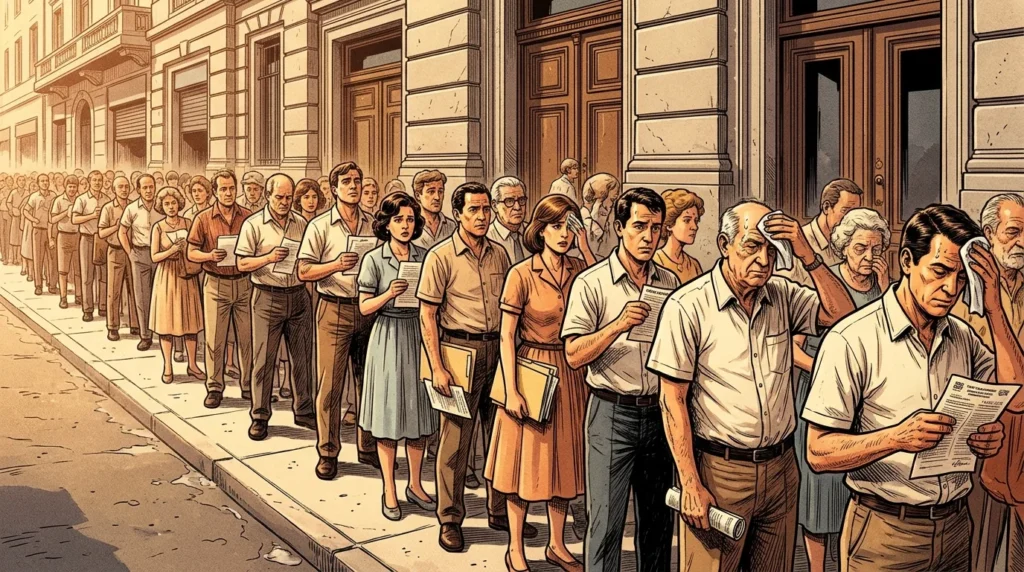
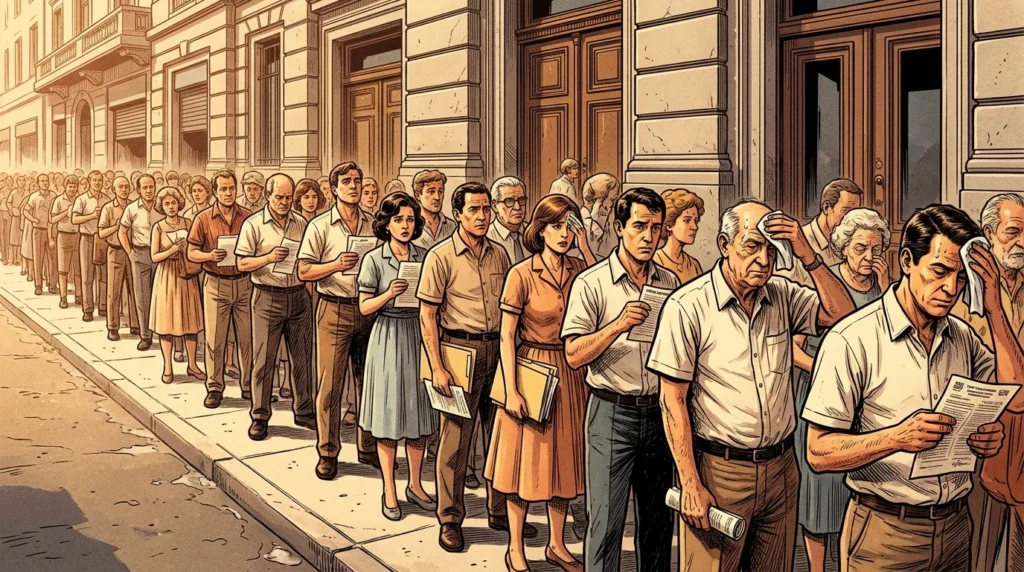
For nearly a year, the heterodox Plan Austral appeared to have broken the back of inertial inflation without triggering a deep industrial depression. Yet currency redenominations and ingenious de-indexation tables could not permanently substitute for fiscal solvency. When export prices sagged, public-enterprise deficits widened, and the central bank’s own interest-bearing liabilities snowballed into an uncontrollable “quasi-fiscal” deficit, the stabilization unraveled. Between February and July 1989, a speculative run on the Austral sent monthly consumer price inflation to 196.6% in July 1989 and cumulative annual inflation to 3,079.5%, sparking supermarket riots across Greater Buenos Aires and Rosario and forcing Alfonsín to transfer the presidency to Carlos Menem five months ahead of schedule. [2]
From the Peso Ley 18.188 to Martínez de Hoz’s Tablita (1970–1981)
For eighty-eight years following the monetary unification of 1881, Argentina conducted its commerce in the Peso Moneda Nacional (m$n). Postwar fiscal expansion, chronic balance-of-payments bottlenecks, and recurring distributional struggles between agricultural exporters, protected urban manufacturers, and organized labor steadily eroded the currency’s purchasing power. After annual inflation averaged roughly 25% to 30% during the 1950s and 1960s, the military government of General Juan Carlos Onganía enacted Law 18.188 on April 15, 1969, taking effect on January 1, 1970. The reform lopped two zeros off the currency, replacing 100 Pesos Moneda Nacional with 1 Peso Ley 18.188, which traded at 3.50 to 4.00 per US dollar. [3]
Rather than ushering in monetary stability, the 1970s subjected the Peso Ley to escalating shocks. In June 1975, Economy Minister Celestino Rodrigo attempted to correct severe price distortions and an overvalued exchange rate through a shock 100% currency devaluation and utility rate hikes of up to 175%. Known as the Rodrigazo, the adjustment ignited a wage-price spiral that pushed annual inflation above 180% in 1975 and past 440% in 1976, institutionalizing backward-looking indexation across Argentine financial contracts, rents, and collective bargaining agreements. [4]
Following the March 1976 military coup, Economy Minister José Alfredo Martínez de Hoz initially pursued orthodox monetary tightening before pivoting on December 20, 1978, to a novel exchange-rate anchor known colloquially as la tablita (“the little table”). Under the tablita, the central bank published a pre-announced, gradually decelerating schedule of monthly peso devaluations against the US dollar, set deliberately below the prevailing domestic inflation rate. Grounded in the monetary approach to the balance of payments, the policy assumed that full capital mobility and pre-committed exchange-rate depreciation would force domestic tradable goods prices to converge toward international inflation. [5]
Instead, domestic non-tradable inflation remained stubbornly near 100% in 1979 and 87% in 1980 due to fiscal deficits in state enterprises and backward wage indexation. The Peso Ley became drastically overvalued in real terms, devastating domestic manufacturing while encouraging state conglomerates and private banks to borrow heavily in cheap US dollars abroad. When the failure of Banco de Intercambio Regional (BIR) in March 1980 triggered a domestic banking panic, savers recognized that the exchange rate could not hold. Capital flight drained BCRA reserves, forcing Martínez de Hoz’s successor, Lorenzo Sigaut, to abandon the tablita in early 1981 through a series of chaotic devaluations exceededing 400%. To rescue insolvent private corporate debtors in 1981–1982, the BCRA under Domingo Cavallo assumed their dollar liabilities through subsidized exchange-rate insurance schemes, socializing billions of dollars in private external debt onto the public balance sheet. [6]
The 1983 Peso Argentino and the Olivera-Tanzi Fiscal Trap
By the middle of 1983, the aftermath of the 1982 South Atlantic War, sovereign debt arrears across Latin America, and unrestrained monetary emission had reduced the Peso Ley 18.188 to a unit of account requiring million-peso banknotes for everyday transactions. Under Law 22.707, effective June 1, 1983, the outgoing military regime executed a second major currency amputation, replacing 10,000 Pesos Ley with 1 Peso Argentino ($a)—cutting four more zeros so that one new peso equaled one million pre-1970 pesos. [7]
When Raúl Alfonsín took office as Argentina’s first democratically elected president in December 1983, the Peso Argentino was already disintegrating. Alfonsín’s first Economy Minister, Bernardo Grinspun, attempted during 1984 to raise real wages while negotiating confrontationally with international creditor banks and the International Monetary Fund (IMF). With foreign credit closed and the non-financial public sector running a deficit above 12% of GDP, the government relied heavily on the BCRA’s printing press. [8]
Here Argentina encountered two classic macroeconomic mechanisms formalized by Argentine economist Julio Hipólito Guillermo Olivera and Vito Tanzi. Under the Olivera-Tanzi effect, high inflation severely erodes real tax revenues because of the administrative collection lag between the moment a tax liability is incurred and the day the state receives payment in depreciated currency. Simultaneously, the demonetization of the economy shrank the real money base (M1 fell below 3.5% of GDP by mid-1985), meaning the government had to extract the inflation tax from a rapidly vanishing base of money holders. By May 1985, monthly consumer price inflation reached 25.1%, and the first half of June 1985 saw prices rising at an annualized pace exceeding 1,100%. After just twenty-four months in circulation, the Peso Argentino had lost over 95% of its value.
June 14, 1985: The Plan Austral and the Mechanics of the Desagio
Having replaced Grinspun with planning secretary Juan Vital Sourrouille in February 1985, Alfonsín authorized a secretive technical team—including Mario Brodersohn, Adolfo Canitrot, José Luis Machinea, and Roberto Frenkel, working alongside international advising economists such as Lance Taylor and Rudiger Dornbusch—to design a comprehensive heterodox shock. The team diagnosed Argentina’s inflation as possessing two distinct engines: a fundamental fiscal deficit financed by money creation, and a powerful “inertial” component driven by universal backward indexation, where every economic agent priced goods and contracts on the assumption that next month’s inflation would match last month’s 25% to 30% rate.
Launched via Decree 1.096 on June 14, 1985, following a surprise bank holiday, the Plan Austral attacked both engines simultaneously:
- Currency Redenomination and Exchange Anchor: A new currency, the Austral (symbol ₳), replaced the Peso Argentino on June 15, 1985, at a ratio of 1 Austral = 1,000 Pesos Argentinos (cutting three more zeros). Following an 18% devaluation just prior to the freeze, the Austral was pegged at a fixed official rate of ₳0.80 per US dollar.
- Fiscal Adjustment and Central Bank No-Printing Pledge: Public utility tariffs, fuel prices, and export duties were raised sharply just before the freeze to shrink the consolidated fiscal deficit from roughly 12.5% of GDP in the first half of 1985 toward a target of 2.5% of GDP, financed entirely by external credit rather than BCRA advances to the Treasury.
- Income and Price Freeze: Industrial prices, retail goods, public-sector tariffs, and wages (following a final 22.6% compensatory adjustment for May inflation) were frozen indefinitely to coordinate expectations around zero inertial inflation.
- The Desagio (De-indexation Conversion Scale): The most technically celebrated innovation of Decree 1.096 was the desagio (discount or de-indexation mechanism). Millions of outstanding post-dated checks, commercial bills, bank loans, and apartment leases written in Pesos Argentinos prior to June 15 contained an implicit monthly inflation premium of roughly 28% to 30%. Had those contracts been converted into Australs at the flat 1,000-to-1 par while inflation dropped suddenly to 2% per month, creditors would have reaped a massive real windfall and debtors would have been bankrupted overnight. To prevent this arbitrary wealth transfer, the government published a daily conversion table (tabla de conversión) that depreciated the Peso Argentino against the Austral by approximately 0.847% per day (28.5% per month) for every day a pre-June 15 obligation matured after June 15, 1985. By mechanically stripping built-in inflationary expectations out of existing contracts, the desagio neutralized the real-interest shock of sudden disinflation.
The Brief Triumph and the Quasi-Fiscal Time Bomb (1985–1988)
The initial macroeconomic response to the Plan Austral was dramatic. Consumer price inflation plunged from 30.5% in June 1985 to 6.2% in July, 3.1% in August, and an average of roughly 2.3% per month between September 1985 and February 1986. Even more remarkably, disinflation generated a reverse Olivera-Tanzi effect: because inflation fell precipitously, the real value of tax collections jumped by nearly 4% of GDP, while public willingness to hold Australs remonetized the economy. Riding a wave of public relief, Alfonsín’s Radical Civic Union (UCR) won a decisive victory in the November 1985 congressional midterm elections.
Beneath the surface, however, the fiscal foundation remained fragile. The 1985 fiscal improvement relied heavily on temporary export taxes, forced savings schemes, and repressed public-sector wages rather than structural reform of state-owned enterprises (railways, energy, and telecommunications) or revenue-sharing rules with provincial governments. When international grain prices fell by more than 25% in 1986, the government reduced agricultural export retentions, opening a fresh hole in the budget. At the same time, provincial state banks continued extending uncollected credits and rediscounting them at the BCRA, bypassing the Treasury’s formal no-printing pledge.
Even more destructive was the central bank’s quasi-fiscal deficit. To prevent commercial banks from expanding domestic credit and fueling a run on the dollar, the BCRA imposed mandatory reserve requirements exceeding 70% on bank deposits. Because unremunerated reserves of that magnitude would have bankrupted commercial banks, the BCRA paid high market interest rates on these immobilized reserves and issued short-term central bank bills (letras telefónicas and forced bank bonds). As inflation crept back to 81.9% in 1986 and 174.8% in 1987, nominal interest rates rose accordingly, forcing the BCRA to print ever-larger quantities of Australs merely to pay interest on the commercial banking system’s immobilized liabilities.
From the Plan Primavera to the 1989 Hyperinflationary Explosion
After losing the September 1987 legislative and gubernatorial elections to a resurgent Peronist opposition, the Alfonsín administration made one final stabilization attempt before the May 1989 presidential vote. On August 3, 1988, with monthly inflation having reached 25.6% in July, Sourrouille launched the Plan Primavera (Spring Plan). Supported by temporary World Bank loans while relations with the IMF remained strained, the plan introduced a dual exchange rate—buying agricultural export dollars at a low official commercial rate and auctioning them to importers at a higher financial rate—so the BCRA could capture the exchange spread while holding down the parallel dollar.
Market participants quickly perceived that the Plan Primavera was a short-term electoral bridge backed by dwindling foreign reserves and soaring interest rates on domestic debt. As Peronist challenger Carlos Menem surged in opinion polls on promises of a massive wage hike (salariazo) and a debt moratorium, domestic and foreign creditors rushed to exit Austral-denominated assets in January 1989, converting their interest payouts directly into US dollars.
Having burned through more than US$1.5 billion in reserves in a futile defense of the exchange rate, the BCRA ran out of liquid foreign currency and halted dollar auctions on Monday, February 6, 1989. That single day marked the effective collapse of the Austral. Within weeks, the free-market exchange rate bolted from 17 Australs per dollar at the start of February to 40 in March, 100 in April, and 200 in May. Sourrouille resigned on March 31, 1989, succeeded briefly by Juan Carlos Pugliese—who famously lamented to business leaders, “I spoke to you with my heart and you answered me with your pocketbooks”—and then by Jesús Rodríguez.
Between May and July 1989, Argentina descended into full-blown hyperinflation:
- Monthly Consumer Price Spikes: According to INDEC, monthly consumer price inflation accelerated from 9.6% in February 1989 to 17.0% in March, 33.4% in April, 78.5% in May, 114.5% in June, and an all-time peak of 196.6% in July 1989—equivalent to prices rising by roughly 3.6% every single day.
- Annual Hyperinflation: Across calendar year 1989, the consumer price index rose by 3,079.5% (and wholesale prices by over 5,300%), while the year-on-year inflation rate between July 1988 and July 1989 exceeded 3,600%.
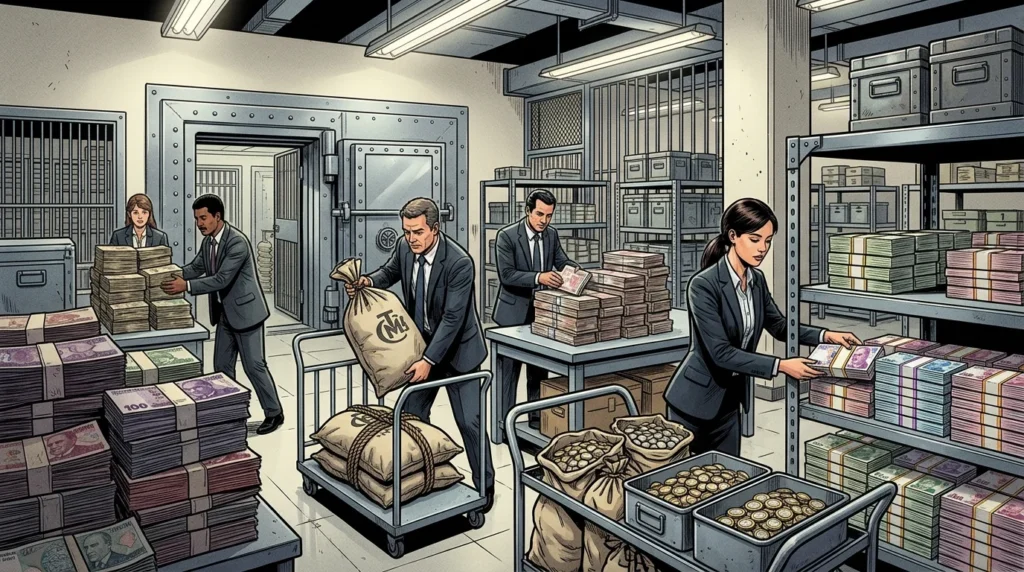
- Banknote Emergency and Social Breakdown: The Casa de Moneda could not print high-denomination Austral notes fast enough, forcing the BCRA to issue emergency provisional checks and overstamp expired Peso Argentino notes into 10,000-, 50,000-, and eventually 500,000-Austral banknotes. Shopkeepers adjusted prices multiple times a day or closed their shutters altogether with signs reading “Closed for lack of prices.”
Supermarket Riots, Early Handover, and Historical Legacy
During the final week of May 1989, the evaporation of real wages triggered widespread looting (saqueos) of supermarkets and food warehouses in Rosario, Córdoba, and the industrial belt of Greater Buenos Aires. Declaring a thirty-day national state of siege on May 29, security clashes left at least fourteen people dead and hundreds injured. With the Austral trading past 650 per US dollar (compared to 0.80 in June 1985) and the state unable to govern, Alfonsín announced in June 1989 that he would resign early, handing the presidential sash to President-elect Carlos Menem on July 8, 1989—five months before his constitutional term expired on December 10.
Even then, the agony of the Austral was not yet finished. A second hyperinflationary wave struck in December 1989–March 1990 (peaking at 95.5% monthly inflation in March 1990 and 2,314% annual inflation for 1990), prompting Economy Minister Erman González to confiscate commercial bank time deposits in exchange for ten-year dollar-denominated government bonds (Bonex 89) on January 1, 1990, eliminating the BCRA’s remunerated-reserve overhang at a stroke. Finally, under Domingo Cavallo’s March 1991 Convertibility Law, the Austral was fixed at 10,000 per US dollar and replaced on January 1, 1992, by the Peso Convertible—lopping four more zeros off the currency and bringing Argentina’s cumulative twenty-two-year amputation between 1970 and 1992 to thirteen zeros (1013).
Theoretical & Balance-Sheet Transmission Mechanism
In the Kindleberger–Minsky taxonomy of financial instability (Kindleberger, 1978; Minsky, 1986) and Irving Fisher’s (1933) debt-deflation framework, speculative asset booms become systemic crises when credit expansion shifts balance sheets from hedge finance (cash flows covering principal and interest) to speculative and Ponzi finance (relying on rising asset prices and short-term margin roll-overs).
Once monetary tightening or an exogenous shock halts price appreciation, forced margin liquidations trigger Fisherian debt-deflation: fire-sale asset discounts erode bank collateral values, contracting credit supply across the real economy.
Sources and Further Reading
- Banco Central de la República Argentina (BCRA), “Billetes y Monedas: Emisiones Anteriores,” Banco Central de la República Argentina, Official Numismatic and Monetary Archive. Central Bank / Monetary Authority
- Rudiger Dornbusch, “External Debt, Budget Deficits, and Disequilibrium Exchange Rates,” National Bureau of Economic Research (NBER Working Paper No. 1466), 1984. Peer-Reviewed / Academic Research
- Archivo General de la Nación, “14 de junio de 1985: Lanzamiento del Plan Austral,” Portal Oficial del Estado Argentino, 2021. Historical & Financial Reference
- Miguel A. Kiguel, “Inflation in Argentina: Stop and Go since the Austral Plan,” World Bank (Policy Research Working Paper No. 162), 1989. International Financial Institution
- Rudiger Dornbusch and Juan Carlos de Pablo, “Debt and Macroeconomic Instability in Argentina,” National Bureau of Economic Research / University of Chicago Press, 1989. Peer-Reviewed / Academic Research
- Cité de l’Économie (Banque de France), “Hyperinflation in Argentina,” Citéco Historical Economics Archive, 2020. Central Bank / Monetary Authority
- Irving Fisher — "The Debt-Deflation Theory of Great Depressions," Econometrica 1, no. 4 (FRASER Federal Reserve Archive, 1933): 337–357 Central Bank / Monetary Authority
- Charles P. Kindleberger & Robert Z. Aliber — Manias, Panics, and Crashes: A History of Financial Crises (Palgrave Macmillan) Peer-Reviewed / Academic Research
Cite This Historical Dossier (APA / Chicago)
APA (7th ed.): Ç., S. (Ed.). (2026). Nine Zeros in Fifteen Years: Argentina's Plan Austral and the 1989 Hyperinflation. In Forgotten Fortunes Historical Monograph Series (Forgotten Fortunes Editorial Desk). https://forgottenfortunes.net/argentina-hyperinflation-nine-zeros/
MLA (9th ed.): Ç., Soner, ed. "Nine Zeros in Fifteen Years: Argentina's Plan Austral and the 1989 Hyperinflation." Forgotten Fortunes: Financial & Monetary History Archive, 2026, https://forgottenfortunes.net/argentina-hyperinflation-nine-zeros/.
Chicago (17th ed.): Ç., Soner, ed. "Nine Zeros in Fifteen Years: Argentina's Plan Austral and the 1989 Hyperinflation." Forgotten Fortunes Historical Monograph Series (Forgotten Fortunes Editorial Desk), September 13, 2026. https://forgottenfortunes.net/argentina-hyperinflation-nine-zeros/.
Have an idea for another financial history documentary or article? Request a story →