In This Article
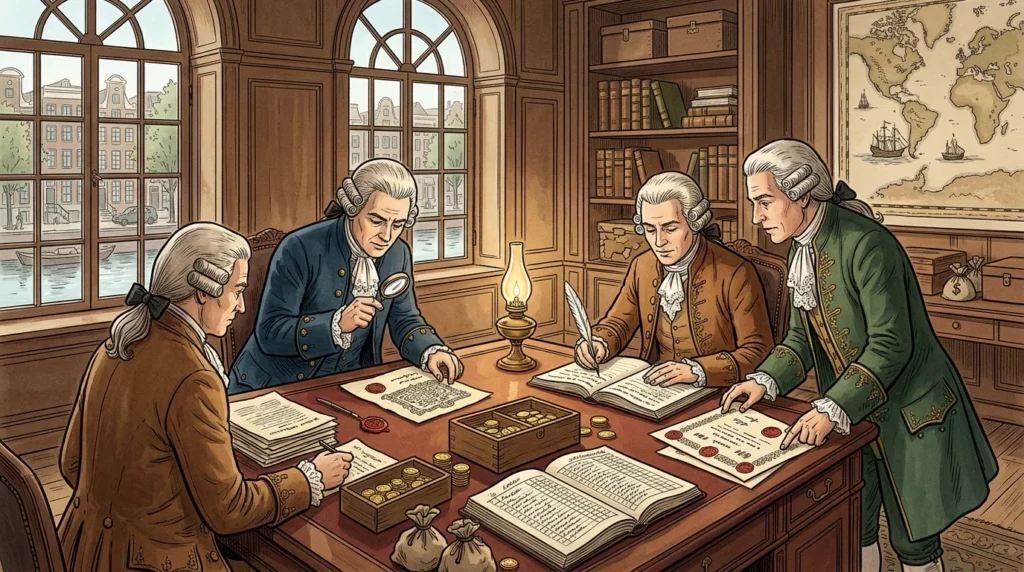
In June 1772, Alexander Fordyce, managing partner of the London banking house Neale, James, Fordyce, and Down, fled to France after losing a fortune speculating in East India Company stock and sinking £243,000 in drawn bills. Within two weeks, the shockwave brought down the Scottish Ayr Bank (Douglas, Heron & Co.), froze European bill markets from Edinburgh to Amsterdam, and left the British East India Company unable to roll over its short-term debt to the Bank of England or pay customs duties on nearly 18 million pounds of unsold tea rotting in London warehouses. To prevent the sovereign-mercantile leviathan from defaulting, Prime Minister Lord North pushed through the Regulating Act of 1773—extending a £1.4 million Exchequer bailout loan in exchange for state oversight—alongside the Tea Act of 1773, which ignited the Boston Tea Party. Six decades later, a second credit earthquake struck the Company’s Indian domain between 1830 and 1834, when all six of the great Calcutta agency houses collapsed with £15 million to £20 million in liabilities, sweeping away the old system of private Company-servant finance. [1]
The Diwani Bubble, Speculation, and the June 1772 Ayr Bank Crash
The roots of the East India Company’s 1772 solvency crisis lay in the euphoria that followed Robert Clive’s acquisition of the Bengal Diwani in August 1765. Anticipating that Bengal’s land taxes would yield a permanent net surplus of £2 million to £4 million a year, speculators in London and Amsterdam bid the price of East India stock from £165 in 1765 to £276 by 1768. Shareholders voted to raise their annual dividend from 6 percent to 10 percent in 1766 and then to 12.5 percent, while the British Treasury negotiated the Indemnity Act of 1767 (renewed in 1769), requiring the Company to pay the Exchequer £400,000 every year simply for the privilege of retaining its territorial revenues. [2]
In reality, the Bengal windfall was a mirage consumed on the spot by war and administrative plunder. The First Anglo-Mysore War (1767–1769) against Hyder Ali, soaring fortification budgets at Fort William, and the catastrophic Bengal Famine of 1769–1770 gutted net revenue while Company servants remitted private fortunes home by drawing over £1.5 million in bills of exchange directly on the Court of Directors in Leadenhall Street. [3]
Meanwhile, in Scotland, Douglas, Heron & Co.—founded at Ayr in November 1769 by 136 prominent aristocrats and merchants including the Dukes of Buccleuch and Queensberry—attempted to alleviate a provincial credit shortage by issuing £200,000 in bank notes and advancing over £800,000 in loans, funded by chaining 60-day accommodation bills drawn on London correspondent houses costs-plus-commission. After Fordyce absconded in early June 1772, triggering runs down Lombard Street, the Ayr Bank suspended payments on June 22 and closed in London on June 25 with £1.12 million to £1.26 million in liabilities, setting off twenty banking failures across London, Edinburgh, and Amsterdam. [4]
| Documented Figure / Metric | Historical Significance & Archival Context |
|---|---|
| 12.5 percent | To maintain its 12.5 percent dividend and meet the £400,000 annual state tribute while honouring the flood of bills drawn from Bengal, the Court of Directors had quietly relied on short-term rolling advances from the Bank of England alongside deferrals of royal customs duties. |
| £1,293,000 | By mid-July 1772, the Company's immediate cash deficit for the coming three months exceeded £1,293,000. |
| 3 pence | High British import duties and the Townshend Revenue Act tax of 3 pence per pound in North America had priced legal East India Company tea out of colonial markets, handing 80 to 90 percent of American consumption to smugglers importing untaxed Dutch tea from St. |
| 6 percent | Too systemically important to fail—its stock and bonds were held by MPs, peers, Dutch financiers, and the Bank of England—the Company reduced its dividend to 6 percent in September 1772 and formally petitioned Parliament for a state rescue on March 2, 1773. |
The Company’s Liquidity Freeze and the 18 Million Pound Tea Glut
As the European credit market seized up in July and August 1772, the East India Company’s balance-sheet fragility stood exposed. To maintain its 12.5 percent dividend and meet the £400,000 annual state tribute while honouring the flood of bills drawn from Bengal, the Court of Directors had quietly relied on short-term rolling advances from the Bank of England alongside deferrals of royal customs duties. [5]
By mid-July 1772, the Company’s immediate cash deficit for the coming three months exceeded £1,293,000. It owed £600,000 in short-term bullion and cash advances to the Bank of England due for repayment within weeks, £203,619 in overdue indemnity payments to the Exchequer, over £400,000 in unpaid customs duties to the Custom House, and hundreds of thousands of pounds in maturing Bengal bills of exchange. When the directors asked the Bank of England to roll over the £600,000 loan and lend an additional £400,000 in July 1772, the Bank—already straining to contain the post-Ayr panic—granted only a temporary two-month reprieve and refused further accommodation in October. [6]
Compounding the cash crunch was an unprecedented inventory crisis at the Leadenhall Street candle auctions. High British import duties and the Townshend Revenue Act tax of 3 pence per pound in North America had priced legal East India Company tea out of colonial markets, handing 80 to 90 percent of American consumption to smugglers importing untaxed Dutch tea from St. Eustatius and Amsterdam. By late 1772, nearly 17 to 18 million pounds of unsold Chinese Bohea and Singlo tea—almost three years’ normal supply—sat locked inside the Company’s bonded London warehouses, tying up working capital and accruing storage charges. [7]
Lord North’s Bailout: The Regulating Act and Tea Act of 1773
Too systemically important to fail—its stock and bonds were held by MPs, peers, Dutch financiers, and the Bank of England—the Company reduced its dividend to 6 percent in September 1772 and formally petitioned Parliament for a state rescue on March 2, 1773. Prime Minister Lord North seized the crisis to subordinate corporate sovereignty to parliamentary control through twin statutes enacted in May and June 1773. [8]
First, the Tea Act of May 10, 1773 (13 Geo. 3 c. 44) sought to monetize the 17-to-18-million-pound tea mountain. The Act granted the Company a full refund (drawback) of the 25 percent ad valorem British import duty on all tea re-exported to North America and licensed the Company to ship tea directly to its own colonial consignees in Boston, New York, Philadelphia, and Charleston, bypassing London wholesale auctions altogether. Crucially, however, Lord North insisted on retaining the 3-pence-per-pound Townshend duty payable in American ports to uphold Parliament’s right of colonial taxation. When the first consigned tea ships reached Massachusetts in late 1773, Sons of Liberty disguised as Mohawks dumped 342 chests of East India Company tea into Boston Harbor on December 16, 1773, setting the thirteen colonies on the path to revolution. [9]
Second, the Loan Act and Regulating Act of June 1773 (13 Geo. 3 c. 63 and c. 64) extended an Exchequer bailout loan of £1,400,000 at 4 percent interest (financed by issuing Exchequer bills bought largely by the Bank of England), suspended the Company’s £400,000 annual tribute until the loan was repaid, and capped dividends at 6 percent during repayment and 7 percent until bonded debt fell to £1,500,000. In exchange, the Regulating Act overhauled the Company’s constitution: raising the voting qualification in the Court of Proprietors from £500 to £1,000 of stock held for at least twelve months, creating the office of Governor-General of Bengal at Fort William (appointing Warren Hastings) with a four-member Supreme Council, establishing a Royal Supreme Court at Calcutta, and requiring all Indian dispatches on revenue and civil administration to be submitted to the Treasury and Secretaries of State. [10]
The Rise of the Calcutta Agency Houses and the Indigo Boom
By banning Company servants from accepting Indian “presents” or engaging in private inland trade while simultaneously restricting the volume of official Company bills of exchange available to remit private savings to London, the Regulating Act of 1773 inadvertently fostered a powerful new financial intermediary in Bengal: the Calcutta agency house.
Founded in the 1770s and 1780s by former Company civil servants and free merchants, a tight oligopoly of six great partnership houses came to dominate the private finance of the Bengal Presidency by the 1820s: Palmer & Co. (headed by John Palmer, celebrated as the “Prince of Merchants”), Alexander & Co. (which founded the private Bank of Hindostan in 1770), Mackintosh & Co., Colvin & Co., Fairlie, Fergusson & Co., and Cruttenden, Mackillop & Co.
Operating without limited liability or statutory reserve requirements, these six houses combined commercial banking with highly leveraged commodity speculation. They accepted fixed deposits at 8 to 10 percent interest from British civil servants, East India Company army officers, clergymen, widows, and wealthy Bengali banyans. In turn, they advanced those short-term deposits as seasonal crop loans at 10 to 12 percent interest—plus 2.5 to 5 percent agency commissions on procurement, freight, and insurance—to hundreds of European indigo planters across Bengal and Bihar, as well as financing private country shipping in Malwa and Bengal opium to Canton and cotton to Europe. Following the Charter Act of 1813, which ended the East India Company’s monopoly on Indian trade (leaving only the China tea monopoly), private British trade boomed and Bengal indigo production soared to supply three-quarters of the world market.
The 1830–1834 Calcutta Crash and the New Banking Order
Beneath their opulent facades along Calcutta’s Tank Square and Garden Reach, the six agency houses suffered from a fatal maturity and asset mismatch. Partners who retired to country estates in England withdrew their capital in cash, leaving the Calcutta partnerships hollowed out and wholly reliant on rolling over civil-servant deposits while their assets were locked up in illiquid mortgages on up-country indigo factories (*nilkutis*), shipping shares, and unrecoverable advances to planters.
The reckoning began in London after the Panic of 1825–1826 and a sharp fall in European indigo prices between 1827 and 1830—from over 10 shillings per pound in London down to under 4 shillings—paired with severe monsoon crop failures in the Gangetic plains. When London correspondent firm Cockerell, Trail & Co. refused to honour further bills without solid collateral, John Palmer & Co. suspended payment on January 4, 1830 with liabilities of roughly 5 करोड़ (50 million) sicca rupees—approximately £5,000,000.
Panic swept through the military cantonments and civil stations of Bengal as depositors rushed to withdraw their life savings. Although Governor-General Lord William Bentinck authorized the semi-official Bank of Bengal and the Company’s Calcutta treasury to advance emergency loans against indigo collateral in 1830–1831 to stem the contagion, continued deflation in London commodity markets doomed the remaining houses. Alexander & Co. collapsed in December 1832 (dragging down its Bank of Hindostan) with liabilities exceeding £3,440,000; Mackintosh & Co. failed in January 1833 for £2,700,000; Colvin & Co. fell in April 1833 for £1,120,000; Fairlie, Fergusson & Co. stopped in November 1833 for £1,800,000; and Cruttenden, Mackillop & Co. closed in January 1834 for £1,350,000.
In barely four years, all six of Calcutta’s premier agency houses had gone bankrupt, defaulting on cumulative liabilities estimated at £15 million to £20 million and paying creditors minuscule dividends often ranging from zero to 10 or 15 pence in the pound. The crash ruined thousands of Company officers, wiped out trust funds and regimental orphanages, and coincided directly with Parliament’s passage of the Charter Act of 1833, which stripped the East India Company of its last commercial operations. Out of the ruins of the old agency houses emerged two enduring institutions of nineteenth-century British India: modern joint-stock and exchange banking (led by the Union Bank of Calcutta in 1829 and the presidency banks) and the corporate “managing agency” system (such as Carr, Tagore & Co. and Jardine, Skinner & Co.) that dominated Indian coal, jute, and tea into the twentieth century.
Theoretical & Balance-Sheet Transmission Mechanism
In the Kindleberger–Minsky taxonomy of financial instability (Kindleberger, 1978; Minsky, 1986) and Irving Fisher’s (1933) debt-deflation framework, speculative asset booms become systemic crises when credit expansion shifts balance sheets from hedge finance (cash flows covering principal and interest) to speculative and Ponzi finance (relying on rising asset prices and short-term margin roll-overs).
Once monetary tightening or an exogenous shock halts price appreciation, forced margin liquidations trigger Fisherian debt-deflation: fire-sale asset discounts erode bank collateral values, contracting credit supply across the real economy.
Sources and Further Reading
- Huw V. Bowen, The East India Company crisis of 1772, Cambridge University Press, 1991. Peer-Reviewed / Academic Research
- Paul Kosmetatos, The winding-up of the Ayr Bank, 1772–1827, Financial History Review (Cambridge University Press), 2014. Peer-Reviewed / Academic Research
- Richard B. Sheridan, The British Credit Crisis of 1772 and The American Colonies, The Journal of Economic History (Cambridge University Press), 1960. Peer-Reviewed / Academic Research
- Huw V. Bowen, The final act? The passage of Lord North's East India legislation, 1773, Cambridge University Press, 1991. Peer-Reviewed / Academic Research
- Anthony Webster, The Richest East India Merchant: The Life and Business of John Palmer of Calcutta, 1767–1836, Boydell & Brewer, 2007. Peer-Reviewed / Academic Research
- Anthony Webster, Building Intra-Asian and Transcontinental Mercantile Networks in the Age of the British East India Company: The Rise and Fall of the House of John Palmer, Palgrave Macmillan UK, 2015. Peer-Reviewed / Academic Research
- Paul Kosmetatos, The 1772–73 British Credit Crisis, Palgrave Macmillan / Springer, 2018. Historical & Financial Reference
- UK Parliament, Parliament and the East India Company, UK Parliament. Official / State Archive
- Irving Fisher — "The Debt-Deflation Theory of Great Depressions," Econometrica 1, no. 4 (FRASER Federal Reserve Archive, 1933): 337–357 Central Bank / Monetary Authority
- Charles P. Kindleberger & Robert Z. Aliber — Manias, Panics, and Crashes: A History of Financial Crises (Palgrave Macmillan) Peer-Reviewed / Academic Research
Cite This Historical Dossier (APA / Chicago)
APA (7th ed.): Ç., S. (Ed.). (2026). The East India Company's 1772 Credit Crisis and the Calcutta Agency House Crash. In Forgotten Fortunes Historical Monograph Series (Forgotten Fortunes Editorial Desk). https://forgottenfortunes.net/east-india-company-1772-crisis-calcutta-agency-houses/
MLA (9th ed.): Ç., Soner, ed. "The East India Company's 1772 Credit Crisis and the Calcutta Agency House Crash." Forgotten Fortunes: Financial & Monetary History Archive, 2026, https://forgottenfortunes.net/east-india-company-1772-crisis-calcutta-agency-houses/.
Chicago (17th ed.): Ç., Soner, ed. "The East India Company's 1772 Credit Crisis and the Calcutta Agency House Crash." Forgotten Fortunes Historical Monograph Series (Forgotten Fortunes Editorial Desk), September 6, 2026. https://forgottenfortunes.net/east-india-company-1772-crisis-calcutta-agency-houses/.
Have an idea for another financial history documentary or article? Request a story →