In This Article
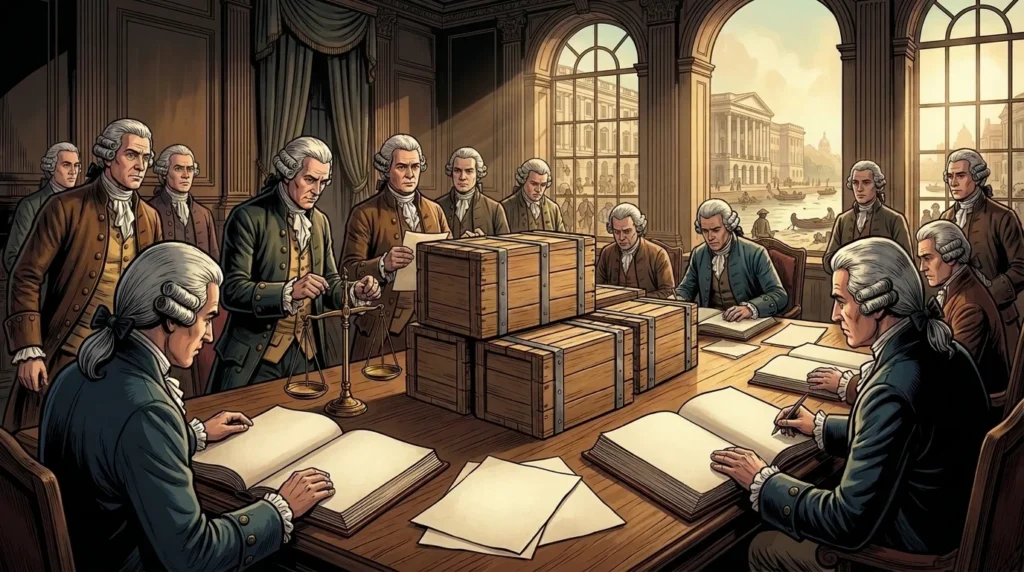
On August 12, 1765, inside a crimson military tent pitched at Allahabad on the banks of the Ganges, the defeated Mughal Emperor Shah Alam II handed a sealed imperial decree (farman) to Major-General Robert Clive, Baron Clive of Plassey. In exchange for an annual imperial tribute of 2.6 million rupees (26 lakhs, roughly £260,000) and the restoration of the districts of Kora and Allahabad, the emperor appointed the English East India Company (EIC) as his perpetual Diwan—chief civil and fiscal administrator—for the eastern provinces of Bengal, Bihar, and Orissa. With a single stroke of parchment, a joint-stock merchant corporation headquartered on Leadenhall Street in London acquired the sovereign right to assess and collect land taxes and customs duties from more than 20 million inhabitants across the richest agricultural and textile-exporting delta in South Asia. [1]

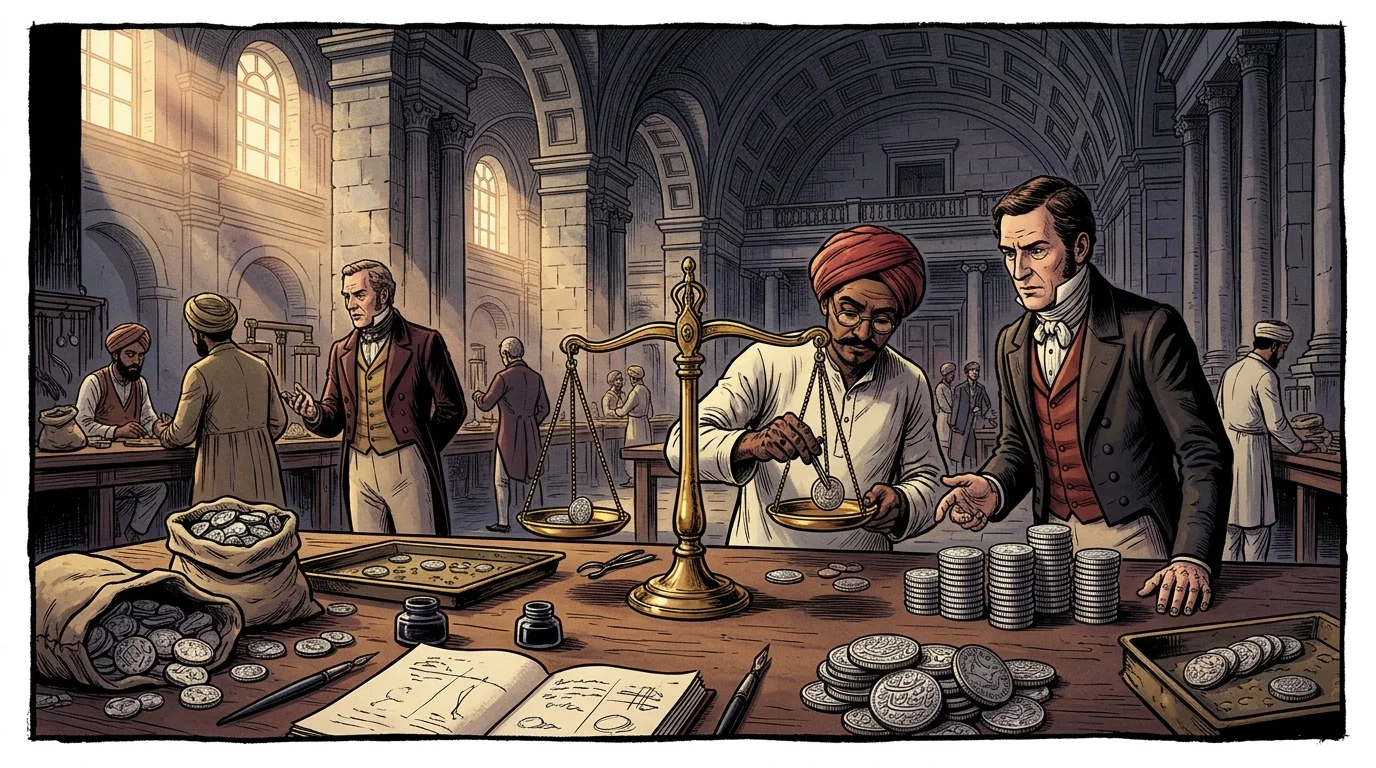
Before 1765, the Company’s Asian trade had suffered from a chronic structural monetary drain: because British woolens and base metals found scant demand in Indian or Chinese markets, the EIC had been forced to ship hundreds of tons of New World silver bullion out of London every season to pay for Bengal cotton muslins, raw silk, and saltpeter. The acquisition of the Diwani reversed that flow overnight. Yielding gross territorial revenues estimated by Clive at 25 to 30 million sicca rupees (£3 million to £3.5 million) per year—and netting the Company roughly £1.65 million to £2 million annually after military and civil stipends—Bengal’s agrarian taxes became the self-funding capital engine (the “Investment”) that purchased Indian textiles for Europe and Bengal opium and silver for the Canton tea trade without requiring a single ounce of British bullion. [2]
From Plassey and Buxar to the Dual System of Government (1757–1765)
The fiscal revolution at Allahabad was the culmination of eight years of corporate military intervention in the succession politics of the Mughal successor state of Bengal. After Robert Clive defeated Nawab Siraj-ud-Daulah at the Battle of Plassey on June 23, 1757—a coup underwritten by the Murshidabad banking house of the Jagat Seths and the defection of commander Mir Jafar—the EIC extracted £2.75 million in war indemnities, personal presents, and district revenue assignments (zamindari and tankhwah grants) in the 24 Parganas, Burdwan, Midnapore, and Chittagong. When Mir Jafar’s successor, Mir Qasim, attempted to abolish internal customs duties to put Indian merchants on an equal footing with duty-exempt EIC servants abusing imperial trading passes (dastaks), war erupted anew. [3]
On October 22, 1764, Major Hector Munro’s Company battalions defeated the combined armies of Mir Qasim, Nawab Shuja-ud-Daula of Awadh (Oudh), and Emperor Shah Alam II at the Battle of Buxar in Bihar. Returning to Calcutta in May 1765 as Governor of Bengal, Clive deliberately stopped short of annexing Awadh or marching on Delhi. Instead, under the Treaty of Allahabad signed in August 1765, he turned Awadh into a buffer state paying a 5-million-rupee war indemnity and instituted the “Dual System” (Diarchy) in Bengal. Under this arrangement, the Company held the Diwani (revenue collection and civil justice) while the young Nawab of Bengal at Murshidabad retained the Nizamat (criminal justice and police administration) on a fixed annual stipend of 5.3 million rupees. Furthermore, to insulate English factor-administrators from direct collection, Clive delegated actual tax extraction to two Indian Deputy Diwans (Naib Diwans): Muhammad Reza Khan at Murshidabad for Bengal and Maharaja Shitab Roy at Patna for Bihar. [4]
| Documented Figure / Metric | Historical Significance & Archival Context |
|---|---|
| £1.5 million | The First Anglo-Mysore War (1767–1769) against Hyder Ali drained the Madras treasury, fortifications at Fort William in Calcutta consumed millions of rupees, and EIC servants remitted their private fortunes to Europe by drawing bills of exchange worth over £1.5 million directly on the Court of Directors in London. |
| 18 million pounds | Caught with 18 million pounds of unsold Chinese tea rotting in its London warehouses and massive Indian bills falling due, the East India Company confessed in July 1772 that it was technically insolvent. |
The Drain of Wealth and the Great Bengal Famine of 1769–1770
The Dual System separated power from responsibility with catastrophic results for Bengal’s agrarian economy. Deprived of the continuous inflow of foreign silver bullion that had previously monetized the delta’s harvests and kept local credit liquid, Bengal experienced an acute deflationary specie shortage just as the EIC escalated its fiscal extraction. Between 1765–1766 and 1768–1769, net land revenue collections in Bengal and Bihar were driven up from roughly £1.47 million (14.7 million rupees) to over £2.3 million, while Company officials monopolized internal trade in salt, betel nut, tobacco, and even staple rice reserves. [5]
When the seasonal monsoon rains failed utterly in the autumn of 1768 and throughout 1769, parching the winter (aman) rice crop across western and central Bengal and Bihar, the EIC’s fiscal apparatus refused to grant the customary Mughal tax remissions (taqavi advances and drought relief) or halt grain exports for its military cantonments. During the height of the Great Bengal Famine of 1770 (the year 1176 in the Bengali calendar, remembered as Chhiyattorer Manvantar), rice prices in Murshidabad and Purnea surged sixfold to tenfold—from 30–40 seers per rupee in normal years to barely 3 or 4 seers per rupee—while up to one-third of Bengal’s population, estimated by Governor-General Warren Hastings in 1772 at approximately 10 million people, perished from starvation and smallpox. [6]
Remarkably, even as entire districts reverted to uncultivated jungle and a third of the peasantry died, the Company’s land tax collections did not fall. Through a coercive surcharge known as the najai—an assessment levied upon the surviving villagers to make up the defaulted tax quotas of their dead or fled neighbors—Warren Hastings reported cleanly to the Court of Directors in November 1772 that net land revenue collected in the famine year of 1770–1771 (£2.13 million / 15.25 million sicca rupees in Bengal proper) actually exceeded the pre-famine receipts of 1768, rising higher still in 1771–1772. [7]
The 1772 London Credit Crash, the Regulating Act, and the Tea Act of 1773
In London, news of the 1765 Diwani grant had ignited an exuberant speculative bubble in East India Stock. Expecting boundless fiscal windfalls, shareholders in the General Court overrode cautious directors and voted to double the EIC’s annual dividend from 6 percent in 1766 to 10 percent in 1767 and 12.5 percent by 1771. To appease the British Treasury, Parliament enacted the East India Company Act 1767, obligating the Company to pay the British Exchequer an annual tribute of £400,000 in return for retaining its territorial revenues. [8]
On the ground in India, however, the Company’s surplus was evaporating. The First Anglo-Mysore War (1767–1769) against Hyder Ali drained the Madras treasury, fortifications at Fort William in Calcutta consumed millions of rupees, and EIC servants remitted their private fortunes to Europe by drawing bills of exchange worth over £1.5 million directly on the Court of Directors in London. Meanwhile, the devastation of the 1770 Bengal Famine finally eroded commercial production and customs receipts.
The reckoning arrived in June 1772, when the Scottish banking partnership of Neal, James, Fordyce and Down—whose partner Alexander Fordyce had speculated heavily in East India stock—collapsed in London, bringing down the Ayr Bank (Douglas, Heron & Company) and freezing European credit markets. Caught with 18 million pounds of unsold Chinese tea rotting in its London warehouses and massive Indian bills falling due, the East India Company confessed in July 1772 that it was technically insolvent. It owed £400,000 to the British Treasury in statutory tribute, more than £200,000 in unpaid customs duties, and £600,000 in short-term bullion overdrafts to the Bank of England—a total liquidity shortfall of £1.4 million.
Prime Minister Lord North responded with a two-pronged legislative bailout in the spring of 1773 that permanently reshaped both British India and the Atlantic world:
- The Regulating Act of 1773 (13 Geo. 3 c. 63): Accompanied by the Loan Act (13 Geo. 3 c. 64), Parliament extended the EIC a £1.4 million sovereign bailout loan at 4 percent interest and capped Company dividends at 6 percent until the loan was repaid. In exchange, the British state asserted constitutional sovereignty over the EIC’s Indian territories for the first time, elevating Warren Hastings to Governor-General of Bengal with a four-member Supreme Council, establishing a Crown Supreme Court at Calcutta, and barring Company officers from private trade and Indian bribes.
- The Tea Act of 1773 (13 Geo. 3 c. 44): To help the cash-starved Company monetize its 18-million-pound mountain of warehoused tea, Parliament granted the EIC a full refund (drawback) of British import duties on tea re-exported to the American colonies and allowed the Company to consign cargoes directly to colonial agents while retaining the three-pence-per-pound Townshend tax. Outraged American merchants and Sons of Liberty dumped 342 chests of EIC tea into Boston Harbor on December 16, 1773, setting off the American Revolutionary War.
Hastings’s Quinquennial Auctions and Cornwallis’s Permanent Settlement (1772–1793)
Back in Calcutta, Warren Hastings abolished Clive’s Dual System in 1772, dismissed the Indian Naib Diwans, transferred the treasury from Murshidabad to Calcutta, and initiated the Quinquennial Settlement (1772–1777), auctioning five-year tax-farming rights (ijaradari) to the highest bidders. Speculative contractors outbid hereditary rural landlords (zamindars), stripped estates through rack-renting, and then defaulted, leaving agrarian revenues unstable throughout the 1780s.
When Charles, Earl Cornwallis arrived as Governor-General in 1786 under instructions from Pitt’s India Act (1784) to establish a predictable, rule-bound fiscal regime, he and Bengal revenue theorist John Shore debated whether tax assessments should be fixed for ten years or forever. Inspired by Whig and Physiocratic ideals that secure private property rights would incentivize English-style landlords to invest in land reclamation and irrigation, Cornwallis promulgated the Permanent Settlement of Bengal (Cornwallis Code, Regulation I of March 22, 1793).
The Permanent Settlement recognized Bengal’s zamindars as absolute, hereditary private proprietors of the soil rather than revocable Mughal tax officials. It fixed the state’s land revenue demand across Bengal, Bihar, and Orissa in perpetuity at roughly 26.8 million sicca rupees (£3.1 million) per year—representing 10/11ths (89 percent) of the estimated net rental value of the estates in 1793, leaving the zamindars 1/11th (11 percent) plus the entire future increment from cultivating wasteland and raising peasant rents. Crucially, the settlement was enforced by the draconian “Sunset Law” (Regulation XIV of 1793): if a zamindar failed to deliver his full tax installment before sunset on the appointed due date, the colonial state automatically seized and auctioned off his estate. Within two decades of 1793, nearly half of Bengal’s ancient landed estates changed hands at collectorate auctions, bought up by urban Calcutta merchants, moneylenders, and former EIC Indian clerks (banians), cementing a rigid absentee-landlord hierarchy over tens of millions of unprotected peasant cultivators (ryots) that persisted until the abolition of zamindari in the 1950s.
Theoretical & Balance-Sheet Transmission Mechanism
In the Kindleberger–Minsky taxonomy of financial instability (Kindleberger, 1978; Minsky, 1986) and Irving Fisher’s (1933) debt-deflation framework, speculative asset booms become systemic crises when credit expansion shifts balance sheets from hedge finance (cash flows covering principal and interest) to speculative and Ponzi finance (relying on rising asset prices and short-term margin roll-overs).
Once monetary tightening or an exogenous shock halts price appreciation, forced margin liquidations trigger Fisherian debt-deflation: fire-sale asset discounts erode bank collateral values, contracting credit supply across the real economy.
Sources and Further Reading
- Sirajul Islam, “ Diwani,” Banglapedia: National Encyclopedia of Bangladesh, Asiatic Society of Bangladesh, 2021. Historical & Financial Reference
- Sirajul Islam, “ Regulating Act, 1773,” Banglapedia: National Encyclopedia of Bangladesh, Asiatic Society of Bangladesh, 2021. Historical & Financial Reference
- Parliament of Great Britain, “ East India Company Act 1772 (Regulating Act 1773, 13 Geo. 3 c. 63),” UK Statute Law Database, The National Archives, 1773. Official / State Archive
- Parliament of Great Britain, “ Tea Act 1773 (13 Geo. 3 c. 44),” UK Statute Law Database, The National Archives, 1773. Official / State Archive
- Sirajul Islam, “ Permanent Settlement, The,” Banglapedia: National Encyclopedia of Bangladesh, Asiatic Society of Bangladesh, 2021. Historical & Financial Reference
- Mark Cartwright, “ East India Company,” World History Encyclopedia, 2022. Historical & Financial Reference
- Irving Fisher — "The Debt-Deflation Theory of Great Depressions," Econometrica 1, no. 4 (FRASER Federal Reserve Archive, 1933): 337–357 Central Bank / Monetary Authority
- Charles P. Kindleberger & Robert Z. Aliber — Manias, Panics, and Crashes: A History of Financial Crises (Palgrave Macmillan) Peer-Reviewed / Academic Research
Cite This Historical Dossier (APA / Chicago)
APA (7th ed.): Ç., S. (Ed.). (2026). The 1765 Treaty of Allahabad: How the East India Company Became Bengal's Tax State. In Forgotten Fortunes Historical Monograph Series (Forgotten Fortunes Editorial Desk). https://forgottenfortunes.net/treaty-of-allahabad-1765-diwani/
MLA (9th ed.): Ç., Soner, ed. "The 1765 Treaty of Allahabad: How the East India Company Became Bengal's Tax State." Forgotten Fortunes: Financial & Monetary History Archive, 2026, https://forgottenfortunes.net/treaty-of-allahabad-1765-diwani/.
Chicago (17th ed.): Ç., Soner, ed. "The 1765 Treaty of Allahabad: How the East India Company Became Bengal's Tax State." Forgotten Fortunes Historical Monograph Series (Forgotten Fortunes Editorial Desk), September 16, 2026. https://forgottenfortunes.net/treaty-of-allahabad-1765-diwani/.
Have an idea for another financial history documentary or article? Request a story →