In This Article
During the 1960s, American expatriate and former social worker Bernard “Bernie” Cornfeld built Geneva-headquartered Investors Overseas Services (IOS) into the largest offshore mutual-fund complex in the world. Recruiting an army of more than 16,000 door-to-door sales representatives with the famous pitch “Do you sincerely want to be rich?”, Cornfeld gathered roughly $2.5 billion in assets under management from nearly one million middle-class investors, expatriates, and American military personnel across Europe, Latin America, and the Middle East. At the heart of the empire stood the IOS Fund of Funds (FOF), an open-ended offshore vehicle that channeled investor savings into American go-go growth funds, hedge funds, and unquoted natural-resource ventures while charging layered management and front-end sales fees. After IOS went public at $10 per share in September 1969, the combination of the 1969–1970 Wall Street bear market, insider loan disclosures, questionable upward revaluations of Canadian Arctic oil permits held alongside Denver promoter John M. King, and more than $300 million in net redemptions triggered a catastrophic crisis in May 1970—opening the door for corporate raider Robert L. Vesco to seize control and loot $224 million from the remaining IOS funds before regulators forced their global liquidation. [1]

“People’s Capitalism” and the Rise of IOS in Geneva
Born in Istanbul in 1927 and raised in Brooklyn, New York, Bernard Cornfeld worked briefly as a Philadelphia social worker before becoming a mutual-fund salesman for Investors Planning Corporation in New York. Moving to Paris in 1955 with a few hundred dollars in savings, Cornfeld began selling American mutual funds out of his apartment to U.S. soldiers and airmen stationed at European NATO bases. Operating under the banner of Investors Overseas Services, Cornfeld discovered two structural advantages in postwar Europe: American servicemen and expatriates possessed surplus dollar incomes with few retail investment options, and wealthy Europeans and Latin Americans facing domestic currency controls or political instability eagerly sought dollar-denominated offshore savings vehicles protected by financial secrecy. [2]
In 1958, seeking a more favorable tax and regulatory climate, Cornfeld relocated IOS’s operational headquarters to Geneva, Switzerland, while incorporating its parent holding company in Panama (and later re-incorporating I.O.S., Ltd. in Canada in 1960 to utilize North American corporate law without submitting to domestic U.S. taxation or regulation). Alongside his chief legal strategist and operational deputy, Yale Law School graduate Edward M. Cowett, Cornfeld constructed a pyramid-style sales organization modeled on multi-level marketing. Sales associates began at the bottom tier and earned overrides on the commissions of every new recruit they brought into the hierarchy, with top managers inducted into the elite “Millionaires’ Club.” [3]
Operating from Villa Elma—a palatial lakeside estate in Geneva once owned by Napoleon Bonaparte’s Josephine—and a 12th-century French castle across the border, Cornfeld cultivated a flamboyant public persona as the apostle of “People’s Capitalism.” By the late 1960s, IOS operated more than a dozen proprietary mutual funds, commercial banks in Switzerland, Luxembourg, and the Bahamas, real estate subsidiaries, and life insurance companies across more than 100 countries. [4]
| Documented Figure / Metric | Historical Significance & Archival Context |
|---|---|
| $300 million | Panic swept IOS's investor base: share prices of I.O.S., Ltd. crashed from $19 toward $2 in May 1970, and fundholders submitted more than $300 million in net redemptions during spring and summer 1970. |
| $15 million | Through his heavily indebted conglomerate, International Controls Corporation (ICC), Vesco offered an emergency $15 million loan package in autumn 1970, portraying himself as a disciplined American industrialist who would stabilize the Geneva complex. |
| $224 million | Vesco, et al.) charging Vesco and 41 individual and corporate co-defendants with looting $224 million from the four IOS mutual funds in what SEC Commissioner Philip Loomis called one of the largest securities frauds ever perpetrated. |
| $1.6 million | Cornfeld spent 11 months in Geneva's Saint-Antoine prison before posting $1.6 million bail, and in October 1979 a Geneva jury acquitted him of criminal fraud charges after defense testimony emphasized that IOS's cash reserves had been intact until Vesco's 1971 takeover. |
The Flagship Fund of Funds and SEC Confrontation
IOS’s decisive breakthrough came in October 1962 with the launch of the Fund of Funds (FOF), incorporated in Ontario, Canada, and managed out of Geneva. Designed by Cowett and Cornfeld, the Fund of Funds operated as a mutual fund that invested exclusively in shares of other American mutual funds and specially created proprietary sub-funds run by star Wall Street portfolio managers during the “Go-Go” bull market of the mid-1960s. [5]
While the concept was marketed to European doctors, shopkeepers, and civil servants as ultimate diversification, its fee structure generated extraordinary revenues for IOS insiders. Investors purchasing long-term IOS contractual savings plans typically paid an upfront sales load of up to 8.5 percent—with as much as half of the first year’s monthly contributions deducted immediately to pay sales commissions—followed by an annual management fee of 0.5 percent and a 10 percent performance incentive fee at the Fund of Funds level, stacked directly on top of the underlying management, brokerage, and incentive fees charged by the target funds in New York. Furthermore, IOS routed the securities transactions of its underlying funds through its own affiliated broker-dealer, Arthur Lipper Corporation, capturing millions of dollars in reciprocal brokerage commissions. [6]
This structure immediately drew the scrutiny of the U.S. Securities and Exchange Commission (SEC), which noted that section 12(d)(1) of the U.S. Investment Company Act of 1940 strictly restricted registered mutual funds from acquiring more than three percent of another investment company’s shares precisely to prevent fee-layering and redemption leverage. In 1966, the SEC initiated administrative proceedings against IOS for selling unregistered offshore securities to U.S. citizens and violating American securities laws. In May 1967, IOS signed a landmark consent order with the SEC under which IOS was permanently barred from selling shares to U.S. citizens or residents anywhere in the world and required to wind down its American client accounts, leaving Cornfeld’s empire operating entirely outside U.S. regulatory supervision. [7]
Arctic Oil Permits, the September 1969 IPO, and the 1970 Liquidity Run
Shut out of the American retail market, IOS doubled down on European expansion—particularly in West Germany, Italy, and Britain—driving total assets under management across its 18 funds to a peak of $2.5 billion in late 1969, including more than $700 million in the Fund of Funds and $680 million in the International Investment Trust (IIT). To monetize their private holdings at the height of the boom, Cornfeld, Cowett, and senior IOS executives took the parent management company, I.O.S., Ltd., public in September 1969 through a $110 million initial public offering underwritten by an international syndicate led by Drexel Harriman Ripley, Banque Rothschild, and Guinness Mahon. Priced at $10 per share, the stock immediately jumped to $19 on its first day of trading, valuing IOS near $1 billion and turning dozens of Geneva sales managers into paper multimillionaires. [8]
Beneath the triumphant IPO, however, IOS’s finances were rapidly deteriorating. As Wall Street entered the severe 1969–1970 bear market, the high-beta technology and conglomerate stocks held by IOS’s underlying funds plunged, erasing performance fees at the exact moment IOS’s overhead expenses in Geneva soared past $60 million a year. Desperate to report positive net asset value (NAV) gains for the Fund of Funds at year-end 1969, Cowett partnered with flamboyant Denver oil promoter John M. King and his King Resources Company. Earlier, the Fund of Funds’ natural-resource sub-account had joined King Resources in acquiring 22.4 million acres of remote oil and gas exploration permits in the Canadian Arctic Islands at roughly $1 per acre. In late 1969, King arranged the sale of a sliver of those Arctic permits to third parties at roughly $8 to $14 per acre, and IOS used that thin transaction to write up the book value of all its remaining Arctic acreage by more than $100 million—allowing IOS to collect a nearly $10 million performance fee on paper profits that generated zero cash.
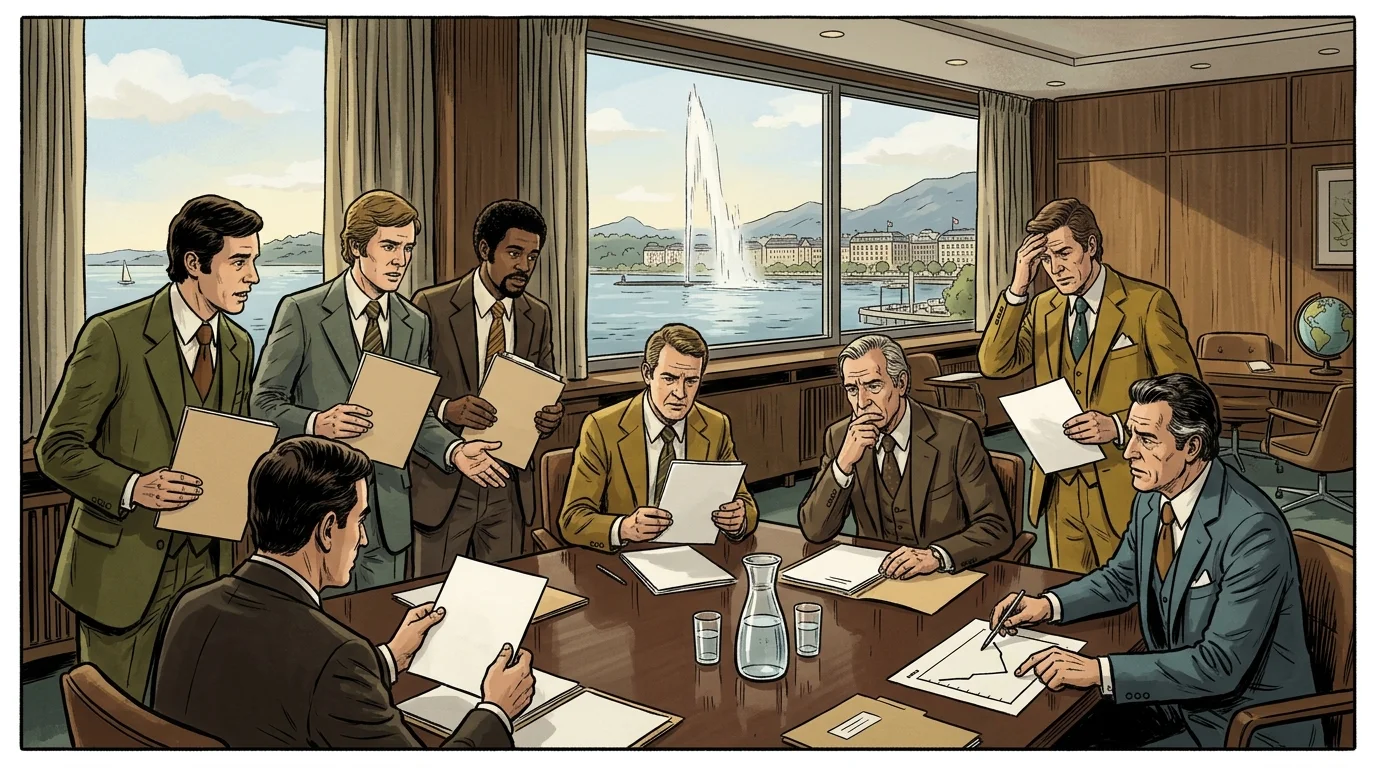
In spring 1970, the facade collapsed. West German regulators under the Federal Banking Supervisory Office (BAKred) restricted IOS’s aggressive door-to-door sales tactics, while rumors spread across European bourses that IOS was illiquid. In April and May 1970, when I.O.S., Ltd. belatedly released its 1969 annual report, analysts discovered that 1969 profits had fallen sharply from forecasts, that the illusory Arctic oil write-up had propped up earnings, and that IOS funds and banks had extended more than $30 million in questionable loans to IOS directors, officers, and companies affiliated with John M. King and Edward Cowett. Panic swept IOS’s investor base: share prices of I.O.S., Ltd. crashed from $19 toward $2 in May 1970, and fundholders submitted more than $300 million in net redemptions during spring and summer 1970. On May 9, 1970, during a stormy marathon board meeting in Geneva, Cornfeld and Cowett were forced to resign their executive posts as the board sought an emergency bailout.
Robert Vesco’s Takeover and the $224 Million Looting of IOS
After rescue talks with Baron Edmond de Rothschild’s European banking syndicate and Denver promoter John King collapsed in mid-1970, a 34-year-old New Jersey corporate acquirer named Robert L. Vesco approached IOS. Through his heavily indebted conglomerate, International Controls Corporation (ICC), Vesco offered an emergency $15 million loan package in autumn 1970, portraying himself as a disciplined American industrialist who would stabilize the Geneva complex. Once inside IOS, Vesco engineered a boardroom coup, and in January 1971 he bought out Bernard Cornfeld’s remaining six million founders’ shares for $5.5 million through a Panamanian shell company, securing undisputed control of IOS and its remaining $1.5 billion in mutual-fund cash and marketable securities.
Rather than rehabilitating the funds, Vesco and a cadre of associates systematically plundered IOS’s four largest dollar funds—the Fund of Funds, IIT, Venture Fund International, and Transglobal Growth Fund. Operating across offshore jurisdictions in the Bahamas, Luxembourg, Costa Rica, and Panama, Vesco directed the funds’ custodians to sell their blue-chip stock portfolios on the New York Stock Exchange and wire the cash proceeds into Vesco-controlled offshore banks and shell corporations, disguising the transfers as legitimate private-equity investments in Costa Rican, Bahamian, and European ventures.
On November 27, 1972, following an intensive cross-border investigation led by SEC Enforcement Director Stanley Sporkin, the SEC filed a landmark civil complaint in the U.S. District Court for the Southern District of New York (SEC v. Robert L. Vesco, et al.) charging Vesco and 41 individual and corporate co-defendants with looting $224 million from the four IOS mutual funds in what SEC Commissioner Philip Loomis called one of the largest securities frauds ever perpetrated. When federal prosecutors also uncovered that Vesco had secretly delivered $200,000 in cash in a briefcase to Maurice Stans, finance chairman of President Richard Nixon’s 1972 re-election committee, in an unsuccessful effort to quash Sporkin’s SEC subpoena, Vesco fled the United States on his private Boeing 707 jet—spending the next three decades as an international fugitive in Costa Rica, the Bahamas, Nicaragua, and Cuba.
Geneva Liquidation, Cornfeld’s Trial, and Regulatory Legacy
With its liquid assets drained and investor redemptions permanently suspended, the IOS complex was forced into court-supervised liquidation across Canada, Luxembourg, the Bahamas, and Switzerland in 1973. When Bernard Cornfeld returned briefly to Geneva in May 1973 claiming he intended to help recover assets from Vesco, Swiss examining magistrate Jean-Pierre Bertossa arrested him for alleged fraud and mismanagement prior to his 1970 ouster. Cornfeld spent 11 months in Geneva’s Saint-Antoine prison before posting $1.6 million bail, and in October 1979 a Geneva jury acquitted him of criminal fraud charges after defense testimony emphasized that IOS’s cash reserves had been intact until Vesco’s 1971 takeover.
Over the ensuing decade, court-appointed international liquidators tracked down frozen bank accounts and won legal settlements against offshore banks and former IOS auditors, eventually returning a partial recovery of several hundred million dollars to the defrauded European and expatriate fundholders. In financial regulatory history, the rise and collapse of Investors Overseas Services permanently ended the era of unregulated offshore retail mutual funds, prompting West Germany, Switzerland, the United Kingdom, and the European Community to enact strict licensing, custodian-segregation, and valuation laws for cross-border collective investment schemes.
Theoretical & Balance-Sheet Transmission Mechanism
In the Kindleberger–Minsky taxonomy of financial instability (Kindleberger, 1978; Minsky, 1986) and Irving Fisher’s (1933) debt-deflation framework, speculative asset booms become systemic crises when credit expansion shifts balance sheets from hedge finance (cash flows covering principal and interest) to speculative and Ponzi finance (relying on rising asset prices and short-term margin roll-overs).
Once monetary tightening or an exogenous shock halts price appreciation, forced margin liquidations trigger Fisherian debt-deflation: fire-sale asset discounts erode bank collateral values, contracting credit supply across the real economy.
Sources and Further Reading
- TIME Magazine, “ Business: A Kingdom Besieged,” TIME, 1970-09-07. Historical & Financial Reference
- TIME Magazine, “ Mutual Funds: Those I.O.S. Loans,” TIME, 1970-06-08. Historical & Financial Reference
- TIME Magazine, “ SCANDALS: One of the Largest Frauds,” TIME, 1972-12-11. Historical & Financial Reference
- TIME Magazine, “ Business: Bernie Cleared,” TIME, 1979-10-29. Historical & Financial Reference
- Matthew Partridge, “ Great frauds in history: Robert Vesco’s dubious schemes,” MoneyWeek, 2022-09-23. Historical & Financial Reference
- William N. Goetzmann, “ Bubble Investing: Learning from History,” National Bureau of Economic Research (NBER Working Paper No. 21693), 2015-11. Peer-Reviewed / Academic Research
- Irving Fisher — "The Debt-Deflation Theory of Great Depressions," Econometrica 1, no. 4 (FRASER Federal Reserve Archive, 1933): 337–357 Central Bank / Monetary Authority
- Charles P. Kindleberger & Robert Z. Aliber — Manias, Panics, and Crashes: A History of Financial Crises (Palgrave Macmillan) Peer-Reviewed / Academic Research
Cite This Historical Dossier (APA / Chicago)
APA (7th ed.): Ç., S. (Ed.). (2026). The 1970 Collapse of Bernard Cornfeld's Investors Overseas Services in Geneva. In Forgotten Fortunes Historical Monograph Series (Forgotten Fortunes Editorial Desk). https://forgottenfortunes.net/cornfeld-investors-overseas-services/
MLA (9th ed.): Ç., Soner, ed. "The 1970 Collapse of Bernard Cornfeld's Investors Overseas Services in Geneva." Forgotten Fortunes: Financial & Monetary History Archive, 2026, https://forgottenfortunes.net/cornfeld-investors-overseas-services/.
Chicago (17th ed.): Ç., Soner, ed. "The 1970 Collapse of Bernard Cornfeld's Investors Overseas Services in Geneva." Forgotten Fortunes Historical Monograph Series (Forgotten Fortunes Editorial Desk), September 10, 2026. https://forgottenfortunes.net/cornfeld-investors-overseas-services/.
Have an idea for another financial history documentary or article? Request a story →