In This Article
On Monday, August 17, 1998, the government of Prime Minister Sergey Kiriyenko and the Central Bank of Russia (CBR) under chairman Sergei Dubinin issued an emergency joint declaration that shattered one of the largest speculative carry trades of the post-Cold War era. Barely five weeks after the International Monetary Fund (IMF), the World Bank, and Japan approved a $22.6 billion stabilization package to defend the Russian currency, Moscow simultaneously widened and effectively abandoned its ruble exchange-rate corridor, suspended payments on all ruble-denominated short-term Treasury bills (GKOs) and longer-dated coupon bonds (OFZs) maturing through the end of 1999, and imposed a 90-day moratorium on private commercial banks’ external debt and currency forward obligations. Within three weeks, the ruble lost more than two-thirds of its value against the U.S. dollar, Russia’s major commercial banks were rendered insolvent, and global contagion helped trigger the collapse of the U.S. hedge fund Long-Term Capital Management (LTCM). [1]
Disinflation Without Fiscal Consolidation: The Birth of the GKO Market
Following the dissolution of the Soviet Union in December 1991 and the price liberalizations of 1992, the Russian Federation suffered near-hyperinflation driven by central bank money printing to finance state enterprise subsidies and chronic federal budget deficits. Beginning in 1995, Russian reformers and the IMF implemented a two-pillar macroeconomic stabilization strategy designed to break inflationary expectations without monetary emission. [2]
First, the Central Bank of Russia anchored the currency in July 1995 by introducing a pre-announced exchange-rate “corridor” (later a crawling band) against the U.S. dollar, which by early 1998 was targeted around 6.1 to 6.2 rubles per dollar within a formal 5.25–7.15 RUB/USD band. Second, instead of printing money to cover federal deficits of 7 to 9 percent of GDP, the Ministry of Finance funded the shortfall by auctioning zero-coupon, ruble-denominated short-term state obligations—Gosudarstvennye Kratkosrochnye Obligatsii (GKOs), typically maturing in three, six, or twelve months—alongside floating- or fixed-rate federal loan bonds known as OFZs (Obligatsii Federalnogo Zaima). [3]
Although exchange-rate anchoring and bond financing succeeded in bringing annual Russian consumer price inflation down from over 200 percent in 1995 to roughly 11 percent by 1997, the underlying fiscal deficit remained unresolved. Tax collection collapsed amid widespread corporate tax arrears, political stalemate between President Boris Yeltsin and the Communist-led State Duma, and a proliferation of non-cash barter and promissory notes (veksels) across Russian industry. [4]
| Documented Figure / Metric | Historical Significance & Archival Context |
|---|---|
| 30 percent | Foreign investment banks, hedge funds, and emerging-market bond funds poured tens of billions of dollars into GKOs, attracted by annualized ruble yields ranging from 20–30 percent in tranquil periods to over 50–100 percent during episodes of political stress, combined with a predictable exchange-rate corridor. |
| 150 percent | To stem capital flight and defend the ruble corridor, the Central Bank of Russia hiked its refinancing rate to 150 percent on May 27, 1998, while secondary-market GKO yields soared above 80 to 100 percent. |
| $5.6 billion | When the State Duma rejected key tax-revenue measures in Kiriyenko's anti-crisis fiscal package, the IMF trimmed its immediate first tranche disbursement from $5.6 billion to $4.8 billion. |
| 84 percent | Major Moscow commercial banks (including Inkombank, SBS-Agro, Rossiyskiy Kredit, and Uneximbank) collapsed or froze depositor accounts; inflation surged to 84 percent for 1998; and President Yeltsin dismissed Kiriyenko on August 23, eventually appointing Yevgeny Primakov as prime minister in September 1998. |
Foreign Capital Inflows, Currency Forwards, and the GKO Debt Pyramid
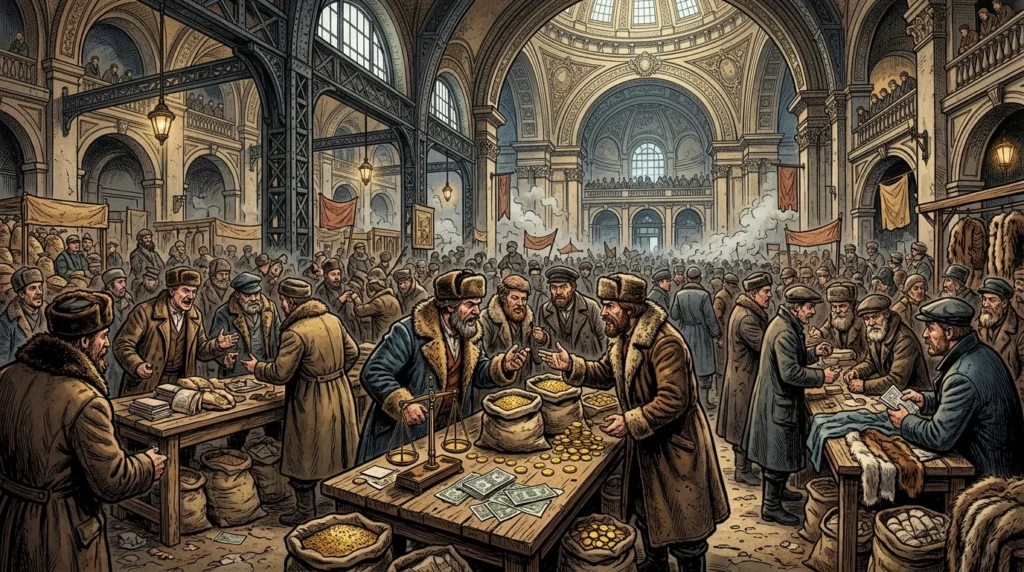
Because the Russian government had to roll over maturing three- and six-month GKOs continuously while borrowing new funds to pay interest, the treasury market evolved into a classic Ponzi-style debt structure in which roughly 50 percent of the federal deficit consisted of interest payments on previously issued debt. Initially restricted to domestic institutions such as Sberbank and Moscow commercial banks, the GKO market was progressively opened to foreign portfolio investors between 1996 and January 1998 to lower yields and expand demand. [5]
Foreign investment banks, hedge funds, and emerging-market bond funds poured tens of billions of dollars into GKOs, attracted by annualized ruble yields ranging from 20–30 percent in tranquil periods to over 50–100 percent during episodes of political stress, combined with a predictable exchange-rate corridor. To hedge against the risk that the ruble might devalue before their GKOs matured, foreign investors bought billions of dollars in non-deliverable and deliverable ruble/dollar currency forward contracts from Russian commercial banks—which simultaneously borrowed dollars abroad via repurchase agreements (repos) against GKO collateral. According to UNCTAD and credit-rating estimates, Russian commercial banks accumulated between $10 billion in net exposure and $40–$50 billion in notional outstanding currency forward obligations to foreign counterparties, leaving the domestic banking sector fatally exposed to any drop in the ruble. [6]
The 1997–1998 Asian Contagion, Oil Price Collapse, and Yield Spikes
The external environment turned sharply against Russia in late 1997. The East Asian financial crisis triggered a broad flight of international capital from emerging markets, while weak global demand sent the price of Urals crude oil—Russia’s primary source of hard-currency export earnings and fiscal excise revenue—plunging toward $10–$12 per barrel, accompanied by steep declines in non-ferrous metal prices. [7]
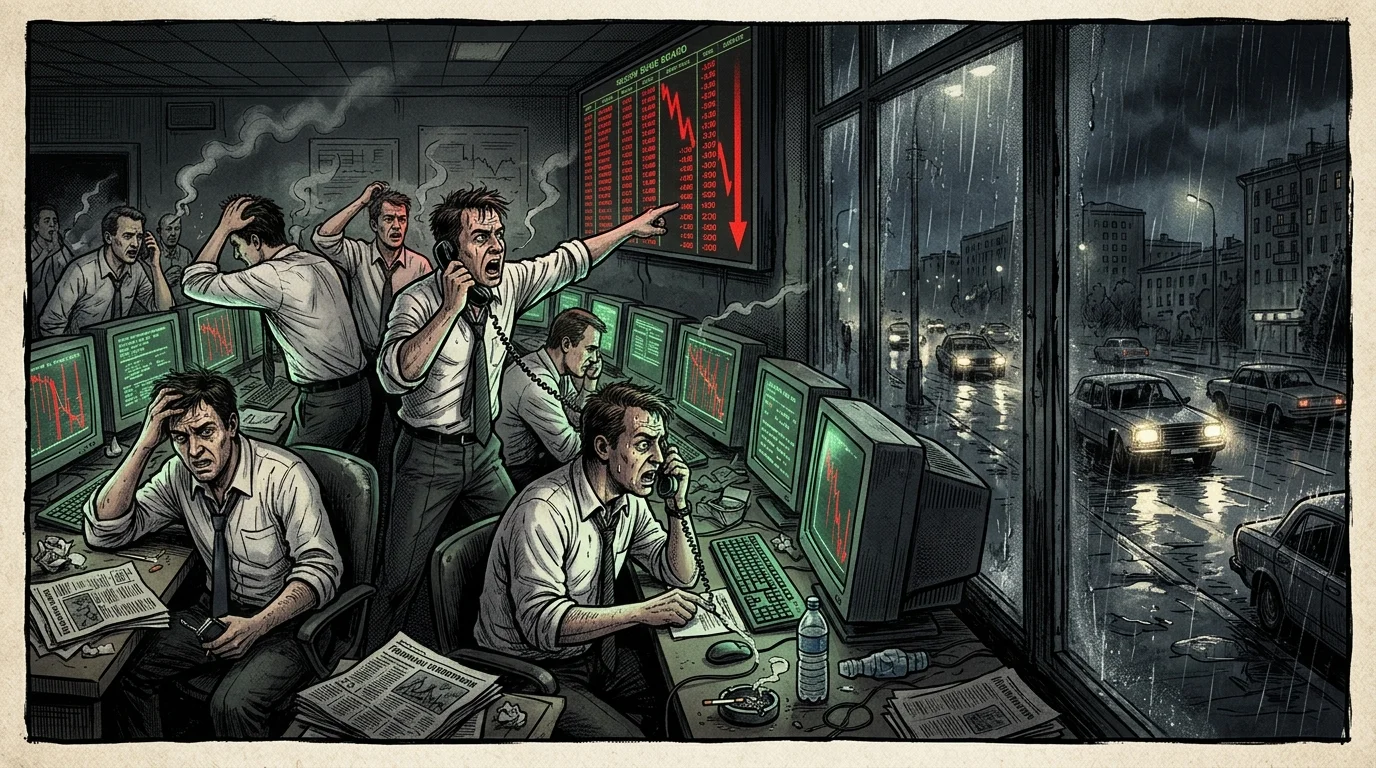
In March 1998, President Yeltsin abruptly dismissed long-serving Prime Minister Viktor Chernomyrdin and appointed 35-year-old Sergey Kiriyenko, sparking a month-long confirmation battle with the State Duma. By May 1998, as weekly GKO debt-service redemptions outstripped new auction proceeds, investor confidence cracked. To stem capital flight and defend the ruble corridor, the Central Bank of Russia hiked its refinancing rate to 150 percent on May 27, 1998, while secondary-market GKO yields soared above 80 to 100 percent. At those interest rates, rolling over the roughly RUB 260–436 billion ($40–$70 billion equivalent) stock of outstanding GKOs and OFZs was mathematically impossible. [8]
The July 1998 $22.6 Billion IMF Rescue and Voluntary Swap Failure
Invoking fears of instability in a nuclear-armed state—a dynamic market participants dubbed the “moral hazard play” of “too nuclear to fail”—Western governments pressed international financial institutions to intervene. On July 13–20, 1998, the IMF, the World Bank, and the Japanese government announced a $22.6 billion emergency financing package for 1998–1999, conditioned on emergency fiscal reforms and accompanied by a voluntary debt exchange swapping short-term ruble GKOs into long-term U.S. dollar Eurobonds maturing in 2005 and 2018.
The relief lasted barely two weeks. When the State Duma rejected key tax-revenue measures in Kiriyenko’s anti-crisis fiscal package, the IMF trimmed its immediate first tranche disbursement from $5.6 billion to $4.8 billion. Meanwhile, the GKO-to-Eurobond swap converted only a fraction of short-term ruble debt while burdening Russia with heavier hard-currency coupon obligations. Russian banks and oligarchic financial-industrial groups, facing margin calls on their dollar repo lines as bond prices tumbled, used the fresh $4.8 billion of central bank dollar liquidity to convert rubles into dollars and exit the country. By mid-August 1998, short-term GKO yields exceeded 140–150 percent and the CBR’s liquid foreign exchange reserves were nearly exhausted.
August 17, 1998: Triple Default, Devaluation, and Moratorium
Over the weekend of August 15–16, 1998, with domestic banks unable to settle interbank obligations and billions of rubles in GKOs maturing the following week, Kiriyenko’s cabinet, CBR chairman Dubinin, and foreign advisors drafted an unprecedented three-part emergency decree announced on Monday morning, August 17, 1998:
- De facto ruble devaluation: Authorities widened the ruble’s trading band from the prevailing ~6.29 RUB/USD level to a new corridor of 6.0 to 9.5 rubles per dollar through year-end. Even that wider corridor collapsed within days; on September 2, 1998, the CBR abandoned the band entirely and floated the ruble, which plunged past 21 rubles per dollar by September 9—a more than threefold depreciation.
- Unilateral domestic GKO/OFZ default: Trading in the GKO-OFZ market was halted and the Ministry of Finance suspended all payments on ruble-denominated treasury obligations maturing before December 31, 1999 (roughly RUB 260+ billion / $40+ billion at pre-crisis exchange rates), announcing a mandatory restructuring into longer-term securities at steep present-value haircuts.
- 90-day private foreign-debt moratorium: To shield Russian commercial banks from immediate foreign foreclosure, the government imposed a 90-day moratorium prohibiting payments to non-residents on principal of foreign bank loans over 180 days, repo margin calls, and all currency forward contracts.
Domestic Banking Collapse, LTCM Contagion, and Post-1998 Recovery
The August 17 default paralyzed the Russian payment and banking system. Major Moscow commercial banks (including Inkombank, SBS-Agro, Rossiyskiy Kredit, and Uneximbank) collapsed or froze depositor accounts; inflation surged to 84 percent for 1998; and President Yeltsin dismissed Kiriyenko on August 23, eventually appointing Yevgeny Primakov as prime minister in September 1998. To restore basic interbank liquidity after the GKO freeze, the Central Bank of Russia began issuing its own zero-coupon, three-month central bank bonds (OBRs) in September 1998 so surviving banks had a liquid collateral instrument.
Internationally, Russia’s unprecedented default on domestic-currency sovereign debt shocked global credit markets. As investors dumped emerging-market and lower-liquidity bonds in a flight to U.S. and German benchmark treasuries, yield spreads widened violently against the highly leveraged relative-value bets of Greenwich, Connecticut hedge fund Long-Term Capital Management (LTCM), forcing the Federal Reserve Bank of New York to coordinate a $3.6 billion private-sector recapitalization of LTCM in September 1998. Paradoxically, inside Russia, the 70+ percent real depreciation of the ruble priced foreign imports out of the domestic market and—combined with a rebound in world oil prices beginning in 1999 and fiscal restraint under the Primakov and Putin administrations—catalyzed an import-substitution and export-led economic recovery from 1999 onward.
Theoretical & Balance-Sheet Transmission Mechanism
In the Kindleberger–Minsky taxonomy of financial instability (Kindleberger, 1978; Minsky, 1986) and Irving Fisher’s (1933) debt-deflation framework, speculative asset booms become systemic crises when credit expansion shifts balance sheets from hedge finance (cash flows covering principal and interest) to speculative and Ponzi finance (relying on rising asset prices and short-term margin roll-overs).
Once monetary tightening or an exogenous shock halts price appreciation, forced margin liquidations trigger Fisherian debt-deflation: fire-sale asset discounts erode bank collateral values, contracting credit supply across the real economy.
Sources and Further Reading
- Homi Kharas, Brian Pinto, and Sergei Ulatov, “ An Analysis of Russia’s 1998 Meltdown: Fundamentals and Market Signals,” Brookings Papers on Economic Activity, 2001. Peer-Reviewed / Academic Research
- UNCTAD and UNECE Secretariats, “ The Russian Crisis,” United Nations Conference on Trade and Development (UNCTAD) / UNECE, 1998-10. Historical & Financial Reference
- Benjamin Hoffner, “ Russia: Central Bank Bonds, 1998,” Journal of Financial Crises (Yale Program on Financial Stability), 2022. Central Bank / Monetary Authority
- William H. Cooper, “ The Russian Financial Crisis of 1998: An Analysis of Trends, Causes, and Implications (CRS Report 98-578),” Congressional Research Service, Library of Congress, 1998. Historical & Financial Reference
- International Monetary Fund, “ Crisis in Russia (Chapter 7, Tearing Down Walls: The International Monetary Fund 1990–1999),” International Monetary Fund, 2012. International Financial Institution
- Brookings Institution, “ An Analysis of Russia’s 1998 Meltdown: Fundamentals and Market Signals (Summary),” Brookings Institution, 2001. Peer-Reviewed / Academic Research
- Irving Fisher — "The Debt-Deflation Theory of Great Depressions," Econometrica 1, no. 4 (FRASER Federal Reserve Archive, 1933): 337–357 Central Bank / Monetary Authority
- Charles P. Kindleberger & Robert Z. Aliber — Manias, Panics, and Crashes: A History of Financial Crises (Palgrave Macmillan) Peer-Reviewed / Academic Research
Cite This Historical Dossier (APA / Chicago)
APA (7th ed.): Ç., S. (Ed.). (2026). The 1998 Russian Financial Crisis: GKO Treasury Bill Bubble and Sovereign Default. In Forgotten Fortunes Historical Monograph Series (Forgotten Fortunes Editorial Desk). https://forgottenfortunes.net/russian-financial-crisis-1998-gko-default/
MLA (9th ed.): Ç., Soner, ed. "The 1998 Russian Financial Crisis: GKO Treasury Bill Bubble and Sovereign Default." Forgotten Fortunes: Financial & Monetary History Archive, 2026, https://forgottenfortunes.net/russian-financial-crisis-1998-gko-default/.
Chicago (17th ed.): Ç., Soner, ed. "The 1998 Russian Financial Crisis: GKO Treasury Bill Bubble and Sovereign Default." Forgotten Fortunes Historical Monograph Series (Forgotten Fortunes Editorial Desk), September 10, 2026. https://forgottenfortunes.net/russian-financial-crisis-1998-gko-default/.
Have an idea for another financial history documentary or article? Request a story →