In This Article
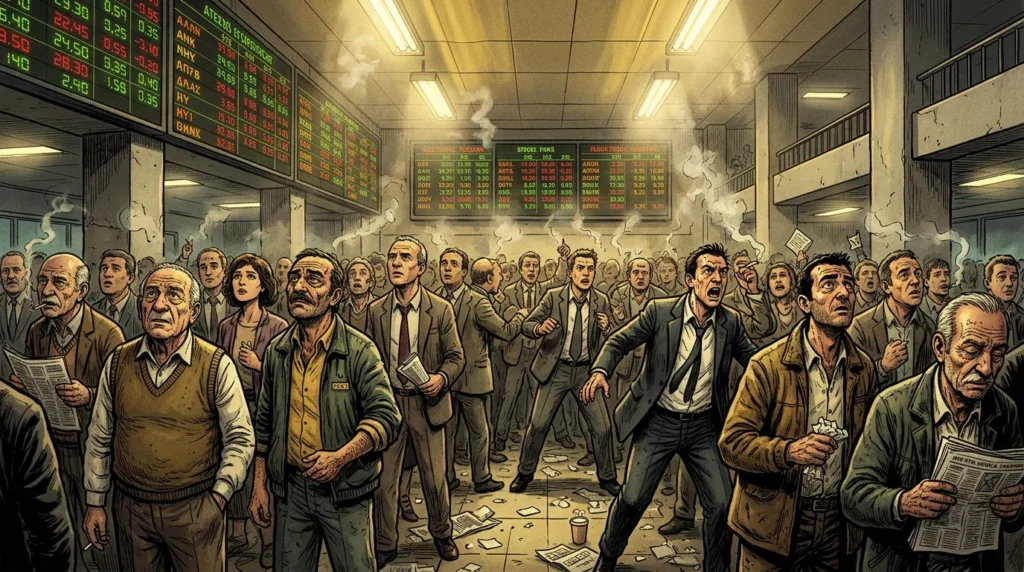
On July 18, 2007, the benchmark OMX Iceland 15 (OMXI15) stock index on the Reykjavík exchange closed at an all-time high of 9,016.48 points—a ninefold (nearly 900 percent) surge in less than five years that made tiny Iceland the fastest-growing equity market in the developed world. Fifteen months later, in the second week of October 2008, the country’s three dominant commercial banks—Kaupthing, Landsbanki, and Glitnir—collapsed within seventy-two hours under combined liabilities exceeding ten times Iceland’s gross domestic product. When the Iceland Stock Exchange resumed trading on October 14, 2008 after a multi-day suspension, the OMX Iceland 15 plunged by 77 percent in a single session and ultimately lost more than 97 percent of its peak value. As the Icelandic Parliament’s Special Investigation Commission (SIC, or Rannsóknarnefnd Alþingis) later revealed in its landmark April 2010 nine-volume report, the stock market miracle had been a mirage of circular financial engineering: the three banks had directly and indirectly financed roughly €3.5 billion (over ISK 300 billion at pre-crash rates) in purchases of their own and one another’s shares, while pledging mutually fabricated “love letter” debt securities to extract liquidity from central banks. [1]
Privatization of Landsbanki and Búnaðarbanki and the Rise of the “Outvasion Vikings”
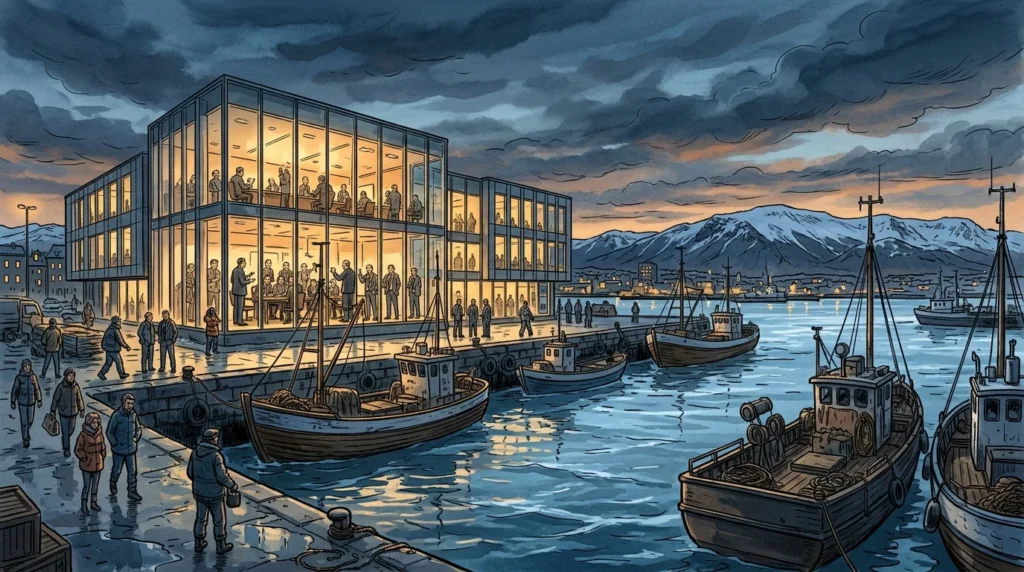
Until the late 1990s, Iceland’s financial system was small, state-dominated, and inwardly focused on the fishing, aluminum, and geothermal energy sectors. Following Iceland’s 1994 entry into the European Economic Area (EEA), which granted Icelandic banks “passporting” rights across the European Union, Prime Minister Davíð Oddsson’s coalition government embarked on a rapid privatization of the state-owned commercial banks. Between 1998 and early 2003, the government sold controlling stakes in Landsbanki Íslands and Búnaðarbanki Íslands (which quickly merged with investment bank Kaupthing in May 2003 to form Kaupthing Búnaðarbanki, later Kaupthing Bank), while several smaller lenders merged to create Íslandsbanki (renamed Glitnir in 2006). [2]
Crucially, rather than selling the state banks to experienced international banking groups—which had set strict conditions during preliminary talks—the Icelandic government awarded controlling blocks to politically connected domestic investor consortia with scant commercial banking expertise. A 45.8 percent controlling stake in Landsbanki was sold in late 2002 to the Samson Holding Company (led by father-and-son tycoons Björgólfur Guðmundsson and Björgólfur Thor Björgólfsson), while a 45.8 percent stake in Búnaðarbanki went to the S-Group. Almost immediately, the new owners paid for their privatization tranches by borrowing from the rival bank and transformed the three institutions—Kaupthing, Landsbanki, and Glitnir—into aggressive international merchant banks fueling a wave of debt-financed overseas corporate acquisitions by Icelandic tycoons celebrated in Reykjavík media as “Outvasion Vikings” (útrásarvíkingar). [3]
| Documented Figure / Metric | Historical Significance & Archival Context |
|---|---|
| 73 percent | Because the three commercial banks and these leveraged investment holding companies accounted for more than 73 percent to 85 percent of the total market capitalization of the OMX Iceland 15, their share prices reinforced one another in a self-amplifying feedback loop. |
| 70 percent | In effect, nearly a third of the apparent equity capital of the Icelandic banking system—and up to 70 percent when cross-financed bank shares and forward equity contracts were included—was "weak capital" backed by nothing more than the value of the bank shares themselves. |
| 1,000 basis points | As international credit default swap (CDS) spreads on Kaupthing, Landsbanki, and Glitnir widened past 500 to 1,000 basis points in late 2007 and spring 2008, wholesale bond markets shut the Icelandic banks out completely. |
| €600 million | The final unraveling began in late September 2008 when Glitnir—heavily exposed to its controlling shareholder Jón Ásgeir Jóhannesson's Baugur/FL Group network—found itself unable to roll over a €600 million bond due in October and requested emergency assistance from the Central Bank of Iceland. |
Leveraged Holding Conglomerates and the 900% OMX Iceland 15 Surge
Between 2003 and 2007, the combined assets of Kaupthing, Landsbanki, and Glitnir expanded from roughly 170 percent of Iceland’s GDP to nearly 900 percent (and over 1,000 percent by mid-2008). Tapping yield-hungry European wholesale bond markets and later retail internet deposit schemes such as Landsbanki’s “Icesave” in the United Kingdom and the Netherlands and Kaupthing’s “Kaupthing Edge,” the three banks channeled vast credit flows into a tight web of publicly listed Icelandic investment holding companies that dominated the OMX Iceland 15 index. [4]
At the center of this corporate network stood four major investment groups closely intertwined with the banks’ boards: Exista (controlled by brothers Lýður and Ágúst Guðmundsson, the largest shareholder in Kaupthing with roughly 23 percent), Baugur Group and FL Group (led by Jón Ásgeir Jóhannesson and Hannes Smárason, the dominant shareholders in Glitnir after early 2007 and aggressive buyers of British high-street retailers including Hamleys, House of Fraser, and Iceland Foods), and Samson (controlling Landsbanki). Because the three commercial banks and these leveraged investment holding companies accounted for more than 73 percent to 85 percent of the total market capitalization of the OMX Iceland 15, their share prices reinforced one another in a self-amplifying feedback loop. When a holding company borrowed euros from Glitnir or Landsbanki to buy shares in Kaupthing or FL Group, the rising stock price boosted the mark-to-market net asset value and reported profits of both the holding company and the banks, justifying even larger loans. [5]
Circular Equity Financing and €3.5+ Billion in Weak-Collateral Share Loans
When the Special Investigation Commission audited the loan books of Kaupthing, Landsbanki, and Glitnir in 2009–2010, it uncovered the central mechanism that had propelled the OMX Iceland 15 to 9,016.48 on July 18, 2007: systematic self-financing of bank capital and cross-shareholding manipulation. Under European banking directives, equity capital is only genuine if it comes from external investors capable of absorbing losses. In Iceland, however, the banks themselves provided the money used to buy their shares. [6]
According to Chapter 9 and the Executive Summary of the SIC report, direct loans granted by the three banks where the sole or primary collateral was the lending bank’s own shares—combined with cross-financing arrangements in which Bank A lent money to investors to buy shares in Bank B while Bank B lent money to buy shares in Bank A—amounted to roughly ISK 300 billion to ISK 400 billion (approximately €3.5 billion to €4 billion) by mid-2008. That sum equaled roughly 70 percent of the total core Tier-1 equity capital of the three banks combined. At Kaupthing and Landsbanki, the banks also lent vast sums to offshore special-purpose vehicles (SPVs) established in the British Virgin Islands or Luxembourg by employees, preferred clients, and controlling shareholders to soak up millions of bank shares whenever selling pressure emerged on the Reykjavík exchange—often waiving margin calls and releasing personal guarantees when the shares fell. [7]
In effect, nearly a third of the apparent equity capital of the Icelandic banking system—and up to 70 percent when cross-financed bank shares and forward equity contracts were included—was “weak capital” backed by nothing more than the value of the bank shares themselves. As long as the OMX Iceland 15 rose, the illusion held. Once share prices began falling in late 2007 and early 2008, the collateral backing those loans evaporated simultaneously with the banks’ own capital base. [8]
“Love Letters” and Central Bank Liquidity Extraction
As international credit default swap (CDS) spreads on Kaupthing, Landsbanki, and Glitnir widened past 500 to 1,000 basis points in late 2007 and spring 2008, wholesale bond markets shut the Icelandic banks out completely. Rather than shrink their balance sheets or sell assets at a loss, the banks engaged in what economists Friðrik Már Baldursson and Richard Portes termed “gambling for resurrection”—increasing loans to their bankrupt insider holding companies while fabricating artificial collateral to borrow cash from central banks.
The most notorious instrument of this late-stage liquidity scramble was the “love letter” (ástirbréf). Because a bank cannot pledge its own unbacked IOUs at a central bank discount window, the three major Icelandic banks (alongside smaller wholesale bank Icebank / Sparidjóðabanki Íslands and Straumur-Burðarás) issued billions of euros in senior unsecured debt bonds to one another without any genuine cash changing hands. Landsbanki, Glitnir, and Kaupthing then took each other’s paper—or routed it through Icebank domestically and through their Luxembourg subsidiaries internationally—and pledged those reciprocal bonds as collateral for repurchase (repo) loans at the Central Bank of Iceland (CBI) and, via Banque centrale du Luxembourg, at the European Central Bank (ECB). By the spring of 2008, Icelandic banks had extracted roughly €4.5 billion from the Eurosystem and over ISK 300 billion from the Central Bank of Iceland using these circular “love letters.” Alarmed by the scale of the abuse, the ECB restricted and forced the unwinding of Icelandic bank paper between May and July 2008, triggering a fatal foreign-currency liquidity crisis.
The October 2008 Three-Day Collapse and 97% Market Wipeout
The final unraveling began in late September 2008 when Glitnir—heavily exposed to its controlling shareholder Jón Ásgeir Jóhannesson’s Baugur/FL Group network—found itself unable to roll over a €600 million bond due in October and requested emergency assistance from the Central Bank of Iceland. On September 29, 2008, the CBI announced it would acquire a 75 percent stake in Glitnir for €600 million, wiping out existing shareholders and devastating the balance sheets of Landsbanki and Kaupthing, which held massive loans collateralized by Glitnir and FL Group stock.
Rating downgrades, a run on Landsbanki’s UK Icesave deposits, and the UK Treasury’s October 8 invocation of anti-terrorism asset-freezing powers against Landsbanki brought down the entire system. On October 6, 2008, the Althingi passed the Emergency Act (Act No. 125/2008), empowering the Financial Supervisory Authority (FME) to seize Landsbanki on October 7, Glitnir on October 8, and Kaupthing on October 9, carving out domestic deposits into new state banks while leaving roughly $85 billion in foreign liabilities in receivership. With the three banks and holding groups such as Exista and Baugur wiped out, the OMX Iceland 15 plummeted from its 9,016.48 peak to below 300 points by late 2008—a 97 percent collapse in equity wealth—followed by special prosecutor indictments and prison sentences for dozens of senior Icelandic bankers for market manipulation and breach of fiduciary duty.
Theoretical & Balance-Sheet Transmission Mechanism
In the Kindleberger–Minsky taxonomy of financial instability (Kindleberger, 1978; Minsky, 1986) and Irving Fisher’s (1933) debt-deflation framework, speculative asset booms become systemic crises when credit expansion shifts balance sheets from hedge finance (cash flows covering principal and interest) to speculative and Ponzi finance (relying on rising asset prices and short-term margin roll-overs).
Once monetary tightening or an exogenous shock halts price appreciation, forced margin liquidations trigger Fisherian debt-deflation: fire-sale asset discounts erode bank collateral values, contracting credit supply across the real economy.
Sources and Further Reading
- Sigríður Benediktsdóttir, Gauti B. Eggertsson, and Eggert Þórarinsson, “ The Rise, Fall, and Resurrection of Iceland: A Postmortem Analysis of the 2008 Financial Crisis,” Brookings Papers on Economic Activity, 2017. Peer-Reviewed / Academic Research
- Sigríður Benediktsdóttir, Gauti Eggertsson, and Eggert T. Thorarinsson, “ Lessons from the Icelandic Financial Crisis,” in The 2008 Global Financial Crisis in Retrospect, Palgrave Macmillan, 2019. Peer-Reviewed / Academic Research
- Eiríkur Bergmann, “ The Crash — Collapse of the Cross-border Banks,” in Iceland and the International Financial Crisis, Palgrave Macmillan, 2014. Peer-Reviewed / Academic Research
- Jón Daníelsson and Gylfi Zoega, “ Iceland: Landsbanki, Glitnir and Kaupthing,” in The Future of Financial Regulation, Cambridge University Press, 2015. Peer-Reviewed / Academic Research
- Ayodeji George, “ Iceland: Landsbanki Restructuring, 2008,” Journal of Financial Crises, 2024. Peer-Reviewed / Academic Research
- Sophia Alden and Léo Brougher, “ Iceland: Kaupthing Emergency Liquidity Program, 2008,” Journal of Financial Crises, 2025. Peer-Reviewed / Academic Research
- Irving Fisher — "The Debt-Deflation Theory of Great Depressions," Econometrica 1, no. 4 (FRASER Federal Reserve Archive, 1933): 337–357 Central Bank / Monetary Authority
- Charles P. Kindleberger & Robert Z. Aliber — Manias, Panics, and Crashes: A History of Financial Crises (Palgrave Macmillan) Peer-Reviewed / Academic Research
Cite This Historical Dossier (APA / Chicago)
APA (7th ed.): Ç., S. (Ed.). (2026). The 2003–2008 OMX Iceland 15 Stock Bubble and Cross-Shareholding Crash. In Forgotten Fortunes Historical Monograph Series (Forgotten Fortunes Editorial Desk). https://forgottenfortunes.net/iceland-omx-15-bubble-2008/
MLA (9th ed.): Ç., Soner, ed. "The 2003–2008 OMX Iceland 15 Stock Bubble and Cross-Shareholding Crash." Forgotten Fortunes: Financial & Monetary History Archive, 2026, https://forgottenfortunes.net/iceland-omx-15-bubble-2008/.
Chicago (17th ed.): Ç., Soner, ed. "The 2003–2008 OMX Iceland 15 Stock Bubble and Cross-Shareholding Crash." Forgotten Fortunes Historical Monograph Series (Forgotten Fortunes Editorial Desk), September 10, 2026. https://forgottenfortunes.net/iceland-omx-15-bubble-2008/.
Have an idea for another financial history documentary or article? Request a story →