
In This Article
Across the fourteenth through sixteenth centuries (1350–1600 CE), as imperial hegemony over the Niger Bend shifted from the declining Mali Empire to the Tuareg (1433) and then to the resurgent Songhai Empire under Sunni Ali (1468) and Askia Muhammad I (r. 1493–1528), long-distance commerce across West Africa depended on far more than camel caravans and river canoes. Because a single commercial venture from Sijilmasa, Fez, or Cairo across the Sahara to Walata, Timbuktu, and Jenne—and onward to the southern goldfields of Bambuk, Bure, and Akan—required twelve to twenty-four months to turn over capital, virtually all wholesale trade operated on sophisticated written credit. [1]

To enforce contracts between North African financiers, Tuareg camel drovers, and Mande Wangara (Juula) gold brokers who belonged to different ethnic groups and political jurisdictions, the commercial cities of the Niger Bend relied on a unified legal infrastructure: the Maliki school of Sunni Islamic jurisprudence (fiqh al-mu’amalat). Administered by independent chief judges (qadis) and scholar-jurists (ulama) affiliated with Timbuktu’s Sankore, Djinguereber, and Sidi Yahya mosque-academies, this legal regime governed credit sales, bills of exchange, partnerships, and strict anti-usury rules on uncoined gold dust—just as the arrival of Portuguese caravels on the Gambia River (1456) and the construction of Castelo de São Jorge da Mina (Elmina) in 1482 introduced a rival Atlantic maritime credit system on West Africa’s southern coast. [2]
The Sankore Ulama and Judicial Autonomy in Timbuktu (1350–1591)
Endowed initially during the reign of Mansa Musa (c. 1325) by a wealthy Mandinka woman and expanded over the fifteenth and sixteenth centuries, the Sankore Mosque in northeastern Timbuktu stood at the center of an urban scholarly network of 150 to 180 Quranic schools and higher learning circles (halقات) educating up to 25,000 students. Unlike European medieval universities with a single corporate rector, Timbuktu’s learning complexes operated through prestigious scholarly families—most notably the Sanhaja Berber Aqit lineage and the Soninke/Wangara Baghayogho lineage—who maintained vast private libraries of thousands of manuscripts and issued authoritative legal opinions (nawazil and fatawa). [3]
During the late fourteenth and early fifteenth centuries, internal succession struggles weakened the Mansas of Mali. In 1433, Maghsharan Tuareg nomads led by Akil ag Malwal seized control of Timbuktu, followed in January 1468 by the Songhai conqueror Sunni Ali (r. 1464–1492), who annexed Timbuktu and Jenne into the expanding Songhai Empire. When General Askia Muhammad Touré (Askia the Great) overthrew Sunni Ali’s son in 1493, he forged a constitutional alliance with Timbuktu’s Maliki jurists. appointing Mahmud ibn Umar Aqit as Chief Judge (Qadi) of Timbuktu in 1498. [4]
For the next century, the Qadi of Timbuktu exercised remarkable judicial independence inside the city, insulating merchants and property contracts from arbitrary imperial seizure. Studying classical Maliki legal compendia—above all the Mudawwana of Sahnun (d. 854), the Risala of Ibn Abi Zayd al-Qayrawani, and the Mukhtasar of Khalil ibn Ishaq al-Jundi (d. 1365)—Timbuktu’s judges notarized commercial contracts, adjudicated bankruptcy estates, and registered debt acknowledgments (iqrar) that were honored from Marrakesh to Hausaland. [5]
Maliki Commercial Law: Salam, Hawala, and the Riba Ban on Uncoined Gold Dust
Surviving manuscript collections in Timbuktu (such as the Ahmed Baba Institute and the Mamma Haidara Commemorative Library) alongside North African and Saharan fatwa compilations reveal how Maliki jurists structured credit across the desert-savanna interface:
- Forward Delivery Contracts (Bay’ al-Salam) and Credit Sales (Bay’ al-Ajal): When a caravan arrived at Timbuktu or Walata laden with Taghaza rock salt slabs, Venetian cloth, and Moroccan horses, local Wangara factors rarely had enough spot gold dust on hand to clear the entire cargo immediately. Under Maliki salam and deferred-payment rules, northern merchants advanced salt slabs on written credit to Wangara traders, who specified the exact weight, quality, place, and future date (typically after the dry-season canoe return from Jenne) at which they would deliver gold dust, kola nuts, or ivory.
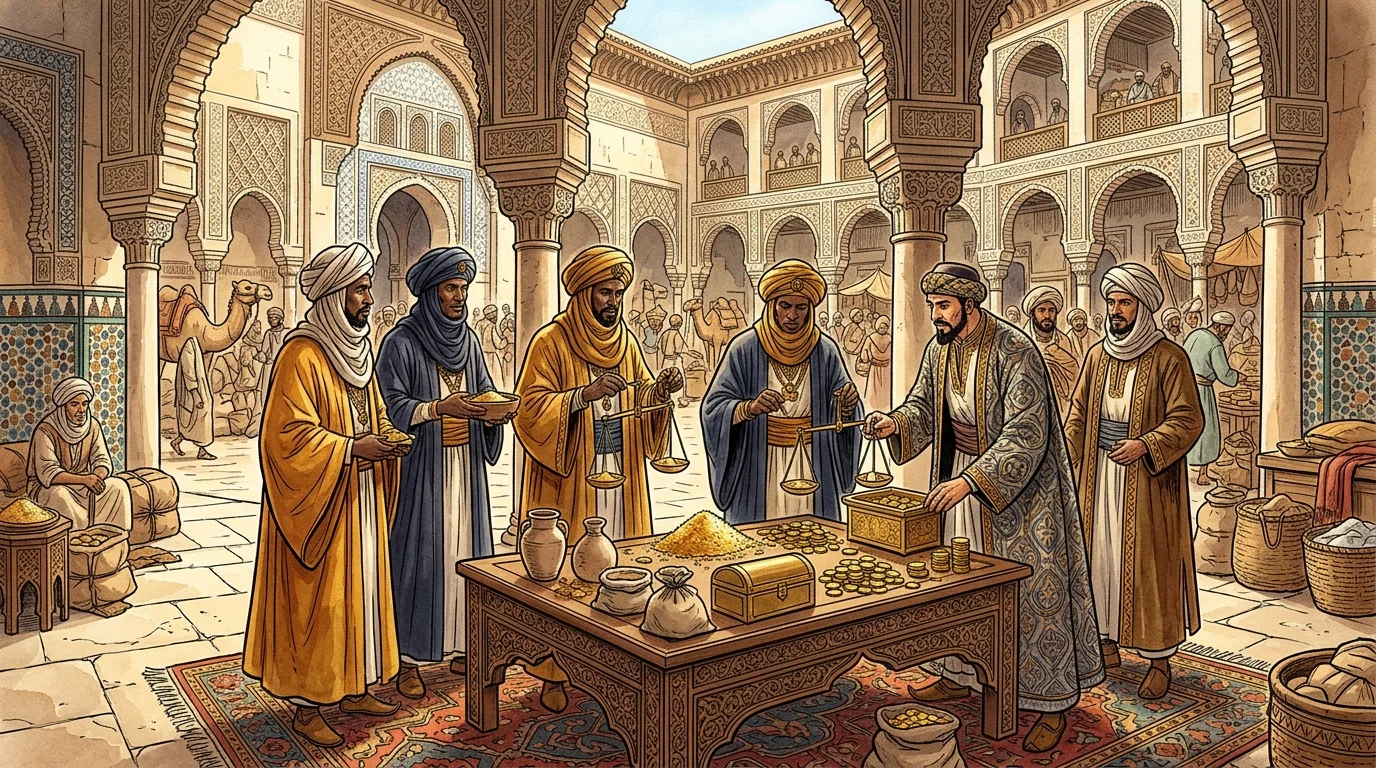
- Debt Transfers and Agency (Hawala, Suftaja, and Wakala): Rather than transporting gold dust back and forth on every leg of a trade circuit, merchant houses maintained resident partner-agents (wakils) in Sijilmasa, Draa, Walata, Timbuktu, and Jenne. Using written debt assignments (hawala) and credit letters (suftaja), a merchant in Fez could advance textiles to a caravan partner and instruct his debtor in Timbuktu to pay out the equivalent in gold dust directly to the bearer.
- The Prohibition of Usury (Riba) in Gold Dust vs. Minted Coinage: The thorniest financial question confronting Sahelian jurists was the legal status of uncoined gold dust (tibr), which served as West Africa’s principal medium of exchange. Under classical Maliki doctrine on riba al-fadl (usury of excess) and riba al-nasi’a (usury of delay), gold could only be exchanged for gold on an immediate, hand-to-hand (yadan bi-yad), equal-weight (mithlan bi-mithl) basis. Yet in trans-Saharan trade, merchants constantly needed to exchange unrefined, unminted Malian gold dust (which contained slight natural impurities and saved the cost of minting) against minted North African gold dinars or to settle credit contracts denominated in gold mithqals.
To prevent commerce from grinding to a halt while upholding Sharia ethics, Saharan and Timbuktu jurists—including the influential Tlemcen scholar Muhammad ibn Abd al-Karim al-Maghili (d. 1504, who corresponded directly with Askia Muhammad on market weights, taxation, and legal governance in 1498) and the preeminent Timbuktu polymath Ahmad Baba al-Timbukti (1556–1627, author of more than forty legal and biographical works)—elaborated precise contractual rules. Jurists mandated standardized imperial scales and glass/brass weights in the marketplace (enforced by the muhtasib market inspector), prohibited fraudulent mixing of copper or sand into gold dust, and allowed merchants to combine gold dust with a secondary commodity (such as salt, cloth, or copper rings) in composite contracts so that credit sales and currency conversions did not violate the strict ban on unequal gold-for-gold delayed exchange. [6]
Portuguese Caravels on the Gambia (1456) and the Founding of Elmina (1482)
While Timbuktu’s jurists perfected the legal machinery of the northern caravan trade, the geopolitical monopoly of the trans-Saharan routes was being outflanked from the Atlantic Ocean. Driven by acute fifteenth-century European bullion shortages and mesmerized by accounts of Mali’s gold wealth on the 1375 Catalan Atlas, Portugal’s Prince Henry the Navigator and King Afonso V dispatched caravels down the West African coast to tap the goldfields directly by sea, bypassing North African Muslim middlemen. [7]
In 1444–1445, the Portuguese established a fortified island factory at Arguin off the coast of Mauritania, diverting a modest stream of western caravan gold. A far more consequential breakthrough occurred between 1455 and 1456, when Venetian navigator Alvise Cadamosto and Portuguese explorer Diogo Gomes sailed sixty miles up the Gambia River into the western provinces of the Mali Empire. At Cantor on the upper Gambia, Gomes negotiated directly with Mande tributary rulers (farim) and Wangara merchants from the Bambuk goldfields, exchanging Portuguese copper bracelets (manillas), North African horses carried by ship, and colored cloth for gold dust. [8]
Even more dramatic was the Portuguese arrival along the southern shoreline of modern Ghana in 1471, within direct reach of the rich Akan forest goldfields. Finding that Mande-Juula and Akan brokers were willing to bring gold dust down to the surf rather than trekking a thousand miles north to Timbuktu and Jenne, King João II of Portugal dispatched nobleman Diogo de Azambuja in December 1481 with a fleet of ten ships, 600 soldiers and artisans, and pre-cut dressed stone blocks from Portugal. In January 1482, after negotiating a ground-rent agreement with the local Eguafo ruler Kwamin Ansa (Caramansa), Azambuja erected Castelo de São Jorge da Mina (Elmina Castle)—the first permanent European fortified trading post in sub-Saharan Africa.
Coastal Factor Credit vs. Saharan Caravan Credit
At both the Gambia river ports and Elmina Castle, Portuguese royal factors had to adapt to West Africa’s established commercial and credit norms. Because maritime ships could not wait months at anchor in malarial waters while Akan or Wangara traders carried merchandise inland to the miners, Portuguese factors extended short- and medium-term coastal credit in brass and copper manillas, Flemish and Moroccan textiles, glass beads, basins, and firearms (or enslaved captives purchased from Benin to carry loads for Akan elites), receiving promised deliveries of gold dust weighed in mithqals and Portuguese pesos.
By the first two decades of the sixteenth century, Elmina Castle alone was shipping an average of 11,000 to 15,000 ounces (roughly 350 to 450 kilograms) of Akan gold per year back to the Casa da Mina in Lisbon—enough to mint the pure gold Portuguese cruzado and finance Vasco da Gama’s voyages to India. Although this Atlantic diversion drained a substantial share of Bambuk and southern Akan gold away from the waning western provinces of the Mali Empire, it did not immediately eclipse Timbuktu or Jenne. Because the Portuguese could not supply the massive quantities of Taghaza rock salt required by the interior populations of the Niger basin, Timbuktu’s Sankore jurists and Wangara credit networks continued to anchor a thriving trans-Saharan trade throughout the sixteenth-century golden age of the Songhai Empire until the Moroccan invasion of 1591.
Theoretical & Balance-Sheet Transmission Mechanism
In the Kindleberger–Minsky taxonomy of financial instability (Kindleberger, 1978; Minsky, 1986) and Irving Fisher’s (1933) debt-deflation framework, speculative asset booms become systemic crises when credit expansion shifts balance sheets from hedge finance (cash flows covering principal and interest) to speculative and Ponzi finance (relying on rising asset prices and short-term margin roll-overs).
Once monetary tightening or an exogenous shock halts price appreciation, forced margin liquidations trigger Fisherian debt-deflation: fire-sale asset discounts erode bank collateral values, contracting credit supply across the real economy.
Sources and Further Reading
- Library of Congress, “ Ancient Manuscripts from the Desert Libraries of Timbuktu: Overview,” Library of Congress Exhibitions, 2003. Official / State Archive
- Encyclopedia.com, “ Religion and Philosophy: Ahmad Baba,” Gale World History Encyclopedia, 2020. Historical & Financial Reference
- Charles C. Stewart, “ What’s in the Manuscripts of Timbuktu? A Survey of the Contents of 31 Private Libraries,” History in Africa (Cambridge University Press), Vol. 48, 2021. Peer-Reviewed / Academic Research
- Mark Cartwright, “ Timbuktu,” World History Encyclopedia, 2019. Historical & Financial Reference
- Mark Cartwright, “ Songhai Empire,” World History Encyclopedia, 2019. Historical & Financial Reference
- Encyclopedia.com, “ Mali Empire,” Complete Dictionary of African History, 2020. Historical & Financial Reference
- Irving Fisher — "The Debt-Deflation Theory of Great Depressions," Econometrica 1, no. 4 (FRASER Federal Reserve Archive, 1933): 337–357 Central Bank / Monetary Authority
- Charles P. Kindleberger & Robert Z. Aliber — Manias, Panics, and Crashes: A History of Financial Crises (Palgrave Macmillan) Peer-Reviewed / Academic Research
Cite This Historical Dossier (APA / Chicago)
APA (7th ed.): Ç., S. (Ed.). (2026). Timbuktu's Sankore Jurists, Maliki Credit Law, and the 1482 Portuguese Shift at Elmina. In Forgotten Fortunes Historical Monograph Series (Forgotten Fortunes Editorial Desk). https://forgottenfortunes.net/timbuktu-maliki-commercial-law/
MLA (9th ed.): Ç., Soner, ed. "Timbuktu's Sankore Jurists, Maliki Credit Law, and the 1482 Portuguese Shift at Elmina." Forgotten Fortunes: Financial & Monetary History Archive, 2026, https://forgottenfortunes.net/timbuktu-maliki-commercial-law/.
Chicago (17th ed.): Ç., Soner, ed. "Timbuktu's Sankore Jurists, Maliki Credit Law, and the 1482 Portuguese Shift at Elmina." Forgotten Fortunes Historical Monograph Series (Forgotten Fortunes Editorial Desk), September 16, 2026. https://forgottenfortunes.net/timbuktu-maliki-commercial-law/.
Have an idea for another financial history documentary or article? Request a story →