In This Article
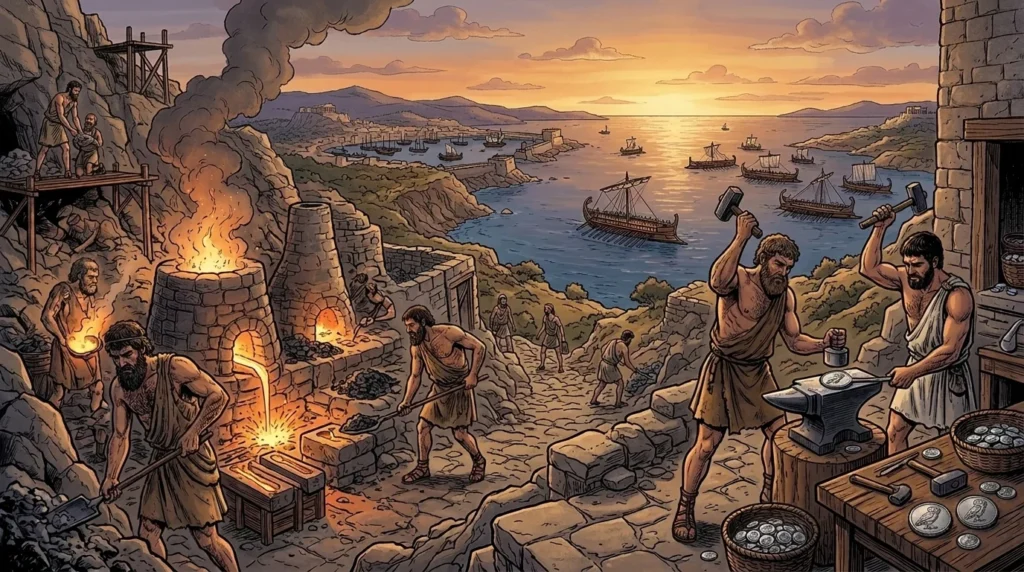
During the fifth and fourth centuries BCE, Classical Athens sustained an urban and rural population of between 150,000 and 250,000 people despite an arid hinterland that produced barely a third of the city’s staple wheat and barley. As the orator Demosthenes reminded Athenian jurors, Athens imported more foreign grain than any other nation in the Greek world—drawing hundreds of thousands of medimnoi each summer across treacherous sea lanes from the Cimmerian Bosporus (Crimea and the Sea of Azov), Egypt, and Sicily. Without sovereign debt bonds, joint-stock shipping corporations, or modern marine insurance companies, fourth-century Athens financed this life-or-death supply line through an sophisticated private credit architecture: high-yield maritime bottomry loans (nautika daneia), deposit-taking private banks (trapezai) managed by emancipated clerks such as Pasion and Phormion, inscribed stone real-estate hypothecations (horoi), and fast-track monthly commercial courts (dikai emporikai). [1]

Maritime Bottomry Loans (Nautika Daneia) and the “No Arrival, No Payment” Rule
In the Aegean and Black Sea worlds of the fourth century BCE (400–322 BCE), most merchant shipowners (naukleroi) and itinerant wholesale traders (emporoi) were men of modest liquid capital. A typical beamy wooden sailing freighter carried between 3,000 and 10,000 talents of cargo (roughly 80 to 250 metric tons), and purchasing a single shipload of wine, olive oil, ceramics, or Pontic wheat required 2,000 to 6,000 silver drachmas—far more than an independent skipper possessed. Conversely, wealthy Athenians, resident aliens (metoikoi), and retired merchants held surplus silver that they wished to deploy at high yields without enduring the physical perils of a sea voyage. [2]
The instrument that united passive capital with maritime enterprise was the bottomry or respondentia loan, known in Greek as a nautikon daneion (or ekdosis). Our detailed knowledge of how these contracts functioned comes directly from five surviving forensic courtroom speeches in the Demosthenic corpus—Demosthenes 32 (Against Zenothemis), 33 (Against Apaturius), 34 (Against Phormio), 35 (Against Lacritus), and 56 (Against Dionysodorus). Uniquely in all of classical literature, Demosthenes 35 (sections 10–13) preserves the complete, verbatim text of a fourth-century BCE maritime loan contract (syngraphe) read aloud to the jury by the court clerk. [3]
In that contract, two lenders—Androcles of the Athenian deme Sphettus and Nausicrates of Carystus—lend 3,000 silver drachmas (30 minas, or half a talent) to two brothers from Phaselis, Artemo and Apollodorus, for a round-trip voyage (amphoteroplous) from Athens to Mende or Scione in northern Greece to load 3,000 amphorae of Mendaean wine, sail into the Black Sea as far as the Bosporus, sell the wine, and return to the Piraeus with a replacement cargo of Pontic grain. The defining financial mechanism of every nautikon daneion was its embedded marine insurance clause: repayment of both principal and interest was strictly contingent on the safe arrival of the ship and cargo (sotheises tes neos). If the vessel sank in a storm (cheimon) or if the cargo was jettisoned or seized by pirates or hostile warships, the debt was legally extinguished in full. “No arrival, no payment” transferred the catastrophic hazard of sea loss from the merchant to the financier. [4]
Because the lender bore 100 percent of the marine casualty risk, maritime loans were exempted from conventional social strictures on high interest and were priced per voyage (typically lasting three to five summer sailing months) rather than per calendar year. A one-way voyage (heteroplous) usually carried a voyage interest rate of 10 to 12.5 percent, while a round-trip voyage (amphoteroplous) commanded between 22.5 and 30 percent. In the contract of Demosthenes 35, the baseline round-trip rate on the 3,000-drachma loan was 22.5 percent (yielding 675 drachmas of interest over roughly four months, equivalent to an annualized return exceeding 65 percent). If, however, the merchants delayed their exit from the Black Sea until after the autumn rising of the star Arcturus (mid-September, when violent equinoctial storms struck the Hellespont and Aegean), the contract automatically ratcheted the interest rate up to 30 percent (900 drachmas). To prevent moral hazard, lenders required the borrower to pledge unencumbered cargo (or the ship’s hull) worth twice the value of the loan—6,000 drachmas of goods securing a 3,000-drachma advance—and deposited the sealed written contract (syngraphe) with a trusted banker or third-party custodian. [5]
Bottomry Scuttling, Double Pledging, and Grain Arbitrage
The high-stakes asymmetric incentives of the “no arrival, no payment” rule bred ingenious commercial frauds that fill the pages of Demosthenes’s speeches. Because a shipwreck wiped out the borrower’s obligation to repay, unscrupulous skippers and merchants sometimes borrowed silver from multiple syndicates in different ports on the same collateral, pocketed the cash ashore, loaded worthless ballast or half-empty amphorae, and deliberately scuttled the ship at sea. In Demosthenes 32 (Against Zenothemis), the Massaliot captain Hegestratus and his accomplice Zenothemis borrowed heavily in Syracuse on pretended cargos of Sicilian wheat, secretly remitted the silver home to Massalia (Marseille), and three days out at sea Hegestratus crept down into the hold at night to chop a hole through the ship’s bottom planks. Discovered by the terrified passengers and crew as water poured in, Hegestratus leaped overboard in the dark to reach a lifeboat and drowned, while his partner Zenothemis brazenly sued in Athens to claim the salvaged hull and real grain owned by Athenian merchants. [6]
In Demosthenes 34 (Against Phormio, c. 327/326 BCE), the merchant Chrysippus lent 2,000 drachmas (20 minas) to a Bosporus trader named Phormio (distinct from the famous banker of the same name) for a round-trip voyage to Crimea on the contractual pledge that Phormio would put aboard 4,000 drachmas of trade goods at the Piraeus. Instead, Phormio secretly took out additional one-way loans of 4,500 drachmas from other creditors, loaded only 5,500 drachmas of merchandise in total, failed to purchase return grain in Crimea when local war depressed his sales, and sent the ship back without him. When the overloaded vessel actually wrecked off the Crimea with the loss of thirty lives and 300 sacks of wheat, Phormio could not simply claim the shipwreck exemption because he had violated the contract by failing to load return cargo for Chrysippus; instead, he concocted the defense that he had paid the debt in gold Cyzicene staters to the ship captain Lampis in Crimea prior to the wreck—a claim Lampis later recanted before arbitrators. [7]
Strict Athenian grain statutes policed every link of this credit chain. Under penalties of death enforced by harbor overseers (epimeletai tou emporiou), no Athenian citizen or resident metic was permitted to lend money on any ship that did not contract to bring a return cargo of grain or approved staples directly to the Piraeus. Yet in Demosthenes 56 (Against Dionysodorus, c. 323/322 BCE), two merchants who had borrowed 3,000 drachmas in Athens to fetch wheat from Egypt learned via an accomplice while sailing north that a bumper harvest shipment from Sicily had caused wheat prices at the Piraeus to drop. Breaking their Athenian contract, they diverted their grain ship to Rhodes, sold the Egyptian wheat there at high profit, and continued using the lenders’ 3,000 drachmas on local Rhodian voyages for another year while offering to pay only fractional pro-rata interest up to Rhodes. [8]
The Trapezai of Pasion and Phormion: From Slavery to Banking Titans
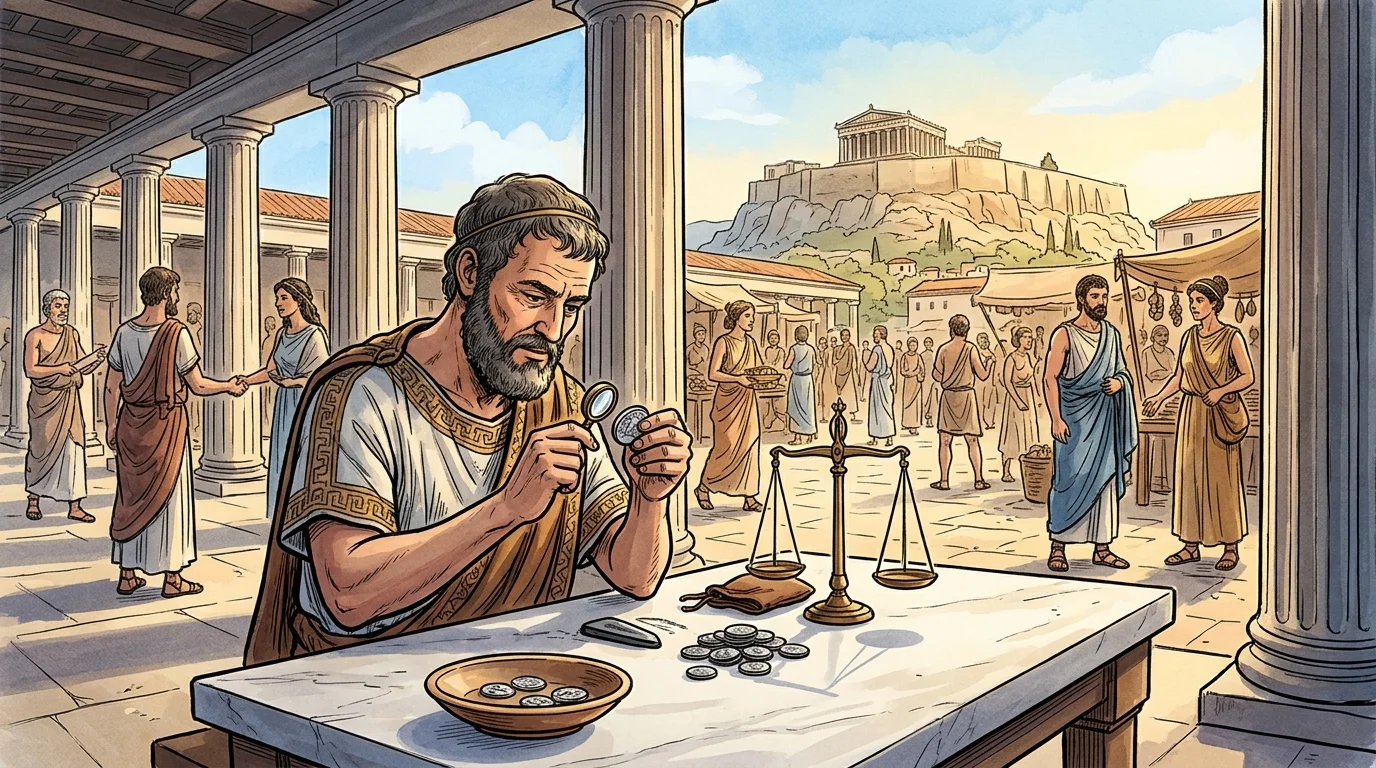
Alongside maritime syndicates stood Athens’s terrestrial banking sector: the trapezai (literally “four-legged tables” set up by moneychangers in the Agora and at the Piraeus port). Originally operating as coin-assaying and foreign-exchange booths that converted Persian darics, Cyzicene electrum staters, and Aeginetan staters into Attic silver tetradrachms, fourth-century trapezitai evolved into full-scale deposit and commercial lending bankers. Because operating a bank required mastery of written ledger accounting (grammata), coin metallurgy, and discreet fiduciary recordkeeping—tasks that aristocratic Athenians disdained to perform with their own hands—bank owners routinely trained bright enslaved clerks to manage daily operations.
This institutional structure produced the two most remarkable social-mobility trajectories in ancient economic history: the careers of Pasion and Phormion, documented across Isocrates’s Trapezitikos (Oration 17) and Demosthenes’s Orations 36 (For Phormion), 45, 49, and 52. Born into slavery (likely in Phoenicia or Syria) in the late fifth century BCE, Pasion began as an enslaved clerk working at the Piraeus banking table of Antisthenes and Archestratus. Demonstrating extraordinary honesty (pistis) and financial acumen, Pasion was manumitted by his masters before 394 BCE and eventually succeeded to full ownership of their bank.
Over the next quarter-century, Pasion became the wealthiest and most trusted financier in Greece. Unlike modern fractional-reserve banks that issue paper banknotes, Pasion’s trapeza accepted substantial sight and term silver deposits (parakatathekai) from local citizens, foreign potentates, and maritime merchants, and re-lent those pooled funds at interest to commercial borrowers, mining entrepreneurs, and politically prominent generals such as Timotheus. For ordinary terrestrial business and real-estate loans—where the borrower remained unconditionally liable whether his venture succeeded or failed—Athenian interest rates typically stood at epi drachme: one drachma per mina (100 drachmas) per month, or 12 percent per annum, rising to 16 or 18 percent per annum for riskier unsecured advances. Using his banking profits, Pasion also established the largest shield-manufacturing workshop in Athens, employing roughly sixty enslaved armorers. After donating 1,000 hoplite shields and five privately outfitted triremes to the Athenian military during the Corinthian and Boeotian wars, the formerly enslaved clerk was voted full hereditary Athenian citizenship by sovereign decree of the Assembly.
When Pasion died in 370/369 BCE at roughly sixty years of age, he left an immense fortune: approximately 20 talents (120,000 drachmas) in landed real estate across Attica—which only an Athenian citizen could legally own—and 50 talents (300,000 drachmas) in active loan portfolios, of which Demosthenes 36.5 reveals that 11 talents (66,000 drachmas) consisted directly of customer bank deposits that Pasion had profitably lent out on credit. Because Pasion’s elder son Apollodorus was a spendthrift aspirant to political glory and his younger son Pasicles was still a minor, Pasion had already in 371 BCE manumitted his own chief enslaved manager, Phormion, and leased both the bank and the shield factory to him—at an annual rent of 1 talent and 40 minas (10,000 drachmas) for the trapeza and 1 talent (6,000 drachmas) for the shield workshop. In accordance with Pasion’s written will, the freedman Phormion married Pasion’s widow Archippe (along with a 5-talent dowry), served as guardian to young Pasicles, received Athenian citizenship in 361/360 BCE, and in 350/349 BCE won a landslide courtroom victory—written for him by Demosthenes in Oration 36 (For Phormion)—when Apollodorus sued him for 20 talents of alleged banking capital.
Classical Horoi Stones and Real-Estate Security
Whereas Solon’s 594 BCE Seisachtheia had uprooted the Archaic horoi that marked personal peasant servitude, fourth-century BCE Athens reinvented the stone horos as a sophisticated public notice of real-estate collateral. Because Classical Athens still lacked a central municipal land registry, a citizen who pledged his farm, urban house, workshop, or Laurion silver-mine lease to secure a loan or dowry agreed to have an inscribed limestone or marble slab set up at the corner of the property to warn prospective buyers or secondary lenders that the asset was encumbered. More than two hundred fourth- and third-century BCE security horoi have been excavated across Attica and the Agora.
These Classical inscriptions distinguish three primary legal mechanisms of real security:
- Hypotheke: A non-possessory mortgage in which the debtor retained possession and cultivation of his land or workshop while paying annual interest (typically 12 percent); upon default, the creditor took possession and sold the property.
- Prasis Epi Lysei (“Sale Subject to Redemption”): The most common commercial mortgage form on surviving horoi, in which the borrower legally transferred conditional title of the farm or house to the lender for the exact sum of the loan, subject to a binding pact that title reverted immediately to the borrower upon repayment of principal, while the borrower usually stayed on the property as a rent-paying tenant paying the equivalent of 12 percent annual interest.
- Apotimema: A specialized security valuation used to guarantee the return of a wife’s monetary dowry in the event of divorce, or to secure the real-estate value of an orphan’s estate leased out under the supervision of the eponymous archon.
The Dikai Emporikai: Fast-Track Monthly Commercial Courts
The final institutional pillar that made fourth-century Athens the financial clearinghouse of the eastern Mediterranean was the creation of the dikai emporikai (commercial maritime lawsuits) around the mid-350s BCE, following the Social War (357–355 BCE) and the fiscal recovery program championed by the statesman Eubulus and analyzed in Xenophon’s treatise Ways and Means (Poroi 3.3). Xenophon had pointed out that foreign grain and silver merchants shunned ports where contract disputes dragged through the courts for years while their ships sat idle; whoever offered the fastest, most impartial judicial enforcement would capture the trade of the Mediterranean.
Athens responded by establishing the dikai emporikai under the jurisdiction of the six junior archons (the thesmothetai). To qualify for this specialized court, a lawsuit had to involve a written contract (syngraphe) concerning maritime trade conducted directly to or from the port of Athens. Once admitted, the dikai emporikai broke radically with traditional Athenian legal parochialism in three ways. First, they were designated as “monthly suits” (emmenoi dikai): filed during the winter months when Aegean navigation paused (from Boedromion through Mounychion, roughly October to April), they had to be adjudicated within thirty days so skippers could sail on the spring winds. Second, enforcement was swift and severe: a losing plaintiff or defendant was physically imprisoned until the judgment or fine was paid in full, preventing mobile foreign traders from absconding aboard their ships. Third, and most revolutionary of all, the dikai emporikai abolished status distinctions at the bar of justice: Athenian citizens, disenfranchised residents, foreign merchants (xenoi) without a citizen patron, metics, and even enslaved commercial agents appeared before the jury on completely equal legal footing, judged solely by the written terms of their syngraphe.
Theoretical & Balance-Sheet Transmission Mechanism
In the Kindleberger–Minsky taxonomy of financial instability (Kindleberger, 1978; Minsky, 1986) and Irving Fisher’s (1933) debt-deflation framework, speculative asset booms become systemic crises when credit expansion shifts balance sheets from hedge finance (cash flows covering principal and interest) to speculative and Ponzi finance (relying on rising asset prices and short-term margin roll-overs).
Once monetary tightening or an exogenous shock halts price appreciation, forced margin liquidations trigger Fisherian debt-deflation: fire-sale asset discounts erode bank collateral values, contracting credit supply across the real economy.
Sources and Further Reading
- Demosthenes (trans. A. T. Murray), “Demosthenes Oration 34: Against Phormio (In the Matter of a Maritime Loan),” Massachusetts Institute of Technology Ancient History Archive. Peer-Reviewed / Academic Research
- Lionel Casson, “Traders and Trading: Classical Athens,” Expedition Magazine, Vol. 21, No. 4, Penn Museum (University of Pennsylvania), 1979. Historical & Financial Reference
- George C. Bitros and Anastassios D. Karayiannis, “Values and Institutions as Determinants of Entrepreneurship in Ancient Athens,” Journal of Institutional Economics, Vol. 4, No. 2, Cambridge University Press, 2008. Peer-Reviewed / Academic Research
- John V. A. Fine, “Horoi: Studies in Mortgage, Real Security, and Land Tenure in Ancient Athens,” Hesperia Supplement 9, American School of Classical Studies at Athens, 1951. Peer-Reviewed / Academic Research
- Cambridge University Repository, “Credit, Maritime Finance, and Banking in Fourth-Century BCE Athens,” University of Cambridge Academic Repository. Peer-Reviewed / Academic Research
- Panteion University of Social and Political Sciences, “Legal Structure of the Athenian Maritime Loan (Nautikon Daneion) and Demosthenes 34,” Epistemonike Epeterida, Panteion University, Athens, 1979. Historical & Financial Reference
- Irving Fisher — "The Debt-Deflation Theory of Great Depressions," Econometrica 1, no. 4 (FRASER Federal Reserve Archive, 1933): 337–357 Central Bank / Monetary Authority
- Charles P. Kindleberger & Robert Z. Aliber — Manias, Panics, and Crashes: A History of Financial Crises (Palgrave Macmillan) Peer-Reviewed / Academic Research
Cite This Historical Dossier (APA / Chicago)
APA (7th ed.): Ç., S. (Ed.). (2026). Athenian Maritime Bottomry Loans, the Banks of Pasion and Phormion, and Commercial Courts. In Forgotten Fortunes Historical Monograph Series (Forgotten Fortunes Editorial Desk). https://forgottenfortunes.net/athenian-maritime-loans-banking/
MLA (9th ed.): Ç., Soner, ed. "Athenian Maritime Bottomry Loans, the Banks of Pasion and Phormion, and Commercial Courts." Forgotten Fortunes: Financial & Monetary History Archive, 2026, https://forgottenfortunes.net/athenian-maritime-loans-banking/.
Chicago (17th ed.): Ç., Soner, ed. "Athenian Maritime Bottomry Loans, the Banks of Pasion and Phormion, and Commercial Courts." Forgotten Fortunes Historical Monograph Series (Forgotten Fortunes Editorial Desk), September 14, 2026. https://forgottenfortunes.net/athenian-maritime-loans-banking/.
Have an idea for another financial history documentary or article? Request a story →