
In This Article
On August 19, 1948, facing the total collapse of China’s wartime legal tender during the Chinese Civil War, President Chiang Kai-shek’s Nationalist (Kuomintang) government promulgated an emergency presidential decree introducing a new currency: the Gold Yuan (Jinyuanquan). Old Chinese National Currency (CNC, or fabi) banknotes were compulsorily retired at a staggering conversion ratio of 3,000,000 old yuan to 1 Gold Yuan, while private citizens and businesses were ordered under threat of severe punishment to surrender all gold, silver, and foreign exchange to the state. To enforce strict price ceilings and bullion requisition in China’s commercial nerve center, Chiang Kai-shek appointed his son, General Chiang Ching-kuo, as deputy economic supervisor in Shanghai, where he unleashed an authoritarian “tiger-hunting” campaign against merchants, bankers, and speculators. Yet because the Nationalist treasury continued to finance massive military deficits via the printing press, note issuance rapidly breached the statutory 2 billion Gold Yuan ceiling—expanding more than 190-fold within months and soaring into the trillions by the spring of 1949. Within ten weeks, the Shanghai price freeze disintegrated, pauperizing the law-abiding urban middle class that had surrendered its hard savings and accelerating the political and military collapse of Nationalist rule on the Chinese mainland. [1]

From Fabi Galloping Inflation to the August 19, 1948 Decree
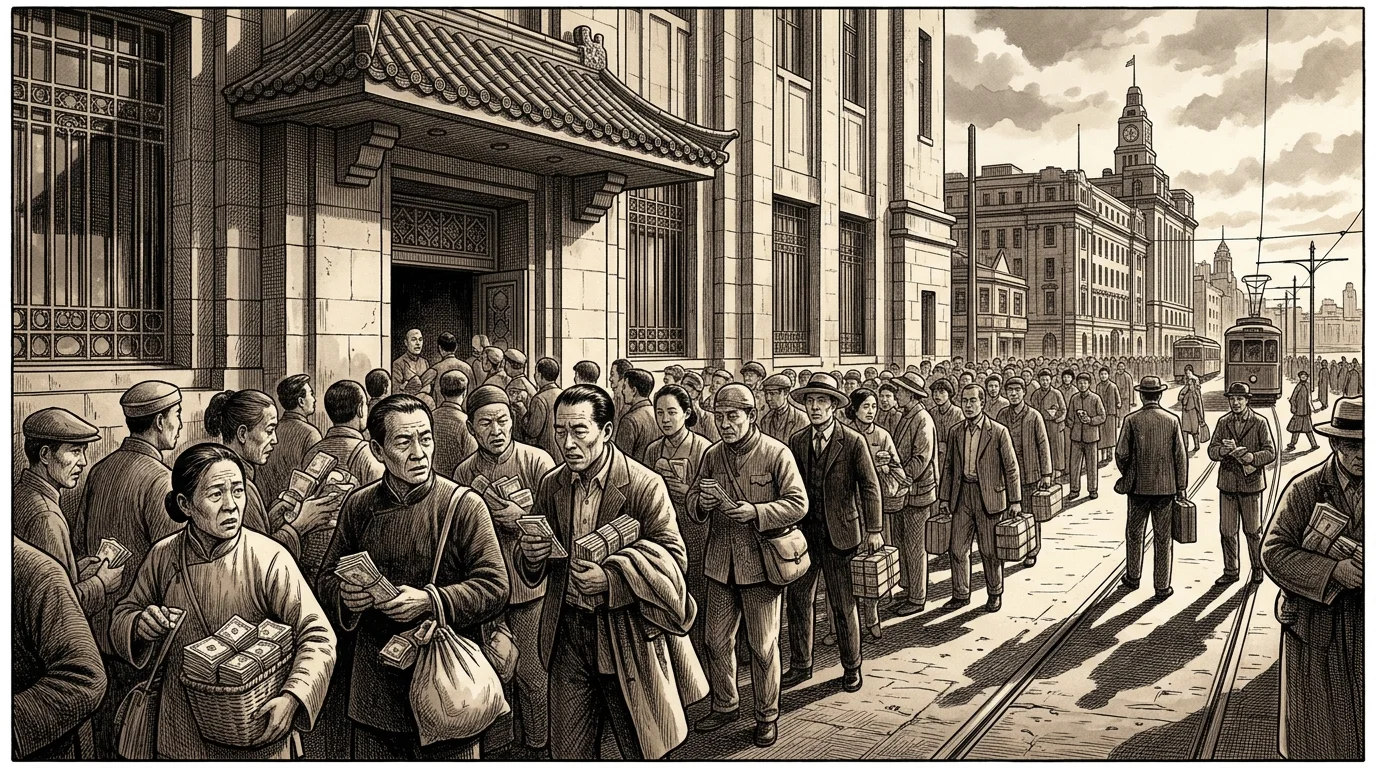
The roots of the 1948 monetary catastrophe lay in more than a decade of unbacked deficit finance. Following the 1935 currency reform that took China off the silver standard and established fiat legal tender (fabi), the Nationalist government relied overwhelmingly on central bank note issuance to fund the Sino-Japanese War (1937–1945) and the subsequent civil war against the Chinese Communist Party. By 1948, tax revenues and state receipts covered less than 30 percent of government expenditures—estimated by United States diplomatic officials at the equivalent of at least US$1 billion annually, roughly 75 percent of which was consumed by military operations. As printing presses ran nonstop, fabi circulation exploded from roughly 30 trillion yuan at the start of 1948 to 700 trillion yuan by August 1948. Over the same eight months, the Shanghai black-market exchange rate plunged from 140,000 CNC per US dollar on January 1, 1948, to approximately 12,000,000 CNC per US dollar by mid-August, reducing physical banknotes to bushel-basket bundles incapable of sustaining ordinary commerce. [2]
Prepared in strict secrecy by Premier Wong Wen-hao, Finance Minister Wang Yun-wu, Vice Minister of Finance Hsu Po-yuan, and Central Bank of China Governor O. K. Yui, the Emergency Financial and Economic Measures were promulgated by presidential mandate on August 19, 1948. The decree replaced fabi at 3,000,000 to 1 (and Northeast circulation notes at 300,000 to 1) with the new Gold Yuan, pegged at an official parity of 4 Gold Yuan to 1 US dollar. Although early drafts of the reform had proposed making the Gold Yuan internally convertible into physical gold, Chiang Kai-shek struck out gold convertibility shortly before promulgation to protect the state’s remaining bullion reserves of slightly under three million ounces. Instead, the Gold Yuan was described as a “managed gold standard” with a statutory maximum note issuance ceiling of 2 billion Gold Yuan (equivalent to US$500 million), ostensibly backed 40 percent by US$200 million in gold, silver, and foreign exchange and 60 percent by US$300 million in state-owned enterprise shares. [3]
| Documented Figure / Metric | Historical Significance & Archival Context |
|---|---|
| 10 percent | For roughly four weeks, what US Ambassador John Leighton Stuart described as "semi-terroristic enforcement measures in Shanghai, reminiscent of a modern police state," held the Shanghai black-market discount on the Gold Yuan within 10 percent of official parity through September 20, 1948. |
| 80 percent | By mid-October 1948, the Gold Yuan had lost 80 percent of its value against the US dollar on the revived black market. |
Forced Bullion Surrender and the Expropriation of Savers
Because retiring the entire existing 700 trillion fabi stock required only about 230 million Gold Yuan (roughly US$60 million), the 2 billion Gold Yuan statutory cap gave the Nationalist treasury massive headroom to issue new notes while claiming full reserve backing. To replenish the Central Bank of China’s depleted vaults—more than half of whose declared foreign exchange reserves were already encumbered by short-term liabilities—the August 19 decree outlawed the private holding or trading of gold, silver bullion, silver coins, and foreign currency anywhere in China. All individuals, families, and domestic firms were ordered to register and surrender their precious metals and hard currencies to the Central Bank of China or designated state banks in exchange for paper Gold Yuan notes at fixed official rates (200 Gold Yuan per ounce of gold, 3 Gold Yuan per silver dollar, and 4 Gold Yuan per US dollar). Chinese citizens holding foreign bank deposits abroad were similarly ordered to register and transfer those assets to the government. [4]
In tandem with the bullion call-in, the August 19 decree froze all commodity prices, service fees, and wages across China at their August 19 levels, prohibited labor strikes, and abolished cost-of-living wage indexation. Simultaneously, an earlier December 1947 regulation governing prewar bank deposits compounded the wipeout of private wealth through the 3,000,000:1 conversion. As Bank of China historical archives document, six prewar depositors holding 22 time-deposit certificates originally worth 13.58 million silver dollars saw their claims converted after twenty years into just 700 Gold Yuan, while an overseas Chinese saver named Mai Jiugen, who had patriotically remitted US$1,200 (1.44 million fabi) to a Bank of China account in April 1946, received a mere 0.48 Gold Yuan upon withdrawal in 1948. Even the Bank of China’s own statutory capital of 60 million fabi shrank arithmetically to just 20 Gold Yuan at the 3,000,000:1 ratio, forcing its board of directors to reallocate 60 million Gold Yuan from accumulated exchange and securities reserves to recapitalize the institution. [5]
Chiang Ching-kuo’s “Tiger-Hunting” Lockdown in Shanghai
The survival of the Gold Yuan hinged on Shanghai, where half of China’s modern banking wealth and industrial trade was concentrated. Recognizing that voluntary compliance was impossible while the civil war raged, Chiang Kai-shek dispatched his Soviet-educated son, General Chiang Ching-kuo, to Shanghai in August 1948 to enforce the economic lockdown. Setting up headquarters at the Central Bank building on the Bund, Chiang Ching-kuo approached price control and bullion collection not as a technical monetary adjustment, but as a militant social crusade under the slogan of “beating tigers” (da laohu)—targeting big speculators, hoarders, and black-market financiers rather than mere “flies”. [6]
Mobilizing thousands of Three People’s Principles Youth Corps cadres alongside special economic police, Chiang Ching-kuo established street-level denunciation boxes, raided warehouses, and set up summary tribunals that arrested prominent Shanghai textile magnates, greenback dealers, and even the son of crime boss Du Yuesheng. Terrorized by public arrests and occasional executions of black-market operatives, Shanghai’s middle class and small merchants queued at bank counters to surrender their life savings—handing over hundreds of millions of US dollars’ worth of gold bars, wedding jewelry, silver coins, and US banknotes in exchange for crisp Gold Yuan bills. For roughly four weeks, what US Ambassador John Leighton Stuart described as “semi-terroristic enforcement measures in Shanghai, reminiscent of a modern police state,” held the Shanghai black-market discount on the Gold Yuan within 10 percent of official parity through September 20, 1948. [7]
Yet the draconian price freeze immediately distorted production and distribution. Because August 19 ceilings locked in arbitrary price-cost mismatches across industries and ignored steep price disparities between North and South China, manufacturers could not buy raw materials at legal rates without operating at a loss. Simultaneously, consumers flooded Shanghai shops in a panic buying spree, using rapidly depreciating paper notes to sweep store shelves completely bare of cloth, medicine, coal, and foodstuffs. [8]
Clash with Elite Privilege and the November 1948 Implosion
In early October 1948, Chiang Ching-kuo’s Shanghai campaign collided fatally with the entrenched power of Nationalist bureaucratic capitalism. Acting on tips of massive commodity hoarding, Chiang Ching-kuo’s investigators raided the warehouses of the Yangtze Development Corporation, a powerful trading conglomerate controlled by David Kung (Kong Ling-kan)—the eldest son of former Finance Minister H. H. Kung and the favored nephew of First Lady Soong Mei-ling (Madame Chiang Kai-shek). When Chiang Ching-kuo attempted to prosecute Kung and seize the corporation’s stockpiles, Soong Mei-ling intervened directly with Chiang Kai-shek, who flew to Shanghai and forced his son to back down. [9]
The shielding of the Kung-Soong family empire shattered the moral and political credibility of the Shanghai enforcement regime overnight. Merchants, bankers, and ordinary citizens realized that the law was being used to expropriate the compliant urban middle class while regime insiders remained above the decree. At the same time, decisive Communist military victories in Manchuria (the Liaoshen campaign) and Shandong caused huge quantities of Gold Yuan from northern cities to flood south into Shanghai seeking tangible goods. Behind the scenes, the Central Bank of China had already abandoned any pretense of respecting the 2 billion Gold Yuan statutory cap: to pay for military defeats, the government printed notes at a frantic pace, pushing circulation past the 2 billion limit in October, beyond 20 billion in November, and eventually past 380 billion Gold Yuan (over 190 times the statutory ceiling) on its way to trillions in early 1949.
By mid-October 1948, the Gold Yuan had lost 80 percent of its value against the US dollar on the revived black market. On November 1, 1948, the Nanjing cabinet capitulated to reality: Premier Wong Wen-hao took personal responsibility for the disaster and resigned, price and wage ceilings were formally lifted across China (except briefly on rice, which only provoked urban rice famines and food riots), and on November 6 Chiang Ching-kuo resigned his Shanghai post in defeat. On November 11, 1948, a revised presidential mandate re-legalized the private holding of gold, silver, and foreign currency and authorized the Central Bank to sell limited gold and silver back to the public at 1,000 Gold Yuan per ounce—ten times the August redemption rate. As Ambassador Stuart observed in a scathing dispatch to Washington, the net result was to legitimize the wealthy who had defied the law while pauperizing the loyal middle class, who now had to fight “Yellow Ox” criminal gangs outside bank doors to buy back a fraction of their own gold at tenfold prices.
Hyperinflationary Endgame and the Fall of the Mainland (1949)
Once price controls were abandoned in November 1948, the Gold Yuan entered a vertical hyperinflationary death spiral that exceeded even the worst days of the fabi. By April 1949, Finance Minister S. Y. Liu privately confessed to Ambassador Stuart that public repudiation of the Gold Yuan was almost total, with the US dollar jumping in Nanjing from 95,000 Gold Yuan on Thursday, April 14, to 130,000 Gold Yuan the very next day. In Shanghai, before the city fell to the People’s Liberation Army in late May 1949, the price of a single dan (100 liters) of rice reached 440 million Gold Yuan on May 21, 1949—meaning that a single grain of rice cost more than 130 Gold Yuan. Across the 1946–1949 civil war period, Chinese wholesale commodity prices rose roughly 36 trillion times and food prices 47 trillion times above prewar June 1937 levels.
The catastrophic failure of the Gold Yuan left an indelible mark on modern Chinese history. By confiscating the hard-currency and bullion reserves of urban shopkeepers, professionals, civil servants, and industrialists in exchange for worthless paper, the Nationalist government alienated the very social strata most inclined to oppose Communism. Conversely, the victorious Chinese Communist Party—which had founded the People’s Bank of China and issued the renminbi on December 1, 1948—prioritized strict monetary consolidation and commodity-linked bank deposits to win urban trust, cementing the transition to the People’s Republic of China in October 1949.
Theoretical & Balance-Sheet Transmission Mechanism
In the Kindleberger–Minsky taxonomy of financial instability (Kindleberger, 1978; Minsky, 1986) and Irving Fisher’s (1933) debt-deflation framework, speculative asset booms become systemic crises when credit expansion shifts balance sheets from hedge finance (cash flows covering principal and interest) to speculative and Ponzi finance (relying on rising asset prices and short-term margin roll-overs).
Once monetary tightening or an exogenous shock halts price appreciation, forced margin liquidations trigger Fisherian debt-deflation: fire-sale asset discounts erode bank collateral values, contracting credit supply across the real economy.
Sources and Further Reading
- Paul H. Nitze, “ Memorandum by the Deputy to the Assistant Secretary of State for Economic Affairs (Nitze) to the Secretary of State: Currency Reform in China,” U.S. Department of State, Foreign Relations of the United States, 1948, Volume VIII, 1948-08-30. Official / State Archive
- John Leighton Stuart, “ The Ambassador in China (Stuart) to the Secretary of State: Financial Aspects of Inflation in China During 1948,” U.S. Department of State, Foreign Relations of the United States, 1949, Volume IX, 1949-01-11. Official / State Archive
- Bank of China, “ ‘One Hundred Yuan for A Grain’ – Grave Impact of Galloping Inflation (1946 – 1949),” Bank of China History Archives, 2008-09-26. Historical & Financial Reference
- Parks M. Coble, “ 1948: The Collapse of Fabi and the Gold Yuan Reform Disaster,” Cambridge University Press (The Collapse of Nationalist China: How Chiang Kai-shek Lost China’s Civil War), 2023. Peer-Reviewed / Academic Research
- John Leighton Stuart, “ The Ambassador in China (Stuart) to the Secretary of State: Revised Regulations Governing Surrender of Gold, Silver and Foreign Currencies,” U.S. Department of State, Foreign Relations of the United States, 1948, Volume VIII, 1948-11-26. Official / State Archive
- Kean Fan Lim, “ On the Rationale and Implications of China’s RMB Internationalization: A Global Historical Perspective,” Journal of Global History (Cambridge University Press), 2023. Peer-Reviewed / Academic Research
- John Leighton Stuart, “ The Ambassador in China (Stuart) to the Secretary of State: Widespread Repudiation of the Gold Yuan,” U.S. Department of State, Foreign Relations of the United States, 1949, Volume IX, 1949-04-16. Official / State Archive
- Irving Fisher — "The Debt-Deflation Theory of Great Depressions," Econometrica 1, no. 4 (FRASER Federal Reserve Archive, 1933): 337–357 Central Bank / Monetary Authority
- Charles P. Kindleberger & Robert Z. Aliber — Manias, Panics, and Crashes: A History of Financial Crises (Palgrave Macmillan) Peer-Reviewed / Academic Research
Cite This Historical Dossier (APA / Chicago)
APA (7th ed.): Ç., S. (Ed.). (2026). The 1948 Chinese Gold Yuan Hyperinflation and the Shanghai Economic Lockdown. In Forgotten Fortunes Historical Monograph Series (Forgotten Fortunes Editorial Desk). https://forgottenfortunes.net/china-1948-gold-yuan-hyperinflation/
MLA (9th ed.): Ç., Soner, ed. "The 1948 Chinese Gold Yuan Hyperinflation and the Shanghai Economic Lockdown." Forgotten Fortunes: Financial & Monetary History Archive, 2026, https://forgottenfortunes.net/china-1948-gold-yuan-hyperinflation/.
Chicago (17th ed.): Ç., Soner, ed. "The 1948 Chinese Gold Yuan Hyperinflation and the Shanghai Economic Lockdown." Forgotten Fortunes Historical Monograph Series (Forgotten Fortunes Editorial Desk), September 11, 2026. https://forgottenfortunes.net/china-1948-gold-yuan-hyperinflation/.
Have an idea for another financial history documentary or article? Request a story →


