
In This Article
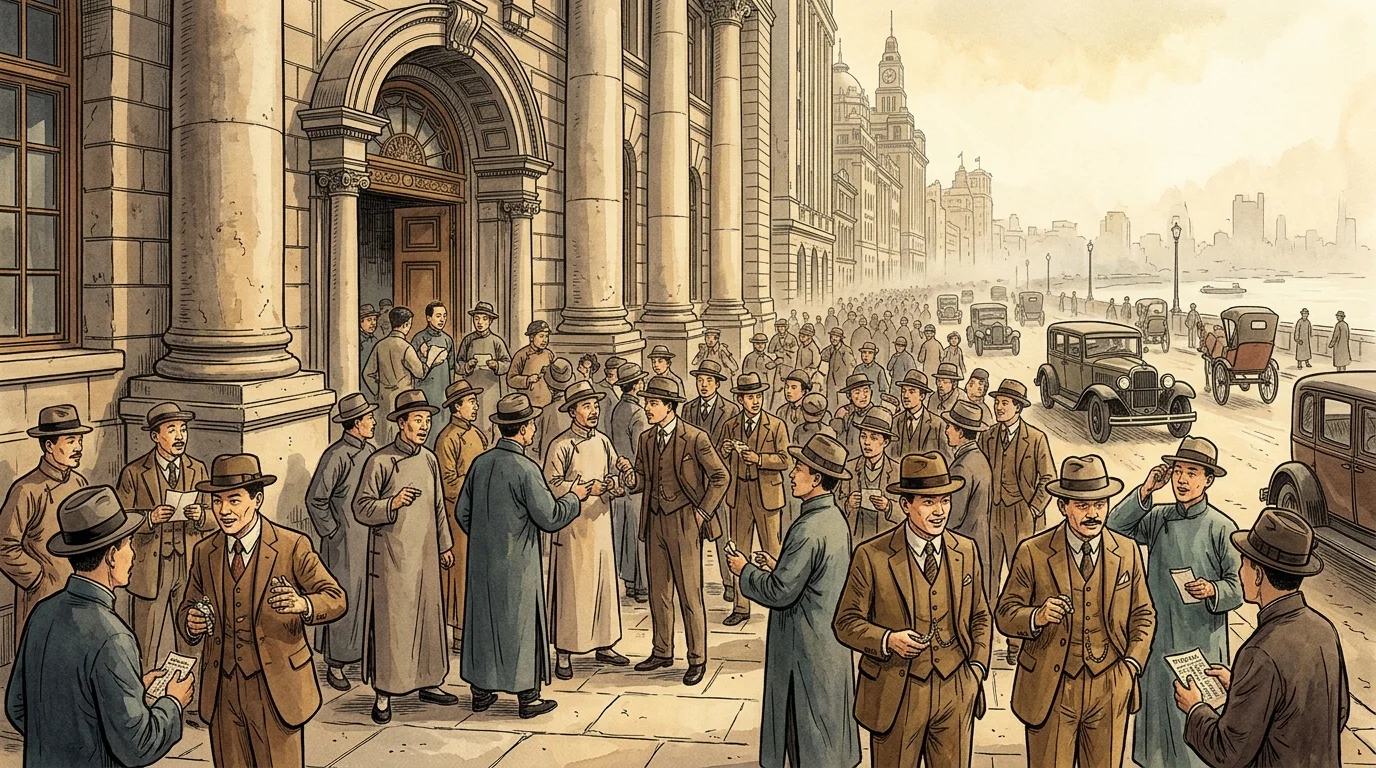
On July 1, 1920, prominent Ningbo shipping magnate and comprador Yu Yaqing (Yu Qiaqing) inaugurated the Shanghai Chartered Stock and Produce Exchange (Shanghai Zhengquan Wupin Jiaoyisuo) at the corner of Avenue Edward VII and Sichuan Road, establishing Republican Shanghai’s first large-scale, Chinese-operated securities and commodities bourse. Within six months of opening, the exchange reported windfall brokerage commissions and distributed dividends that drove its shares to more than five times their paid-in par value. That spectacular early return ignited one of modern Chinese history’s most feverish financial manias: the 1921 “Trust and Exchange Storm” (Xin-Jiao Fengchao, literally the storm of trust companies and exchanges). [1]
Between the spring and late autumn of 1921, company promoters bypassed the Beijing government’s statutory ban on duplicate exchanges by registering in Shanghai’s extraterritorial International Settlement and French Concession, floating between 136 and 150 stock and commodity exchanges alongside 12 newly minted trust companies (xintuo gongsi). With nominal authorized capital exceeding 200 million silver dollars—more than double the combined capital of all Chinese and foreign banks in Shanghai—most of these “mushroom” bourses traded little more than forward contracts on their own promoter shares. When modern banks and traditional native banks (qianzhuang) tightened credit ahead of the Lunar New Year settlement in late 1921 and early 1922, the speculative pyramid imploded, wiping out over 90 percent of the exchanges, triggering a wave of bankruptcies and publicized suicides, and leaving only a handful of institutions standing. [2]
Foreign Monopoly, Nationalist Rhetoric, and the July 1920 Exchange
Before 1920, organized share trading in Shanghai was dominated by foreign brokers and extraterritorial institutions. Western residents had formed the Shanghai Sharebrokers’ Association in 1891 and incorporated the foreign-run Shanghai Stock Exchange in 1905 inside the International Settlement, where trading focused on foreign-registered shipping, dockyard, cotton mill, and Malayan rubber plantation shares—a market that had already suffered a notorious rubber-share bubble and native-bank panic in 1910. Chinese merchants traded domestic company shares and Beijing government bonds more informally through teahouse gatherings, founded the Shanghai Stock and Bonds Trading Association (Shanghai Gupiao Shangye Gonghui) in 1914, and watched uneasily as Japanese financiers backed by Mitsui opened the Osaka-modeled Shanghai Torihikisho in the International Settlement in 1918. [3]
Seeking both commercial profits and political funding for Sun Yat-sen’s Nationalist movement, Yu Yaqing teamed up with fellow Zhejiang financiers and political figures—including Zhang Jingjiang, Dai Jitao, Chen Guofu, and a young Chiang Kai-shek, who participated as a broker at the Maoxin and Hengtai brokerage houses—to petition the Beijing Ministry of Agriculture and Commerce for a comprehensive Chinese bourse trading securities alongside staple commodities. Framing the venture as a patriotic defense of national economic sovereignty (shangzhan, or commercial warfare) against Western and Japanese financial domination, Yu symbolically purchased the two-mu property at Avenue Edward VII and Sichuan Road occupied by the Japanese exchange and evicted the Japanese tenants at the height of the May Fourth Movement boycott in late 1919. [4]
Capitalized at 5 million silver dollars, the Shanghai Chartered Stock and Produce Exchange received provisional ministerial approval in June 1920 and opened on July 1, 1920, licensed to trade seven categories of assets: securities, cotton, cotton yarn, cloth, gold and silver, grain and oil, and furs and hides. Soon afterward, rival members of the older Shanghai Stock and Bonds Trading Association secured separate backing from Beijing officials to open a competing bourse, the Shanghai Chinese Merchant Security Exchange (Shanghai Huashang Zhengquan Jiaoyisuo), even though China’s 1914 Securities Exchange Law strictly limited each commercial district to a single exchange per product line. [5]
The “Three-in-One” Speculative Engine and 100 Percent Dividends
What turned Yu Yaqing’s exchange from a nationalist commercial experiment into the catalyst of a citywide bubble was its corporate structure and immediate profitability. Modeled on Japanese incorporated exchanges rather than Anglo-American mutual member associations, Shanghai’s new exchanges operated under a “three-in-one” (sanheyi) mechanism: the promoters who organized the exchange were simultaneously its principal shareholders and its licensed floor brokers. Worse still, the primary security listed for spot and forward trading on each exchange’s floor was the stock of the exchange itself.
During its first half-year of operation in late 1920, the Chartered Stock and Produce Exchange earned roughly 500,000 silver dollars in net profit on paid-up capital of 1.25 million silver dollars (one-quarter of its 5 million nominal capital), allowing it to declare spectacular initial dividends and bonuses approaching 40 to 100 percent on paid-in cash while its share price leaped from 12.5 silver dollars paid-in to 70 silver dollars and eventually above 100 silver dollars in early 1921. Contemporary chronicler Yu Huancheng recalled the psychological shock across Shanghai: “Once our exchange’s shares soared, everyone who wanted to get rich wanted to organize an exchange… People’s minds went mad; upon hearing that an exchange was being formed, they tried every possible connection to subscribe to the stock. Having shares in hand meant having cash in hand”. [6]
Extraterritorial Consular Registration and the 140-Exchange Mania
By the summer and autumn of 1921—the tenth year of the Republic, giving the episode its alternative name, the “Year Ten Storm” (Min-Shi Fengchao)—promoters were floating new exchanges for every conceivable commodity and trade: flour, rice, bean oil, coal, timber, bricks, sugar, yarn, tobacco, liquor, and even sand and dried mud. Because the Beijing Ministry of Agriculture and Commerce refused to charter dozens of overlapping bourses, Chinese promoters exploited Shanghai’s fragmented semi-colonial jurisdiction. For a modest registration fee or monthly consular tax—such as the 100 silver taels per month charged by French authorities—promoters incorporated exchanges under foreign consular protection in the International Settlement and the French Concession, frequently placing a foreign lawyer or nominal foreign director on the masthead to claim extraterritorial immunity from Chinese police and ministry inspectors. [7]
A British Chamber of Commerce and Foreign Office survey in November 1921 reported that of the scores of exchanges operating in Shanghai, only ten claimed registration with the Chinese government, while sixteen were registered at the French Consulate, eleven at the Spanish Consulate, four under American protection, and others under Italian or Portuguese flags. Journalist George Sokolsky documented in the North-China Daily News that 98 exchanges with 169 million silver dollars in declared capital were operating in November 1921, swelling by early December 1921 to 140 exchanges with 200 million silver dollars in nominal capitalization—nearly triple the 75 million silver dollars in combined capital held by all Chinese and foreign banks in the city. [8]
Alongside the 136 to 150 exchanges, financiers organized 12 trust companies (xintuo gongsi)—including the Central Trust Company and Chung Wai Trust—with over 80 million silver dollars in nominal capital. Rather than acting as conservative fiduciary custodians, the trust companies underwrote new exchange promotions, lent heavily on margin against exchange shares, and traded their own stock forward. To draw in clerks, students, shopkeepers, and women, at least 20 “night exchanges” (yeshi jiaoyisuo) opened inside amusement halls such as the Great World (Da Shijie) entertainment complex, with pawnshops stationed directly outside the trading doors so retail speculators could pledge jewelry and clothing for immediate margin cash.
The Winter 1921–1922 Credit Squeeze and Collapse
The financial arithmetic of the Xin-Jiao Fengchao was inherently unsustainable. Most newly floated exchanges conducted zero genuine commodity delivery; instead, speculators engaged in maikong maikong (“buying empty and selling empty”)—naked forward trading in the shares of the exchanges and trust companies themselves. Promoters typically collected only one-quarter of subscribed share capital in cash, immediately used those funds to bid up their own exchange’s one-month forward share price, and pledged the inflated shares at native banks (qianzhuang) or trust companies to borrow cash for the next promotion.
By November 1921, this circular leverage had drained liquid silver reserves across Shanghai’s money market just as seasonal demand for cash rose for the autumn agricultural harvest and the approaching year-end settlements. Alarmed by the overextension of credit against illiquid promoter scrip, Shanghai’s modern Chinese banks, foreign exchange banks, and native-bank clearing guilds stopped accepting exchange and trust company shares as loan collateral and refused to roll over short-term call loans. Chinese Foreign Ministry commissioner Xu Yuan repeatedly petitioned French Consul-General Auguste Wilden and International Settlement authorities in November and December 1921 to shut down unlicensed exchanges, warning that collapsing share prices were already producing bankruptcies and suicides.
Without fresh bank credit to finance monthly forward settlements, buyers defaulted en masse at the end-of-month clearing dates between December 1921 and February 1922. Share prices of even flagship institutions like the Chartered Stock and Produce Exchange plunged by more than 70 percent before trading was suspended, while shares of the minor commodity and night exchanges became completely worthless overnight. By March 1922, more than 130 of Shanghai’s 140-plus exchanges and most of the 12 trust companies had collapsed, absconded with investor deposits, or liquidated.
Social Trauma, the Death of Xi Shangzhen, and Regulatory Legacy
The crash devastated Shanghai’s urban middle class, merchant guilds, and small savers while triggering a crisis of public confidence in Western-style financial modernity. Downtown commercial rents, which had jumped 20 percent at the height of the autumn 1921 office-leasing frenzy, slumped as shuttered exchange halls emptied out. Dozens of native banks and merchant houses suffered heavy loan losses, and newspapers filled with reports of absconding directors, civil lawsuits before the Mixed Court, and ruined speculators taking their own lives.
The most famous personal tragedy of the crash occurred on September 8, 1922, when 24-year-old female clerk and normal-school graduate Xi Shangzhen hanged herself with a silk cord in the office of the Shangbao (Journal of Commerce) after losing her family savings and borrowed funds in defaulted trust-company shares promised for repurchase by her employer, newspaper managing director and exchange promoter Tang Jiezhi. Analyzed at length by intellectual commentators, dramatist Zheng Zhengqiu, and modern historian Bryna Goodman, Xi’s suicide became the emblem of what contemporaries called the “crime of economics” (jingji zhi zui’e) and the peril of “empty industry” (xuye) divorced from productive manufacturing. Only six exchanges—including the reorganized Shanghai Chinese Merchant Security Exchange and the Chinese Gold and Silver Exchange—and two trust companies survived the 1921–1922 storm, prompting the Nationalist government in 1929 to enact a revised Stock Exchange Law that banned bourses from organizing as joint-stock companies trading their own shares and consolidated Shanghai’s securities trading into a single regulated market.
Theoretical & Balance-Sheet Transmission Mechanism
In the Kindleberger–Minsky taxonomy of financial instability (Kindleberger, 1978; Minsky, 1986) and Irving Fisher’s (1933) debt-deflation framework, speculative asset booms become systemic crises when credit expansion shifts balance sheets from hedge finance (cash flows covering principal and interest) to speculative and Ponzi finance (relying on rising asset prices and short-term margin roll-overs).
Once monetary tightening or an exogenous shock halts price appreciation, forced margin liquidations trigger Fisherian debt-deflation: fire-sale asset discounts erode bank collateral values, contracting credit supply across the real economy.
Sources and Further Reading
- Bryna Goodman, “ Questions of Colonialism, Nationalism, and the Early Shanghai Stockmarket (上海早期股票市场的殖民主义、民族主义和中国文化问题),” Provincial China (UTS ePress), 2009-01. Peer-Reviewed / Academic Research
- Bryna Goodman, “ The Suicide of Miss Xi: Democracy and Disenchantment in the Chinese Republic,” Harvard University Press, 2021. Peer-Reviewed / Academic Research
- Bryna Goodman, “ Before the Crash: Financial Publicity and Chinese Stock Speculation in 1921 Shanghai,” Business History Conference, 2013. Historical & Financial Reference
- William N. Goetzmann, “ The Shanghai Stock Exchange,” Yale International Center for Finance / WilliamGoetzmann.com, 2024. Historical & Financial Reference
- Economic History Society, “ China’s Sovereign Debt Market,” Economic History Society, 2022. Historical & Financial Reference
- “ Shanghai Stock Exchange,” China Daily, 2018-12-11. Historical & Financial Reference
- Irving Fisher — "The Debt-Deflation Theory of Great Depressions," Econometrica 1, no. 4 (FRASER Federal Reserve Archive, 1933): 337–357 Central Bank / Monetary Authority
- Charles P. Kindleberger & Robert Z. Aliber — Manias, Panics, and Crashes: A History of Financial Crises (Palgrave Macmillan) Peer-Reviewed / Academic Research
Cite This Historical Dossier (APA / Chicago)
APA (7th ed.): Ç., S. (Ed.). (2026). The 1921 Shanghai Trust and Exchange Storm (Xin-Jiao Fengchao) Stock and Commodity Crash. In Forgotten Fortunes Historical Monograph Series (Forgotten Fortunes Editorial Desk). https://forgottenfortunes.net/shanghai-1921-trust-and-exchange-storm-crash/
MLA (9th ed.): Ç., Soner, ed. "The 1921 Shanghai Trust and Exchange Storm (Xin-Jiao Fengchao) Stock and Commodity Crash." Forgotten Fortunes: Financial & Monetary History Archive, 2026, https://forgottenfortunes.net/shanghai-1921-trust-and-exchange-storm-crash/.
Chicago (17th ed.): Ç., Soner, ed. "The 1921 Shanghai Trust and Exchange Storm (Xin-Jiao Fengchao) Stock and Commodity Crash." Forgotten Fortunes Historical Monograph Series (Forgotten Fortunes Editorial Desk), September 11, 2026. https://forgottenfortunes.net/shanghai-1921-trust-and-exchange-storm-crash/.
Have an idea for another financial history documentary or article? Request a story →


