In This Article
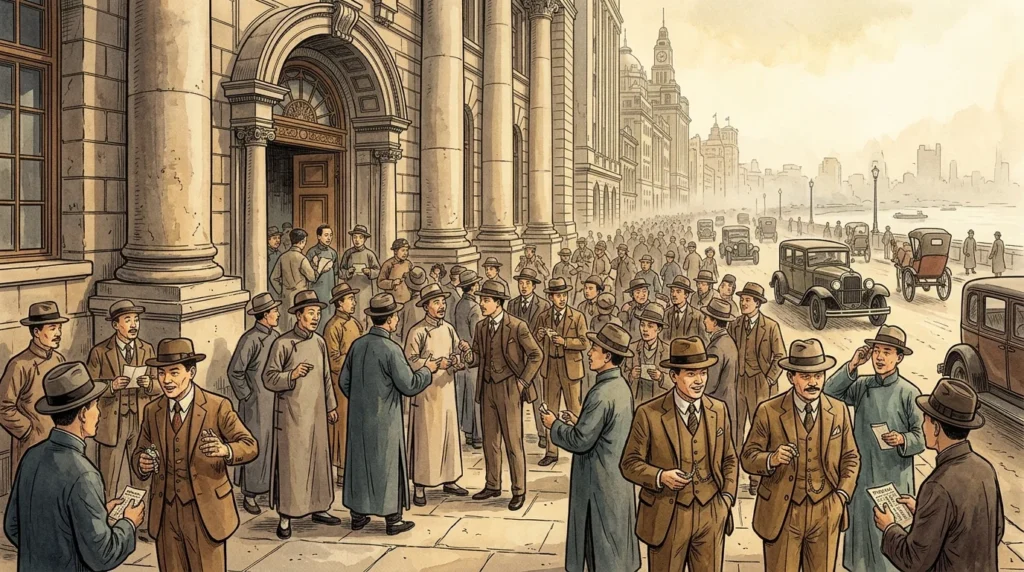
Between 1914 and 1921, as wartime shipping blockades cut off British manufactured imports and turned Indian cotton mills and steelworks into munitions suppliers for the Allied war effort, the price of a membership card on the Native Share and Stock Brokers’ Association—now the Bombay Stock Exchange (BSE)—soared from ₹2,900 to ₹48,000. Yet the fortune-making boom on Dalal Street quickly degenerated into a battlefield of predatory “corners,” short squeezes, and defaults financed through India’s indigenous fortnightly carry-forward system known as badla. Across the interwar decades, a succession of market panics—from the textile mill corners of 1921–1923 and the June 1925 crash to the 1933 bankruptcy of the Currimbhoy Ebrahim cotton-mill empire—compelled the colonial Government of Bombay to appoint the landmark Atlay Committee (1923–1924) and Morison Committee (1936–1937), culminating in wartime derivative bans under the Defence of India Rules in 1943. [1]

The World War I Industrial Boom on the Bombay and Calcutta Exchanges
Before the outbreak of the First World War in August 1914, organized equity trading in colonial India was modest in scale. Formally constituted as a voluntary association on December 3, 1887 (building on an informal 1875 brokers’ association that initially paid ₹1 each), the Native Share and Stock Brokers’ Association in Bombay had grown to 361 members by 1909 under its first president, Seth Chunilal Motichand, trading mainly government paper and a handful of local cotton-spinning shares. Across the subcontinent, the Ahmedabad Stock Exchange (founded in 1894) specialized in regional cotton mills, while the Calcutta Stock Exchange (formally organized in 1908) traded jute mills, coal mines, and tea plantations. [2]
World War I transformed both Bombay and Calcutta into booming industrial capital markets. With European factories diverted to war production and maritime freight scarce, Indian textile mills, Calcutta jute factories, and the newly operational Tata Iron and Steel Company (TISCO) in Jamshedpur reaped extraordinary profits supplying uniforms, sandbags, and steel rails to British imperial forces. Dividends soared, new joint-stock company flotations were oversubscribed many times over, and retail investors of modest means poured savings into the share bazaars. By 1921, the value of a Bombay Stock Exchange membership card had multiplied more than sixteenfold from its pre-war level. [3]
Mechanics of Speculation: Badla Carry-Forward Financing and Blank Transfers
The interwar speculative mania on the Bombay Stock Exchange rested on two interconnected institutional mechanisms that enabled massive leverage without upfront cash:
- Fortnightly Badla (Carry-Forward) Trading: While cash (ready delivery) contracts existed on paper, the vast majority of volume consisted of forward dealings settled on fortnightly or monthly accounting dates. Rather than paying for or delivering physical shares on settlement day, bulls and bears rolled their open positions forward to the next settlement cycle through the badla market. Financiers known as vyaj badliwalla advanced money to carry over long positions in exchange for a contango interest charge (badla or vyaj), while share lenders (teji badliwalla) lent stock when bears were squeezed. When a share was heavily oversold and bulls demanded delivery, trapped bears were forced to pay a penalty backwardation rate (undha badla) to postpone delivery.
- Blank Transfers: Because registering a buyer’s name in a company’s share ledger took up to a month and required paying government stamp duty and corporate transfer fees, certificates circulated indefinitely via “blank transfers”—transfer deeds signed by the original seller with the buyer’s name and date left blank. Blank transfers turned physical shares into quasi-bearer instruments that could be pledged instantly for bank or badla credit, while concealing the true ownership of cornered shares and facilitating tax evasion.
The 1921–1923 Mill Corners and the Atlay Committee Report (1924)
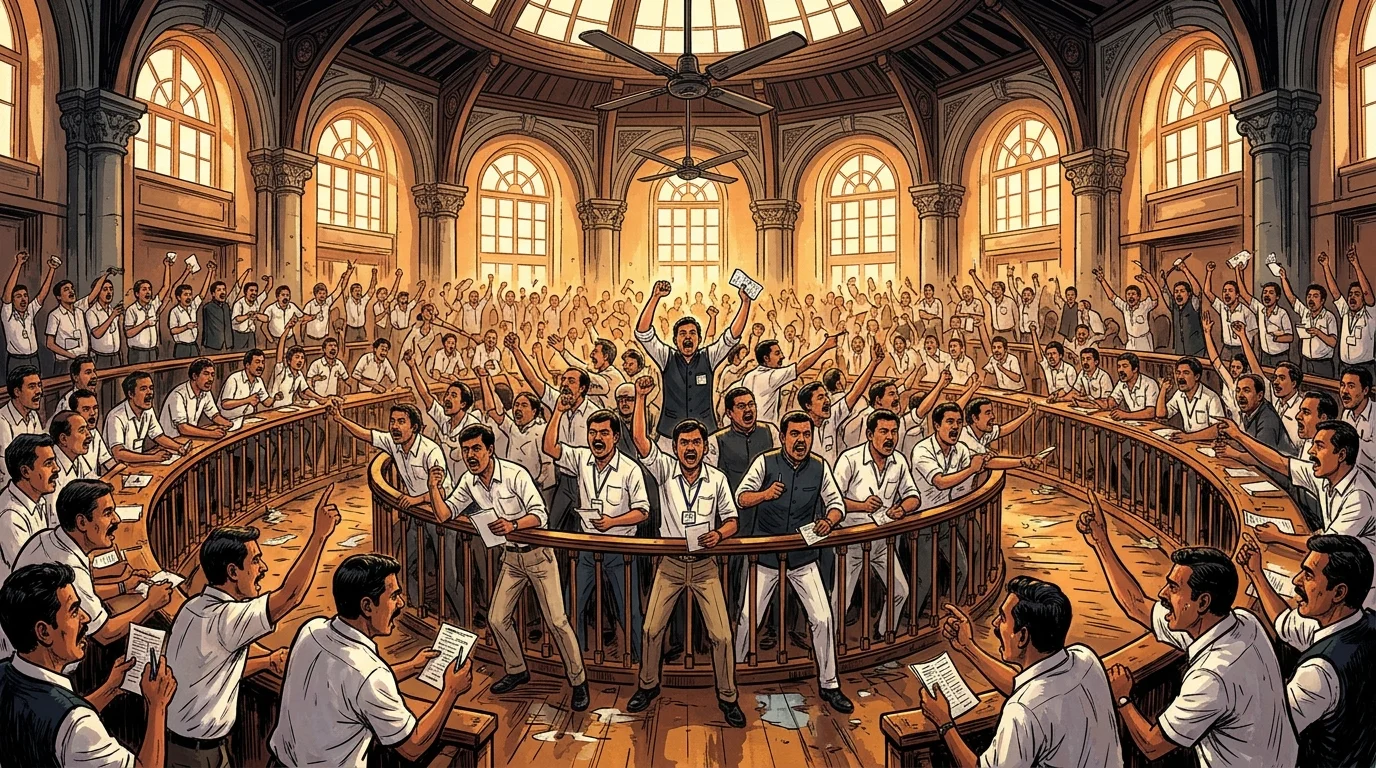
When post-war deflation hit global commodity markets in 1920–1921, Bombay speculators turned to aggressive bear raids and retaliatory bull corners. A “corner” occurred when a syndicate quietly accumulated more shares (via forward contracts and blank transfers) than the entire floating supply available for delivery on settlement day, holding short-sellers to ransom. Under Rule 26 of the Bombay Stock Exchange, the governing board had discretionary power to declare a corner and artificially “fix” a compromise settlement price to rescue trapped brokers—a power frequently criticized when board members themselves held positions in the market. [4]
Whereas corners had been rare before 1918, they paralyzed Bombay trading repeatedly between 1921 and 1923. Formal corners were declared in Fazulbhoy Mill in February 1921, Currimbhoy Mill in July 1921, and Finlay Mill in January 1922, followed by cornering battles in Nagpur, Swadeshi, Currim, and David Mills in 1922, price-fixing in Shapurji Broacha Mill, two corners in Kohinoor Mill in 1923, and a corner in the New Great Eastern Spinning and Weaving Company while regulators were actively taking testimony. [5]
Following a resolution in the Bombay Legislative Council, the Government of Bombay appointed the Bombay Stock Exchange Enquiry Committee on September 14, 1923, chaired by Sir Wilfrid Atlay, a former Chairman of the London Stock Exchange, alongside Indian jurist Bhulabhai Desai (who authored a famous Minority Report). Submitting its report on January 9, 1924, the Atlay Committee uncovered systemic laxity: exchange rules were printed on loose slips of paper or kept unprinted so the public could not verify them; brokers acted simultaneously as principals and agents to extract secret profits (gala) from clients; trades were jotted in pencil memoranda rather than stamped contract notes; and the exchange closed at the whim of members. [6]
The Atlay Majority Report recommended abolishing Rule 26 so that short-sellers would face ordinary open-market buying-in penalties, printing uniform bylaws, and enforcing strict discipline. The exchange, led from 1923 by long-serving President K. R. P. Shroff, adopted several administrative reforms but favored Bhulabhai Desai’s Minority Report compromise, which allowed the board to suspend future dealings in a cornered stock across two settlement cycles. Before legislation was enacted, another speculative corner and crash erupted in June 1925, prompting the legislature to pass the Bombay Securities Contracts Control Act of 1925. Because the Act merely declared contracts outside recognized exchange rules void (rather than illegal), unapproved speculative forward trading continued with impunity. [7]
The 1933 Currimbhoy Ebrahim Crash and the Morison Committee (1937)
The fragility of Bombay’s interwar industrial-financial nexus was exposed during the Great Depression by the collapse of Currimbhoy Ebrahim & Sons Ltd., one of India’s premier textile managing agency houses, which controlled a vast group of Bombay and Indore cotton mills. Weakened by inter-company loans, speculative overextension, and Japanese textile competition, the Currimbhoy Ebrahim group collapsed into bankruptcy in the autumn of 1933. Shares of its managed mills plunged, triggering widespread broker defaults and forcing the Bombay Stock Exchange to suspend forward trading for seven weeks between September and November 1933. [8]
When another speculative crisis and forward-trading suspension rocked the exchange in 1936, the Government of Bombay appointed a second inquiry committee on November 24, 1936, chaired by Walter B. Morison (including Sir Sorabji Pochkhanawala, Sir Rahimtoola Chinoy, and H. M. Patel). Reporting on March 6, 1937, the Morison Committee calculated that 80 to 90 percent of all transactions on the Bombay Stock Exchange were purely speculative, degenerating into “gambling in differences.” [9]
The Morison Report recommended mandatory margin deposits, the abolition or strict time-limiting of blank transfers, a ban on speculative trading by exchange employees, deposits for sub-brokers (remisiers), and statutory power for the provincial government to supersede the exchange’s Board of Directors. Fierce opposition from BSE brokers and the outbreak of World War II in September 1939 stalled the Morison legislative bill.
World War II Panics and Defence of India Rule 94C (1940–1945)
World War II brought one final cycle of boom, panic, and state intervention. When Germany overran France in May–June 1940, Indian equity prices collapsed; the Calcutta Stock Exchange shut down for six weeks, while the Bombay Stock Exchange halted forward trading and imposed emergency minimum floor prices across all listed shares. By 1942–1943, however, wartime inflation and the government’s ban on commodity futures in cotton, oilseeds, and bullion drove a torrent of speculative money into equities via the badla market.
On September 24, 1943, the Government of India invoked wartime emergency powers to promulgate Defence of India Rule 94C, which banned all option and badla carry-forward facilities on organized stock exchanges and restricted all share dealings to spot “ready delivery” contracts settled within seven days. Rather than extinguishing speculation, the wartime ban pushed leveraged forward trading out of the exchange ring and into unorganized street markets—the “grey markets” in Bombay and Ahmedabad and the Katni market in Calcutta—which soon rivaled the official exchanges in volume and set the stage for economist P. J. Thomas’s 1948 report and independent India’s Securities Contracts (Regulation) Act of 1956.
Theoretical & Balance-Sheet Transmission Mechanism
In the Kindleberger–Minsky taxonomy of financial instability (Kindleberger, 1978; Minsky, 1986) and Irving Fisher’s (1933) debt-deflation framework, speculative asset booms become systemic crises when credit expansion shifts balance sheets from hedge finance (cash flows covering principal and interest) to speculative and Ponzi finance (relying on rising asset prices and short-term margin roll-overs).
Once monetary tightening or an exogenous shock halts price appreciation, forced margin liquidations trigger Fisherian debt-deflation: fire-sale asset discounts erode bank collateral values, contracting credit supply across the real economy.
Sources and Further Reading
- Securities and Exchange Board of India (SEBI), “Material on the History of Indian Securities Market: Atlay Committee (1924), Bombay Act (1925), Morison Committee (1937), and P. J. Thomas Report (1948),” SEBI Historical Archives, September 2010. Official / State Archive
- Sir Wilfrid Atlay (Chairman), “Report of the Bombay Stock Exchange Enquiry Committee, 1924,” Government Central Press, Bombay (Archived by SEBI), January 9, 1924. Official / State Archive
- Government of Bombay, “The Bombay Securities Contracts Control Act, 1925 (Bombay Act No. VIII of 1925),” Bombay Government Gazette (Archived by SEBI), 1925. Official / State Archive
- Walter B. Morison (Chairman), “Report of the Stock Exchange Enquiry Committee, 1937,” Government Central Press, Bombay (Archived by SEBI), March 6, 1937. Official / State Archive
- P. J. Thomas, “Report on the Regulation of the Stock Market in India,” Ministry of Finance, Government of India (Archived by SEBI), 1948. Official / State Archive
- Rediff Business Desk, “BSE: Stock Exchange That Refused To Die,” Rediff.com, July 25, 2024. Historical & Financial Reference
- The Securities Blawg, “Historical Underpinnings of Indian Securities Market Regulation — Part I: Pre-Independence,” The Securities Blawg, 2019. Historical & Financial Reference
- Irving Fisher — "The Debt-Deflation Theory of Great Depressions," Econometrica 1, no. 4 (FRASER Federal Reserve Archive, 1933): 337–357 Central Bank / Monetary Authority
- Charles P. Kindleberger & Robert Z. Aliber — Manias, Panics, and Crashes: A History of Financial Crises (Palgrave Macmillan) Peer-Reviewed / Academic Research
Cite This Historical Dossier (APA / Chicago)
APA (7th ed.): Ç., S. (Ed.). (2026). Corners, Badla, and Crash: The Interwar Bombay Stock Exchange Inquiries (1914–1945). In Forgotten Fortunes Historical Monograph Series (Forgotten Fortunes Editorial Desk). https://forgottenfortunes.net/bombay-stock-exchange-badla/
MLA (9th ed.): Ç., Soner, ed. "Corners, Badla, and Crash: The Interwar Bombay Stock Exchange Inquiries (1914–1945)." Forgotten Fortunes: Financial & Monetary History Archive, 2026, https://forgottenfortunes.net/bombay-stock-exchange-badla/.
Chicago (17th ed.): Ç., Soner, ed. "Corners, Badla, and Crash: The Interwar Bombay Stock Exchange Inquiries (1914–1945)." Forgotten Fortunes Historical Monograph Series (Forgotten Fortunes Editorial Desk), September 13, 2026. https://forgottenfortunes.net/bombay-stock-exchange-badla/.
Have an idea for another financial history documentary or article? Request a story →