In This Article
Two and a half years before Wall Street’s October 1929 collapse, Weimar Germany experienced its own devastating stock-market panic—remembered in German financial history as Schwarzer Freitag (“Black Friday”) on May 13, 1927. Between January 1926 and April 1927, during the brief period of economic stabilization following the 1923 hyperinflation and the 1924 Dawes Plan, share prices on the Berlin Stock Exchange (Berliner Börse) surged by roughly 160 percent. Convinced that equity valuations reflected speculative excess and that stock-exchange margin loans were diverting scarce domestic credit and attracting volatile foreign “hot money,” Reichsbank President Hjalmar Schacht delivered a secret ultimatum to Berlin’s major commercial banks in early May 1927. When the Berlin banking cartel (Stempelvereinigung) publicly announced after market close on Thursday, May 12, 1927 that it would slash stock-exchange margin loans (Reportkredite and Lombardkredite) by 25 percent within a month, forced liquidations triggered a single-day crash on Friday, May 13, 1927 that wiped out a large fraction of the Berlin market’s capitalization and prematurely choked off the Weimar Republic’s recovery. [1]

The Dawes Plan Stabilization and the 1926–1927 Berlin Bull Market
Following the hyperinflation of 1922–1923—which had destroyed paper-mark bond wealth and severely disrupted normal equity trading—Germany stabilized its currency through the November 1923 Rentenmark miracle and the August 1924 Dawes Plan. Supervised by Reichsbank President Hjalmar Schacht and Allied Reparations Agent General Seymour Parker Gilbert, the Dawes Plan rescheduled Germany’s World War I reparations and re-anchored the new gold-backed Reichsmark (RM) at its prewar parity of RM 4.20 per U.S. dollar. [2]
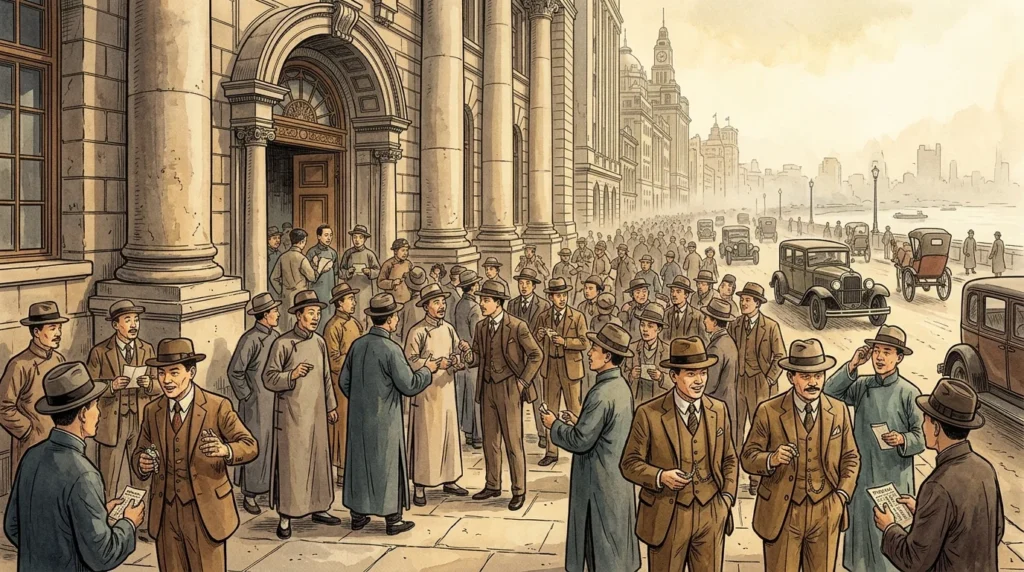
After a sharp post-stabilization recession in late 1925, the Berlin Stock Exchange entered a vigorous bull market at the beginning of 1926. Several structural forces propelled the rally: [3]
- Resumption of forward trading (Terminhandel): In October 1925, the Berlin Stock Exchange restored official forward and margin trading in leading industrial and banking shares for the first time since July 1914, vastly expanding market liquidity.
- Reichsbank discount rate cuts and foreign inflows: Seeking to stimulate recovery from the 1925 slump and discourage excessive short-term foreign borrowing, the Reichsbank lowered its official discount rate in steps from 9 percent in early 1926 to 5 percent in January 1927. Simultaneously, high German bond yields relative to New York and London attracted billions of Reichsmarks in American, British, and Dutch capital inflows.
- Industrial rationalization and recovery: Led by corporate giants such as IG Farben, Vereinigte Stahlwerke, and Siemens, German industrial production and machinery orders rebounded strongly through 1926 and early 1927.
Between January 1926 and peak levels in April 1927, the broad German stock index compiled by the Statistisches Reichsamt rose by roughly 160 percent over seventeen months, while trading volumes and initial public offerings on the Berlin Stock Exchange reached their highest levels of the interwar era. [4]
Margin Credit Mechanics: Reportkredite, Lombardkredite, and Foreign Funds
On the Berlin Börse, leveraged equity purchases were financed through two primary short-term credit instruments extended by Germany’s great universal banks (Großbanken)—including Deutsche Bank, Disconto-Gesellschaft, Dresdner Bank, Danat-Bank (Darmstädter und Nationalbank), and Commerz- und Privat-Bank—which were organized in the influential cartel known as the Vereinigung von Berliner Banken und Bankiers, or Stempelvereinigung:
- Reportkredite (Prolongation / Contango loans): Standardized one-month forward carry loans used in Terminhandel settlement, whereby a bank purchased shares from a leveraged speculator at the end-of-month settlement price and simultaneously agreed to resell them at the next month’s settlement date at a fixed contango interest rate (Reportsatz).
- Lombardkredite (Collateralized margin loans): Direct short-term loans advanced to brokerage clients against pledged equity securities held in bank custody accounts.
Because Berlin’s universal banks both acted as commercial lenders, operated proprietary trading desks, and crossed client buy and sell orders internally before routing net imbalances to the Berlin Stock Exchange’s daily call auctions, their balance sheets were deeply intertwined with the equity market. By spring 1927, total Report and Lombard stock-exchange loans reported by the major Berlin banks had climbed to roughly RM 800–900 million, funded in significant part by short-term deposits borrowed from London, Amsterdam, and New York money-market banks. [5]
Hjalmar Schacht’s Campaign and the Ultimatum of May 1927
Throughout early 1927, Reichsbank President Hjalmar Schacht—strongly echoed by Reparations Agent Parker Gilbert—voiced growing alarm over the Berlin stock-market boom. Schacht’s hostility to the equity rally rested on three convictions: [6]
- He believed that German share prices had detached from fundamentals in a speculative mania fueled by bank credit.
- He subscribed to the fallacy that money lent for stock-exchange margin trading was “absorbed” by the bourse and physically diverted away from productive industrial and agricultural investment.
- Above all, after cutting the Reichsbank discount rate to 5 percent in January 1927, Schacht watched the Reichsbank lose roughly RM 1 billion in gold and foreign-exchange reserves during the first four months of 1927 as German banks borrowed short-term foreign currency abroad to lend at higher 7–8 percent contango rates on the Berlin Stock Exchange.
Unwilling to raise the official discount rate immediately—fearing that a higher discount rate would simply attract even more short-term foreign debt, which Schacht viewed as a threat to Germany’s balance of payments and its leverage in reparations diplomacy—Schacht turned instead to direct administrative coercion.
After verbal warnings in March and April 1927 went unheeded by the commercial banks, Schacht summoned the leaders of the Stempelvereinigung in early May 1927 and delivered a blunt ultimatum: unless Berlin’s major banks immediately agreed to slash their stock-exchange margin lending, the Reichsbank would refuse to rediscount their commercial bills of exchange and promissory notes at the central bank window. Because losing access to Reichsbank rediscounting would leave any commercial bank illiquid in a funding squeeze, the cartel capitulated. [7]
Late on Thursday, May 12, 1927, the Stempelvereinigung issued a terse official communiqué to the press announcing that its member banks had resolved to reduce their Report- und Lombardkredite (contango and collateralized stock-exchange loans) by 25 percent by mid-June 1927, and to undertake further unspecified reductions thereafter. [8]
“Schwarzer Freitag” (May 13, 1927) and the Deleveraging Spiral
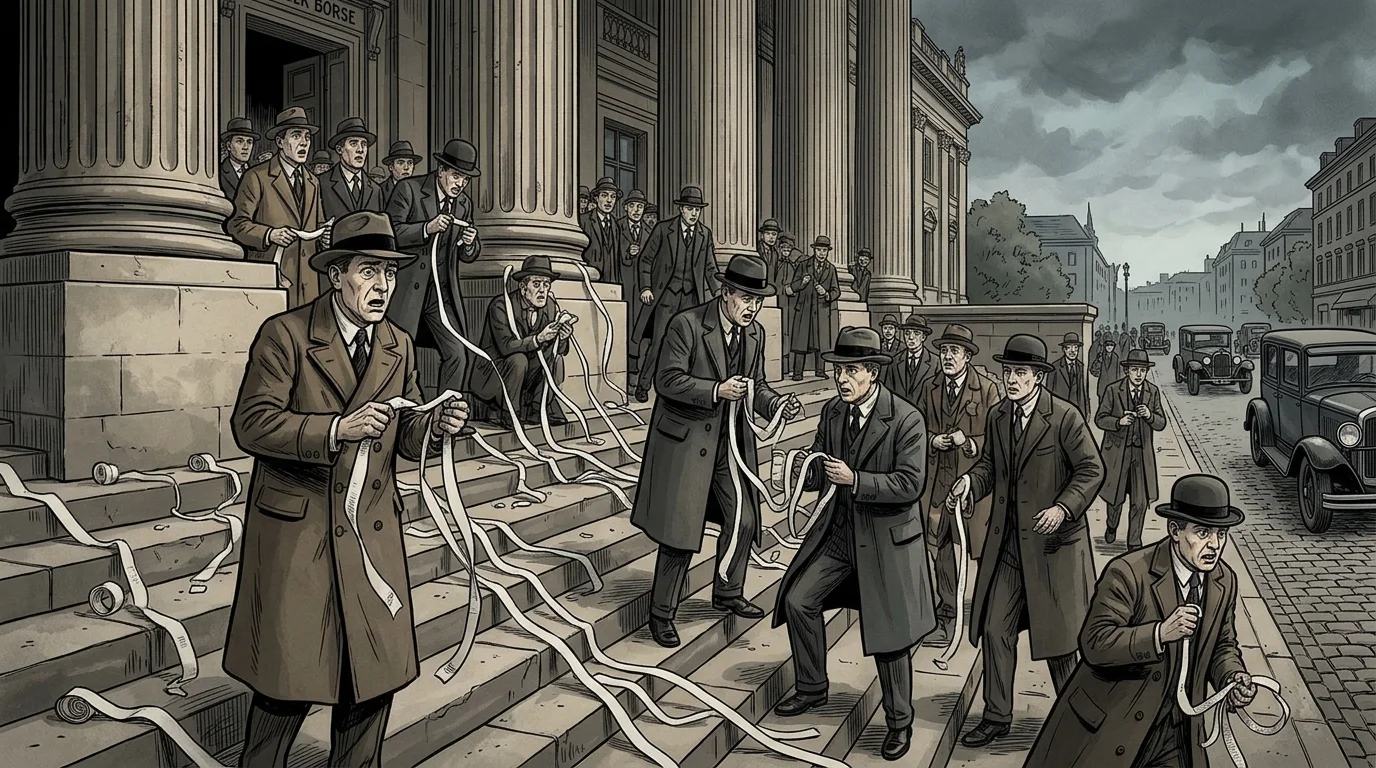
When the Berlin Stock Exchange opened on the morning of Friday, May 13, 1927, the banking cartel’s surprise announcement triggered immediate pandemonium. Because Reportkredite were rolled over at monthly settlement dates and Lombardkredite were callable on short notice, thousands of leveraged retail and institutional investors realized simultaneously that their banks would demand a 25 percent repayment of margin debt within four weeks—leaving them no choice but to dump shares into a falling market before their neighbors did.
The result was a classic fire-sale and margin-call spiral across the Berlin call auctions:
- On Friday, May 13, 1927 alone, the headline Berlin stock-market indices plunged by between 11 and 13 percent on average, while heavily traded industrial and chemical shares dropped by 20 to over 30 percent in a single session.
- On the Berlin exchange floor, scores of securities could not even establish a market-clearing price due to overwhelming sell imbalances (recorded in official exchange sheets as Brief or unfilled excess supply).
- As econometric analysis by Federal Reserve economist Stefan Gissler (2015) demonstrates using bank-level balance sheets and corporate interlocks, the crash struck unevenly: over the four weeks following May 12, 1927, shares of industrial firms closely affiliated with banks that had the heaviest exposure to margin lending and Reichsbank rediscount pressure fell by more than 12 percent further than comparable peers, while their daily price volatility doubled.
Macroeconomic Fallout and the Central Bank Asset-Price Debate
Rather than engineering a soft landing or improving money-market liquidity, Schacht’s May 1927 intervention permanently broke the Weimar Republic’s only sustained equity boom. Less than four weeks after “Black Friday,” on June 10, 1927, the Reichsbank was forced to raise its official discount rate from 5 percent to 6 percent anyway (and to 7 percent in October 1927), proving that crashing the stock market had neither halted foreign borrowing nor eased money-market strains.
In modern macroeconomic and financial history—led by Hans-Joachim Voth’s landmark 2003 study “With a Bang, Not a Whimper” and central banking analyses by Michael Bordo and colleagues—Germany’s May 1927 crash stands alongside the Federal Reserve’s 1928–1929 tightening as a foundational case study in the perils of central bank “bubble pricking”:
- Was there a bubble in May 1927? Quantitative analysis of price-dividend ratios, return reversals, and industrial production shows that Berlin share valuations in spring 1927 were actually lower relative to earnings and dividends than pre-1914 benchmarks, and that total margin credit (~RM 850 million) was well below prewar levels. There was no irrational bubble—only a cyclical recovery from depressed post-hyperinflation valuations.
- Real investment contraction: By destroying equity market liquidity and raising the cost of capital across 1927–1928, the crash choked off corporate share issuances and depressed German business investment—tipping the Weimar economy into a domestic downturn by 1928, more than a year before the October 1929 Wall Street crash plunged Germany into the full catastrophe of the Great Depression.
Theoretical & Balance-Sheet Transmission Mechanism
In the Kindleberger–Minsky taxonomy of financial instability (Kindleberger, 1978; Minsky, 1986) and Irving Fisher’s (1933) debt-deflation framework, speculative asset booms become systemic crises when credit expansion shifts balance sheets from hedge finance (cash flows covering principal and interest) to speculative and Ponzi finance (relying on rising asset prices and short-term margin roll-overs).
Once monetary tightening or an exogenous shock halts price appreciation, forced margin liquidations trigger Fisherian debt-deflation: fire-sale asset discounts erode bank collateral values, contracting credit supply across the real economy.
Sources and Further Reading
- Stefan Gissler, “ A Margin Call Gone Wrong: Credit, Stock Prices, and Germany’s Black Friday 1927,” Board of Governors of the Federal Reserve System (Finance and Economics Discussion Series 2015-054), 2015. Central Bank / Monetary Authority
- Hans-Joachim Voth, “ With a Bang, Not a Whimper: Pricking Germany’s ‘Stock Market Bubble’ in 1927 and the Slide into Depression,” The Journal of Economic History, Vol. 63, No. 1 (Cambridge University Press), 2003. Peer-Reviewed / Academic Research
- Hans-Joachim Voth, “ Did High Wages or High Interest Rates Bring Down the Weimar Republic? A Cointegration Model of Investment in Germany, 1925–1930,” The Journal of Economic History, Vol. 55, No. 4, 1995. Peer-Reviewed / Academic Research
- Stephanie Collet and Caroline Fohlin, “ Trading in ‘The Great Disorder’: The Berlin Stock Exchange in the 1920s,” Deutsche Bundesbank / Emory University / Geneva Graduate Institute Macro History Seminar, 2020. Central Bank / Monetary Authority
- Michael D. Bordo, Øyvind Eitrheim, Marc Flandreau, and Jan F. Qvigstad (eds.), “ Bubbles and Central Banks (Chapter 12) in Central Banks at a Crossroads: What Can We Learn from History?,” Cambridge University Press, 2016. Peer-Reviewed / Academic Research
- Carsten Burhop, David Chambers, and Brian R. Cheffins, “ Law, Politics and the Rise and Fall of German Stock Market Development, 1870–1938,” SSRN Electronic Journal / University of Cambridge Faculty of Law, 2015. Peer-Reviewed / Academic Research
- Irving Fisher — "The Debt-Deflation Theory of Great Depressions," Econometrica 1, no. 4 (FRASER Federal Reserve Archive, 1933): 337–357 Central Bank / Monetary Authority
- Charles P. Kindleberger & Robert Z. Aliber — Manias, Panics, and Crashes: A History of Financial Crises (Palgrave Macmillan) Peer-Reviewed / Academic Research
Cite This Historical Dossier (APA / Chicago)
APA (7th ed.): Ç., S. (Ed.). (2026). The May 13, 1927 "Black Friday" Crash on the Berlin Stock Exchange (Schwarzer Freitag). In Forgotten Fortunes Historical Monograph Series (Forgotten Fortunes Editorial Desk). https://forgottenfortunes.net/berlin-1927-black-friday-crash/
MLA (9th ed.): Ç., Soner, ed. "The May 13, 1927 "Black Friday" Crash on the Berlin Stock Exchange (Schwarzer Freitag)." Forgotten Fortunes: Financial & Monetary History Archive, 2026, https://forgottenfortunes.net/berlin-1927-black-friday-crash/.
Chicago (17th ed.): Ç., Soner, ed. "The May 13, 1927 "Black Friday" Crash on the Berlin Stock Exchange (Schwarzer Freitag)." Forgotten Fortunes Historical Monograph Series (Forgotten Fortunes Editorial Desk), September 9, 2026. https://forgottenfortunes.net/berlin-1927-black-friday-crash/.
Have an idea for another financial history documentary or article? Request a story →