In This Article
At 15:30 Central European Time (16:30 local German summer time) on June 26, 1974, West Germany’s federal banking supervisory office revoked the license of Bankhaus I.D. Herstatt KGaA, a privately owned commercial bank headquartered in Cologne. Although Herstatt was only a medium-sized domestic lender, its sudden closure after the end of the German interbank clearing day—while morning trading was still underway in New York—triggered an immediate freeze in international foreign exchange markets. Counterparty banks had already irrevocably delivered Deutsche Marks to Herstatt through the Bundesbank’s payment system earlier that day, only to find Herstatt’s New York correspondent accounts frozen before their corresponding U.S. dollar payments could be released through the Clearing House Interbank Payments System (CHIPS). The crisis gave global finance a permanent term—”Herstatt risk,” or foreign exchange settlement risk—and directly prompted the Group of Ten (G10) central bank governors to establish the Basel Committee on Banking Supervision later in 1974. [1]

The End of Bretton Woods and Currency Speculation in Cologne
Founded in Cologne in 1955 by Iwan David Herstatt with the backing of industrialist Hans Gerling’s insurance group, Bankhaus I.D. Herstatt grew rapidly during the 1960s and early 1970s by combining retail banking with aggressive securities and foreign exchange trading. The collapse of the Bretton Woods fixed-exchange-rate system between 1971 and March 1973 fundamentally altered the incentives facing European commercial banks. As major currencies transitioned to floating exchange rates and the 1973–1974 OPEC oil embargo sent petrodollars surging through lightly regulated Eurocurrency markets, daily volatility between the West German Deutsche Mark (DM) and the U.S. dollar expanded dramatically. [2]
Inside Bankhaus Herstatt’s Cologne headquarters, foreign exchange trading became the bank’s primary profit engine—and its fatal vulnerability. Led by chief currency dealer Daniël (Dany) Dattel and his team of young traders known colloquially as the “Goldjungs” (golden boys), Herstatt’s foreign exchange desk took massive directional positions in spot and forward DM/USD contracts far exceeding the bank’s modest capital base of roughly DM 44 million. Relying on technical chart patterns and expecting the U.S. dollar to depreciate continuously against the Deutsche Mark, Herstatt’s dealers sold enormous volumes of U.S. dollars forward while funding and rolling positions across international interbank counterparties. [3]
Hidden Forward Losses and the June 1974 Audit
During late 1973 and early 1974, the U.S. dollar unexpectedly rallied and then fluctuated sharply against the Deutsche Mark, moving against Herstatt’s unhedged forward positions. Rather than realizing losses and cutting exposure, Herstatt’s foreign exchange department doubled down by writing new forward contracts and concealing losing trades through internal accounting manipulations and unrecorded maturity mismatches. [4]
By the spring of 1974, rumors of outsized currency positions at Herstatt began circulating among European central banks and London foreign exchange desks. Bank of England archival records later showed that British and international supervisors had grown increasingly alarmed by the opaque explosion of Eurocurrency and foreign exchange exposure at mid-sized banks following losses at institutions such as Franklin National Bank in the United States and Lloyds Bank’s Lugano branch. When auditors and officials from the Deutsche Bundesbank and the Federal Banking Supervisory Office (Bundesaufsichtsamt für das Kreditwesen, or BAKred) examined Herstatt’s true forward book in June 1974, they discovered that accumulated losses had reached roughly DM 470 million—more than ten times the bank’s equity capital. After emergency talks with West Germany’s three largest commercial banks (Deutsche Bank, Dresdner Bank, and Commerzbank) failed to produce a private bailout once the scale of the DM 470 million hole became clear, BAKred ordered Bankhaus Herstatt into immediate liquidation on June 26, 1974. [5]
The 15:30 CET Shutdown and the Time-Zone Trap
The systemic shock of Herstatt’s failure stemmed not from the size of its domestic deposit base, but from the exact timing of the regulatory closure across international time zones. BAKred waited until 15:30 CET (3:30 p.m. Frankfurt time) on Wednesday, June 26, 1974—immediately after German interbank clearing had closed for the day—to revoke Herstatt’s banking license and halt all outgoing payments. [6]
In a standard spot foreign exchange transaction settled two business days after trade execution (T+2), settlement required two separate payment instructions executed in the domestic payment systems of the two currencies involved. For trades maturing on June 26, 1974, in which Herstatt had bought Deutsche Marks and sold U.S. dollars, European and American counterparty banks had already instructed their German correspondents to transfer Deutsche Marks irrevocably into Herstatt’s account at the Landeszentralbank (Bundesbank) during the German morning. [7]
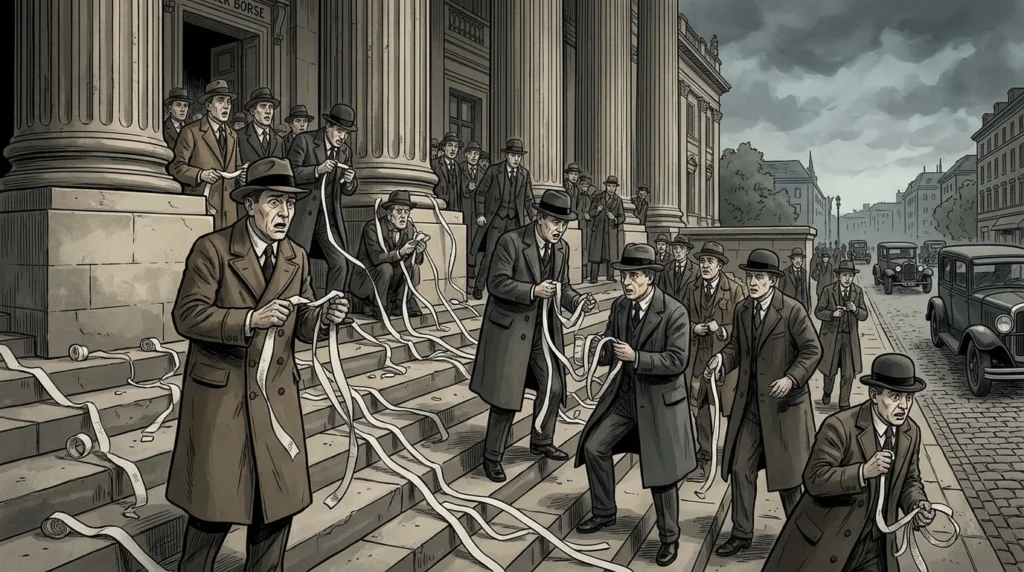
When BAKred shut Herstatt down at 15:30 CET, it was only 9:30 or 10:30 a.m. in New York. Upon receiving word from Cologne and Frankfurt that Herstatt was in bankruptcy receivership, Herstatt’s primary U.S. correspondent bank in New York—Chase Manhattan Bank—immediately froze Herstatt’s dollar account. It refused to execute hundreds of millions of dollars in queued outgoing payment orders via CHIPS to the counterparty banks that had already paid Deutsche Marks in Germany hours earlier. Those counterparties were abruptly reduced to unsecured creditors in a German insolvency proceeding for the full principal value of their currency trades. [8]
Gridlock on CHIPS and International Contagion
The unilateral freeze of the U.S. dollar leg triggered immediate chaos in New York and London. In 1974, the Clearing House Interbank Payments System (CHIPS) in New York operated on an end-of-day multilateral net settlement basis without real-time intraday finality or pre-funded collateral pools. When Chase Manhattan withheld Herstatt’s outgoing dollar payments, New York banks that were counting on those incoming receipts to fund their own downstream obligations refused to release payments to their counterparties.
Chain-reaction recalls and payment holds paralyzed the New York interbank clearing system. Daily transaction volumes through CHIPS plummeted, the system experienced a temporary operational freeze as member banks revoked provisional payment messages, and eurodollar interbank lending rates spiked as banks hoarded liquidity and cut credit lines to all but the largest sovereign-backed institutions. Smaller and medium-sized banks across Europe, Japan, and North America suddenly found themselves shut out of wholesale dollar funding markets.
From “Herstatt Risk” to the Basel Committee and CLS Bank
Before June 26, 1974, commercial bankers and central bank economists generally treated foreign exchange exposure as a matter of market risk—the risk that an exchange rate would move unfavorably before a contract matured, costing a bank the difference between the contract rate and the spot rate. Herstatt demonstrated that asynchronous cross-border settlement created principal risk (or foreign exchange settlement risk): the danger that a bank could lose 100 percent of the notional principal value of a trade during the hours between paying out the sold currency and receiving the bought currency.
The regulatory consequences reshaped global banking governance. Recognizing that national supervisors acting in isolation could no longer contain cross-border payment and Eurocurrency shocks, the central bank governors of the G10 countries met at the Bank for International Settlements (BIS) in Basel at the end of 1974. At the initiative of Bank of England Governor Gordon Richardson and with Peter Cooke serving as an early architect, the G10 governors established the Standing Committee on Banking Regulations and Supervisory Practices—soon known as the Basel Committee on Banking Supervision (BCBS). Its initial 1975 Basel Concordat established principles for sharing supervisory responsibility over foreign bank branches and subsidiaries so that no international banking operation could escape prudential oversight.
Resolving the underlying payment-system vulnerability took nearly three decades. Following a landmark 1996 report by the BIS Committee on Payment and Settlement Systems (CPSS) warning that trillions of dollars in daily foreign exchange trades still faced multi-day Herstatt risk, major central banks pushed global commercial banks to construct a simultaneous settlement utility. In September 2002, Continuous Linked Settlement (CLS) Bank went live, linking central bank real-time gross settlement (RTGS) systems through a Payment-versus-Payment (PvP) mechanism in which the final transfer of one currency occurs if and only if the final transfer of the counter-currency takes place simultaneously. Even so, BIS studies in the 2020s documented that roughly $1.4 trillion to $2.2 trillion of daily global foreign exchange turnover settled outside PvP mechanisms continued to face the time-zone settlement hazard first exposed in Cologne on June 26, 1974.
Theoretical & Balance-Sheet Transmission Mechanism
In the Kindleberger–Minsky taxonomy of financial instability (Kindleberger, 1978; Minsky, 1986) and Irving Fisher’s (1933) debt-deflation framework, speculative asset booms become systemic crises when credit expansion shifts balance sheets from hedge finance (cash flows covering principal and interest) to speculative and Ponzi finance (relying on rising asset prices and short-term margin roll-overs).
Once monetary tightening or an exogenous shock halts price appreciation, forced margin liquidations trigger Fisherian debt-deflation: fire-sale asset discounts erode bank collateral values, contracting credit supply across the real economy.
Sources and Further Reading
- European Central Bank, “ Box 19: More Than Thirty Years After the ‘Herstatt’ Case, Foreign Exchange Settlement Risk Is Still an Issue,” ECB Financial Stability Review, 2007-12. Central Bank / Monetary Authority
- Cité de l’Économie (Banque de France), “ Collapse of the Herstatt Bank in Germany and Creation of the Basel Committee,” Citéco – 10,000 Years of Economy, 2019. Central Bank / Monetary Authority
- Bank of Japan Institute for Monetary and Economic Studies, “ Transfer, Clearing and Settlement Systems in Japan and Abroad,” Bank of Japan Monetary and Economic Studies, 1990-09. Central Bank / Monetary Authority
- Central Banking Newsdesk, “ More Than $1.4tn of Daily FX Trades Face Herstatt Risk – BIS Study,” Central Banking, 2022. Historical & Financial Reference
- Bank for International Settlements, “ History of the Basel Committee,” Bank for International Settlements (BIS), 2023. Central Bank / Monetary Authority
- Bank Underground, “ BoE Archives Reveal Little-Known Lesson from the 1974 Failure of Herstatt Bank,” Bank of England Bank Underground, 2015-06-24. Central Bank / Monetary Authority
- Irving Fisher — "The Debt-Deflation Theory of Great Depressions," Econometrica 1, no. 4 (FRASER Federal Reserve Archive, 1933): 337–357 Central Bank / Monetary Authority
- Charles P. Kindleberger & Robert Z. Aliber — Manias, Panics, and Crashes: A History of Financial Crises (Palgrave Macmillan) Peer-Reviewed / Academic Research
Cite This Historical Dossier (APA / Chicago)
APA (7th ed.): Ç., S. (Ed.). (2026). The 1974 Collapse of Bankhaus Herstatt and the Birth of Settlement Risk. In Forgotten Fortunes Historical Monograph Series (Forgotten Fortunes Editorial Desk). https://forgottenfortunes.net/1974-herstatt-settlement-risk/
MLA (9th ed.): Ç., Soner, ed. "The 1974 Collapse of Bankhaus Herstatt and the Birth of Settlement Risk." Forgotten Fortunes: Financial & Monetary History Archive, 2026, https://forgottenfortunes.net/1974-herstatt-settlement-risk/.
Chicago (17th ed.): Ç., Soner, ed. "The 1974 Collapse of Bankhaus Herstatt and the Birth of Settlement Risk." Forgotten Fortunes Historical Monograph Series (Forgotten Fortunes Editorial Desk), September 9, 2026. https://forgottenfortunes.net/1974-herstatt-settlement-risk/.
Have an idea for another financial history documentary or article? Request a story →