
In This Article
On March 10, 1997, Deutsche Börse opened a specialized trading segment in Frankfurt designed to transform Germany’s bank-dominated corporate economy into a hub for high-growth technology, telecommunications, and media enterprises. Named the Neuer Markt (New Market) and modeled on the US NASDAQ, the platform sought to provide young, innovative companies with direct access to public equity capital. Driven by an unprecedented wave of retail stock ownership, the benchmark Nemax 50 index surged roughly 1,600 percent from its base to an all-time high of 9,665.81 points on March 10, 2000, while total market capitalization across the segment exceeded €234 billion. Within three years of that peak, however, a 96 percent price collapse and a string of brazen accounting and market-manipulation scandals—most notably at EM.TV, Infomatec, and Comroad—destroyed investor confidence, forcing Deutsche Börse to abolish the segment in 2003. [1]

Deutschland AG and the Birth of the “Volksaktie”
Throughout the twentieth century, corporate finance in Germany rested on the institutional framework known as Deutschland AG, a bank-based system in which universal banks (Hausbanken) provided long-term patient credit, held significant corporate equity blocks, and occupied seats on industrial supervisory boards. Small and medium-sized enterprises (Mittelstand) relied almost exclusively on bank loans and retained earnings, while German households kept the bulk of their savings in low-yield passbook accounts (Sparbücher), life insurance policies, and government bonds. Initial public offerings were rare, averaging fewer than twenty per year across all German exchanges during the early 1990s.
Two structural shifts in the mid-1990s upended this conservative equilibrium. First, policymakers and Frankfurt financial executives recognized that traditional bank lending was ill-suited to financing early-stage software, internet, and biotechnology ventures that lacked tangible collateral and positive cash flows. Second, the German federal government launched the partial privatization of the state telecommunications monopoly, Deutsche Telekom, in November 1996. Marketed aggressively to the general public as the Volksaktie (“people’s share”) through television campaigns featuring popular actor Manfred Krug, the Deutsche Telekom flotation raised roughly 20 billion Deutsche Marks (over US$10 billion) and drew nearly two million retail investors into the stock market. As Deutsche Telekom shares rallied strongly over the following three years, millions of German households opened brokerage accounts for the first time, creating a vast pool of retail liquidity eager for higher-yielding growth stocks. [2]
| Documented Figure / Metric | Historical Significance & Archival Context |
|---|---|
| 100 percent | Issue prices were routinely oversubscribed twenty- to fifty-fold, and first-day trading gains (underpricing) frequently exceeded 100 percent within hours of the opening bell. |
| 750 percent | That afternoon, the broad Nemax All Share index closed at an all-time peak of 8,546.19 points (up more than 750 percent from its 1,000-point starting level), while the flagship Nemax 50 hit a record 9,665.81 points, representing an approximate 1,600 percent surge from its 1997 base calculation. |
| US$680 million | Flush with highly valued shares in early 2000, CEO Thomas Haffa embarked on a debt- and equity-fueled acquisition spree, purchasing The Jim Henson Company (creator of the Muppets) for US$680 million and acquiring a 50 percent stake in SLEC, the holding company for Formula One motor racing, for US$1.65 billion. |
| $93.6 million | Released in April 2002, the audit revealed that between 86 percent and 97 percent of Comroad's reported revenues from 1998 to 2000—including nearly all of its $93.6 million in stated 2000 revenue—were completely fabricated. |
Regulatory Architecture of the Neuer Markt
When Deutsche Börse inaugurated the Neuer Markt on March 10, 1997, with just two debut listings—telecommunications challenger Mobilcom AG and engineering services firm Bertrandt AG—it engineered a hybrid legal structure to attract both domestic retail savers and international institutional funds. Legally, issuers gained statutory admission to the Regulated Market (Geregelter Markt) under public stock exchange law, which carries relatively modest baseline requirements, but simultaneously signed a binding private-law contract with Deutsche Börse subjecting them to the stricter Regelwerk Neuer Markt (Neuer Markt Rulebook). [3]
On paper, the segment’s disclosure rules were the most stringent in continental Europe. Listed companies were required to publish financial statements prepared under International Accounting Standards (IAS) or US Generally Accepted Accounting Principles (US-GAAP) rather than traditional German commercial code rules (Handelsgesetzbuch, or HGB), which permitted hidden reserves and creditor-oriented conservatism. Issuers also had to release quarterly reports in both German and English, publish an annual corporate action calendar, maintain a minimum free float of 20 percent, and appoint at least two “Designated Sponsors” (investment banks or brokerages) to guarantee continuous bid-ask liquidity on the electronic Xetra trading system. Furthermore, founding executives and pre-IPO shareholders were bound by a mandatory six-month lock-up period barring them from selling shares immediately after flotation. [4]
Euphoria, Subscription Lotteries, and the March 2000 Peak
These transparency credentials, combined with the global dot-com boom, turned the Neuer Markt into Europe’s dominant technology exchange, capturing more than 60 percent of the total market capitalization of all European “new markets” by 1999. By the end of 1998, 64 companies were listed on the segment with a combined valuation of €26 billion, and the Neuer Markt index had risen more than 250 percent. In 1999, the pace of flotations turned into a stampede: more than 130 companies went public on the segment within a single calendar year, pushing total listings to 201 firms worth €111 billion by December 1999. To track the largest and most liquid issuers, Deutsche Börse launched the blue-chip Nemax 50 index on July 1, 1999. [5]
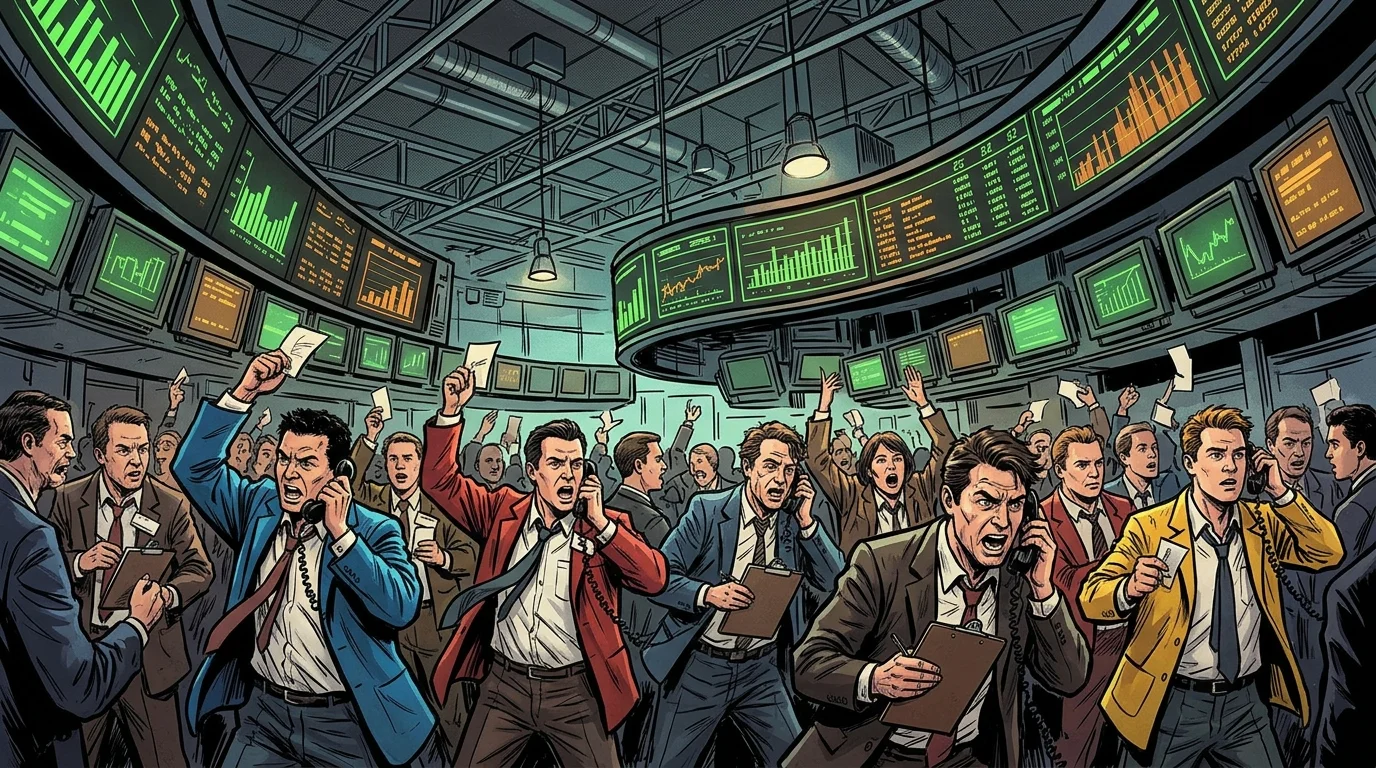
At the height of the mania in 1999 and early 2000, financial television broadcasts, print magazines, and telephone hotlines turned IPO subscription lotteries into a national pastime. Issue prices were routinely oversubscribed twenty- to fifty-fold, and first-day trading gains (underpricing) frequently exceeded 100 percent within hours of the opening bell. On July 22, 1999, thousands of retail shareholders packed the Frankfurt Festhalle—an arena normally reserved for rock concerts—to celebrate the annual general meeting of Munich-based media distributor EM.TV & Merchandising AG. Founded by brothers Thomas and Florian Haffa and taken public in October 1997, EM.TV saw its split-adjusted share price climb by more than 16,600 percent from its IPO price, turning a €6,000 initial stake into a theoretical paper fortune of €1 million. [6]
The speculative frenzy reached its apex on March 10, 2000—the exact third anniversary of the segment’s launch. That afternoon, the broad Nemax All Share index closed at an all-time peak of 8,546.19 points (up more than 750 percent from its 1,000-point starting level), while the flagship Nemax 50 hit a record 9,665.81 points, representing an approximate 1,600 percent surge from its 1997 base calculation. Across 229 listed enterprises, total market capitalization stood at more than €234 billion. Even after prices began to slip alongside the US NASDAQ the following day, primary market momentum carried T-Online, the internet subsidiary of Deutsche Telekom, to a €2.5 billion flotation on April 17, 2000—the largest IPO in the history of the Neuer Markt. [7]
Accounting Frauds and Governance Failures: EM.TV, Infomatec, and Comroad
As global technology valuations contracted in mid-2000, the private-law enforcement mechanisms of the Neuer Markt proved incapable of preventing widespread disclosure abuse, insider dealing, and outright balance-sheet fabrication. Empirical investigations of Neuer Markt filings later demonstrated that dozens of issuers exploited transition loopholes between HGB, IAS, and US-GAAP, submitted incomplete quarterly reports, or used mandatory ad-hoc regulatory announcements as promotional press releases to inflate share prices before insider lock-ups expired. [8]
The first major blow to retail confidence came from the segment’s flagship stock, EM.TV. Flush with highly valued shares in early 2000, CEO Thomas Haffa embarked on a debt- and equity-fueled acquisition spree, purchasing The Jim Henson Company (creator of the Muppets) for US$680 million and acquiring a 50 percent stake in SLEC, the holding company for Formula One motor racing, for US$1.65 billion. In autumn 2000, EM.TV was forced to admit that improper revenue recognition and consolidation errors had overstated its earnings projections; its projected profit of roughly 600 million DM collapsed into huge operating losses, and the stock plunged by more than 95 percent as German prosecutors indicted the Haffa brothers for misrepresenting financial conditions to investors.
Simultaneously, Augsburg-based software and hardware vendor Infomatec AG became the symbol of ad-hoc market manipulation. Co-founders Alexander Häfele and Gerhard Harlos issued a series of glowing regulatory notices between 1999 and May 2000 claiming multimillion-mark orders for their “Surfstation” internet terminals from telecommunications giant Mobilcom. When investigators and Mobilcom executives revealed that the purported binding bulk orders were merely preliminary contingencies that never materialized, it emerged that Infomatec’s founders had quietly sold massive blocks of personal shares into the artificially inflated market before the firm slid into insolvency.
The most audacious fraud occurred at Comroad AG, a telematics and navigation-systems supplier based in Unterschleißheim near Munich and led by CEO Bodo Schnabel. Throughout 1999 and 2000, Comroad reported quadrupling sales and unbroken profitability, propelling its stock more than tenfold. In early 2002, however, auditor KPMG resigned after uncovering irregularities in Comroad’s Asian sales records, prompting a forensic audit by Rödl & Partner. Released in April 2002, the audit revealed that between 86 percent and 97 percent of Comroad’s reported revenues from 1998 to 2000—including nearly all of its $93.6 million in stated 2000 revenue—were completely fabricated. Assisted by his wife, Schnabel had invented imaginary component shipments and fictional sales through a non-existent Hong Kong customer named VT Electronics. Deutsche Börse expelled Comroad from the Neuer Markt on April 19, 2002, and a Munich court subsequently sentenced Schnabel to seven years in prison.
The 96 Percent Crash and Closure of the Segment
By late 2000, financial newspapers were publishing regular “death lists” (Todeslisten) tracking the cash burn rates of Neuer Markt companies. On September 15, 2000, telecommunications provider Gigabell AG filed for bankruptcy, becoming the segment’s first formal insolvency, and was delisted in February 2001. In July 2001, Deutsche Börse attempted to purge the exchange’s tarnished reputation by introducing rules to expel insolvent firms and “penny stocks” trading below €1.00, though legal challenges from affected issuers temporarily forced the exchange to suspend its delisting rules in April 2002.
Nothing halted the broader liquidation. The Nemax 50 index fell below 1,000 points on August 20, 2001, and by autumn 2002 both the Nemax 50 and the Nemax All Share had fallen to roughly 300 to 350 points—an aggregate collapse of approximately 96 percent from their March 2000 highs that wiped out more than €220 billion in market value. Only eleven companies went public on the segment in 2001, and in 2002 the IPO pipeline froze almost completely.
Concluding that the “Neuer Markt” brand had suffered irreparable reputational damage, Deutsche Börse announced on September 26, 2002, that the segment would be dissolved. In March 2003, the exchange reorganized Frankfurt’s equity market into two statutory transparency tiers—the Prime Standard (retaining international accounting and quarterly reporting under public law supervised by the newly created federal regulator BaFin) and the General Standard—while launching the TecDAX index to track the 30 largest technology survivors, such as Qiagen, United Internet, and Aixtron. When the Neuer Markt was formally terminated in June 2003, household stock ownership in Germany retreated for more than a decade, reinforcing the country’s traditional skepticism toward speculative equity finance.
Theoretical & Balance-Sheet Transmission Mechanism
In the Kindleberger–Minsky taxonomy of financial instability (Kindleberger, 1978; Minsky, 1986) and Irving Fisher’s (1933) debt-deflation framework, speculative asset booms become systemic crises when credit expansion shifts balance sheets from hedge finance (cash flows covering principal and interest) to speculative and Ponzi finance (relying on rising asset prices and short-term margin roll-overs).
Once monetary tightening or an exogenous shock halts price appreciation, forced margin liquidations trigger Fisherian debt-deflation: fire-sale asset discounts erode bank collateral values, contracting credit supply across the real economy.
Sources and Further Reading
- Sigurt Vitols, “ Changes in Germany’s Bank-Based Financial System: A Varieties of Capitalism Perspective,” Wissenschaftszentrum Berlin für Sozialforschung (WZB) Discussion Paper No. SP II 2004-03, 2004. Historical & Financial Reference
- Anne d’Arcy and Sonja Grabensberger, “ The Quality of Neuer Markt Quarterly Reports—An Empirical Investigation,” The International Journal of Accounting, 2003. Peer-Reviewed / Academic Research
- Deutsche Bundesbank, “ Macroeconomic and Macro-Financial Developments in Germany,” Deutsche Bundesbank Monthly Report, 2003. Central Bank / Monetary Authority
- Deutsche Börse Group, “ Nemax 50 Index Lexicon,” Deutsche Börse AG, 2024. Historical & Financial Reference
- Manager Magazin, “ 10 Jahre Neuer Markt: Von der Oase zum Schrottplatz,” Manager Magazin, 2007-03-09. Historical & Financial Reference
- Der Spiegel, “ Neuer-Markt-Jubiläum: Zocker, Zirkus, Dreistigkeit,” Der Spiegel, 2007-03-09. Historical & Financial Reference
- Irving Fisher — "The Debt-Deflation Theory of Great Depressions," Econometrica 1, no. 4 (FRASER Federal Reserve Archive, 1933): 337–357 Central Bank / Monetary Authority
- Charles P. Kindleberger & Robert Z. Aliber — Manias, Panics, and Crashes: A History of Financial Crises (Palgrave Macmillan) Peer-Reviewed / Academic Research
Cite This Historical Dossier (APA / Chicago)
APA (7th ed.): Ç., S. (Ed.). (2026). Germany's Neuer Markt (1997–2003): The Rise and Collapse of Frankfurt's Tech Bubble. In Forgotten Fortunes Historical Monograph Series (Forgotten Fortunes Editorial Desk). https://forgottenfortunes.net/germany-neuer-markt-tech-bubble-collapse/
MLA (9th ed.): Ç., Soner, ed. "Germany's Neuer Markt (1997–2003): The Rise and Collapse of Frankfurt's Tech Bubble." Forgotten Fortunes: Financial & Monetary History Archive, 2026, https://forgottenfortunes.net/germany-neuer-markt-tech-bubble-collapse/.
Chicago (17th ed.): Ç., Soner, ed. "Germany's Neuer Markt (1997–2003): The Rise and Collapse of Frankfurt's Tech Bubble." Forgotten Fortunes Historical Monograph Series (Forgotten Fortunes Editorial Desk), September 9, 2026. https://forgottenfortunes.net/germany-neuer-markt-tech-bubble-collapse/.
Have an idea for another financial history documentary or article? Request a story →


