In This Article
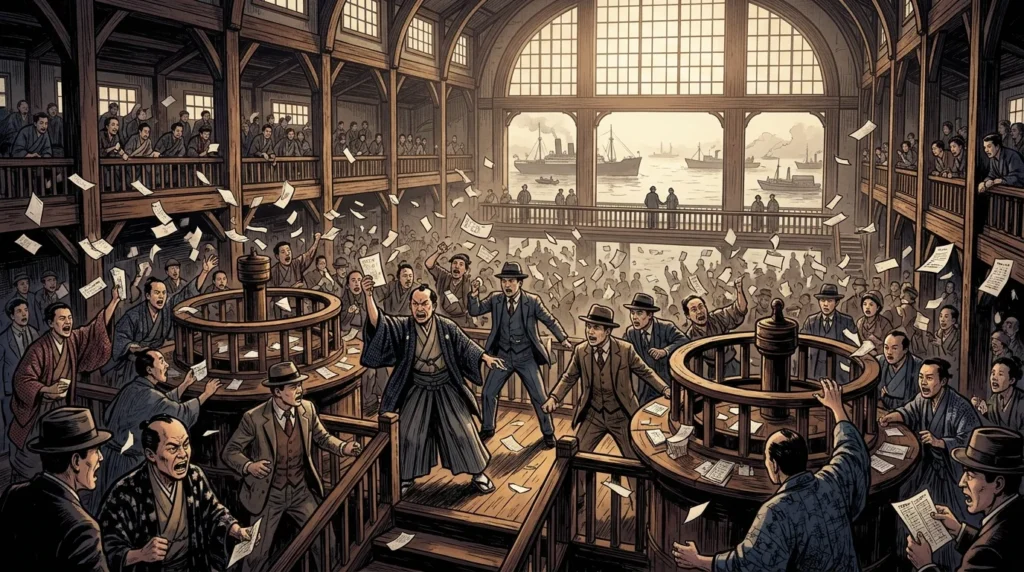
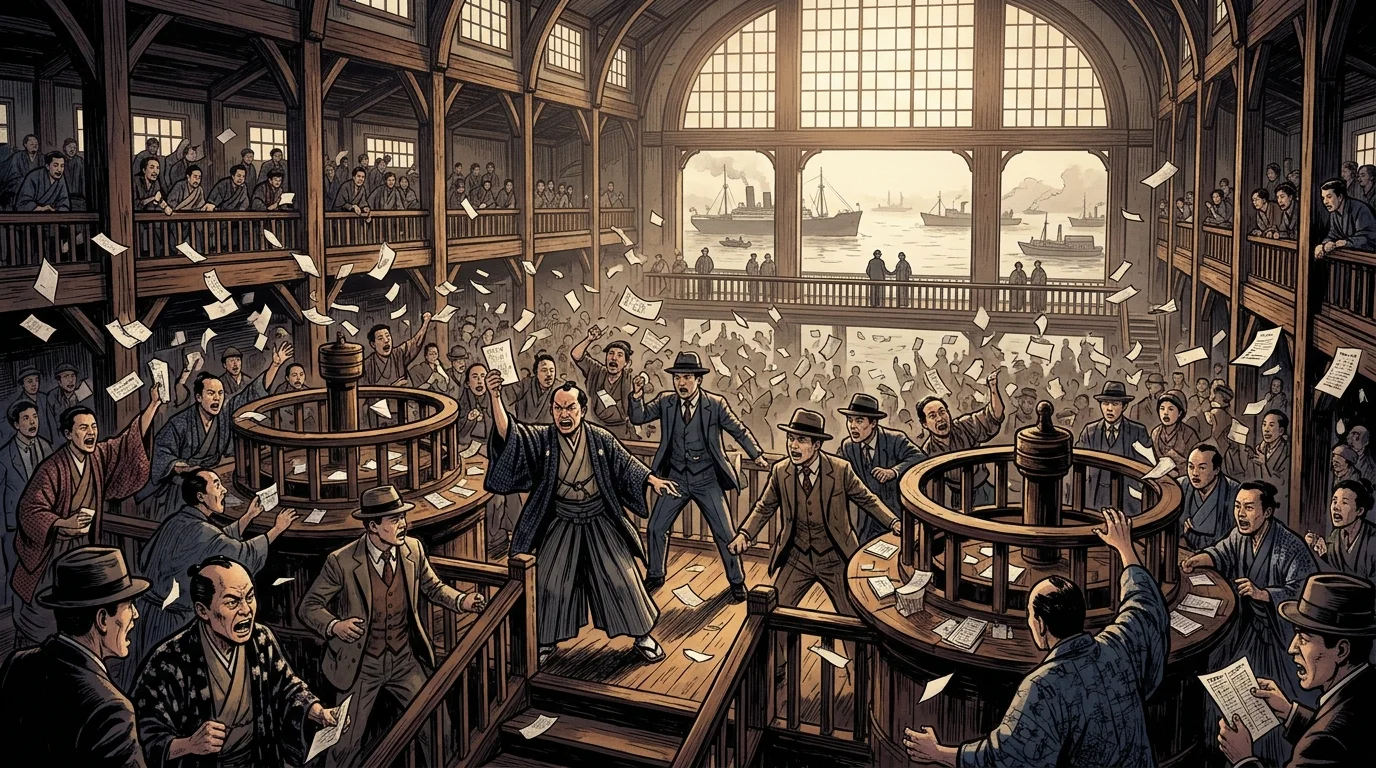
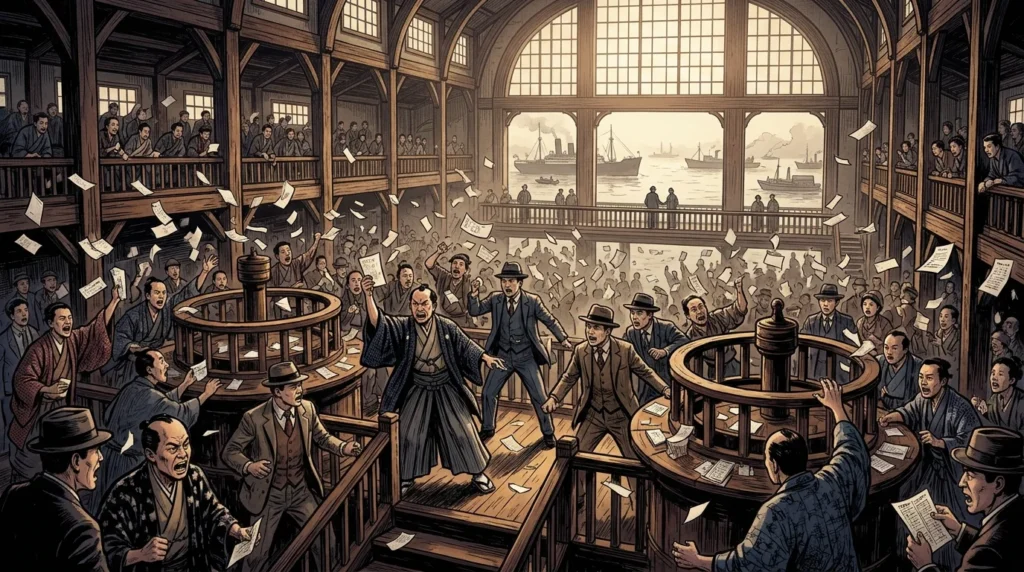
On May 15, 1878, Finance Minister Shigenobu Okuma granted a charter to industrialist Eiichi Shibusawa, Yanosuke Mitsui, and a syndicate of Tokyo merchants to open the Tokyo Stock Exchange (Tokyo Kabushiki Torihikijo) in the former samurai villa district of Kabuto-cho. When trading commenced on June 1, 1878—followed closely by the Osaka Stock Exchange, licensed in June and opened in August 1878 under promoter Tomoatsu Godai—neither bourse resembled an industrial equity market. Instead, they were engineered to solve a sovereign fiscal emergency: providing liquidity for ¥173.9 million in compulsory commutation bonds issued to strip Japan’s former samurai class (shizoku) of their hereditary rice stipends. Within three decades, however, those bond-trading floors evolved into leveraged engines of corporate speculation, propelling Meiji Japan through its first railway and cotton-spinning stock mania in 1886–1890 and culminating in the dramatic post-Russo-Japanese War narikin boom and crash of 1907. [1]
The 1876 Kinroku Kosai Commutation and the Birth of Kabuto-cho (1878)
During the first decade after the 1868 Meiji Restoration, hereditary stipend payments to roughly 400,000 former samurai families consumed between one-quarter and one-third of the central government’s annual budget. After voluntary commutation through Chitsuroku bonds proved insufficient, the Meiji government enacted the compulsory August 1876 commutation decree, converting all remaining stipends into long-term interest-bearing government securities known as Kinroku Kosai (Hereditary Pension Bonds). The issuance totaled ¥173.9 million—more than triple the ¥51.5 million in total Japanese public debt previously outstanding—cutting the state’s annual fiscal outlay on samurai obligations from ¥34.6 million to ¥12.8 million. [2]
To prevent impoverished samurai from dumping their certificates at ruinous discounts to Curbside moneychangers and to channel bond capital into banking, the government revised the National Bank Decree in 1876 to allow national banks to issue banknotes backed by Kinroku bonds. The number of national banks jumped from 6 in 1876 to 153 by 1879, absorbing roughly 27 percent of the samurai bonds. For the remaining securities, Finance Minister Shigenobu Okuma promulgated the Stock Exchange Ordinance (Kabushiki Torihikijo Jorei) on May 4, 1878, organizing the exchanges themselves as profit-seeking, joint-stock corporations whose own shares traded on their floors. [3]
At the end of 1878, the Tokyo Stock Exchange listed five government bond issues—New and Old Public Bonds, Chitsuroku bonds, Kinroku bonds, and Kigyo (Public Works) bonds—alongside just four equity issues: the Tokyo Stock Exchange itself, the Dai-Ichi National Bank, and the Kabuto-cho and Kakigara-cho Rice Merchant Associations. Government bonds accounted for nearly all secondary trading volume until the mid-1880s. [4]
| Documented Figure / Metric | Historical Significance & Archival Context |
|---|---|
| 31 percent | By 1893, fully 31 percent of all outstanding shares in the Hokutan and Sanyo railways were deposited at the Bank of Japan as loan collateral, and equity-secured finance accounted for between 36 percent and 46.7 percent of all Japanese commercial bank loans and bill discounts throughout the 1890s. |
| ¥450 million | A second enterprise boom followed the 1894–1895 Sino-Japanese War, when the receipt of the Chinese war indemnity expanded the Bank of Japan's balance sheet to ¥450 million (27 percent of GNP) in 1896 and enabled Japan to adopt the gold standard in 1897. |
| ¥750 | Driven by cornering battles, Tokyo Stock Exchange shares soared to a record peak above ¥750 in mid-January 1907. |
| 60 percent | Between January and May 1907, flagship speculative stocks—including Tokyo Stock Exchange shares—plunged by more than 60 percent, triggering a domestic banking panic in February–May 1907 that preceded the autumn 1907 Wall Street panic. |
Matsukata Deflation Recovery and the 1886–1889 Railway and Spinning Mania
The excessive issue of inconvertible government paper money—reaching ¥140 million against just ¥15 million in specie reserves during the 1877 Satsuma Rebellion—triggered severe inflation and bond price volatility. Appointed Finance Minister in 1881, Masayoshi Matsukata imposed strict fiscal austerity, retired government paper notes, and founded the Bank of Japan (BOJ) in 1882. By May 1885, the Bank of Japan began issuing silver-convertible banknotes, and in January 1886 the government resumed full silver convertibility at par. [5]
The end of the Matsukata Deflation left Japan with low interest rates, stable silver-backed currency, and rising merchant liquidity. Between 1886 and 1889, Japan experienced its first modern corporate promotion mania (kigyo bokko), centered on private railway companies and mechanized cotton-spinning mills. Inspired by the high dividends of the quasi-public Nihon Railway (founded in 1881) and Eiichi Shibusawa’s Osaka Spinning Company (which grew its paid-in capital and cumulative dividend ratio from 3 percent in 1883 to 61 percent by 1889), regional landlords, merchants, and former samurai rushed to subscribe to newly floated joint-stock corporations (kabushiki kaisha). [6]
Two institutional mechanisms amplified the speculative fever on the Tokyo and Osaka exchanges:
- Stock Installment Payment System (Bunkatsu Harikomi): Subscribers to new railway and spinning shares were required to pay only an initial fraction (often 10 to 20 percent) of the par value upon allotment, paying the remainder in later calls. Speculators could control large blocks of shares with minimal upfront cash and flip them in long-term forward margin transactions (teiki torihiki) spanning up to three months.
- Equity-Secured Bank Lending: Investors pledged their partially paid shares as collateral at private and national banks to borrow the cash needed to meet subsequent installment calls or purchase additional stock. Even conservative industrialist Eiichi Shibusawa used bank loans equal to roughly 70 percent of the par value of his portfolio to leverage his equity holdings across 28 company boards.
The Panic of 1890 and the Bank of Japan Collateral-Loan Rescue
By late 1889 and early 1890, the rapid proliferation of railway and spinning startups outstripped domestic savings. A poor rice harvest in the autumn of 1889 forced large rice imports, draining silver reserves and prompting banks to tighten credit just as heavy capital installment calls fell due on newly incorporated railway shares. Share prices plunged on the Tokyo and Osaka exchanges in early 1890, threatening a chain collapse of commercial banks whose loan portfolios were heavily tied up in illiquid corporate stocks. [7]
Confronted with Japan’s first modern industrial panic in May 1890, the Bank of Japan intervened as lender of last resort by instituting the “collateral loan discounting system” (mikaeri-hin tsuki tegata waribiki). Reversing its initial ban on accepting corporate equities as security, the central bank agreed to rediscount commercial bank bills collateralized by shares in fifteen designated strategic corporations—primarily major private trunk railways such as Nihon, Sanyo, Kyushu, Kansai, and Hokutan Railways, alongside Nippon Yusen shipping. By 1893, fully 31 percent of all outstanding shares in the Hokutan and Sanyo railways were deposited at the Bank of Japan as loan collateral, and equity-secured finance accounted for between 36 percent and 46.7 percent of all Japanese commercial bank loans and bill discounts throughout the 1890s. As Mitsui Bank executive Shigeaki Ikeda later observed, commercial banking in the 1890s largely consisted of checking whether a corporate stock was on the Bank of Japan’s eligible collateral list and taking an interest spread on central bank funds. [8]
The 1905–1907 Post-Russo-Japanese War Bubble and the Narikin Crash
A second enterprise boom followed the 1894–1895 Sino-Japanese War, when the receipt of the Chinese war indemnity expanded the Bank of Japan’s balance sheet to ¥450 million (27 percent of GNP) in 1896 and enabled Japan to adopt the gold standard in 1897. Yet the most explosive speculative bubble of the Meiji era erupted after Japan’s victory in the Russo-Japanese War (February 1904–September 1905). Although the September 1905 Treaty of Portsmouth yielded no cash indemnity from Russia, massive wartime foreign bond issuances in London and New York—which pushed the Bank of Japan’s total assets to ¥900 million (26 percent of GNP)—flooded the domestic banking system with liquidity. [9]
In 1906, two catalysts ignited a mania on the Tokyo and Osaka stock exchanges: the March 1906 Railway Nationalization Law, under which the state bought out seventeen private trunk railways (including Sanyo, Kyushu, and Kansai) with government bonds, and the founding of the South Manchuria Railway Company (Mantetsu), whose autumn 1906 public share offering was oversubscribed more than a thousand times. Flush with proceeds from nationalized railway stocks and cheap bank credit—where equity-secured loans and discounted bills jumped from ¥267.1 million in 1905 to ¥413.0 million (42.4 percent of total bank lending) at the end of 1906—speculators piled into cotton-spinning mills, sugar refineries, electric utilities, and the shares of the Tokyo Stock Exchange itself.
The 1906 rally minted a new social archetype in Japan: the narikin (a term borrowed from shogi chess for a humble pawn that crosses the board to promote into a golden general), denoting an overnight stock market millionaire. The most famous Kabuto-cho narikin was Hisahiro (Kugoro) Suzuki, known as “Suzukyu,” a former clerk who borrowed heavily from commercial banks to corner shares of Kanegafuchi Spinning (Kanebo) and the Tokyo Stock Exchange. Driven by cornering battles, Tokyo Stock Exchange shares soared to a record peak above ¥750 in mid-January 1907.
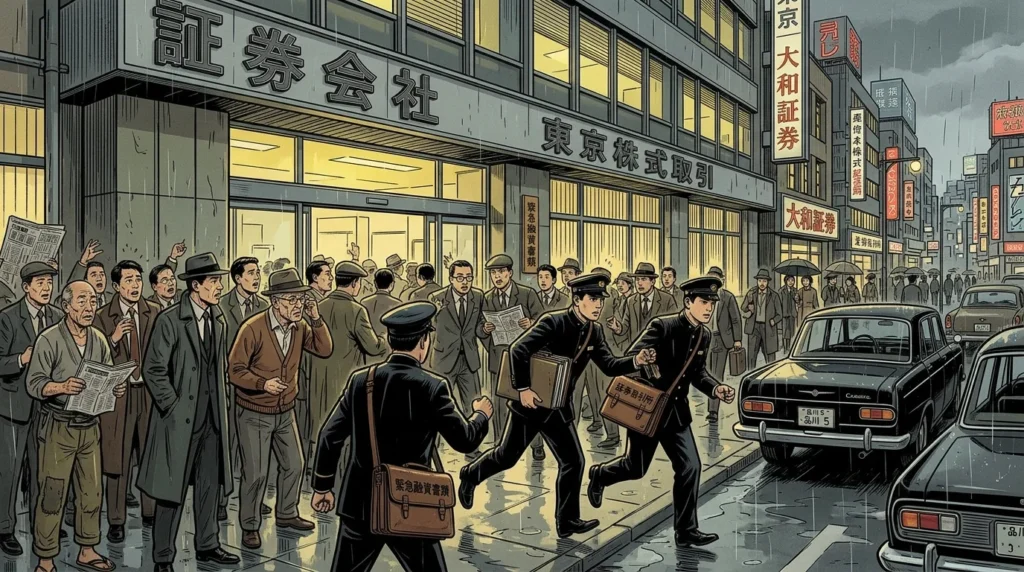
On January 21, 1907, the bubble burst. Alarmed by overextended bank lending, commercial banks curtailed margin credit, triggering a wave of forced liquidations across Kabuto-cho and Kitahama. Between January and May 1907, flagship speculative stocks—including Tokyo Stock Exchange shares—plunged by more than 60 percent, triggering a domestic banking panic in February–May 1907 that preceded the autumn 1907 Wall Street panic. Overnight narikin fortunes evaporated, wiping out Suzuki’s leveraged empire and forcing the Bank of Japan once again to expand private-sector credit between October 1907 and May 1908 to contain systemic contagion.
Theoretical & Balance-Sheet Transmission Mechanism
In the Kindleberger–Minsky taxonomy of financial instability (Kindleberger, 1978; Minsky, 1986) and Irving Fisher’s (1933) debt-deflation framework, speculative asset booms become systemic crises when credit expansion shifts balance sheets from hedge finance (cash flows covering principal and interest) to speculative and Ponzi finance (relying on rising asset prices and short-term margin roll-overs).
Once monetary tightening or an exogenous shock halts price appreciation, forced margin liquidations trigger Fisherian debt-deflation: fire-sale asset discounts erode bank collateral values, contracting credit supply across the real economy.
Sources and Further Reading
- Japan Exchange Group (JPX), “History of the Kabuto-cho District (Tokyo Stock Exchange),” JPX Corporate History Archive, accessed 2026. Historical & Financial Reference
- Japan Securities Research Institute (JSRI), “Chapter II: The History of the Japanese Securities Market,” Securities Market in Japan 2024, 2024. Historical & Financial Reference
- Sergi Basco and John P. Tang, “The Samurai Bond: Credit Supply and Economic Growth in Pre-War Japan,” Banco de España Conference Paper, October 2017. Historical & Financial Reference
- Juro Teranishi, “Were Banks Really at the Center of the Prewar Japanese Financial System?,” Monetary and Economic Studies (Bank of Japan Institute for Monetary and Economic Studies), Vol. 25, No. 1, March 2007. Central Bank / Monetary Authority
- Kanji Ishii, “Equity Investments and Equity Investment Funding in Prewar Japan,” Monetary and Economic Studies (Bank of Japan Institute for Monetary and Economic Studies), Vol. 25, No. 1, March 2007. Central Bank / Monetary Authority
- Ryoji Koike, “Bank of Japan’s Balance Sheet in 1882–1955: Reassembled Data and Their Developments,” Bank of Japan IMES Discussion Paper Series, No. 2024-E-7, May 2024. Central Bank / Monetary Authority
- Government of Japan (JapanGov), “Lessons from Shibusawa Eiichi, the Man Who Formed the Foundation of Japanese Capitalism,” Kizuna Magazine, January 2022. Historical & Financial Reference
- Irving Fisher — "The Debt-Deflation Theory of Great Depressions," Econometrica 1, no. 4 (FRASER Federal Reserve Archive, 1933): 337–357 Central Bank / Monetary Authority
- Charles P. Kindleberger & Robert Z. Aliber — Manias, Panics, and Crashes: A History of Financial Crises (Palgrave Macmillan) Peer-Reviewed / Academic Research
Cite This Historical Dossier (APA / Chicago)
APA (7th ed.): Ç., S. (Ed.). (2026). Samurai Bonds to Narikin Ruin: Meiji Japan's Stock Exchanges and Speculative Crises (1878–1907). In Forgotten Fortunes Historical Monograph Series (Forgotten Fortunes Editorial Desk). https://forgottenfortunes.net/meiji-japan-stock-market-crashes/
MLA (9th ed.): Ç., Soner, ed. "Samurai Bonds to Narikin Ruin: Meiji Japan's Stock Exchanges and Speculative Crises (1878–1907)." Forgotten Fortunes: Financial & Monetary History Archive, 2026, https://forgottenfortunes.net/meiji-japan-stock-market-crashes/.
Chicago (17th ed.): Ç., Soner, ed. "Samurai Bonds to Narikin Ruin: Meiji Japan's Stock Exchanges and Speculative Crises (1878–1907)." Forgotten Fortunes Historical Monograph Series (Forgotten Fortunes Editorial Desk), September 13, 2026. https://forgottenfortunes.net/meiji-japan-stock-market-crashes/.
Have an idea for another financial history documentary or article? Request a story →