In This Article
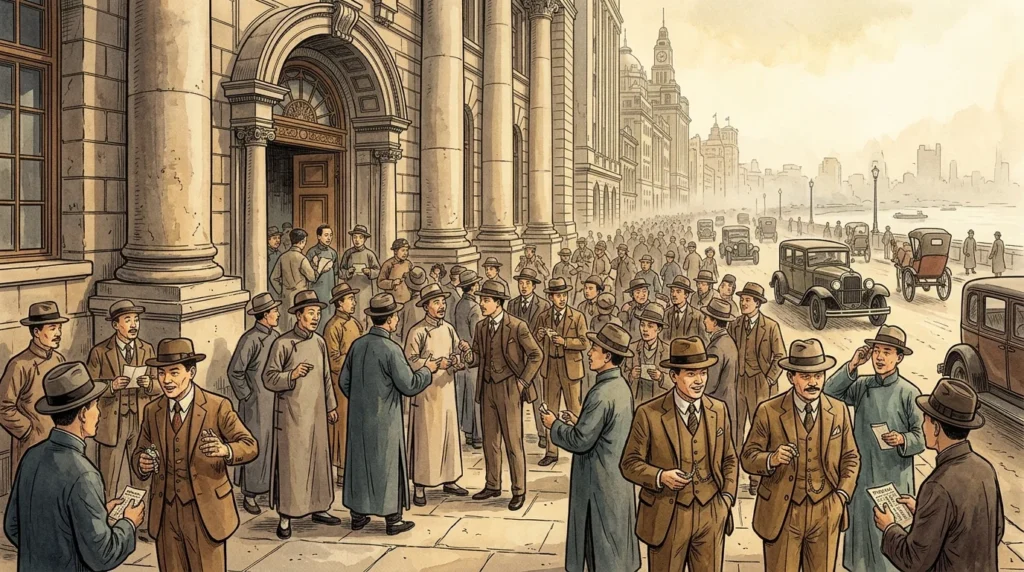
Between 1914 and 1919, the withdrawal of European industrial powers from Asian commercial markets and the surge in Allied procurement transformed Imperial Japan from an indebted borrower on the London money market into a major international creditor. Driven by an export boom in merchant shipping, shipbuilding, cotton textiles, and raw silk, Japan’s real gross national product expanded at an average annual rate of 6.2 percent while its combined domestic and overseas specie reserves more than sextupled from 341 million yen at the end of 1914 to 2,179 million yen by the end of 1920. In popular culture, this windfall prosperity (taisen keiki) became synonymous with the narikin—a term borrowed from shōgi chess for a humble pawn promoted to a gold general—describing the overnight millionaires who amassed fortunes in tramp shipping (funanarikin), iron and steel (tetsunarikin), cotton yarn, and stock speculation. [1]
Paradoxically, the most manic phase of equity and commodity speculation erupted not during the war itself, but in 1919 and early 1920, when loose monetary expansion under Finance Minister Korekiyo Takahashi and post-Armistice inventory hoarding drove Tokyo Stock Exchange shares, Yokohama raw silk, and Osaka Sampin cotton yarn futures to record heights. When Japan’s trade balance swung back into deficit and the Bank of Japan (BOJ) raised its official discount rate twice in late 1919 to curb inflation, the leveraged edifice gave way. On March 15, 1920, the Tokyo Stock Exchange suffered a violent crash that forced a two-day market closure, followed on April 7, 1920, by the collapse of Osaka’s Masuda Bill Broker Bank (Masuda Biru Burōkā Ginkō) and on May 24, 1920, by the failure of Yokohama’s 74th Bank (Shichijūshi Ginkō) alongside raw silk trading house Mogi Shoten. Equity and staple commodity prices plunged by more than 55 percent, inaugurating a decade of chronic deflation and banking fragility that culminated in the Shōwa Financial Crisis of 1927. [2]
From Debtor to Creditor: The Wartime Export Boom and the Narikin
On the eve of World War I in July 1914, Japan labored under a heavy burden of foreign-currency sovereign debt contracted to finance the 1904–1905 Russo-Japanese War and chronic current-account deficits that threatened the convertibility of the yen under the gold standard. Within months of the European outbreak, however, the economic landscape reversed completely. As British, German, and French factories shifted to war production and Allied merchant fleets were requisitioned or sunk by submarine warfare, Japanese manufacturers captured markets across China, Southeast Asia, India, and Africa, while the booming U.S. wartime economy absorbed vast quantities of Japanese raw silk. [3]
Merchant shipping and shipbuilding generated the most spectacular windfalls. Charter rates for ocean freighters multiplied severalfold between 1914 and 1918, turning independent shipowners and charter operators in Kobe and Osaka—such as Uchida Nobuya, Katsuda Ginjiro, and Yamashita Kamesaburo—into the celebrated funanarikin (“shipping nouveaux riches”). Simultaneously, chemical dye importers, copper and iron merchants, and Osaka cotton spinning mills paid annual dividends of 50 to 100 percent. Newspaper cartoons famously caricatured a narikin lighting a hundred-yen banknote in a darkened entryway so a geisha could find his shoes. [4]
Because the United States and European belligerents suspended gold convertibility and embargoed gold exports—a step Japan followed by imposing its own gold embargo in September 1917—Japan could no longer convert its huge overseas trade surpluses into imported gold bullion on demand. Instead, Japanese exchange banks accumulated massive balances of pound sterling and U.S. dollar reserves in London and New York, while the Bank of Japan expanded domestic banknote circulation against rising specie holdings. Between 1914 and 1919, Japan’s GNP price deflator rose at an average pace of 13.6 percent per year, sparking the nationwide Rice Riots of August 1918 when consumer rice prices doubled faster than industrial wages. [5]
| Documented Figure / Metric | Historical Significance & Archival Context |
|---|---|
| 390 million yen | As European manufacturers resumed exports and Japan's inflated domestic price level sucked in foreign raw cotton, machinery, and steel, Japan's wartime trade surplus flipped into a massive merchandise trade deficit of nearly 390 million yen in the first quarter of 1920 alone. |
| 30 percent | Share prices of spinning mills, shipping lines, sugar companies, and the Tokyo Stock Exchange Company itself plunged by 20 to 30 percent in a single session, forcing TSE officials to suspend trading for two days on March 16 and 17 to allow brokers to untangle defaulted accounts. |
The 1919–Early 1920 Post-Armistice Speculative Mania
When the European Armistice was signed in November 1918, Japanese industrialists initially braced for a sharp postwar contraction as wartime shipping charters and munitions orders were canceled. During the winter of 1918–1919, copper, iron, and shipping freight rates dropped noticeably. By the spring of 1919, however, pent-up consumer and reconstruction demand in the United States and Europe—combined with an expansionary domestic fiscal and monetary stance overseen by Prime Minister Hara Takashi and Finance Minister Korekiyo Takahashi—reignited a secondary boom far more speculative than the wartime expansion itself. [6]
Seeking to modernize Japanese transport, education, and heavy industry while encouraging an institutional market in bank acceptances, Takahashi resisted calls for immediate postwar fiscal retrenchment. Throughout 1919, corporate promoters launched an “enterprise fever” (kigyō netsu), floating thousands of new joint-stock companies in textiles, electric power, chemicals, shipping, and colonial agriculture across Japan, Taiwan, Korea, and Manchuria. Critically, rural regional banks aggressively collected household deposits enriched by soaring cocoon and agricultural prices and funneled that liquidity into speculative margin loans for local merchants buying shares and commodity futures. [7]
Across the second half of 1919 and the first ten weeks of 1920, key commodity and equity benchmarks went parabolic: [8]
- Raw Silk: On the Yokohama Raw Silk Exchange, benchmark Shinshu No. 1 raw silk—which had traded below 1,000 yen per bale before the war and around 1,500 yen in early 1919—soared past 3,000 yen in late 1919 to hit an all-time peak of 4,360 yen per bale in January 1920.
- Cotton Yarn: On Osaka’s Sampin (Three-Commodity) Exchange, 20-count cotton yarn futures more than doubled from pre-1919 levels to pass 700 yen per bale in early March 1920.
- Equities: On the Tokyo Stock Exchange (TSE), the benchmark share price of the Tokyo Stock Exchange Company itself—the bellwether speculative vehicle of prewar Japanese finance—climbed past 500 yen per share by the beginning of March 1920.
Monetary Tightening and the March 15, 1920 Tokyo Stock Exchange Crash
Beneath the euphoria on the trading floors of Kabutocho in Tokyo and Kitahama in Osaka, Japan’s external liquidity position was deteriorating rapidly. As European manufacturers resumed exports and Japan’s inflated domestic price level sucked in foreign raw cotton, machinery, and steel, Japan’s wartime trade surplus flipped into a massive merchandise trade deficit of nearly 390 million yen in the first quarter of 1920 alone. To settle import bills, foreign exchange banks had to buy back gold and dollar balances, draining liquidity from the domestic call-money market.
Alarmed by runaway commodity inflation and rampant corporate promotion, the Bank of Japan—under Governor Junnosuke Inoue—raised its official discount rate twice in the autumn of 1919, from 6.57 percent to 7.30 percent in October and then to 8.03 percent (2.2 sen per 100 yen per day) in November 1919, while warning commercial banks to curtail speculative margin lending. By early March 1920, major Tokyo and Osaka city banks found their reserve ratios depleted and began calling in short-term call loans and refusing to roll over stockbrokers’ settlement credits.
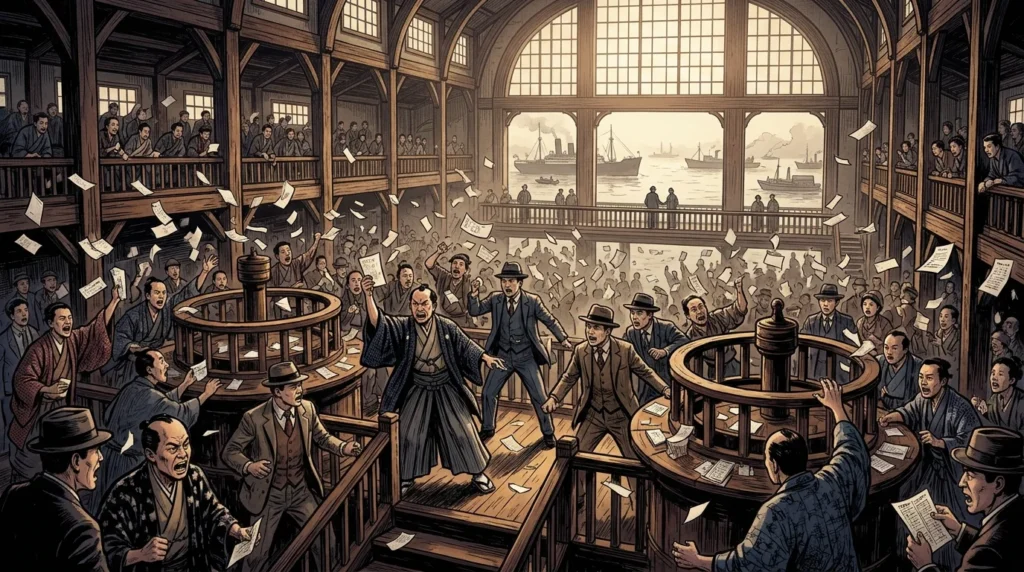
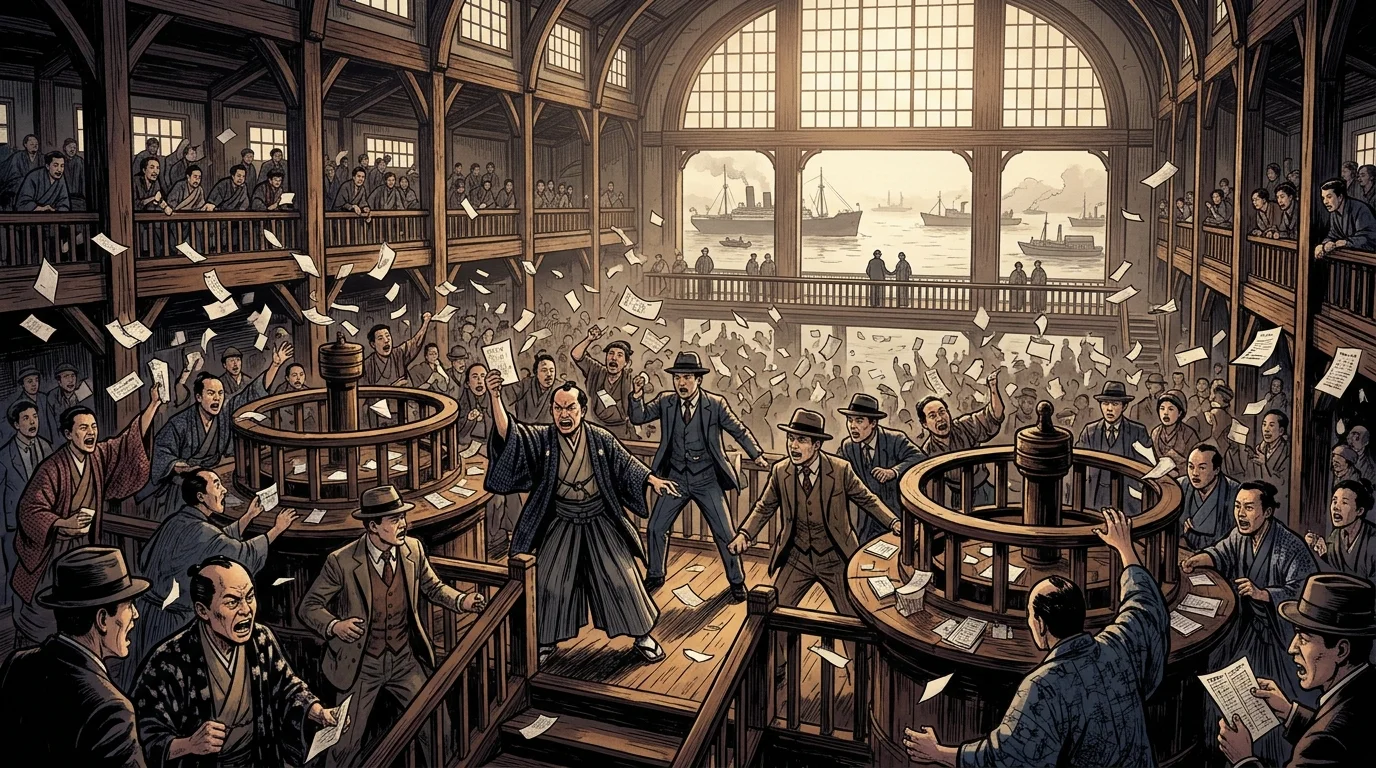
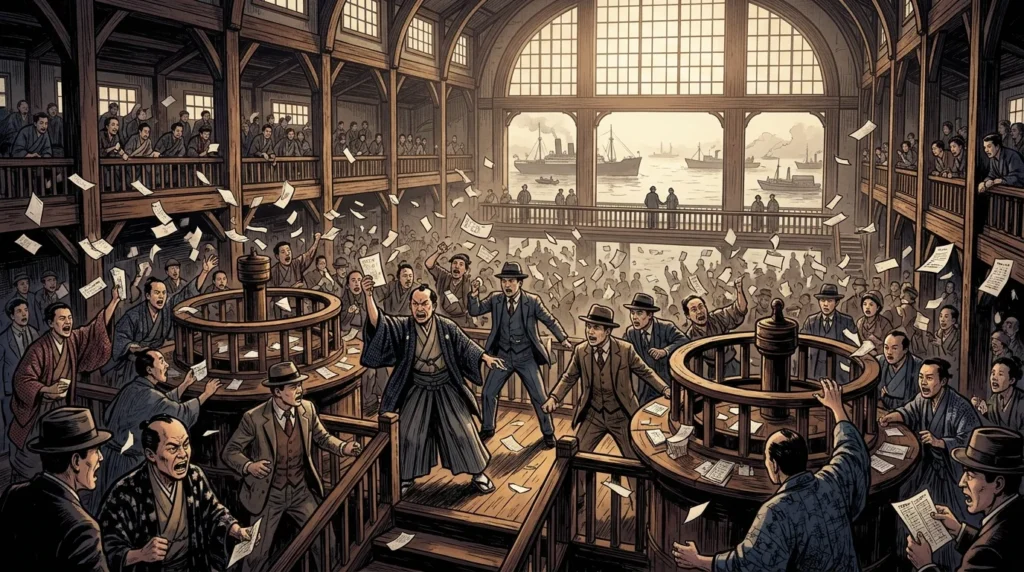
The breaking point arrived on Monday, March 15, 1920. Confronted with simultaneous bank loan recalls and margin demands ahead of the mid-month settlement, panicked speculators dumped holdings across the board on the Tokyo Stock Exchange. Share prices of spinning mills, shipping lines, sugar companies, and the Tokyo Stock Exchange Company itself plunged by 20 to 30 percent in a single session, forcing TSE officials to suspend trading for two days on March 16 and 17 to allow brokers to untangle defaulted accounts.
Contagion: Masuda Bill Broker Bank and Yokohama’s 74th Bank
Rather than stabilizing when trading resumed, the March 15 sell-off triggered a fatal liquidity squeeze in Japan’s interbank call market. During the wartime boom, Osaka-headquartered Masuda Bill Broker Bank (Masuda Biru Burōkā Ginkō)—founded by the Masuda family with branches in Tokyo, Nagoya, Kyoto, and Moji—had served as a primary conduit channeling short-term call money from major city banks and regional lenders into commercial bills and stock-collateralized loans. When Tokyo and Osaka city banks abruptly withdrew call funds in late March and early April 1920, Masuda could not liquidate its frozen loans to struggling stock and cotton-yarn speculators.
On April 7, 1920, Masuda Bill Broker Bank failed to clear its obligations and suspended operations. The collapse of Japan’s leading bill broker sent shockwaves through both western and eastern Japan: the Tokyo, Osaka, and Nagoya stock exchanges immediately plummeted again and closed their floors from April 14 into May, while Osaka’s Sampin Cotton Yarn Exchange and Yokohama’s Raw Silk Exchange suspended futures trading as prices cratered below margin maintenance levels.
Six weeks later, the panic struck the heart of Japan’s export economy in Yokohama. Mogi Sōbei III, the young head of Mogi Shoten (Mogi & Co.)—one of Yokohama’s premier raw silk export houses and a celebrated wartime narikin conglomerate—had speculated heavily in raw silk, cotton yarn, and equities financed by loans from the family-controlled 74th Bank (Shichijūshi Ginkō) and the Yokohama 74th Savings Bank. When raw silk prices collapsed by more than half from their January peak, Mogi Shoten became insolvent. On May 24, 1920, the 74th Bank—the largest domestic commercial bank in Yokohama after the Yokohama Specie Bank—suspended payments and closed its doors, wiping out silk reelers’ working capital and igniting runs on dozens of banks across the Kanto, Tokai, and Kansai regions.
The 55 Percent Deflation and the Road to the 1927 Shōwa Crisis
Between April and July 1920, 21 banks across Japan permanently or temporarily suspended operations while more than 160 bank runs erupted nationwide. By the autumn of 1920, the carnage across Japanese asset and commodity markets was staggering: the Tokyo Stock Exchange share price index had fallen by roughly 55 percent from its March peak (with Tokyo Stock Exchange Co. shares dropping from over 500 yen to nearly 100 yen), Osaka cotton yarn futures had plunged 60 percent from over 700 yen to below 300 yen per bale, and Yokohama raw silk had collapsed by 75 percent from 4,360 yen to roughly 1,100 yen per bale.
To prevent a complete systemic collapse, the Bank of Japan under Governor Inoue and Finance Minister Takahashi intervened aggressively as lender of last resort, extending roughly 250 million to 300 million yen in emergency “special loans” (tokubetsu yūzū) to commercial banks, stock exchange clearing syndicates, cotton yarn merchants, sugar and copper syndicates, and the state-backed Imperial Silk Company (Teisan) organized in September 1920 to buy and warehouse surplus raw silk. Although these emergency credits halted the acute bank runs by late summer 1920 and allowed the government to reorganize the failed 74th Bank into the newly founded Bank of Yokohama later that year, they allowed fragile regional banks and industrial borrowers to roll over uncollected wartime bad debts rather than write them off. Compounded by the 1922 Ishii Corporation banking panic and the September 1923 Great Kantō Earthquake, the unresolved balance-sheet rot left behind by the March 1920 crash festered throughout the decade until erupting in the systemic Shōwa Financial Crisis of April 1927.
Theoretical & Balance-Sheet Transmission Mechanism
In the Kindleberger–Minsky taxonomy of financial instability (Kindleberger, 1978; Minsky, 1986) and Irving Fisher’s (1933) debt-deflation framework, speculative asset booms become systemic crises when credit expansion shifts balance sheets from hedge finance (cash flows covering principal and interest) to speculative and Ponzi finance (relying on rising asset prices and short-term margin roll-overs).
Once monetary tightening or an exogenous shock halts price appreciation, forced margin liquidations trigger Fisherian debt-deflation: fire-sale asset discounts erode bank collateral values, contracting credit supply across the real economy.
Sources and Further Reading
- Masato Shizume, “ The Japanese Economy during the Interwar Period: Instability in the Financial System and the Impact of the World Depression,” Bank of Japan Review (2009-E-2), 2009-05. Central Bank / Monetary Authority
- Kunio Okina, Masaaki Shirakawa, and Shigenori Shiratsuka, “ The Asset Price Bubble and Monetary Policy: Japan’s Experience in the Late 1980s and the Lessons,” Monetary and Economic Studies (Institute for Monetary and Economic Studies, Bank of Japan), 2001-02. Central Bank / Monetary Authority
- Masato Shizume, “ The Japanese Economy during the Interwar Period: Instability in the Financial System and the Impact of the World Depression (” Palgrave Macmillan (The Gold Standard Peripheries), 2012),” Palgrave Macmillan (The Gold Standard Peripheries), 2012. Peer-Reviewed / Academic Research
- Masato Shizume, “ Financial Crises and the Central Bank: Lessons from Japan during the 1920s,” Waseda University WINPEC Working Paper No. E1611 (RePEc), 2016-11. Central Bank / Monetary Authority
- Michiko Hatoyama, “ Trends in Exports and Exchange Rates in the 1930s,” Monetary and Economic Studies (Institute for Monetary and Economic Studies, Bank of Japan), 2002. Central Bank / Monetary Authority
- Richard J. Smethurst, “ From Foot Soldier to Finance Minister: Takahashi Korekiyo, Japan’s Keynes,” Harvard University Asia Center / Brill, 2007. Peer-Reviewed / Academic Research
- Irving Fisher — "The Debt-Deflation Theory of Great Depressions," Econometrica 1, no. 4 (FRASER Federal Reserve Archive, 1933): 337–357 Central Bank / Monetary Authority
- Charles P. Kindleberger & Robert Z. Aliber — Manias, Panics, and Crashes: A History of Financial Crises (Palgrave Macmillan) Peer-Reviewed / Academic Research
Cite This Historical Dossier (APA / Chicago)
APA (7th ed.): Ç., S. (Ed.). (2026). Japan's World War I Narikin Speculative Boom and the March 1920 Stock and Commodity Crash. In Forgotten Fortunes Historical Monograph Series (Forgotten Fortunes Editorial Desk). https://forgottenfortunes.net/japan-1920-narikin-stock-crash/
MLA (9th ed.): Ç., Soner, ed. "Japan's World War I Narikin Speculative Boom and the March 1920 Stock and Commodity Crash." Forgotten Fortunes: Financial & Monetary History Archive, 2026, https://forgottenfortunes.net/japan-1920-narikin-stock-crash/.
Chicago (17th ed.): Ç., Soner, ed. "Japan's World War I Narikin Speculative Boom and the March 1920 Stock and Commodity Crash." Forgotten Fortunes Historical Monograph Series (Forgotten Fortunes Editorial Desk), September 11, 2026. https://forgottenfortunes.net/japan-1920-narikin-stock-crash/.
Have an idea for another financial history documentary or article? Request a story →