In This Article
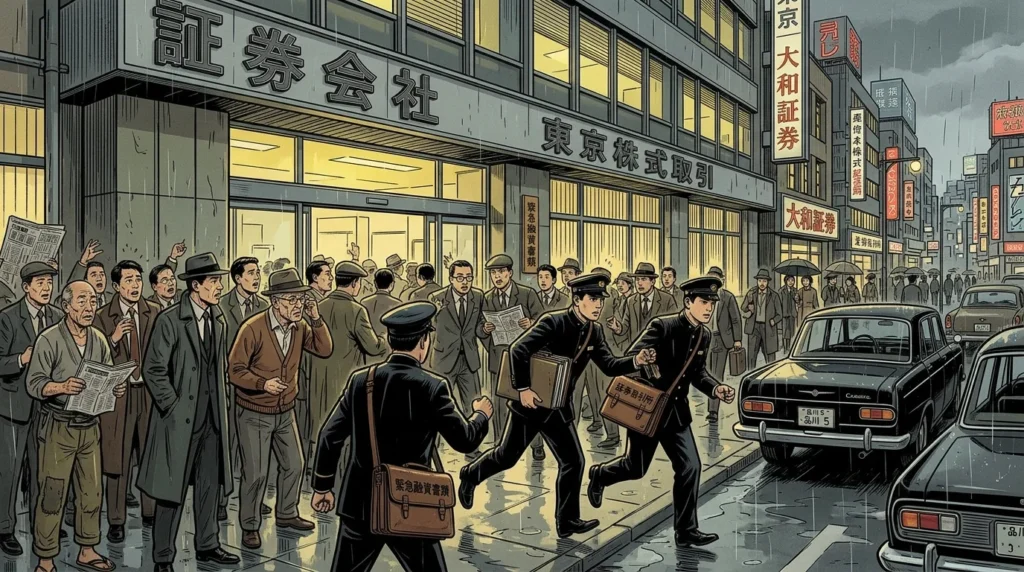
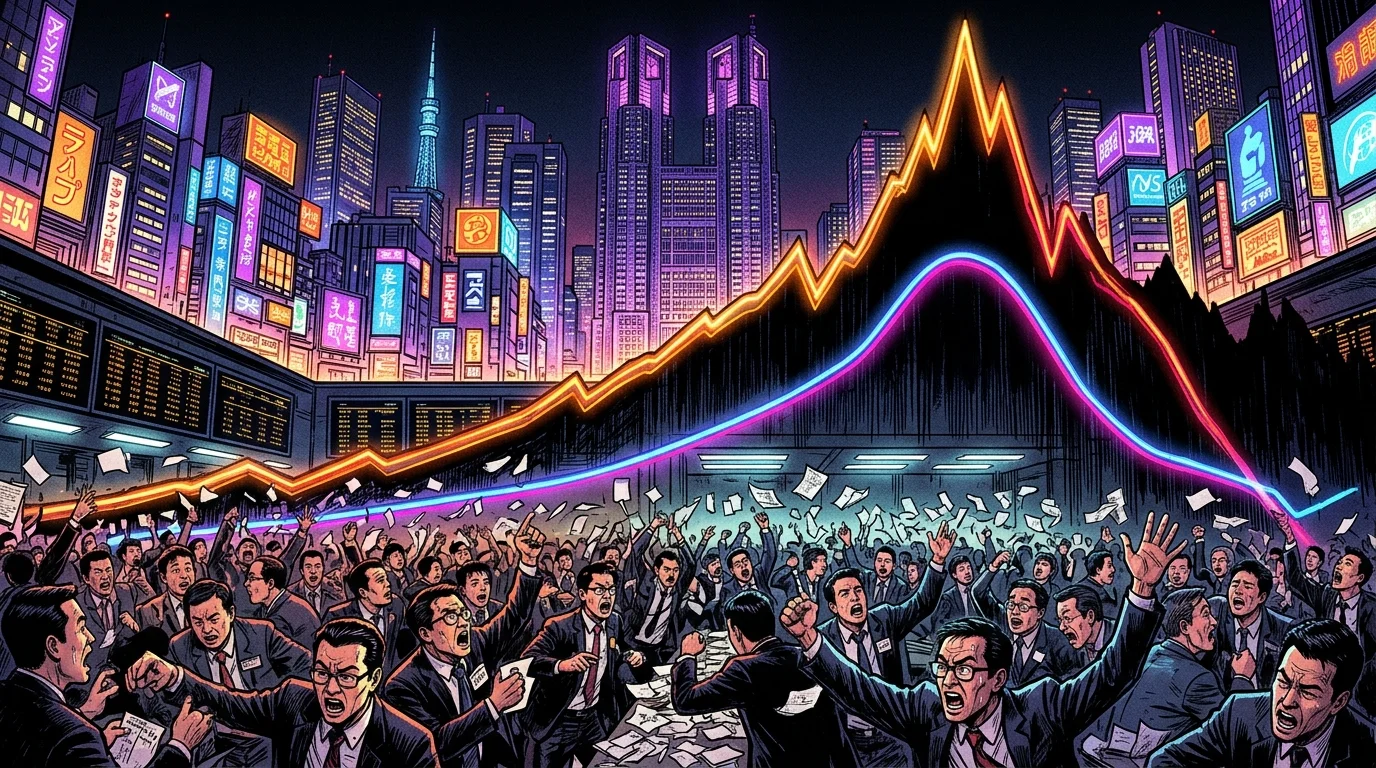
On December 29, 1989—the final trading session of the 1980s and the first year of Emperor Akihito’s Heisei era—the benchmark Nikkei 225 Stock Average on the Tokyo Stock Exchange reached an all-time intraday high of 38,957.44 and closed at a record 38,915.87 points. At that moment, Japanese equities accounted for more than 40 percent of global stock market capitalization, while commercial land values in central Tokyo had tripled in five years under a torrent of bank credit and corporate financial engineering known as zaitech. Less than two weeks earlier, however, career central banker Yasushi Mieno had assumed office as Governor of the Bank of Japan (BOJ) with a mandate to break the speculative fever. Between December 1989 and August 1990, the combination of Mieno’s aggressive interest-rate hikes—lifting the Official Discount Rate to 6.0 percent—and the Ministry of Finance’s April 1990 quantitative cap on real-estate lending (Sōryō Kisei) punctured both bubbles simultaneously, triggering a 63 percent equity crash by August 1992, a devastating commercial property slump, and a decade-long banking crisis. [1]

Plaza Accord Liquidity and Asymmetric Deregulation
The origins of Japan’s late-1980s asset bubble lay in the interaction between macroeconomic policy after the September 1985 Plaza Accord and the partial deregulation of Japan’s postwar financial system. When the Group of Five industrial nations agreed at the Plaza Hotel in New York to depreciate the US dollar, the yen appreciated rapidly from roughly ¥240 per dollar in 1985 to ¥120 by 1988. To cushion export-reliant manufacturers from the ”strong-yen recession” (endaka fukyō) and stimulate domestic demand, the Bank of Japan cut its Official Discount Rate (ODR) five times between January 1986 and February 1987, bringing the benchmark rate down from 5.0 percent to a postwar low of 2.5 percent—a level it maintained for more than two years until May 1989. [2]
This prolonged monetary expansion collided with an asymmetric regulatory overhaul of Japanese corporate finance. Throughout the high-growth postwar era, large industrial firms had depended on ”main bank” credit lines under strict interest-rate controls. During the 1980s, however, the Ministry of Finance (MOF) relaxed restrictions on corporate bond issuance and cross-border Eurobond offerings, allowing blue-chip manufacturing corporations to tap public capital markets directly by issuing convertible bonds and equity-warrant bonds at near-zero effective interest rates.
While large corporations fled bank loan windows for cheap capital-market funding, commercial banks were still barred from entering full-scale investment banking and faced fierce competition for deposits. Deprived of their traditional industrial borrowers, city banks, long-term credit banks, and trust banks pivoted aggressively toward small and medium-sized enterprises, commercial property developers, construction firms, and non-bank housing-loan subsidiaries known as jusen. Because Japanese banking practice relied heavily on land as collateral rather than discounted cash-flow analysis, rising urban property prices automatically expanded borrowers’ collateral capacity, enabling larger loans that drove land valuations even higher in a self-reinforcing credit cycle.
| Documented Figure / Metric | Historical Significance & Archival Context |
|---|---|
| ¥40 trillion | Between 1985 and 1989, assets held in tokkin and fund trusts ballooned past ¥40 trillion, binding corporate balance sheets, brokerage houses, and trust banks into a tightly leveraged web of equity exposure. |
| 2.5 percent | In May 1989, the Bank of Japan belatedly raised the Official Discount Rate from 2.5 percent to 3.25 percent and followed with a hike to 3.75 percent in October 1989, yet equity investors shrugged off the moves and pushed the Nikkei 225 relentlessly toward 39,000. |
| 4.25 percent | Viewing runaway asset inflation as a threat to social cohesion and long-term price stability, Mieno moved just eight days after taking office: on December 25, 1989, the BOJ raised the Official Discount Rate by half a percentage point to 4.25 percent. |
| 6.0 percent | Because Japanese city and trust banks had been routing vast sums to property speculators indirectly through non-bank affiliates, the pairing of a 6.0 percent discount rate with the Sōryō Kisei lending cap severed the liquidity pipeline supporting commercial land transactions. |
Zaitech Speculation and Tokkin Trust Accounts
On the corporate side, ultra-cheap capital-market funding gave rise to pervasive treasury speculation known as zaitech (a portmanteau of the Japanese word zaimu, meaning finance, and the English word ”technology”). Major manufacturing and trading firms discovered that they could issue Eurodollar bonds with detachable equity warrants at coupon rates below 1 or 2 percent—once swapped into yen—and immediately invest the proceeds into high-yielding financial assets or domestic equities. By 1988 and 1989, dozens of major industrial companies on the Tokyo Stock Exchange reported that zaitech treasury operations generated between 30 and 50 percent of their total pre-tax corporate profits. [3]
The primary vehicle for corporate equity speculation was the tokkin (Specified Money Trust, or Tokutei Kinsen Shintaku), along with closely related kingaishin fund trusts. Under a 1980 tax-accounting ruling by the Ministry of Finance, Japanese corporations were permitted to segregate securities held inside a tokkin trust account from their long-term strategic cross-shareholdings. Normally, Japanese tax law required companies to value all shares of a given issuer at average historical cost; selling trading shares would have forced a corporation to realize massive taxable capital gains on its decades-old relationship holdings. By routing speculative funds through a tokkin account managed by a trust bank or discretionary investment advisor, corporate treasurers could trade stocks rapidly and book short-term gains as ordinary operating income without disturbing their core balance-sheet holdings. Between 1985 and 1989, assets held in tokkin and fund trusts ballooned past ¥40 trillion, binding corporate balance sheets, brokerage houses, and trust banks into a tightly leveraged web of equity exposure. [4]
Governor Yasushi Mieno and the Monetary Tightening of 1989–1990
By 1989, the distortions of the bubble had provoked intense public resentment across Japan. Skyrocketing metropolitan land prices pushed homeownership out of reach for ordinary salaried workers in Tokyo and Osaka, widening wealth inequality between landholders and non-landholders. In May 1989, the Bank of Japan belatedly raised the Official Discount Rate from 2.5 percent to 3.25 percent and followed with a hike to 3.75 percent in October 1989, yet equity investors shrugged off the moves and pushed the Nikkei 225 relentlessly toward 39,000. [5]
The decisive policy shift arrived on December 17, 1989, when Yasushi Mieno—a lifelong Bank of Japan insider rather than a Ministry of Finance bureaucrat—succeeded Satoshi Sumita as the central bank’s 26th Governor. Viewing runaway asset inflation as a threat to social cohesion and long-term price stability, Mieno moved just eight days after taking office: on December 25, 1989, the BOJ raised the Official Discount Rate by half a percentage point to 4.25 percent. Four days later, on December 29, 1989, the Nikkei 225 closed at its historic peak of 38,915.87. [6]
When trading resumed in January 1990, bond yields spiked and equity prices began to slide immediately. Rather than pausing as stocks retreated, Mieno pressed forward to ensure that speculative land hoarding was extinguished. On March 20, 1990, the Bank of Japan raised the Official Discount Rate by a full percentage point to 5.25 percent, and on August 30, 1990—amid oil-price fears following Iraq’s invasion of Kuwait—the BOJ lifted the rate a fifth and final time to 6.0 percent, more than doubling the benchmark cost of money in fifteen months. Simultaneously, the central bank tightened its administrative ”window guidance” (madoguchi shidō) ceilings on commercial bank credit expansion. [7]
The April 1990 Sōryō Kisei Real-Estate Lending Cap
Monetary tightening was reinforced by a blunt administrative intervention from the Ministry of Finance that choked off credit to the property market overnight. On March 27, 1990, the Banking Bureau of the Ministry of Finance issued an administrative directive—taking effect on April 1, 1990—establishing quantitative restrictions on real-estate lending, known as Sōryō Kisei (”Total Volume Control”). [8]
Under the Sōryō Kisei directive, all regulated financial institutions were ordered to keep the quarterly growth rate of their real-estate-related loans below the growth rate of their total loan portfolios. In addition, banks were required to submit detailed reports on all credit extended to the ”three bubble industries”: real estate developers, construction companies, and non-bank financial institutions (such as leasing firms and the jusen housing lenders). Because Japanese city and trust banks had been routing vast sums to property speculators indirectly through non-bank affiliates, the pairing of a 6.0 percent discount rate with the Sōryō Kisei lending cap severed the liquidity pipeline supporting commercial land transactions.
The 1990–1992 Unwind and the Road to the Lost Decade
The twin shock of monetary and administrative tightening triggered a rapid collapse in equity valuations followed by a protracted collapse in real estate. During 1990 alone, the Nikkei 225 plunged by nearly 39 percent—briefly dropping below 20,000 points in October 1990 before closing the year at 23,848. As stock prices fell, the zaitech and tokkin apparatus unraveled with devastating speed. Corporations that had issued hundreds of billions of yen in equity-warrant bonds during 1987–1989 suddenly found their stock prices far below the warrant exercise strikes; instead of converting into permanent equity, the bonds matured as ordinary debt that had to be refinanced at much higher interest rates just as the firms’ tokkin portfolios suffered huge capital losses.
In the summer of 1991, the collapse of tokkin accounts exposed a systemic governance scandal at Japan’s ”Big Four” securities houses—Nomura, Daiwa, Nikko, and Yamaichi. Tax auditors and journalists revealed that the brokerages had secretly paid more than ¥170 billion in unlawful loss compensation (hoten) and arranged off-balance-sheet account transfers (tobashi) to shield favored corporate tokkin clients from market losses while leaving retail investors to absorb the crash. The scandal forced the resignation of Finance Minister Ryutaro Hashimoto and the presidents of Nomura and Nikko, further depressing market participation.
Even after the Bank of Japan began cutting interest rates in July 1991 and the Ministry of Finance lifted the Sōryō Kisei cap at the end of December 1991, the downward spiral continued. On August 18, 1992, the Nikkei 225 fell to 14,309.41 points—a 63.2 percent collapse from its December 1989 peak that erased more than ¥300 trillion (over US$2 trillion) in equity wealth. Meanwhile, commercial land prices in Japan’s six largest cities, which peaked between late 1990 and 1991, embarked on a fifteen-year slide that ultimately erased more than 70 to 80 percent of peak commercial property values. Because commercial banks possessed thin capital cushions and delayed recognizing bad property and jusen loans, the 1990–1992 asset crash paralyzed credit transmission and locked Japan into the prolonged stagnation known as the ”Lost Decade”.
Theoretical & Balance-Sheet Transmission Mechanism
In the Kindleberger–Minsky taxonomy of financial instability (Kindleberger, 1978; Minsky, 1986) and Irving Fisher’s (1933) debt-deflation framework, speculative asset booms become systemic crises when credit expansion shifts balance sheets from hedge finance (cash flows covering principal and interest) to speculative and Ponzi finance (relying on rising asset prices and short-term margin roll-overs).
Once monetary tightening or an exogenous shock halts price appreciation, forced margin liquidations trigger Fisherian debt-deflation: fire-sale asset discounts erode bank collateral values, contracting credit supply across the real economy.
Sources and Further Reading
- Takatoshi Ito and Tokuo Iwaisako, “ Explaining Asset Bubbles in Japan,” National Bureau of Economic Research Working Paper No. 5358, 1995. Peer-Reviewed / Academic Research
- Takeo Hoshi and Anil Kashyap, “ The Japanese Banking Crisis: Where Did It Come From and How Will It End?,” National Bureau of Economic Research Working Paper No. 7250, 1999. Peer-Reviewed / Academic Research
- Takeo Hoshi, Anil Kashyap, and David Scharfstein, “ The Choice Between Public and Private Debt: An Analysis of Post-Deregulation Corporate Financing in Japan,” National Bureau of Economic Research Working Paper No. 4421, 1993. Peer-Reviewed / Academic Research
- Tamim Bayoumi, “ Monetary Policy Transmission in Japan,” Post-Bubble Blues: How Japan Responded to Asset Price Collapse, International Monetary Fund, 2000. International Financial Institution
- Steven Fries, “ Japanese Banks and the Asset Price ‘Bubble’,” International Monetary Fund Working Paper No. 93/85, 1993. International Financial Institution
- Kenneth Rogoff and Yuanchen Yang, “ A Tale of Two Countries – The Real Estate Crises in 1990s Japan and Contemporary China,” National Bureau of Economic Research Working Paper No. 35054, 2026. Peer-Reviewed / Academic Research
- Irving Fisher — "The Debt-Deflation Theory of Great Depressions," Econometrica 1, no. 4 (FRASER Federal Reserve Archive, 1933): 337–357 Central Bank / Monetary Authority
- Charles P. Kindleberger & Robert Z. Aliber — Manias, Panics, and Crashes: A History of Financial Crises (Palgrave Macmillan) Peer-Reviewed / Academic Research
Cite This Historical Dossier (APA / Chicago)
APA (7th ed.): Ç., S. (Ed.). (2026). The Collapse of Japan's Heisei Bubble Economy (1990–1992). In Forgotten Fortunes Historical Monograph Series (Forgotten Fortunes Editorial Desk). https://forgottenfortunes.net/japan-heisei-bubble-economy-collapse-1990/
MLA (9th ed.): Ç., Soner, ed. "The Collapse of Japan's Heisei Bubble Economy (1990–1992)." Forgotten Fortunes: Financial & Monetary History Archive, 2026, https://forgottenfortunes.net/japan-heisei-bubble-economy-collapse-1990/.
Chicago (17th ed.): Ç., Soner, ed. "The Collapse of Japan's Heisei Bubble Economy (1990–1992)." Forgotten Fortunes Historical Monograph Series (Forgotten Fortunes Editorial Desk), September 12, 2026. https://forgottenfortunes.net/japan-heisei-bubble-economy-collapse-1990/.
Have an idea for another financial history documentary or article? Request a story →