
In This Article
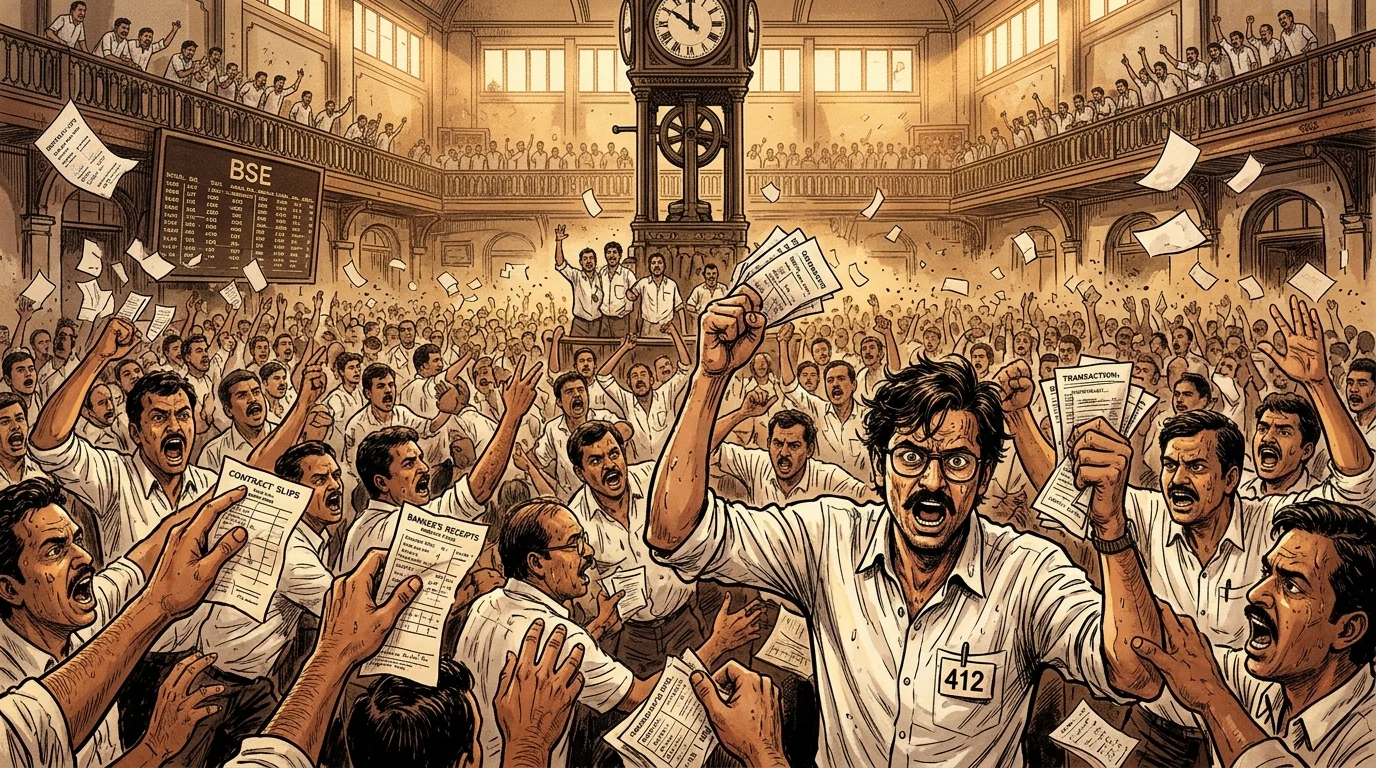
Between July 1991 and April 1992, the Bombay Stock Exchange (BSE) experienced a parabolic bull run that captivated India’s urban middle class and transformed charismatic stockbroker Harshad Shantilal Mehta—universally dubbed “The Big Bull”—into a national celebrity. In less than ten months, the benchmark BSE Sensitive Index (Sensex) surged by roughly 270 percent, climbing from around 1,194 points in mid-1991 to a peak of 4,467 points on April 22, 1992, while bellwether industrial shares such as Associated Cement Companies (ACC) soared from ₹200 to nearly ₹10,000. Yet the euphoria was not driven solely by Finance Minister Manmohan Singh’s landmark July 1991 economic liberalization budget. As financial journalist Sucheta Dalal revealed in The Times of India on April 23, 1992, and as the Reserve Bank of India’s (RBI) Janakiraman Committee later documented in forensic detail, Mehta and a nexus of money-market brokers had exploited paper-based Bank Receipts (BRs) and uncomputerized Subsidiary General Ledger (SGL) settlement lags to siphon ₹4,025 crore (approximately US$1.3 billion at 1992 exchange rates) out of the interbank government-securities market directly into BSE equities. [1]

Statutory Liquidity Ratios and the Paper-Based Ready Forward Market
To understand how a stockbroker could commandeer billions of rupees from India’s commercial banking system, one must examine the regulatory architecture of Indian banking at the dawn of the 1990s. To finance chronic government fiscal deficits at controlled interest rates, the Reserve Bank of India imposed a punitive Statutory Liquidity Ratio (SLR) requiring commercial banks to hold up to 38.5 percent of their net demand and time liabilities in low-yielding central and state government securities (G-Secs) and public-sector enterprise (PSU) bonds, alongside a 15 percent Cash Reserve Ratio (CRR). [2]
Because daily deposit fluctuations constantly altered each bank’s required SLR holdings, banks actively traded government bonds with one another through short-term repurchase agreements known in India as “Ready Forward” (RF) deals—typically 14-day interbank loans collateralized by government securities. In theory, every transfer of central government bonds in Bombay was recorded in the Subsidiary General Ledger (SGL) maintained manually by the RBI’s Public Debt Office (PDO). [3]
In practice, the PDO’s manual bookkeeping lagged days or weeks behind market trading volume, and PSU bonds were traded purely by physical allotment letters without any central depository. To settle Ready Forward transactions immediately without waiting for physical bond certificates or SGL clearance, selling banks issued a paper trust document permitted by the Indian Banks’ Association: the Bank Receipt (BR). A Bank Receipt certified that the issuing bank had received payment and was holding the specified securities in trust on behalf of the purchasing bank until physical delivery or SGL transfer was completed. Under RBI rules, BRs were strictly non-transferable, had to be backed 100 percent by actual securities in the seller’s vault, and were required to be redeemed within 30 to 90 days. [4]
How Harshad Mehta Rigged the Interbank Loop
Through his flagship brokerage firm, Growmore Research and Assets Management, Harshad Mehta turned the sleepy interbank bond market into a high-velocity liquidity engine. Although RBI regulations prohibited banks from paying Ready Forward proceeds into stockbrokers’ personal accounts, banks routinely relied on brokers to match counterparties and informally allowed brokers to substitute their own names on settlement routing instructions.
Mehta exploited this operational blind spot through three interconnected mechanisms:
- Check Routing and SGL Manipulation at State Bank of India (SBI) and National Housing Bank (NHB): When a lending bank issued a check drawn on the RBI to purchase government securities in a Ready Forward deal, compliant mid-level officers at state-owned institutions—most notably at the main Bombay branch of the State Bank of India, its merchant banking subsidiary SBI Capital Markets, and the RBI-owned National Housing Bank—credited the proceeds directly into Harshad Mehta’s current account at ANZ Grindlays Bank rather than to a counterparty bank. At SBI’s securities division, a deputy manager falsified SGL transfer entries and vault reconciliations so that SBI appeared to hold hundreds of crores of government bonds that had never actually been delivered.
- Unbacked Bank Receipts from Captive Small Banks: Whenever Mehta needed to raise fresh cash without holding underlying bonds, he turned to two small institutions over which brokers exercised effective control: the Bank of Karad (BoK) and the Metropolitan Co-operative Bank (MCB). Officials at BoK and MCB issued entirely fictitious, unbacked Bank Receipts—certifying nonexistent holdings of government bonds or Unit Trust of India (UTI) units—which Mehta discounted with major nationalized and foreign banks to borrow hundreds of crores of rupees for 14-day intervals.
- Rolling Over the Gap via the BSE Bull Run: Mehta poured the diverted interbank cash into concentrated positions on the Bombay Stock Exchange, cornering the floating supply of stocks such as ACC, Apollo Tyres, Reliance, and Tata Iron and Steel (TISCO). As retail investors piled into the rally and the Sensex climbed from 1,194 in July 1991 past 4,000 in March 1992, Mehta used profits from rising share prices—and ever-larger Ready Forward rollovers—to pay off maturing 14-day BRs with fresh 14-day BRs issued to new banking counterparties.
April 1992: The SBI Reconciliation, Sucheta Dalal’s Exposé, and the Crash
The pyramid began to unravel in March and April 1992 when RBI Governor S. Venkitaramanan grew alarmed at the simultaneous surge in call-money rates and stock prices and instructed central bank supervisors to scrutinize bank securities accounts. When internal auditors at the State Bank of India cross-checked their investment ledger against the RBI Public Debt Office’s SGL balances in early April 1992, they discovered a staggering shortfall: SBI was missing ₹500 crore to ₹622 crore in government securities that were supposedly held via SGL forms and Bank Receipts arranged through Harshad Mehta. [5]
Under intense pressure from SBI brass between April 13 and April 24, 1992, Mehta deposited roughly ₹622 crore into SBI’s account at the RBI by drawing emergency funds out of the National Housing Bank (NHB), which in turn issued unbacked checks credited through ANZ Grindlays Bank. Before the cover-up could hold, financial editor Sucheta Dalal broke the story on the front page of The Times of India on April 23, 1992, exposing the ₹500+ crore reconciliation hole at the State Bank of India and naming Harshad Mehta as the broker at the center of the missing securities. [6]
When trading resumed on the Bombay Stock Exchange on April 28, 1992, after a brokers’ boycott, the Sensex plunged by 570 points—nearly 13 percent in a single session—as banks immediately froze Ready Forward rollovers and refused to honor unbacked Bank Receipts. With NHB, Bank of Karad, and Metropolitan Co-operative Bank unable to redeem their paper, the entire interbank chain seized up. Over the ensuing year, the BSE Sensex fell by roughly 45 percent from its April 1992 peak of 4,467 to below 2,500, wiping out approximately ₹100,000 crore (US$32 billion) in market capitalization. [7]
The Janakiraman Committee, Special Court, and Market Modernization
On April 30, 1992, RBI Governor Venkitaramanan appointed a high-level investigative committee chaired by RBI Deputy Governor R. Janakiraman (the Committee to Enquire into the Securities Transactions of Banks and Financial Institutions). Across six detailed reports published between May 1992 and April 1993, the Janakiraman Committee quantified total gross problem exposures across banks and financial institutions at ₹4,025 crore (later revised slightly upward by the 30-member Joint Parliamentary Committee chaired by Ram Niwas Mirdha). [8]
The institutional and human fallout was sweeping. The RBI placed both the Bank of Karad and the Metropolitan Co-operative Bank into liquidation; NHB Chairman Manohar J. Pherwani died suddenly in May 1992 shortly after the ₹1,200+ crore hole at NHB came to light; and NHB and ANZ Grindlays fought a nine-year legal battle over ₹506 crore in disputed checks for which the banks agreed a settlement in December 2001; the Supreme Court approved that agreement in January 2002. The Central Bureau of Investigation (CBI) arrested Harshad Mehta in June 1992, and Parliament enacted the Special Court (Trial of Offences Relating to Transactions in Securities) Act of 1992 to attach his assets and adjudicate more than 70 criminal and civil cases—proceedings that were still ongoing when Mehta died in custody on December 31, 2001. [9]
More enduringly, the 1992 scam catalyzed the modernization of India’s financial infrastructure. Acting on the recommendations of the Janakiraman and Nadkarni Committees, the RBI banned interbank Ready Forward deals in corporate and PSU bonds, prohibited the use of physical Bank Receipts where SGL facilities existed, and computerized the Public Debt Office into a Delivery-versus-Payment (DvP) system in 1995. Simultaneously, the Indian government granted statutory enforcement powers to the Securities and Exchange Board of India (SEBI) in 1992, abolished the opaque floor-based badla carry-forward system on the BSE, and chartered the fully automated, screen-based National Stock Exchange (NSE) in 1992–1994 alongside the National Securities Depository Limited (NSDL) in 1996 to eliminate paper share certificates forever.
Theoretical & Balance-Sheet Transmission Mechanism
In the Kindleberger–Minsky taxonomy of financial instability (Kindleberger, 1978; Minsky, 1986) and Irving Fisher’s (1933) debt-deflation framework, speculative asset booms become systemic crises when credit expansion shifts balance sheets from hedge finance (cash flows covering principal and interest) to speculative and Ponzi finance (relying on rising asset prices and short-term margin roll-overs).
Once monetary tightening or an exogenous shock halts price appreciation, forced margin liquidations trigger Fisherian debt-deflation: fire-sale asset discounts erode bank collateral values, contracting credit supply across the real economy.
Sources and Further Reading
- Reserve Bank of India, “ Master Circular – Prudential Norms for Classification, Valuation and Operation of Investment Portfolio by FIs (Subsidiary General Ledger and Bank Receipt Rules),” Reserve Bank of India, 2009. Historical & Financial Reference
- Reserve Bank of India, “ Janakiraman Committee Reports on the Securities Transactions of Banks and Financial Institutions,” Reserve Bank of India Publications, 1993. Historical & Financial Reference
- S. S. Nadkarni Committee, “ Report of the High Powered Committee on Trading in Public Sector Bonds and Units of Mutual Funds,” Reserve Bank of India (via The 1991 Project Archive), 1992. Historical & Financial Reference
- Prabhakar Sinha, “ NHB, ANZ Settle Scores Over 1992 Securities Scam,” The Times of India, 2001-12-14. Historical & Financial Reference
- Saurabh Shukla, “ Inside The RBI During The Harshad Mehta Scam: Insights From An Insider,” ETV Bharat, 2024-06-18. Historical & Financial Reference
- Carmen M. Reinhart and Kenneth S. Rogoff, “ This Time is Different: A Panoramic View of Eight Centuries of Financial Crises,” National Bureau of Economic Research (NBER Working Paper No. 13882), 2008. Peer-Reviewed / Academic Research
- Times of India / TNN, “ SC okays NHB, ANZ pact in shares scam,” Times of India, 18 January 2002. Historical & Financial Reference
- Irving Fisher — "The Debt-Deflation Theory of Great Depressions," Econometrica 1, no. 4 (FRASER Federal Reserve Archive, 1933): 337–357 Central Bank / Monetary Authority
- Charles P. Kindleberger & Robert Z. Aliber — Manias, Panics, and Crashes: A History of Financial Crises (Palgrave Macmillan) Peer-Reviewed / Academic Research
Cite This Historical Dossier (APA / Chicago)
APA (7th ed.): Ç., S. (Ed.). (2026). The 1992 Harshad Mehta Indian Stock Market Scam and the Bank Receipt Rig. In Forgotten Fortunes Historical Monograph Series (Forgotten Fortunes Editorial Desk). https://forgottenfortunes.net/india-1992-harshad-mehta-scam/
MLA (9th ed.): Ç., Soner, ed. "The 1992 Harshad Mehta Indian Stock Market Scam and the Bank Receipt Rig." Forgotten Fortunes: Financial & Monetary History Archive, 2026, https://forgottenfortunes.net/india-1992-harshad-mehta-scam/.
Chicago (17th ed.): Ç., Soner, ed. "The 1992 Harshad Mehta Indian Stock Market Scam and the Bank Receipt Rig." Forgotten Fortunes Historical Monograph Series (Forgotten Fortunes Editorial Desk), September 12, 2026. https://forgottenfortunes.net/india-1992-harshad-mehta-scam/.
Have an idea for another financial history documentary or article? Request a story →


