In This Article
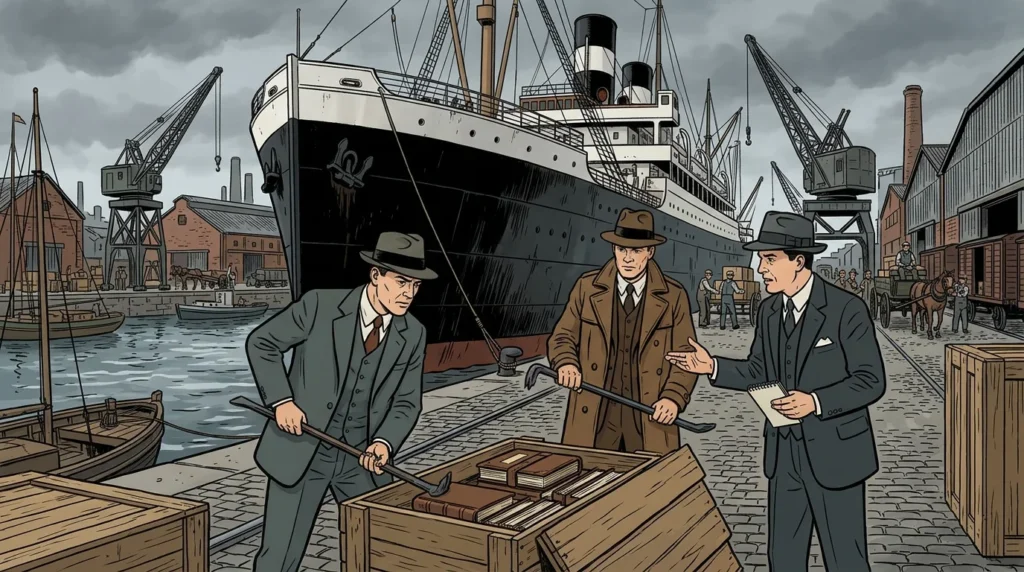
The American-Oriental Bank case belongs to a period of intense financial turmoil in Shanghai. Between the outbreak of the First World War in 1914 and the end of the Second World War in 1945, China’s commercial and financial hub in Shanghai—and later the Nationalist wartime capital of Chongqing—experienced rapid institutional experimentation alongside recurring governance breakdowns. Modern joint-stock corporations, securities and commodity exchanges, and commercial banks expanded far faster than statutory oversight or independent auditing could constrain them. Divided jurisdiction between Chinese Republican ministries and foreign treaty-port concessions compounded the problem, allowing promoters to arbitrage between Chinese commercial statutes and foreign consular incorporation rules. [1]
Three major episodes illustrate how statutory fragility, self-dealing, and monetary dislocation interacted across the Republican era: the 1921–1924 Shanghai trust and exchange bubble (Xin Jiao Fengchao), which saw more than 130 speculative exchanges and trust companies collapse after exploiting gaps in the 1914 Company Law (Gongsi Tiaoli); the May 24, 1935 failure of American expatriate financier Frank Jay Raven’s Shanghai banking and real-estate group amid silver deflation and insider self-lending; and the March 1945 Chongqing gold-sale scandal, in which leaks of an official price hike on United States-supplied anti-inflation bullion triggered massive insider profiteering and a formal Nationalist corruption inquiry. [2]
The 1914 Company Law and Treaty-Port Regulatory Fragmentation
In January 1914, the Beijing-based Beiyang Ministry of Agriculture and Commerce promulgated the Revised Company Law (Gongsi Tiaoli), expanding upon the late-Qing 1904 corporate statute (Gongsi Lü). Running to 251 articles, the 1914 ordinance recognized four corporate forms—unlimited companies, limited partnerships, joint-stock limited companies, and joint-stock limited partnerships—and set out formal procedures for registration, shareholder meetings, and statutory supervisors (jiancharen). In practice, however, registration remained rare and enforcement mechanisms were severely underfunded. As historian William C. Kirby has documented, Chinese family firms and merchant partnerships frequently mistrusted state registration as an invitation to arbitrary taxation or warlord exactions, while promoters who did adopt the joint-stock form faced almost no independent verification of paid-in capital or financial disclosures. [3]
Crucially, China’s emerging profession of independent public accountants did not receive formal statutory recognition until the Beiyang government issued the Provisional Regulations for Accountants in 1918, pioneered by reformer Xie Lin, and Shanghai’s first professional accounting association was not organized until the mid-1920s. Even where Chinese ministry regulations existed on paper, Shanghai’s partitioned governance—split among the Anglo-American-dominated International Settlement, the French Concession, and the Chinese municipality—enabled promoters to register exchanges and financial houses inside foreign concessions beyond the police jurisdiction of Beijing regulators. [4]
Foreign merchants and expatriate financiers exploited an parallel set of jurisdictional loopholes. British businesses registered under the Hong Kong Companies Ordinances, while American promoters in Shanghai incorporated either in individual American states or, after 1922, under the China Trade Act administered by the United States Department of Commerce and adjudicated by the United States Court for China. Neither Chinese statutory supervisors nor foreign consular registrars possessed dedicated bank-examination staffs capable of auditing cross-affiliate lending among intertwined holding companies, real-estate trusts, and deposit-taking banks. [5]
| Documented Figure / Metric | Historical Significance & Archival Context |
|---|---|
| 50,000 yuan | By early 1945, however, the official Central Bank gold selling price of 20,000 fabi yuan per liang (tael, roughly one troy ounce) had fallen far below the Chongqing black-market price, which exceeded 35,000 to 50,000 yuan per tael. |
| 75 percent | Speculators and officials rushed to purchase tens of thousands of taels of gold and gold-savings certificates at the old 20,000-yuan rate, reaping an overnight windfall of 75 percent at the direct expense of the state stabilization reserve. |
The 1921–1924 Shanghai Stock and Commodity Exchange Crash
The institutional weaknesses of the 1914 legal framework were laid bare during the Shanghai Trust and Exchange Crisis (Xin Jiao Fengchao) of 1921–1924. Following the establishment of the Shanghai Stock and Produce Exchange (Shanghai Zhengquan Wupin Jiaoyisuo) by Yu Xiaqing and business associates in July 1920 and the Chartered Stock and Produce Exchange later that year, early trading profits ignited a citywide mania. Promoters realized that an exchange not only earned brokerage commissions on forward contracts in cotton yarn, gold bars, flour, oil, and corporate shares, but could also issue its own publicly traded equity shares—and accept those very shares as margin collateral for speculative forward trades. [6]
Between the spring and autumn of 1921, approximately 140 stock and commodity exchanges and a dozen new trust companies (xintuo gongsi) were launched in Shanghai, many operating day and night sessions out of rented storefronts inside the International Settlement and the French Concession. Their aggregate nominal registered capital exceeded 200 million silver yuan, even though actual paid-in cash constituted only a fraction of that figure. Promoters routinely used deposit money and installment payments from initial subscribers to bid up their own exchange shares on the forward market, creating an illusion of soaring market capitalization while pledging unissued or partially paid scrip to native banks (qianzhuang) and modern commercial banks for short-term call loans. [7]
When seasonal credit demand tightened Shanghai’s silver money market in late autumn 1921, native and modern banks curtailed loans secured by exchange shares. Margin calls cascaded across the forward markets in November and December 1921, and the bubble burst. Within months, more than 130 exchanges and the majority of newly formed trust companies collapsed into insolvency, wiping out tens of millions of silver yuan in paper wealth and driving prominent speculators and ruined retail clerks to bankruptcy and suicide. Lingering liquidations, defaulted forward contracts, and aftershock failures among overextended financial houses dragged on through 1924, leaving only six surviving exchanges in Shanghai and prompting the Nationalist government in Nanjing to enact a stricter Exchange Law and Company Law in 1929. [8]
Frank Jay Raven and the American-Oriental Banking Corporation
While Chinese exchanges collapsed in the early 1920s, an equally fragile corporate pyramid was expanding inside Shanghai’s foreign concession under the leadership of American expatriate entrepreneur Frank Jay Raven. Having arrived in Shanghai in 1904 as a civil engineer, Raven entered real-estate development and finance, founding the American-Oriental Banking Corporation (AOBC) in 1917—incorporated in Connecticut and headquartered at 29 Nanking Road—alongside three closely interlocked affiliates: the Raven Trust Company, the American-Oriental Finance Corporation, and the Asia Realty Company. [9]
Cultivating a reputation for Christian philanthropy, civic leadership on the Shanghai Municipal Council, and presidency of the American Chamber of Commerce, Raven marketed the American-Oriental Banking Corporation directly to missionary boards, expatriate professionals, Russian émigrés, and middle-class Chinese depositors. Unlike conservative British exchange banks that restricted dealings to large wholesale bills, AOBC welcomed small check and savings accounts, accumulating thousands of retail depositors across Shanghai and Tianjin.
Behind its facade of American rectitude, the “Raven Interests” operated as an unexamined internal capital market. Because Connecticut state banking examiners never traveled to Shanghai and the China Trade Act registrar lacked bank-supervision authority, Raven’s group fell into a complete regulatory blind spot. Throughout the late 1920s and early 1930s, AOBC funneled millions of silver dollars in liquid customer deposits into illiquid Shanghai land speculation via the Asia Realty Company and into margin and corporate-share financing through the American-Oriental Finance Corporation and Raven Trust Company. Furthermore, Raven and his fellow officers borrowed heavily from the bank and trust company to purchase and support shares of their own affiliated corporations, masking non-performing inter-company advances through circular book entries and dividend payments out of capital.
Silver Deflation and the May 24, 1935 Collapse
The macroeconomic shock that punctured Shanghai’s property and banking boom arrived from Washington in June 1934 with the passage of the United States Silver Purchase Act. By directing the United States Treasury to buy silver until world market prices reached $1.29 per ounce or silver constituted one-fourth of American monetary reserves, the Act drove global silver prices sharply upward. Because China remained on the silver standard, rising world bullion prices made silver worth far more in London and New York than as coined money in Shanghai, triggering a massive outflow of physical silver, severe domestic monetary deflation, falling urban real-estate values, and soaring interbank interest rates.
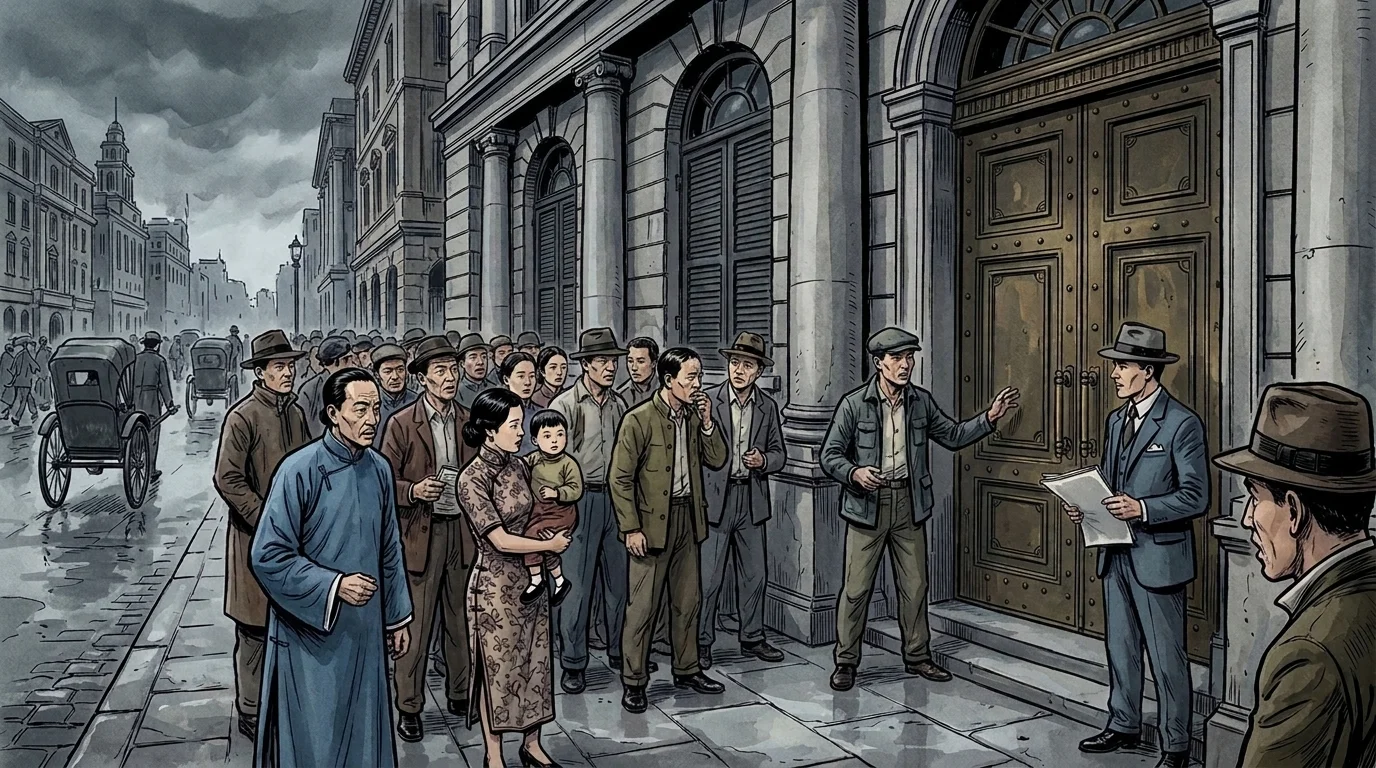
Starved of liquid silver reserves and burdened by frozen real-estate loans to Asia Realty and insolvent insiders, Raven’s empire buckled. On the morning of May 24, 1935, the American-Oriental Banking Corporation, the American-Oriental Finance Corporation, and the Raven Trust Company failed to open their doors and petitioned the United States Court for China for the appointment of a liquidator—closing alongside the Chinese-owned Minghwa Commercial and Savings Bank. As United States Consul General Edwin S. Cunningham reported to Washington in his May 27, 1935 dispatch, Raven initially issued a press statement attributing the collapse solely to American monetary policy: “In a word the situation can be attributed to the American silver purchasing plan which has drained silver from the country. There is no silver to carry on.”
When Court-appointed liquidator Frank L. Hough and auditors examined the books of the three shuttered institutions and the Asia Realty Company, however, they uncovered systematic balance-sheet manipulation and insider self-dealing. Of roughly 20 million Chinese silver dollars (approximately US$7 million at prevailing exchange rates) in obligations across the group, nearly half of the bank’s loan portfolio had been channeled to Raven’s own affiliates and directors without adequate collateral. More than 6,500 depositors—including Protestant and Catholic missions, schools, hospitals, and thousands of Chinese savers—saw their accounts frozen. Indicted before Judge Milton J. Helmick in the United States Court for China on charges of embezzlement and fraudulent conversion, Frank Jay Raven was convicted in early 1936 and sentenced to five years in the United States Federal Penitentiary at McNeil Island, Washington.
The March 1945 Chongqing Wartime Gold Scandal
The silver crisis of 1935 forced the Nationalist government to abandon the silver standard in November 1935 in favor of a managed fiat currency (fabi). Once full-scale war with Japan erupted in July 1937 and the Nationalist government retreated to Chongqing, relies on central-bank note issuance to finance military expenditures triggered devastating hyperinflation. Under the Sino-American Financial Aid Agreement of March 1942, which extended a US$500 million credit to China, Finance Minister H. H. Kung negotiated an arrangement with United States Treasury Secretary Henry Morgenthau Jr. on July 27, 1943 to ship physical gold bullion from the Federal Reserve Bank of New York to China. The Central Bank of China sold gold bars and forward gold deposit certificates in Chongqing for fabi banknotes with the stated goal of soaking up excess paper currency and restraining price inflation.
By early 1945, however, the official Central Bank gold selling price of 20,000 fabi yuan per liang (tael, roughly one troy ounce) had fallen far below the Chongqing black-market price, which exceeded 35,000 to 50,000 yuan per tael. On March 28, 1945, officials at the Ministry of Finance and the Central Bank of China held a confidential meeting deciding to raise the official gold sale price by 75 percent—from 20,000 yuan to 35,000 yuan per tael—effective the following day, March 29.
During the afternoon and evening of March 28, before the price hike was publicly announced, word leaked to well-connected Chongqing banks, Treasury and Central Bank insiders, and commercial syndicates. Speculators and officials rushed to purchase tens of thousands of taels of gold and gold-savings certificates at the old 20,000-yuan rate, reaping an overnight windfall of 75 percent at the direct expense of the state stabilization reserve. Public outrage in Chongqing was immediate. The Control Yuan (Jianchayuan) and the People’s Political Council demanded a full investigation, while Secretary Morgenthau formally rebuked Foreign Minister T. V. Soong in May 1945, warning that “the manner in which the gold sales have been conducted and the consequent public criticism of them in China are not conducive to achieving the purposes for which our financial aid was provided.” Although a Chongqing court eventually prosecuted a handful of mid-level Central Bank and Treasury clerks while shielding senior figures, the scandal permanently discredited Nationalist fiscal governance and hastened H. H. Kung’s removal from China’s financial leadership.
Theoretical & Balance-Sheet Transmission Mechanism
In the Kindleberger–Minsky taxonomy of financial instability (Kindleberger, 1978; Minsky, 1986) and Irving Fisher’s (1933) debt-deflation framework, speculative asset booms become systemic crises when credit expansion shifts balance sheets from hedge finance (cash flows covering principal and interest) to speculative and Ponzi finance (relying on rising asset prices and short-term margin roll-overs).
Once monetary tightening or an exogenous shock halts price appreciation, forced margin liquidations trigger Fisherian debt-deflation: fire-sale asset discounts erode bank collateral values, contracting credit supply across the real economy.
Sources and Further Reading
- Edwin S. Cunningham, The Consul General at Shanghai (Cunningham) to the Secretary of State, May 28, 1935 (Document 566), Foreign Relations of the United States, Diplomatic Papers, 1935, The Far East, Vol. III, 1935-05-28. Official / State Archive
- Henry Morgenthau Jr., The Secretary of the Treasury (Morgenthau) to the Chinese Minister for Foreign Affairs (Soong), May 16, 1945 (Document 815), Foreign Relations of the United States, Diplomatic Papers, 1945, The Far East, China, Vol. VII, 1945-05-16. Official / State Archive
- Yale SOM International Center for Finance, Shanghai Stock Exchange Indexes: 1870–1940, Yale School of Management, 2021. Peer-Reviewed / Academic Research
- Bryna Goodman, The Crime of Economics: Speculation and the 1921 Shanghai Stock and Commodity Exchange Crisis, Éditions de la Maison des sciences de l'homme, 2010. Peer-Reviewed / Academic Research
- Parks M. Coble, Hyperinflation and the Rivalry between T. V. Soong and H. H. Kung, Cambridge University Press, 2023. Peer-Reviewed / Academic Research
- Parks M. Coble, Jr., The Shanghai Capitalists and the Nationalist Government, 1927–1937, Harvard University Asia Center, 1980. Peer-Reviewed / Academic Research
- Commercial and Financial Chronicle, June 8, 1935, Federal Reserve Bank of St. Louis FRASER, 1935-06-08. Central Bank / Monetary Authority
- Irving Fisher — "The Debt-Deflation Theory of Great Depressions," Econometrica 1, no. 4 (FRASER Federal Reserve Archive, 1933): 337–357 Central Bank / Monetary Authority
- Charles P. Kindleberger & Robert Z. Aliber — Manias, Panics, and Crashes: A History of Financial Crises (Palgrave Macmillan) Peer-Reviewed / Academic Research
Cite This Historical Dossier (APA / Chicago)
APA (7th ed.): Ç., S. (Ed.). (2026). From the 1921 Shanghai Exchange Crash to the 1935 American-Oriental Bank Failure and 1945 Gold Scandal. In Forgotten Fortunes Historical Monograph Series (Forgotten Fortunes Editorial Desk). https://forgottenfortunes.net/shanghai-exchange-crash-american-oriental-bank-collapse/
MLA (9th ed.): Ç., Soner, ed. "From the 1921 Shanghai Exchange Crash to the 1935 American-Oriental Bank Failure and 1945 Gold Scandal." Forgotten Fortunes: Financial & Monetary History Archive, 2026, https://forgottenfortunes.net/shanghai-exchange-crash-american-oriental-bank-collapse/.
Chicago (17th ed.): Ç., Soner, ed. "From the 1921 Shanghai Exchange Crash to the 1935 American-Oriental Bank Failure and 1945 Gold Scandal." Forgotten Fortunes Historical Monograph Series (Forgotten Fortunes Editorial Desk), September 6, 2026. https://forgottenfortunes.net/shanghai-exchange-crash-american-oriental-bank-collapse/.
Have an idea for another financial history documentary or article? Request a story →